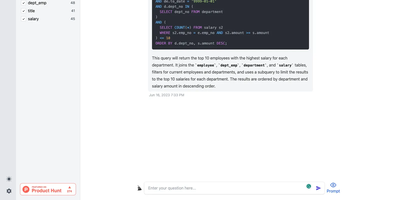
SQL Chat
Describe what you want in plain language and get real SQL against your real schema: SQL Chat is an open-source, chat-based SQL client from the Bytebase team. Instead of writing queries in a traditional editor, you connect a database and describe what you want in plain language; the AI reads your schema automatically, generates SQL that references real table and column names, executes it, and returns tabular results in the conversation. Follow-up messages refine the query, so exploration becomes a dialogue - narrow a result set, add a join, change an aggregation - without retyping statements. It supports MySQL, PostgreSQL, SQL Server, TiDB Cloud, and OceanBase from one interface, and covers modification as well as reads: insert, update, and delete operations phrased conversationally. Built with Next.js and TypeScript, it deploys as a single stateless Docker container in single-user mode - connection profiles live in the browser, so there is nothing server-side to maintain. A custom AI endpoint setting routes inference through any OpenAI-compatible API, including self-hosted models, and an optional database-backed mode adds accounts and quotas for offering the tool to a team. MIT-licensed.
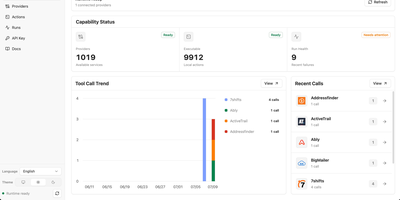
Open Connector
With over 5,000 GitHub stars since its June 2026 launch, OOMOL OpenConnector bridges the gap between AI agents and the real world by handling the authentication nightmare that stops LLMs from calling external APIs safely. The runtime connects to more than 1,000 SaaS providers — GitHub, Gmail, Notion, Slack, Microsoft, HubSpot, Google Workspace, and hundreds more — through 10,000+ prebuilt typed Actions that agents can discover and execute without ever touching raw credentials. OAuth2 flows, API key rotation, custom credentials, and no-auth providers are all managed centrally with AES-encrypted storage, scoped runtime tokens, and configurable action allowlists and blocklists that enforce least-privilege access. Agents interact through five access surfaces: the Model Context Protocol endpoint at /mcp for Claude and other MCP-capable hosts, a full REST API at /v1 for programmatic control, an auto-generated OpenAPI specification for code generation, a TypeScript SDK for application integration, and the oo CLI for local agent relay. The built-in Web Console provides browser-based administration for configuring OAuth apps, managing connections, inspecting action schemas, and reviewing execution logs with redacted inputs. Deploy via Docker Compose with SQLite for single-server setups, run from source on Node.js 22+, or push to Cloudflare Workers with D1 and R2 for edge deployment. Running on a dedicated VPS on RepoCloud with guaranteed CPU, RAM, and SSD, full root SSH access, and a browser serial console. Apache 2.0 licensed.
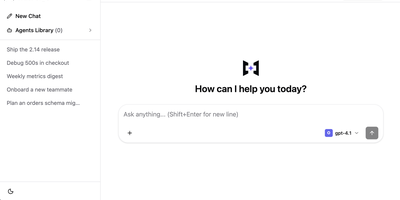
TrueForge
With over 2,100 GitHub stars in its first month and benchmarked at 30-75% lower cost than Claude Managed Agents on enterprise task suites, TrueForge is the open-source agent harness that provides the complete runtime layer for turning any LLM into a working production agent on your own infrastructure. The TypeScript server runs the full execution loop — streaming every step, routing tool calls through MCP servers with centralized header-auth and in-chat OAuth, delegating parallelizable work to isolated subagents, and pausing for human approval on sensitive actions. Context engineering keeps token costs low: deferred tool-schema loading delays MCP schemas until invoked, large-result offloading moves oversized outputs to files, Code Mode processes structured data through sandboxed execution, and automatic compaction summarizes older history at a configurable 50,000-token threshold while preserving the full transcript. The sandbox-as-a-tool architecture provisions isolated Daytona environments only when code execution is required, allowing one server to run many concurrent agents without idle overhead. Agents are configured from shipped YAML catalogs of models, MCP servers, git-backed SKILL.md instruction packs, and sandbox providers, then saved to an Agents Library accessible via the chat UI, TypeScript SDK, or embeddable React UI SDK. Run locally with SQLite via a single npx command, or deploy for teams with Docker Compose or Helm using Postgres and Redis with OIDC authentication. Running on a dedicated VPS on RepoCloud with guaranteed CPU, RAM, and SSD, full root SSH access, and a browser serial console. MIT licensed.
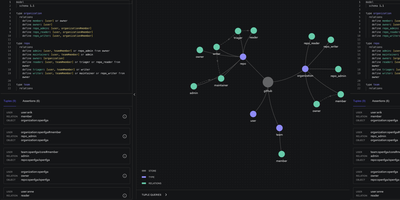
OpenFGA
OpenFGA answers the question 'can this user perform this action on this resource?' in single-digit milliseconds, implementing Google's Zanzibar paper as a production-ready authorization engine adopted by Auth0, Grafana Labs, Canonical, Docker, Agicap, and Read.AI. The server exposes both gRPC and HTTP APIs for authorization queries including Check, ListObjects, ListUsers, Expand, and the high-throughput BatchCheck endpoint that deduplicates and processes multiple authorization decisions in a single request. Authorization models combine relationship-based access control with role-based and attribute-based patterns through a purpose-built DSL that supports contextual tuples, conditional relationship tuples with CEL expressions, and time-based filtering via the ReadChanges API. Storage backends include PostgreSQL 14+, MySQL 8, and SQLite in beta, with an in-memory adapter for development and testing. Official SDKs for Java, .NET, Node.js, Go, and Python provide type-safe client integration, while a Terraform provider enables infrastructure-as-code management of authorization stores and models. The built-in browser playground at port 3000 lets developers visually model authorization schemas, write relationship tuples, and test access control queries interactively before deployment. OpenTelemetry instrumentation integrates with existing monitoring infrastructure, and Helm charts simplify Kubernetes deployment. A VS Code extension provides syntax highlighting and validation for FGA model files, and GitHub Actions automate model testing in CI/CD pipelines. A CNCF incubating project with transparent governance. Running on a dedicated VPS on RepoCloud with guaranteed CPU, RAM, and SSD, full root SSH access, and a browser serial console. Apache 2.0 licensed.
AI Researcher
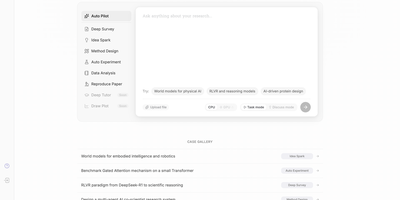
Accepted as a NeurIPS 2025 Spotlight paper and rapidly approaching 6,000 GitHub stars, AI-Researcher from the Hong Kong University Data Science Lab delivers the first fully autonomous scientific research system — a multi-agent platform that takes a list of reference papers and returns a complete research contribution with working code, validated experiments, and a formatted academic manuscript. The pipeline orchestrates five distinct phases: a Resource Collector systematically gathers materials from arXiv, IEEE Xplore, ACM Digital Library, Google Scholar, GitHub, and Hugging Face; an Idea Generator performs gap analysis against semantic embeddings to produce 3-5 novel hypotheses with feasibility scores; an Algorithm Designer transforms concepts into functional implementations; a Validation Engine automates testing, performance evaluation, and iterative optimization; and a Manuscript Creator generates polished full-length papers with figures, tables, and citations. The Gradio-based web GUI provides intuitive tabs for environment configuration, example selection, and real-time monitoring of research progress, while the production deployment at novix.science offers immediate browser access without local setup. Scientist-Bench provides a standardized benchmark comprising state-of-the-art papers across diverse AI research domains for evaluating autonomous research capabilities. The system supports multiple LLM providers including OpenAI, Anthropic, Google Gemini, and OpenRouter models with per-task routing for cost optimization. Deploy via Python with pip dependencies or Docker containerization. Running on a dedicated VPS on RepoCloud with guaranteed CPU, RAM, and SSD, full root SSH access, and a browser serial console. Apache-2.0 licensed.
KillBill
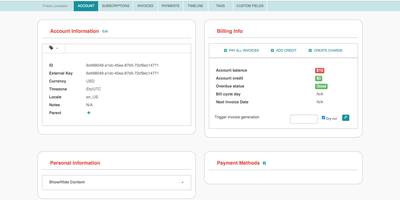
Kill Bill handles the complete subscription billing lifecycle from plan definition through invoice generation to payment collection across any gateway, with 15 years of Fortune 500 production use and 5,600+ GitHub stars behind it. Plans, trials, add-ons, and pricing tiers live in a versioned XML catalog that propagates changes without code deploys. The multi-phase subscription engine manages trial periods, promotional discounts, evergreen billing, usage-based metering, and hybrid pricing models with automatic proration on plan upgrades and downgrades. Automated invoice generation calculates charges, applies credits and adjustments, and triggers payment collection through pluggable gateways including Stripe, Adyen, Braintree, PayPal, and CyberSource. The Java plugin framework extends every billing domain with custom logic for tax calculation via Avalara AvaTax or Vertex, fraud detection through Accertify or Feedzai, and ERP integration without modifying the core. The Kaui admin dashboard gives finance and operations teams account management, subscription controls, invoice views, payment configuration, billing timeline visualization, MRR tracking, advanced search, and full audit history with object-level change tracking. Multi-tenancy isolates billing data across thousands of brands with tenant-specific catalogs, payment configs, and RBAC policies. REST APIs expose every operation with webhook notifications for downstream integration. Deploys via Docker Compose on MySQL or PostgreSQL. Running on a dedicated VPS on RepoCloud with guaranteed CPU, RAM, and SSD, full root SSH access, and a browser serial console. Apache 2.0 licensed.
Dograh
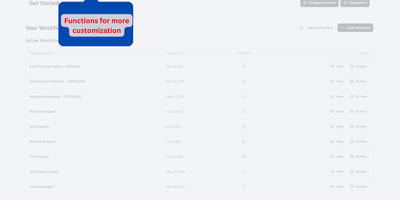
Build a voice AI agent that answers calls, qualifies leads, books appointments, and transfers to a human when needed, all from a drag-and-drop workflow builder in your browser. Dograh ships as a Docker Compose stack (API, web UI, Postgres, Redis, MinIO) that you self-host on any Linux server with automatic HTTPS provisioning via Let's Encrypt. The visual workflow builder lets you design multi-turn conversation flows by connecting nodes for greetings, intent classification, tool calls, and handoffs; describe your use case in plain English and the platform generates the LLM prompt and node graph for you. Connect your own speech-to-text, LLM, and text-to-speech providers (OpenAI, Anthropic, Gemini, ElevenLabs, Deepgram, local Whisper, Kokoro, or any OpenAI-compatible endpoint) or use the built-in Speech-to-Speech mode with Gemini Flash Live and GPT-Realtime-2 for sub-200ms latency. Telephony plugs in through Twilio, Vonage, Vobiz, or Cloudonix for inbound and outbound calling, with live agent transfer when the conversation needs a human. Webhook tool calls connect to Salesforce, HubSpot, Google Calendar, Cal.com, or any REST API without writing orchestration code. The ClonedVoice feature mixes real human voice recordings for high-frequency phrases with neural TTS fallback for dynamic content, cutting costs while improving caller trust. A built-in MCP server lets AI coding agents like Claude Code or Cursor design, test, and edit workflows through natural language. Deploy on a dedicated VPS on RepoCloud with guaranteed CPU, RAM, and SSD, full root SSH access, and a browser serial console. BSD 2-Clause licensed.
Kan
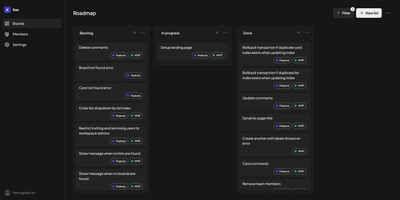
What Trello fans wanted Trello to stay: Kan (kan.bn) is a minimalist, frills-free kanban board capturing the original vision before the enterprise pivots - and then adds the things 2025 actually demands. The core is exactly right: drag-and-drop cards across lists, labels and filters to find work fast, comments for discussion on cards, checklists, a detailed activity log tracking every change, and reusable board templates. Workspaces gather your team with member invites and role management, and board visibility controls decide who can view or edit each board. Migration is first-class: a built-in Trello importer brings existing boards over, so switching costs an afternoon, not a quarter. The standout differentiator is the bundled Model Context Protocol server exposing 46 tools across workspaces, boards, lists, cards, comments, checklists, labels, and members - meaning Claude Desktop, Cursor, Copilot, or any MCP client can read and manage your boards in natural language: "move everything assigned to me into Done" becomes a sentence, not a click marathon. The stack is modern TypeScript - Next.js, tRPC, Drizzle ORM over PostgreSQL, Better Auth (credentials or OAuth), Tailwind - with optional SMTP email and S3 file storage. Unlimited boards, lists, and cards; AGPL-licensed.
Casibase
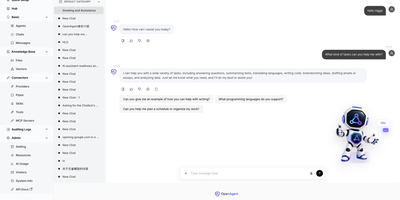
Casibase lets organizations build AI-powered knowledge bases that answer questions from their own documents, connecting to 30+ model providers through a unified admin interface with RAG retrieval and multi-agent orchestration via MCP and A2A protocols. The platform plugs into OpenAI GPT-4o, Anthropic Claude, Meta Llama, Google Gemini, DeepSeek, Ollama local models, HuggingFace, Azure OpenAI, and additional providers, while embedding APIs from OpenAI Ada and Baidu handle vector representation of ingested documents. Document ingestion parses TXT, Markdown, DOCX, PDF, CSV, XLSX, and PPTX files with intelligent chunking strategies for optimal retrieval accuracy. The built-in chat interface provides real-time AI conversations with manual session handover for human agent escalation, and comprehensive chat session logging enables audit trails for compliance. Enterprise identity management integrates Casdoor for Single Sign-On supporting GitHub, Google, WeChat, and OIDC providers with fine-grained access control via the Casbin permission engine. The multi-tenant architecture supports isolated knowledge bases per organization with role-based user management and configurable storage, model, and embedding providers per tenant. The React frontend with Ant Design v5 provides a polished admin dashboard for managing providers, knowledge stores, chat sessions, and user access, while the Go backend with Beego framework handles API logic with MySQL or MariaDB persistence. Running on a dedicated VPS on RepoCloud with guaranteed CPU, RAM, and SSD, full root SSH access, and a browser serial console. Apache 2.0 licensed.
ezBookkeeping
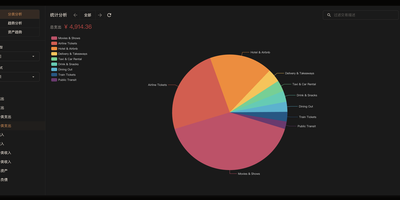
Managing household finances and personal investments becomes completely private with ezBookkeeping, a self-hosted accounting platform that combines multi-currency ledger tracking, automated bank imports, and AI-assisted receipt analysis into a responsive financial dashboard. Users can record daily income, expenses, and asset transfers using hierarchical two-level accounts and customizable tags, attaching photographic receipts and geographic location coordinates to individual entries. The automated data ingestion engine processes bank statements across standardized CSV, OFX, QIF, CAMT, and MT940 files, applying user-defined column mappings and custom conversion scripts to eliminate manual bookkeeping. Financial planners can schedule recurring bills, configure monthly category spending limits, and track asset distribution with interactive charts, trend graphs, and activity heatmaps in the Insight Explorer. Integrated artificial intelligence tools scan uploaded invoice photos to extract line items automatically while a native Model Context Protocol server lets external desktop assistants query balances and audit budgets safely. Security features include time-based two-factor authentication, single sign-on via standard identity providers, and biometric passkey screen locks that secure private monetary ledgers on shared computers. Account owners can export full audit histories to portable spreadsheets, manage multi-currency exchange rate tables, and access clean web interfaces on both desktop monitors and mobile devices. Running on a dedicated VPS on RepoCloud with guaranteed CPU, RAM, and SSD, full root SSH access, and a browser serial console. MIT licensed.
TrailBase
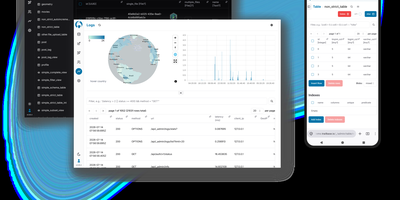
With 5,400+ GitHub stars and sub-millisecond response times that eliminate the need for dedicated caches entirely, TrailBase consolidates your database, API server, auth service, realtime subscriptions, and admin interface into a single Rust binary weighing under 40MB. The platform generates type-safe CRUD APIs automatically from your SQLite schema with configurable access control rules using SQL expressions, while realtime subscriptions push data changes to connected clients via Server-Sent Events. The embedded Wasmtime runtime executes custom server-side logic as WebAssembly components compiled from Rust, JavaScript, Python, or any language targeting WASI, enabling complex business logic without external services. First-class geospatial support through the in-house LiteGIS GEOS extension provides GeoJSON integration, spatial indexing via R-Trees, and query operators including @within, @intersects, and @contains for location-based applications. Client SDKs span JavaScript/TypeScript, Dart/Flutter, Rust, C#/.NET, Swift, Kotlin, Go, and Python — covering mobile, web, desktop, and IoT platforms. The admin dashboard offers visual schema editing, a data browser, Record API configuration, OAuth provider setup, user management, SQL query editor, ERD visualization, and server logs. Experimental PostgreSQL support (v0.28+) allows connecting to existing Postgres instances via connection string. Deploy via a single binary, Docker container, or the one-line install script across Linux, macOS, and Windows. Running on a dedicated VPS on RepoCloud with guaranteed CPU, RAM, and SSD, full root SSH access, and a browser serial console. OSL-3.0 licensed.
Flexprice
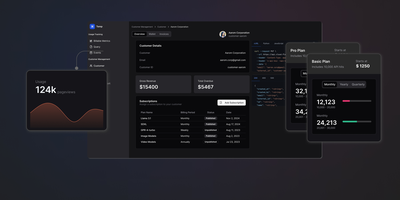
Flexprice is a developer-first billing platform built specifically for AI-native and SaaS companies that need usage-based, credit-based, and hybrid pricing models without building custom billing infrastructure. The metering engine ingests millions of usage events in real time through HTTP APIs or SDK calls, supporting sum, count, unique count, latest value, and multiplier aggregation strategies across custom event schemas like API calls, token counts, compute minutes, and GPU time. Credit management handles prepaid wallets with promotional grants, rollover caps, auto top-ups, and priority-based credit application during invoice generation. The pricing engine supports per-unit, tiered, volume, package, and flat-rate models with per-customer overrides, committed minimums, and enterprise contract terms. Feature entitlements enforce boolean toggles, metered usage limits, and configuration values per plan, enabling applications to gate functionality through simple API checks. Automated invoicing calculates charges from real-time usage data with proration for mid-cycle upgrades and downgrades, generating detailed line items linked to tracked consumption. The architecture separates event ingestion through Kafka from billing computation via Temporal workflow orchestration, allowing each layer to scale independently with ClickHouse handling high-performance usage aggregation. Stripe Connect integration processes payments and manages customer payment methods. Running on a dedicated VPS on RepoCloud with guaranteed CPU, RAM, and SSD, full root SSH access, and a browser serial console. AGPLv3 licensed.

Open Canvas
Open-source alternative to OpenAI's Canvas — a collaborative writing and coding environment where AI agents help you draft, edit, and refine documents through an agentic architecture built on LangGraph. The dual-mode editor combines a BlockNote rich text editor for live-rendered markdown with a CodeMirror-based code editor supporting syntax highlighting across multiple programming languages, letting you switch between prose and code artifacts within the same session. The built-in reflection agent automatically generates style rules and user insights from your chat history, storing them in a shared LangGraph memory store that persists across sessions for increasingly personalized assistance. Pre-built quick actions provide one-click access to common writing transformations including summarize, expand, simplify, and translate, while coding actions offer explain, refactor, add comments, and convert between languages. The monorepo architecture separates the Next.js 14 frontend from the LangGraph agent backend, connecting via HTTP and WebSocket protocols through the @langchain/langgraph-sdk client. Seven LLM providers are supported out of the box — OpenAI, Anthropic Claude, Google Gemini, Fireworks AI, Groq, Azure OpenAI, and local Ollama models — with Supabase handling authentication and data persistence. Deploy via Docker or build from source. Running on a dedicated VPS on RepoCloud with guaranteed CPU, RAM, and SSD, full root SSH access, and a browser serial console. MIT licensed.
Plunk
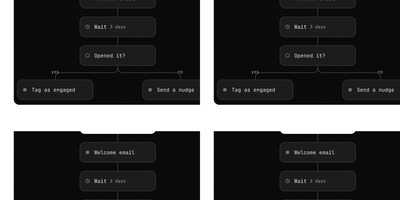
Plunk consolidates transactional emails, marketing campaigns, and drip automation into one platform riding AWS SES at roughly one-tenth of a cent per message, with zero per-contact charges regardless of list size. The Turborepo monorepo architecture separates the Express.js API server (handling REST requests with Prisma ORM against PostgreSQL) from a dedicated BullMQ worker process that consumes email, campaign, and workflow jobs independently for fault isolation and horizontal scaling. Transactional emails support HTML bodies, template variable substitution via React Email components, attachments, and custom headers with dedicated SMTP relay on ports 465 and 587 for integration with existing frameworks. The campaign system sends newsletters and product updates to full contact lists or dynamically segmented audiences based on contact properties and behavioral events, with scheduling, A/B testing, and performance tracking for opens, clicks, and bounces. The workflow automation builder creates event-triggered sequences with delays, conditional branches, and webhook steps for lifecycle campaigns like onboarding drip sequences and re-engagement flows. Contact management stores unlimited contacts with custom data fields, CSV import, full activity history, and dynamic segmentation. Custom domain verification with DKIM and SPF ensures deliverability, while inbound email processing handles incoming messages with custom routing rules. Docker Compose deployment runs five containers including PostgreSQL, Redis, MinIO for S3-compatible storage, and ntfy for notifications. Running on a dedicated VPS on RepoCloud with guaranteed CPU, RAM, and SSD, full root SSH access, and a browser serial console. AGPL-3.0 licensed.
Vikunja
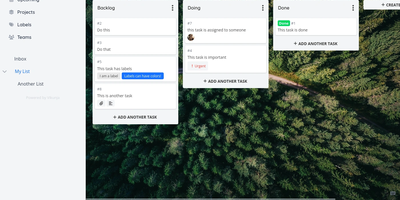
A personal to-do list that scales to team project management: Vikunja is an open-source task manager that grows with the work. Every project can be viewed four ways - classic list, drag-and-drop Kanban board, Gantt chart for timeline planning, and a spreadsheet-style table - so a project manager watches the Gantt while developers work the board, on the same data. Tasks carry the full attribute set: labels, priorities, due dates and reminders, recurring schedules, subtasks and task relations, file attachments, assignees, and comments, and Quick Add Magic parses natural-language input like dates and labels typed inline. Projects share with team members or via links, and saved filters slice tasks across projects. Built-in CalDAV support (VTODO) syncs tasks bidirectionally with clients like Thunderbird, DAVx5, and iOS Reminders, and one-click importers migrate from Todoist, Trello, and Microsoft To-Do. Nothing is metered - unlimited projects, tasks, filters, and attachments. A single Go binary with a Vue frontend runs against SQLite, MySQL, or PostgreSQL, exposes a full REST API, and works as an installable PWA on mobile. AGPLv3-licensed.
Kokoro FastAPI
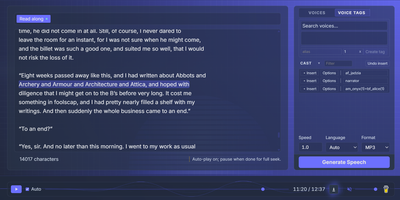
Kokoro-FastAPI turns text into natural-sounding speech across eight languages by serving the 82-million-parameter Kokoro-82M model through an OpenAI-compatible REST API, so any existing OpenAI SDK client can generate audio by just changing the base URL. With over 5,300 GitHub stars since December 2024, the fully Dockerized FastAPI server covers American English, British English, Spanish, French, Hindi, Italian, Japanese, Brazilian Portuguese, and Mandarin Chinese with language-specific phoneme processing. Inline voice mixing blends multiple profiles using weighted ratios like af_bella(2)+af_heart(1), automatically normalizing weights and caching combined voicepacks as PyTorch tensor files for reuse. Audio streams in real time over HTTP with configurable chunk sizes, or generates complete files in MP3, WAV, OPUS, FLAC, AAC, or PCM formats with speed control from 0.25x to 4.0x. Per-word timestamped captions with speaker-tagged voice labels enable subtitle generation for podcasts, audiobooks, and accessibility workflows. Pre-built Docker images support NVIDIA GPU acceleration via CUDA, experimental AMD GPU inference via ROCm, and CPU-only deployment on linux/amd64 and linux/arm64 architectures, with Apple Silicon MPS support available through direct UV execution. The integrated web interface at port 8880 provides browser-based speech generation, while the Swagger UI at /docs exposes the full API reference. Debug endpoints report system statistics for monitoring inference load. Running on a dedicated VPS on RepoCloud with guaranteed CPU, RAM, and SSD, full root SSH access, and a browser serial console. Apache 2.0 licensed.
Unkey
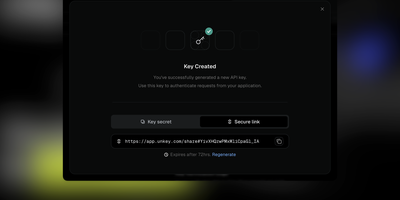
Unkey is the open-source platform that unifies API key management, rate limiting, deployment, and observability into a single control plane. The Go API service validates keys with sub-millisecond latency using regional Redis caches and MySQL 8.0 persistent storage, while ClickHouse captures every verification event for per-key and per-keyspace analytics with filterable time-series charts, request counters, and active key tracking. Keyspaces organize API keys by product, environment, or tier, each configurable with custom prefixes, byte lengths, IP whitelists, encrypted key recovery, and delete protection. Per-key settings include expiration dates, rate limit quotas with configurable windows, RBAC roles and permissions, owner identities linking multiple keys to a single user or organization, and key rotation with grace periods from immediate revocation through 24-hour overlap. The deployment pipeline connects GitHub repositories for automatic Docker container builds, generates preview environments per commit, promotes tested versions to production, and validates releases with OpenAPI diff detection flagging breaking changes before production. The edge gateway authenticates and rate-limits requests at the closest region before routing to the nearest API instance. Immutable audit logs track every key creation, verification, deletion, and configuration change with actor, timestamp, and event metadata. The CLI provides terminal access to key management, analytics queries, and deployment operations. On RepoCloud, deploy Unkey on a dedicated VPS with Docker, root SSH access, and complete control over your API infrastructure, all under the AGPL license.
Isso
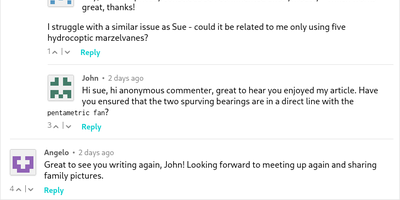
Named from the German "Ich schrei sonst" - roughly "or I'll scream" - Isso is a lightweight Python/JavaScript commenting server, a drop-in Disqus replacement for people who noticed what Disqus does to reader privacy and page load times. The design premise is printed right in the docs: comments are not Big Data. So the backend is a single SQLite file rather than a database cluster, and the entire client is one embeddable JavaScript file - 65 kB, 20 kB gzipped - that you drop into any static site, blog, or CMS. Commenters write in Markdown, need no account, and can edit or delete their own comments within a configurable window (15 minutes by default). Spam control comes from an optional moderation queue: held comments stay invisible until you activate them via an admin interface or email notification links. Migration is a first-class feature, with importers for Disqus and WordPress exports, so years of existing threads move over intact. Because everything is server-rendered from your own instance, no third party tracks your readers, and real-world switchers report smaller pages and faster loads than the Disqus embed. MIT-licensed, running since 2012.