Ovis
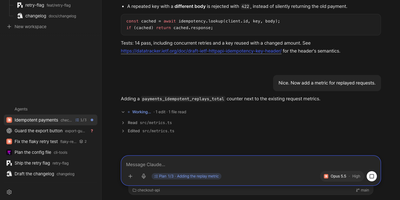
Ovis puts every coding agent running on your machine into your pocket, turning Claude Code, Codex, and a dozen other agent panes into clean phone-friendly chats you can read, answer, and steer from anywhere. Each pane shows the agent's own transcript as a conversation instead of terminal scrollback, with the live terminal one tap away when you need raw output. Permission requests, questions, and plan menus arrive as cards you answer with a tap or a number, and Ovis checks the prompt is still current before sending your answer. Live status for every pane shows which agents are working, which finished, and which are waiting on you. Web push alerts reach you even with the app closed, so a blocked agent never sits idle while you are away from the desk. Install it on your phone as a PWA with a rearrangeable key bar for Esc, Tab, Ctrl, and arrow keys, paired by QR code to your Tailscale address. Dictate replies into chat or terminal with mixed Korean and English speech, review the transcript, then send it to the agent. Open working-tree, staged, or commit comparisons from the file browser and read each file's diff without touching the repository. Reach remote PCs over SSH, queue a message for the agent's next turn, or send it immediately. Running on a dedicated VPS on RepoCloud with guaranteed CPU, RAM, and SSD, full root SSH access, and a browser serial console. MIT licensed.
Maloja
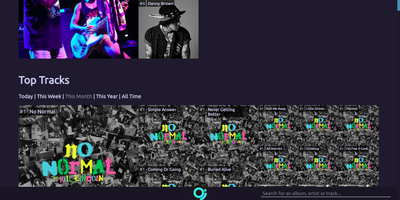
Maloja's one job is to be your own scrobble database, charting what you listen to from a server you control. Players and media servers that speak the native JSON API or a ListenBrainz, GNU FM, or Audioscrobbler 1.2 compatible protocol can scrobble with their own API keys. Vinyl sessions and background music can be logged by hand on a manual scrobble page. Existing history moves in from a Last.fm export, a Spotify data export, a ListenBrainz export, or another Maloja instance, while a proxy option forwards new scrobbles to Last.fm or a second Maloja server. The start page ranks top artists, tracks, and albums for today, this week, this month, this year, or all time, alongside a pulse chart of listening volume and a feed of the latest scrobbles. Artist and album pages add performance charts that follow chart position over time. Collaborations credit every artist on a track, and subunits, solo projects, and main acts can be combined or separated in charts at any time. Gold, Platinum, and Diamond awards mark tracks and albums that pass scrobble thresholds you set. Artwork can come from Last.fm, Spotify, Deezer, TheAudioDB, or MusicBrainz lookups, or from images you upload yourself. Week start, timezone, theme, and tile layout are all settings, and an API explorer lists endpoints for scripts. Running on a dedicated VPS on RepoCloud with guaranteed CPU, RAM, and SSD, full root SSH access, and a browser serial console. GPL-3.0 licensed.
Lingva Translate
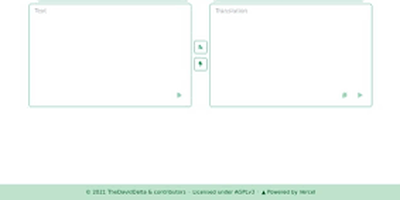
What Nitter was to Twitter and Invidious is to YouTube, Lingva Translate is to Google Translate: a privacy front-end delivering the service's full capability while cutting Google out of the loop between you and your text. Built on Next.js with TypeScript and Chakra UI, it uses the purpose-built Lingva Scraper to fetch translations from Google Translate without your browser ever touching a Google-related service - no cookies, no tracking, no account, while retaining what makes Google Translate hard to give up: 100+ languages with the translation quality of Google's production models, unlike offline engines that trade privacy for accuracy. The clean interface covers automatic source-language detection, text-to-speech audio playback for pronunciations, definitions and examples, and light/dark themes. For developers, every instance doubles as a translation API: a RESTful endpoint at /api/v1/:source/:target/:query returns JSON translations, an audio endpoint serves TTS buffers, and a full GraphQL API at /api/graphql exposes translations, audio, and language lists for richer integrations - all unmetered on your own instance. Deployment is a single stateless container with one environment variable for the site domain; defaults for theme and language pair are configurable. GPL-licensed, and popular as the translation backend for privacy-respecting apps.
BeaverHabits
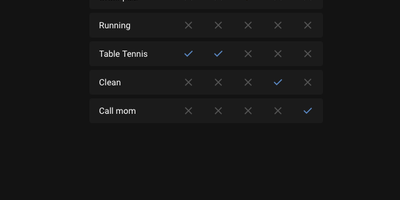
No targets, no gamification spiral, no motivational nagging: Beaver Habit Tracker is a self-hosted habit tracker deliberately built without "Goals". The core loop is honest: add habits, check them off each day, watch streaks accumulate on a calendar view. Its design follows behavioral-science basics - make it obvious (visual streak cues), make it attractive (progress is the motivator), make it satisfying (tracking becomes its own reward). Beyond the daily checklist it supports per-day notes intelligently grouped per habit, periodic habits, habit categories and tags, drag-to-reorder (manual or automatic), dark mode, and detailed streak and frequency views. Data lives where you choose: a single SQLite database or flat JSON files on a mounted volume, with JSON export and import for full portability. A REST API opens automation - community integrations already cover Stream Deck buttons, Home Assistant triggers, and CalDAV. The Python app ships as one Docker container with no external dependencies; environment variables tune everything from first day of week and index-page columns to iOS standalone PWA mode, and single-user setups can bypass the login entirely with TRUSTED_LOCAL_EMAIL. BSD-3-Clause licensed with no commercial restrictions - a well-executed single-purpose tool whose mobile PWA works anywhere a browser does.
dyrector.io
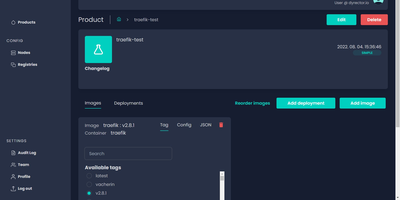
dyrector.io gives teams a visual web interface for deploying and managing containerized applications across Docker, Kubernetes, and Podman environments, replacing repetitive CLI commands and YAML editing with point-and-click configuration. Lightweight Go agents installed on target infrastructure communicate with the central TypeScript platform, enabling deployments to AWS, GCP, Azure, and on-premises servers without requiring infrastructure migration. Unified configuration screens eliminate redundant YAML editing across environments with support for all three container runtimes. Version management lets teams configure OCI-compatible container images once and deploy them as versioned releases with auto-generated changelogs and release notes. Multi-instance deployment enables simultaneous rollouts to multiple nodes with environment-specific configuration overrides, secret management, and instant test environment provisioning from any branch. The fine-grained RBAC system controls user access at project and environment levels, while audit logging tracks every deployment action. Registry integrations support Docker Hub, GitLab, GitHub, Google, and Azure container registries for image sourcing. ChatOps notifications integrate with Slack, Discord, and Microsoft Teams for deployment status alerts. Scheduled releases and workflow support enable automated deployment pipelines triggered by CI events via the REST API with JWT authentication. Running on a dedicated VPS on RepoCloud with guaranteed CPU, RAM, and SSD, full root SSH access, and a browser serial console. Apache 2.0 licensed.
PdfDing
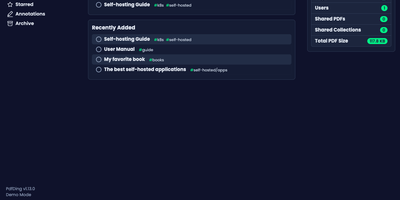
PdfDing turns a scattered folder of PDFs into a proper library you can read, annotate, sign, and share from any browser. The viewer remembers exactly where you stopped in every document, so a manual opened on your desktop resumes mid-page on your phone, and progress bars in the library show how far you have read at a glance. Workspaces and collections group related documents, multi-level tags classify them, and starring, archiving, and bulk actions keep even a large archive tidy. Inside the viewer you can add text, highlights, and freehand drawings, then review and export your highlights and comments from dedicated sections and attach Markdown notes to a document. A signature you create once is stored on your server and waits for you on every device, ready to drop onto contracts and forms. Sharing a collection or a single PDF takes a link or a QR code, with optional access control over who can open it and for how long. Accounts are protected by OIDC single sign-on and two-factor authentication with TOTP or WebAuthn, and dark mode, an inverted color mode, and multiple layouts keep long reading sessions comfortable. Running on a dedicated VPS on RepoCloud with guaranteed CPU, RAM, and SSD, full root SSH access, and a browser serial console. AGPL-3.0 licensed.
RackPeek
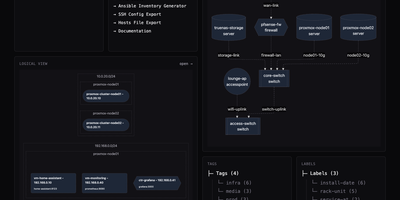
Every server, switch port, virtual machine, and network VLAN in a homelab or small IT environment can be cataloged, visualized, and exported through RackPeek's unified web interface and command-line toolkit. Operators record rack-mounted servers, managed switches, routers, firewalls, wireless access points, and uninterruptible power supplies alongside their CPU, memory, and storage specifications in a clean browser dashboard. Beyond physical gear, the inventory tracks operating systems, containerized or bare-metal services, IP subnets, and port-to-port cable connections while organizing assets with searchable tags and key-value labels. From that structured inventory, the interactive visualization engine renders live physical wiring diagrams and logical subnet-grouped service maps that export directly as high-resolution PNG graphics or Mermaid flowcharts. Because all state lives in a single human-readable configuration file backed by built-in Git repository synchronization, teams can version-control infrastructure changes or push automated updates through the authenticated REST API with dry-run diff previews. Day-to-day administration becomes faster with built-in generators that turn your cataloged hosts into ready-to-use Ansible inventory files, SSH client configurations, and tag-filtered hosts tables. Line-and-column validation feedback in the web editor catches schema mistakes immediately before changes are committed. Running on a dedicated VPS on RepoCloud with guaranteed CPU, RAM, and SSD, full root SSH access, and a browser serial console. AGPL-3.0 licensed.
Part-DB
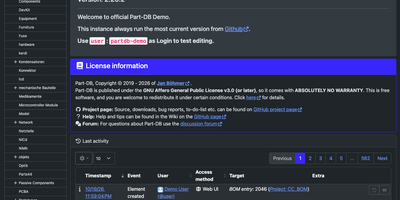
Across electronics labs, hardware startups, and university makerspaces, Part-DB indexes thousands of resistors, microcontrollers, and SMD reels with datasheets, storage locations, and live supplier pricing. Each component record tracks categories, footprints, manufacturers, multi-currency order histories, electrical tolerances, and custom tags for instant parametric search. New shipments populate part attributes, product photos, and PDF datasheets directly from Octopart, DigiKey, Mouser, Farnell, LCSC, or TME, alongside AI-assisted extraction from uploaded datasheets. Print custom barcode labels on demand. Scan internal IDs, GTIN codes, or distributor DataMatrix labels with a webcam or USB scanner to jump straight to any bin. Hardware engineers import KiCad bills of materials into project workspaces to calculate buildable board quantities and deduct stock in one step. Schematic designers can even connect Part-DB as a native KiCad 8 HTTP library source to place verified lab components with pre-linked footprints directly inside their EDA editor. Fine-grained group permissions, SAML single sign-on, WebAuthn two-factor authentication, and a versioned audit log with rollback protect shared inventories. Running on a dedicated VPS on RepoCloud with guaranteed CPU, RAM, and SSD, full root SSH access, and a browser serial console. AGPL-3.0 licensed.
Codync
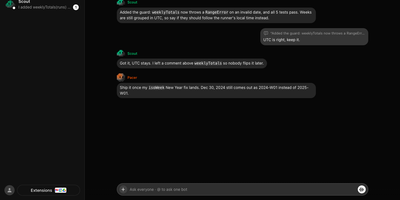
Codync turns the coding agents already installed on your computer into named bots you can message from your phone, so the Claude Code or Codex session on your desk keeps working while you are away. Each bot wraps one agent in one project folder, with its own standing instructions, memory, and approval rules, and several bots run side by side on one machine. Message any bot from the iPhone app, the desktop app, or a terminal; group rooms put bots in one thread, and an @name mention routes a question to exactly one of them. Bots ask each other for reviews inside the room and quote-reply to specific messages. File changes arrive as approval cards naming the file and computer, with Allow once, Always allow, or Deny; finished and blocked work both ping you as push notifications. The connection between phone and computer is end-to-end encrypted through a free relay, your own relay, or directly over the same Wi-Fi or Tailscale. Watch the computer's screen from your phone, hand a bot a computer-use tool, or talk to it in a voice call, and approve every new device per computer with a six-digit code. Your existing agent subscription does the work; Codync never calls a provider API with your login, and there is no paid tier. Running on a dedicated VPS on RepoCloud with guaranteed CPU, RAM, and SSD, full root SSH access, and a browser serial console. Apache-2.0 licensed.
ServerKit
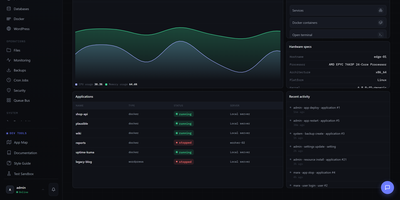
ServerKit delivers a server control panel that fits on a small VPS while managing everything from Docker containers to mail servers. The Python/Flask backend exposes 1,519 REST endpoints across 107 blueprints with full OpenAPI documentation at /api/v1/docs, while the React frontend spans 65 screens in a 1.75MB gzipped bundle served entirely from your own infrastructure. Docker management includes full container lifecycle control, Docker Compose project orchestration, real-time log streaming, and terminal access. Database panels cover MySQL/MariaDB and PostgreSQL with user management, browser-based query consoles, and automated backups to S3, Backblaze B2, or local storage. Nginx virtual host management automates Let's Encrypt certificate provisioning with hardened TLS 1.2+ configurations and Cloudflare-aware setups. The Go-based cross-platform agent enables multi-server fleet management with HMAC-SHA256 authentication over a WebSocket gateway, supporting Linux, Windows, and macOS across amd64 and ARM64 architectures. Fleet monitoring provides cross-server heatmaps, metric comparison charts, alert thresholds, anomaly detection, and capacity forecasting. A built-in marketplace distributes 106 one-click application templates using a declarative YAML schema with Docker Compose stacks. The extension system allows community plugins for Kubernetes management, Redis browsers, and WordPress site orchestration. Running on a dedicated VPS on RepoCloud with guaranteed CPU, RAM, and SSD, full root SSH access, and a browser serial console. MIT licensed.
Talkyard
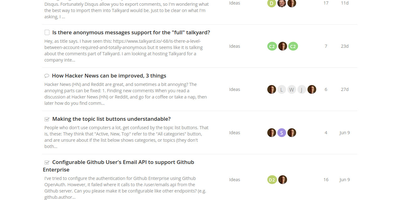
Talkyard combines five discussion formats in one platform: StackOverflow-style Q&A with accepted answers, Reddit-like upvote sorting for ideas, threaded forums, real-time chat channels, and embeddable blog comments. Running separate tools for each conversation type fragments community knowledge across disconnected systems, but Talkyard keeps it all searchable in one place. Question askers mark accepted answers, and community voting surfaces the best solutions for future visitors. Idea topics sort by upvotes for crowdsourced feedback prioritization and product decisions. Chat channels handle real-time day-to-day conversation, while forum threads preserve important discussions that need to remain findable months later. The embedding capability goes beyond blog comments: entire Talkyard forums can live inside iframes on your existing website with automatic deep-linking and iframe auto-resizing, adding community discussion to any page without rebuilding your site. Docker Compose containers run with dropped capabilities, no-new-privileges enforcement, non-root processes, health checks, and automatic log rotation. Multi-site hosting serves multiple communities from one installation with isolated databases and separate domains. Automated upgrades pull new images and restart services without intervention. ElasticSearch indexes every discussion format for instant full-text search. The Scala backend with TypeScript frontend stores data in PostgreSQL with automatic Let's Encrypt HTTPS. Runs on a RepoCloud VPS with guaranteed CPU, RAM, SSD, root SSH, and browser console. AGPL licensed.
TimeTagger
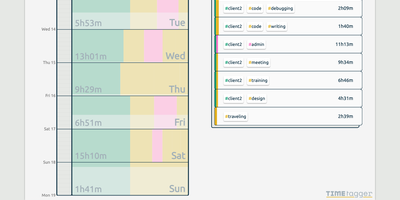
Freelancers, consultants, and solo workers get an accurate record of their hours from TimeTagger, a time tracker that logs tagged tasks on an interactive timeline and summarizes them as billable reports. Press S, type a description, and hit Enter to start the clock without the mouse, or drag across the timeline to log finished work. Hashtags in a description become autocompleting tags, with no projects to set up. Renaming a tag updates every record that uses it. Drag a record's edges to fix its times, then zoom the timeline out to a week or month with mouse, touch, or arrow keys. An overview panel totals time per tag combination for the selected range, and the Report button saves it as a client-ready PDF or a CSV with decimal hours. Daily, weekly, and monthly targets track progress toward your goals, and an optional Pomodoro timer alternates work and break periods with an alarm and a notification. Settings add a dark theme, local date notations, a Monday-to-Friday week, and a day offset for night shifts. The interface adapts from desktop to phone, installs as a progressive web app, works offline, and syncs records across devices once the connection returns. A web API and a command-line client let you query, create, and update records from scripts or the terminal. Running on a dedicated VPS on RepoCloud with guaranteed CPU, RAM, and SSD, full root SSH access, and a browser serial console. GPL-3.0 licensed.
MantisBT
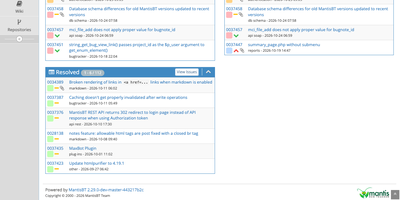
Every bug a team finds, from the first report to the day it is marked resolved, lives in one shared list in MantisBT, an open-source issue tracker. Reporters file issues with a summary, steps to reproduce, severity, and attachments, and email notifications reach the reporter, the handler, monitors, and note authors. Six access levels, from viewer to administrator, can be overridden project by project, and private projects stay hidden from users below the configured level. Administrators define their own status values, workflow transitions, and custom fields. Sub-projects inherit versions and categories from their parents, and issues link as related, parent and child, or duplicates. @mentions pull colleagues into a discussion, tags group related work, and a chronological history records who changed what. Triage works from stored and shared filters, the My View page, and summary charts, while a roadmap and changelog track what each version contains. Reporting comes through CSV and Excel export, optional time tracking with billing totals, and RSS feeds. Sign-in can use LDAP or Active Directory, scripts reach the tracker through REST and SOAP APIs, plugins extend the interface, and 50 languages are included. Running on a dedicated VPS on RepoCloud with guaranteed CPU, RAM, and SSD, full root SSH access, and a browser serial console. GPL-2.0-or-later licensed.
Relaticle
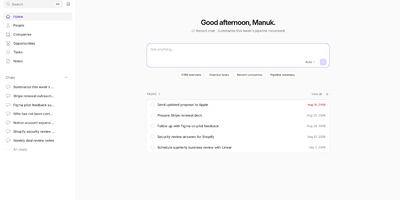
Relaticle delivers the first CRM built from the ground up for both human operators and AI agents — a self-hosted platform where Claude, GPT, Gemini, or any custom model connects through a production-grade MCP server exposing 30 tools for full CRUD operations across companies, people, opportunities, tasks, and notes without a single line of integration code. The 22 custom field types include text, email, phone, currency, date, select, multiselect, entity relationships, conditional visibility rules, and per-field encryption — all configurable through the UI without database migrations or code changes. Multi-team isolation enforces data boundaries through a 5-layer authorization system with team-scoped workspaces, API tokens, and granular permissions. The JSON:API REST surface provides Spatie QueryBuilder filtering, sorting, and pagination with schema discovery endpoints that let agents introspect your data model at runtime. A built-in AI chat connects directly to CRM data for natural language queries, while the external MCP server gives any compatible agent the same 30-tool access. Docker Compose deployment runs five containers — app (nginx + PHP-FPM), Horizon queue worker, scheduler, PostgreSQL 17, and Redis 7 — with automatic migrations on startup and demo data seeding for new teams. Running on a dedicated VPS on RepoCloud with guaranteed CPU, RAM, and SSD, full root SSH access, and a browser serial console. AGPL-3.0 licensed.
Gramps Web
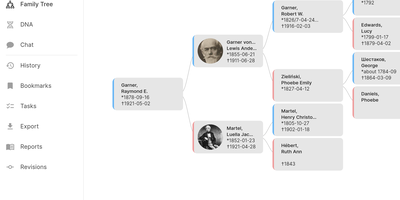
Together with relatives and fellow researchers anywhere in the world, family historians can build, visualize, and preserve shared ancestry databases using Gramps Web, a self-hosted collaborative genealogy platform. Interactive family tree charts let you explore ancestor, descendant, hourglass, relationship, and fan views across configurable generation depths, while inline editing buttons allow you to add parents, spouses, and children directly inside the graph and export finished diagrams as SVG files. When tracing where ancestors lived and migrated, the interactive map plots life events across OpenStreetMap and OpenHistoricalMap layers with a historical time slider and custom image overlays, complemented by a zoomable chronological timeline spanning centuries. Photograph collections become searchable archives through automated face detection that tags relatives in two clicks, alongside an integrated family history blog for publishing illustrated biographical stories. Researchers can also analyze autosomal DNA match segments in an interactive chromosome browser, determine patrilineal Y-DNA haplogroups locally without sending genetic data to third parties, and query people, places, citations, and notes using Gramps Query Language filters or a conversational AI assistant. Bidirectional synchronization with Gramps Desktop, full transaction history with undo, role-based privacy controls for living individuals, and pre-filled searches for FamilySearch and Ancestry keep every record accurate and protected. Running on a dedicated VPS on RepoCloud with guaranteed CPU, RAM, and SSD, full root SSH access, and a browser serial console. AGPL-3.0 licensed.
Damselfly
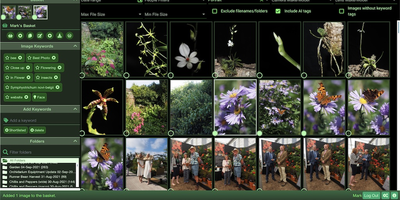
Damselfly puts a searchable brain over a folder-based photo archive, so a library of hundreds of thousands of images stays browsable from any browser. Point it at your existing folders and it indexes everything in the background, generating thumbnails and reading IPTC keywords, EXIF camera data, and file names into one catalogue. Search returns results in under a second even across 500,000 photographs, and advanced filters narrow by date range, camera or lens model, file size, orientation, detected objects, or recognized faces. Face detection and recognition run locally and offline, so you tag a person once and Damselfly finds them in other shots without sending family photos to a cloud service. Keyword tagging writes metadata with ExifTool without re-encoding JPEGs, keeping originals byte-identical while tags travel with the files into DigiKam, Photoshop, or other tools. The Picasa-style basket collects picks from search results for download, watermarked export for social media or email, or upload to WordPress, and baskets can be personal or shared between users. Photos with location metadata appear on a map, visually similar images can be found from a single example, and untagged shots can be listed so nothing stays unlabelled. Accounts with role-based permissions let everyone browse while only editors tag or reorganize, and an optional desktop client syncs basket selections to a laptop for editing. Running on a dedicated VPS on RepoCloud with guaranteed CPU, RAM, and SSD, full root SSH access, and a browser serial console. GPL-3.0 licensed.
Dialoqbase
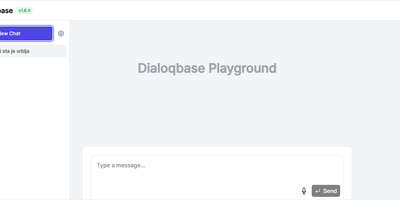
Retrieval-augmented chatbots on your own knowledge base - that is the whole mission of Dialoqbase, an open-source bot-building platform. Feed it content through a broad set of data loaders - web pages and full crawls, sitemaps, PDFs, DOCX, CSV, plain text, GitHub repositories, YouTube videos, and MP3/MP4 audio - and it handles the whole RAG pipeline in one self-contained app: chunking, embedding, vector storage, and LLM querying. The distinguishing architecture choice is PostgreSQL with pgvector for embedding storage and similarity search, which removes the separate vector-database dependency, and Redis-backed Bull queues for ingesting large documents without blocking the API. Model choice is wide open: OpenAI, Anthropic Claude, Google Gemini, Cohere, Fireworks, Hugging Face, local models via Ollama, and any OpenAI-compatible endpoint, with an equally broad list of embedding providers. Finished bots embed on any website with customizable styling or deploy to Telegram, Discord, and WhatsApp, and an API creates and manages bots programmatically. Multi-user support adds registration limits and per-user bot quotas. MIT-licensed and free for commercial use.
Rackula
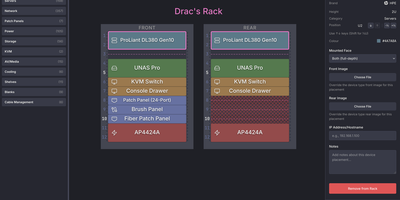
Before lifting a heavy four-unit storage server or rewiring a cramped network closet, you can map every unit of cabinet space in Rackula, an interactive drag-and-drop rack layout designer and capacity planner. Instead of staring at generic grey rectangles in a spreadsheet, you pull switches, routers, patch panels, UPS battery banks, and rackmount chassis from a hardware catalog populated with authentic front and rear faceplates from the NetBox device library. Equipment snaps cleanly to standard EIA-310 rack unit boundaries, while half-width gear and mini PCs nest inside one-unit carrier shelves and mounting brackets. Audiovisual technicians can group bayed cabinets side by side to plan amplifier racks, signal processor chains, and patch bays across multi-rack installations. Network engineers and data center operators can rearrange hardware with full undo and redo history, attach custom device graphics, and export crisp diagrams as PNG, SVG, or PDF files for runbooks and change control tickets. Sharing a proposed cabinet topology with a colleague in the field takes seconds using an encoded URL or a scannable QR code that opens on mobile browsers. Server-side persistence stores your rack definitions as portable YAML files and supports optional local accounts or OpenID Connect single sign-on for shared infrastructure teams. Running on a dedicated VPS on RepoCloud with guaranteed CPU, RAM, and SSD, full root SSH access, and a browser serial console. MIT licensed.