Chatwoot
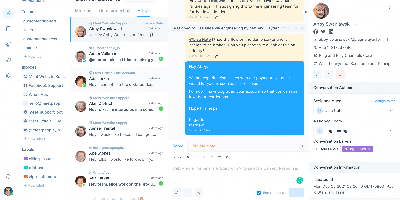
Unleash the power of Chatwoot, the open-source superhero in the world of customer experience! This platform is perfect for businesses craving to connect with their customers across a multitude of channels without breaking the bank. Wave goodbye to the high-and-mighty likes of Intercom, Zendesk, and Salesforce Service Cloud, and say hello to a wallet-friendly powerhouse. Chatwoot turns your agents into customer service ninjas, armed with the latest in workload management, performance tracking reports that refresh themselves (because who has time for that?), and automations that work smarter, not harder. Zap through conversations with lightning-fast responses and manage your social media and email interactions in a single bound. Plus, with Chatwoot, you get to be the Sherlock of customer satisfaction, deducing your CSAT scores on autopilot. All this hosted on RepoCloud, where the cost is as tiny as the effort you'll need to switch over. Get ready to engage, enlighten, and entertain your customers with Chatwoot!
1Panel
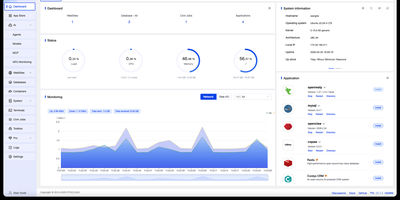
Backed by over 36,000 GitHub stars and 120 contributors with 123 releases since 2022, 1Panel has rapidly become the go-to open-source alternative to cPanel and Plesk for modern Linux server management. The platform delivers a clean Vue.js dashboard powered by a Go backend using the Gin framework, providing visual management of Docker containers, images, networks, and volumes without touching the command line. Its curated app marketplace offers one-click installation of 165+ trusted open-source applications including Nextcloud, Bitwarden, Umami analytics, WordPress, and NocoBase, each running in isolated containers for maximum security. Native AI capabilities set 1Panel apart from every competing panel: deploy Ollama LLMs directly from the dashboard, spin up OpenClaw personal agents, monitor GPU utilization, and manage AI models through a unified interface. Website management includes automatic domain binding, Let's Encrypt SSL certificate provisioning, and Nginx configuration with zero manual setup. Security runs deep with built-in firewall rules, fail2ban integration, container isolation, WAF protection, and comprehensive audit logging enabled from day one. Automated backups support AWS S3, Cloudflare R2, and local storage with one-click restore from any snapshot. The panel supports Debian, Ubuntu, CentOS, and Rocky Linux across x86_64, aarch64, armv7l, ppc64le, and s390x architectures. Running on a dedicated VPS on RepoCloud with guaranteed CPU, RAM, and SSD, full root SSH access, and a browser serial console. GPL-3.0 licensed.

Vane
Perplexity's search experience without Perplexity: Vane deploys Perplexica, an open-source AI answer engine built as the self-hosted alternative. Instead of returning a page of links, it reads your question, searches the live web through the SearxNG metasearch engine, and composes a direct answer with cited sources. Retrieval quality comes from embeddings and similarity search: fetched pages are re-ranked against the query so the model answers from the most relevant passages rather than whatever ranked first. Two query modes cover different needs - Normal mode runs a straightforward web search, while Copilot mode generates multiple reformulated queries and actively pulls content from top matches for harder questions. Focus modes specialize retrieval for academic papers, YouTube, Reddit discussions, Wolfram Alpha calculations, or the general web. The answering model is your choice: OpenAI-compatible APIs or fully local LLMs such as Llama 3 and Mixtral through Ollama, which keeps queries entirely on your infrastructure. Because SearxNG pulls live results, answers reflect current information, and no search history is tracked.
Nextcloud
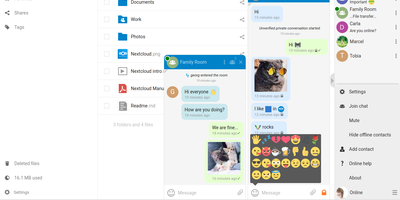
Google Workspace and Microsoft 365, replaced by a platform you actually control: Nextcloud is the self-hosted digital workspace. Files is the core: file storage and sync across desktop, mobile, and web clients, with sharing, versioning, and collaboration built in. Around it, Talk provides private text chat, audio/video conferencing with screen sharing, SIP integration, and persistent voice rooms; Groupware bundles calendar, contacts, and mail with delegation support; and Office offers two collaborative suites - the Collabora-based option with deep ODF support, and Euro-Office, whose local-processing architecture delivers strong Microsoft Office compatibility and fast browser rendering with reduced server load. The Nextcloud Assistant threads AI through the platform via a context-aware sidebar, Whiteboard covers visual collaboration, Flow handles automation, and an app ecosystem of hundreds of extensions adds everything from Kanban boards to end-to-end encryption. Hub 26 brings a lighter UI with a unified app switcher and Nextcloud Governance for organizations under strict regulatory requirements. This is the flagship of data sovereignty: your files, chats, calendars, and documents live on your server, under your jurisdiction, with GDPR compliance by architecture rather than by contract.
Tailscale
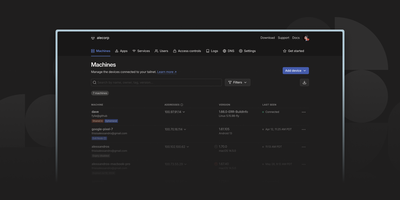
With over 34,000 GitHub stars and backing from a well-funded engineering team, Tailscale has fundamentally simplified how developers and system administrators think about secure networking. The client daemon establishes WireGuard tunnels directly between devices using sophisticated NAT traversal techniques, achieving direct peer-to-peer connections in the vast majority of network configurations without requiring port forwarding, firewall rules, or VPN concentrators. When direct connections prove impossible due to restrictive network environments, DERP relay servers provide encrypted fallback paths. MagicDNS assigns human-readable hostnames to every device on the network, eliminating the need to remember IP addresses across a tailnet. Subnet routing allows nodes to advertise access to entire local networks, enabling remote access to office resources, home labs, or cloud VPCs through a single gateway node. Exit node functionality routes all internet traffic through a designated device for privacy protection or geographic flexibility. Access control lists define granular policies for which devices and users can communicate with which services, enforced cryptographically at the network layer. The authentication layer integrates with identity providers including Google, Microsoft, GitHub, Apple, and OIDC-compliant systems for single sign-on access. Taildrop enables direct encrypted file transfers between devices without cloud intermediaries. The tailscale CLI provides complete network management from the terminal including status monitoring, route advertisement, and node configuration. Running Tailscale on a dedicated VPS on RepoCloud with guaranteed CPU, RAM, and SSD, full root SSH access, and a browser serial console provides a permanent, always-on node in your mesh network. BSD-3-Clause licensed with an active open-source community.
Medusa
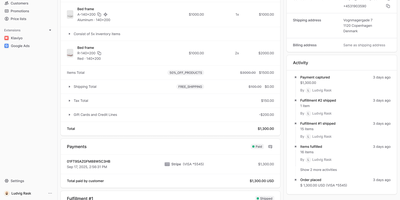
With over 35,000 GitHub stars and 460 contributors, Medusa is the headless commerce framework that gives development teams full ownership of their e-commerce backend without license fees, per-transaction charges, or revenue sharing. The modular architecture ships over 18 domain modules covering products, collections, categories, inventory, pricing, carts, orders, payments, fulfillment, promotions, customers, users, API keys, and stock locations, each independently usable and replaceable. REST and GraphQL APIs expose every commerce operation to any frontend framework — official starters exist for Next.js with community options for Nuxt, Remix, and Gatsby. The React-based admin dashboard provides out-of-the-box order management, product maintenance, promotions configuration, B2B accounts, and multi-warehouse inventory, extensible via the Admin SDK for custom views and workflows. The workflow engine orchestrates long-running commerce processes like checkout, fulfillment, and returns with compensating transactions for reliability. Over 200 official and community plugins integrate Stripe, PayPal, Klarna, Algolia, Meilisearch, SendGrid, Mailchimp, Contentful, Sanity, and Klaviyo. Native multi-region and multi-currency support handles tax-inclusive pricing, region-specific payment and fulfillment providers, and localized storefronts from a single backend. Enterprises including Viessmann, Makro PRO, and INSPIRED Pet Nutrition run Medusa in production. Self-hosting deploys via Docker or directly on Node.js with PostgreSQL and Redis. Running on a dedicated VPS on RepoCloud with guaranteed CPU, RAM, and SSD, full root SSH access, and a browser serial console. MIT licensed.
HashiCorp Vault
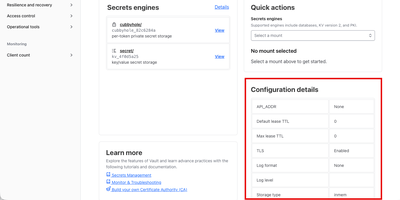
With over 36,000 GitHub stars and adoption by organizations including Adobe, Shopify, and Roblox, HashiCorp Vault is the industry-standard platform for secrets management, encryption services, and privileged access control across hybrid and multi-cloud infrastructure. The key/value secrets engine stores arbitrary secrets with full versioning, soft-delete, and metadata tracking, while dynamic secrets engines generate on-demand, short-lived credentials for AWS, Azure, GCP, databases including PostgreSQL, MySQL, MongoDB, and MSSQL, and SSH access with automatic revocation after configurable lease periods. The PKI secrets engine dynamically issues X.509 certificates on demand with automatic rotation and ACME protocol support, eliminating manual certificate management workflows entirely. Encryption as a service through the transit secrets engine lets applications encrypt, decrypt, sign, verify, and generate HMACs without managing cryptographic keys directly, supporting AES-GCM-256, ChaCha20-Poly1305, RSA-2048/4096, ECDSA-P256/P384, and ED25519 algorithms. Authentication integrates with LDAP, OIDC/OAuth2, SAML, AppRole for machine-to-machine access, Kubernetes service accounts, AWS IAM, Azure Active Directory, and GitHub tokens. Fine-grained ACL policies use path-based rules with glob patterns and sentinel policies for programmatic enforcement. The integrated Raft storage backend provides high-availability clustering without external dependencies, while alternative backends include Consul, S3, DynamoDB, PostgreSQL, and MySQL. The built-in web UI provides a visual interface for browsing secrets, managing policies, configuring auth methods, and monitoring cluster health. Running on a dedicated VPS on RepoCloud with guaranteed CPU, RAM, and SSD, full root SSH access, and a browser serial console. BSL 1.1 licensed.
Postiz
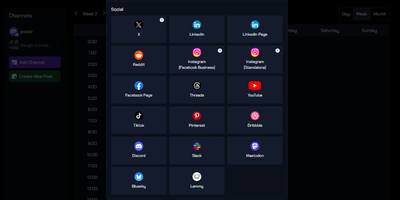
Powering over $145K monthly recurring revenue as a one-person company and holding 34,000+ GitHub stars, Postiz has emerged as the most widely adopted open-source alternative to Buffer, Hootsuite, and Hypefury — combining social media scheduling with AI-driven content creation and agentic automation in a single self-hosted platform. The Next.js 14 frontend with React 18 and Tailwind CSS delivers a visual calendar and Canva-like design editor, while the NestJS backend orchestrates publishing across 30+ social networks including X, LinkedIn, Instagram, TikTok, YouTube, Reddit, Pinterest, Threads, Dribbble, Discord, Bluesky, Mastodon, and Facebook. Temporal handles durable workflow execution for reliable scheduled posting, retry logic, and background job processing. The built-in AI assistant generates post ideas, captions, hashtags, images, and short videos from natural language prompts — all within a single chat interface. An agentic layer exposes a CLI and MCP server that allow AI agents like OpenClaw, Claude, and ChatGPT to autonomously plan, draft, and schedule posts programmatically. Team collaboration includes role-based permissions, approval workflows, multi-workspace management for agencies, and commenting on scheduled content. A full REST API with a NodeJS SDK, N8N custom nodes, and Make.com integration enables automation pipelines. Analytics track engagement, reach, and growth across all connected accounts from a unified dashboard. The self-hosted stack deploys via Docker Compose with PostgreSQL, Redis, and Temporal pre-wired — no feature limitations compared to the cloud version. Running on a dedicated VPS on RepoCloud with guaranteed CPU, RAM, and SSD, full root SSH access, and a browser serial console. AGPL-3.0 licensed.
CyberChef
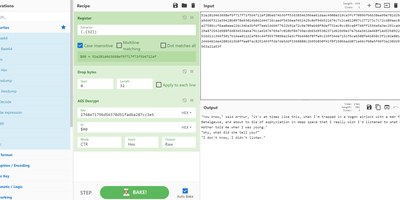
GCHQ open-sourced its "Cyber Swiss Army Knife", and CyberChef became the web app security analysts, incident responders, and CTF players reach for when data needs decoding, decrypting, or dissecting. Its interface is four panes: paste or drag input (files up to 2GB), search a categorized library of hundreds of operations, drag them into a recipe with arguments, and read the output. Operations span Base64, hex, and XOR encoding; AES, DES, and Blowfish encryption; classical ciphers from Caesar to Railfence; hashes and checksums; compression; regex and string extraction of IPs, domains, and URLs; timestamp conversion; and parsers for IPv6, X.509 certificates, and more. Recipes chain arbitrarily - convert from a hexdump then decompress, decrypt AES pulling the IV from the cipher stream, or let the Magic operation auto-detect several layers of nested encoding. Auto Bake re-runs the recipe live as input or arguments change, Step executes one operation at a time for debugging, and flow control (forks, subsections, registers) applies different operations to different parts of the data. Recipes save to files or share as URLs encoding the full pipeline. Crucially, CyberChef is entirely client-side JavaScript - nothing uploads anywhere - and self-hosting guarantees an unmodified copy inside your own network, where malware artifacts belong.
QwenPaw
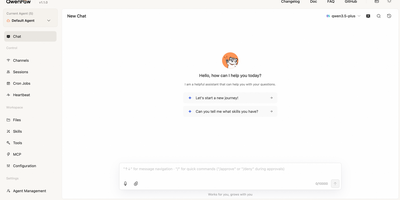
Designed as a unified personal AI workstation, QwenPaw operates as an autonomous digital copilot that coordinates scheduled automations, interactive coding sessions, and multi-channel team communication across everyday messaging apps. Users can dispatch long-running research tasks, process office documents including PDF, Excel, and Word files, and execute browser-based data collection without manual intervention. The built-in web console and terminal interface provide full visibility into agent reasoning, allowing operators to inspect intermediate thinking steps, review proposed file edits, and approve sensitive tool calls. Through direct connectors for Discord, Telegram, DingTalk, Lark, and WeChat, teams can trigger specialized skills or query shared workspaces directly from their existing group channels. A self-evolving personal memory system continuously indexes chat interactions and local resources into editable Markdown files, ensuring knowledge persists across restarts and task delegations. Built-in guardrails including a sandboxed execution runtime, tool access policies, and automated skill scanners protect underlying host files from unauthorized modifications during autonomous scripting runs. Running on a dedicated VPS on RepoCloud with guaranteed CPU, RAM, and SSD, full root SSH access, and a browser serial console. Apache 2.0 licensed.
Web-Check
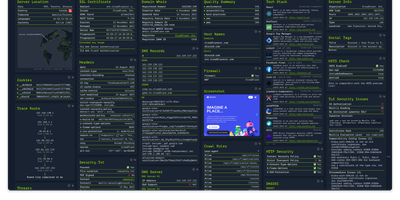
Enter a URL and get a dashboard of everything publicly discoverable about its security posture, server architecture, and technology stack: Web-Check is an all-in-one OSINT tool for analyzing any website. One scan surfaces IP info and server location, the full SSL certificate chain with issuing authority and validity, DNS records (A, MX, NS, CNAME, TXT) with DNSSEC status, HTTP response headers interpreted for security directives like HSTS, CSP, and X-Frame-Options, cookies and their flags, WHOIS domain info, robots.txt crawl rules, a sitemap-derived page map, the redirect ledger, open ports, traceroute, detected technologies, third-party trackers, associated hostnames, site performance, and even carbon footprint. Each card explains what the data means and why it matters, which makes the tool double as a security education resource - junior engineers learn headers and attack surfaces by scanning real sites. Practical uses span pre-deployment security audits (catch missing headers and misconfigurations before they ship), privacy compliance checks (identify trackers and cookie behavior for GDPR work), competitive tech-stack research, and network debugging via DNS and redirect inspection. Built by Lissy93 in TypeScript, it deploys as a single Docker container, and self-hosting keeps your reconnaissance targets and audit activity off third-party services.
Langfuse
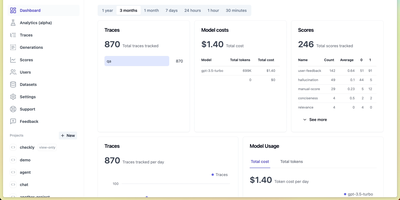
Backed by Y Combinator and trusted by over 2,300 companies processing billions of observations monthly, Langfuse is the most widely adopted open-source platform for building, monitoring, evaluating, and debugging LLM applications. The hierarchical tracing engine captures every LLM call, tool invocation, retrieval step, and agent action as nested spans based on OpenTelemetry, with automatic cost calculation, latency tracking, and token usage attribution across sessions and users. Prompt Management separates prompts from code with versioned artifacts, label-based deployments, one-click rollbacks, and runtime SDK fetching with server-side caching, while linking every generation back to its exact prompt version for attribution analytics. The evaluation system supports LLM-as-a-judge scoring, heuristic code evaluators, user feedback collection, and manual annotation workflows that run automatically on production traces or against curated datasets. The Playground enables interactive prompt testing on real production inputs with side-by-side model comparison across providers. Datasets and Experiments define test cases for systematic benchmarking with comparative result visualization. Native SDKs for Python and TypeScript provide decorator-based instrumentation, while 100+ integrations cover LangChain, LlamaIndex, OpenAI SDK, LiteLLM, Vercel AI SDK, and any OpenTelemetry-instrumented framework. The analytics dashboard surfaces cost breakdowns, quality scores, latency percentiles, and usage trends across models and prompt versions. Running on a dedicated VPS on RepoCloud with guaranteed CPU, RAM, and SSD, full root SSH access, and a browser serial console. MIT licensed.
Backstage
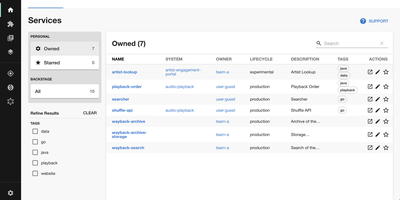
Adopted by over 3,400 companies and backed by 34,000 GitHub stars, Backstage is the open-source developer portal framework created by Spotify and now hosted by the Cloud Native Computing Foundation. The centralized Software Catalog registers every service, library, data pipeline, website, and ML model in your organization using YAML metadata files stored alongside code in GitHub, GitHub Enterprise, or GitLab, tracking ownership, lifecycle status, and dependency relationships across your entire ecosystem. Software Templates provide self-service infrastructure provisioning where developers fill out a form and Backstage automatically scaffolds new repositories, CI/CD pipelines, and cloud resources following your organization's standardized best practices. TechDocs renders Markdown documentation directly alongside the services it describes using a docs-like-code approach powered by MkDocs, with the TechDocs Addon Framework for extending the reading experience. The Search Platform indexes content across the catalog, TechDocs, Confluence, and Stack Overflow through configurable search backends. Kubernetes monitoring built specifically for service owners rather than cluster admins displays pod health, logs, and deployment status across any cloud provider or managed Kubernetes service. The plugin ecosystem includes over 230 open-source integrations covering CI/CD systems like GitHub Actions and GitLab Pipelines, monitoring platforms like Datadog and Grafana, cloud providers including AWS and Azure, plus specialized plugins for security scanning, cost management, API documentation, PagerDuty incident management, and Lighthouse website auditing. Running on a dedicated VPS on RepoCloud with guaranteed CPU, RAM, and SSD, full root SSH access, and a browser serial console. Apache-2.0 licensed.
Change Detection
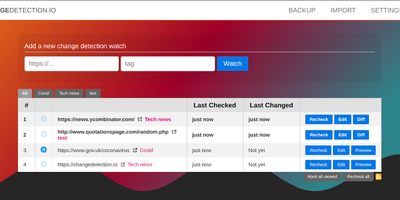
Price drops, restocks, job postings, government announcements, competitor edits - changedetection.io watches web pages and alerts you the moment anything changes, down to PDF text and checksums. Point it at a URL, set a check interval, and precise filters decide what counts as a change: a Visual Selector targets page elements by pointing and clicking, CSS selectors and XPath narrow scope, trigger-text and ignore-text rules (with regex support) cut noise, and JSONPath or jq handles API responses. A dedicated re-stock and price detection mode extracts product metadata and fires on thresholds - alert only when the price drops below your target or the percentage change exceeds a limit. JavaScript-heavy sites render through a real Chrome browser via Playwright, with the ability to execute JS steps first (log in, click, scroll) before extracting text. Notifications reach 85+ services through Apprise - Discord, Slack, Telegram, email, webhooks - optionally with a screenshot of the changed page, and AI-powered summaries (any OpenAI-compatible endpoint, including local Ollama) describe what changed. Per-watch proxies, custom headers, and POST/GET control cover hostile targets. Apache-2.0 licensed with local file-based storage: the URLs you monitor and why stay entirely your business.
Tabby
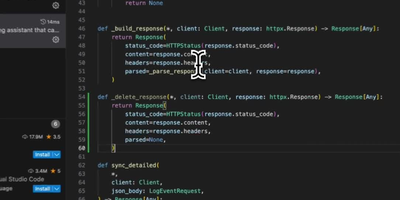
With over 33,000 GitHub stars and a codebase written in 92.9% Rust for maximum performance and memory safety, Tabby is the most widely adopted self-hosted alternative to GitHub Copilot — delivering real-time code completions entirely on your own infrastructure with zero code leaving your network. Deploy a single Docker container on any NVIDIA CUDA, Apple Silicon Metal, AMD ROCm, or CPU-only server and connect VS Code, JetBrains IDEs (IntelliJ, PyCharm, WebStorm, GoLand), Vim, Neovim, and Emacs through native extensions. The completion engine supports a curated registry of models including StarCoder2 (1B to 15B parameters), DeepSeek-Coder, CodeLlama, CodeGemma, Qwen2.5-Coder, and Mistral Code — swappable at runtime through the admin dashboard without redeployment. Repository indexing parses your Git repositories and feeds project-specific types, function signatures, and patterns into completion context via RAG, producing suggestions that understand your codebase rather than generic boilerplate. The Answer Engine provides instant responses to code queries within the IDE, while inline chat enables contextual code editing and explanation without switching windows. The admin dashboard manages per-developer API tokens, usage analytics, and model configuration. Enterprise features include SSO via LDAP, OAuth, and SAML, role-based access control, and audit logging for compliance environments. A single RTX 4090 workstation serves a team of 10-15 developers with sub-500ms completion latency. Running on a dedicated VPS on RepoCloud with guaranteed CPU, RAM, and SSD, full root SSH access, and a browser serial console. Apache 2.0 licensed.
Apache Kafka
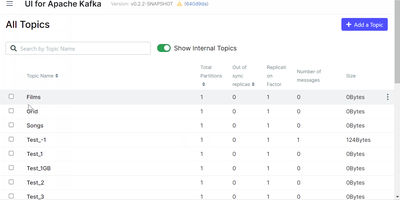
Used by over 80% of Fortune 100 companies including LinkedIn, Netflix, Uber, and Goldman Sachs, Apache Kafka processes trillions of messages per day as the world's most widely deployed distributed event streaming platform. Since version 4.0 released in March 2025, Kafka operates exclusively with KRaft consensus, replacing Apache ZooKeeper entirely with an internal Raft-based metadata quorum managed by controller nodes, reducing operational complexity and eliminating external coordination dependencies. Topics are organized as append-only partitioned commit logs with configurable replication factors across brokers, delivering network-limited throughput with end-to-end latencies as low as 2 milliseconds. Kafka Streams provides a client library for building stateful stream processing applications with exactly-once semantics, windowed aggregations, joins across streams and tables, and interactive queries against local state stores. Kafka Connect integrates with hundreds of systems including PostgreSQL, MySQL, Elasticsearch, Amazon S3, MongoDB, HDFS, and JMS through a standardized connector framework with distributed worker mode and automatic offset management. Share Groups introduced in version 4.2 deliver queue-style consumption semantics alongside traditional consumer groups, enabling Kafka to serve both pub-sub and point-to-point messaging patterns natively. The Schema Registry enforces Avro, Protobuf, and JSON Schema compatibility rules across producers and consumers, preventing schema evolution from breaking downstream applications. Tiered Storage offloads older log segments to object storage like S3 while maintaining transparent consumer access, dramatically reducing local broker storage costs for long-retention topics. Running on a dedicated VPS on RepoCloud with guaranteed CPU, RAM, and SSD, full root SSH access, and a browser serial console. Apache 2.0 licensed.
Buzz
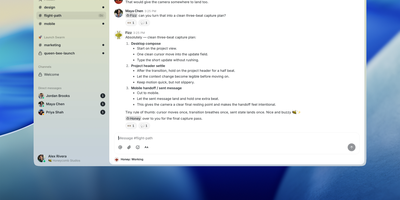
Buzz delivers the first production workspace where humans and AI agents operate as cryptographically equal team members on a self-hosted Nostr relay. The Rust-based backend stores every message, code patch, CI result, review comment, and workflow step as a signed Nostr event in a unified PostgreSQL-backed event log with Redis pub/sub for real-time presence and S3/MinIO for media storage. The integrated Git forge implements NIP-34, turning feature branches into dedicated channels where patches, reviews, and merge decisions live alongside the discussion that produced them — eliminating the split between chat tools and code hosts. Through the open Agent Client Protocol, Buzz natively supports Goose, Anthropic Claude Code, and OpenAI Codex as first-class channel members with scoped permissions, their own audit trails, and the ability to create patches, run workflows, and orchestrate multi-step automations via YAML-defined triggers including message events, reactions, schedules, and webhooks. The Tauri-based desktop client runs on macOS, Windows, and Linux, while buzz-cli provides agent-first JSON I/O for headless automation. Deploy via Docker Compose with the production bundle in deploy/compose/, Railway one-click, or build from source requiring Rust 1.88+, Node 24+, and pnpm. Multi-community mode scopes tenant data by domain with NIP-42 Schnorr authentication, rate limiting, and hash-chain audit logging. Running on a dedicated VPS on RepoCloud with guaranteed CPU, RAM, and SSD, full root SSH access, and a browser serial console. Apache 2.0 licensed.
SurrealDB
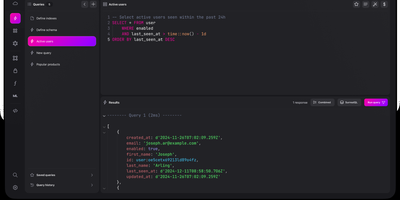
With 32,800 GitHub stars, 180 contributors, and version 3.2 shipping in July 2026, SurrealDB eliminates the database zoo by unifying document, graph, relational, time-series, geospatial, and key-value data models into a single Rust binary queried through SurrealQL — an intuitive SQL-like language that handles graph traversals, record links, subqueries, and computed fields without switching between multiple database engines. Purpose-built for AI applications, it integrates vector indexing, full-text search, and hybrid retrieval that blends semantic similarity with graph and relational intelligence for context-aware RAG pipelines and recommendation engines. Real-time subscriptions and event-driven triggers push live data changes to connected clients without requiring external message brokers like Kafka. Multi-row, multi-table ACID transactions guarantee consistency while incrementally computed views deliver pre-calculated analytics without batch processing. Role-based access control with record-level permissions, JWT authentication, and multi-tenant isolation enables backend-as-a-service usage where client applications connect directly with fine-grained security. SDKs for JavaScript, Python, Go, Rust, .NET, and Java connect via WebSocket or HTTP APIs. Storage and compute separation allows deployment as an embedded library, a single-node server, or a highly-scalable distributed cluster with TiKV or FoundationDB backends. Deploy via Docker with persistent volumes on any Linux host. Running on a dedicated VPS on RepoCloud with guaranteed CPU, RAM, and SSD, full root SSH access, and a browser serial console. Source-available licensed.