ClientSt0r
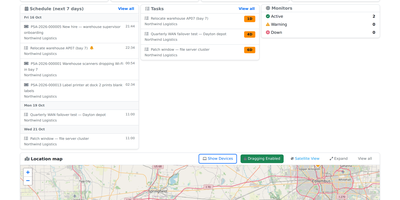
ClientSt0r is a self-hosted operations platform for managed service providers that keeps client documentation, IT assets, credentials, and the service desk in one multi-tenant system running on your own infrastructure. Open any ticket and the client's active contract, the asset it concerns, the runbook that covers it, and the vault entries you are allowed to use appear alongside the conversation, so nobody switches between four products during an outage. Readiness scoring grades every client against what should be documented, explains each gap, and queues the fixes, while versioned documents with owners and review dates keep runbooks from quietly going stale. The credential vault encrypts secrets with AES-256-GCM, isolates them per client, enforces IP, geography, and time-of-day access rules, logs every reveal, generates TOTP codes, checks passwords against known breaches, and imports existing Bitwarden or Vaultwarden libraries. Asset records cover hardware inventory, IP address management, rack layouts, and printable QR labels. The service desk adds queues, SLA timers, dispatch views, time entries, quotes with electronic signatures, invoices, contracts, approvals, a workflow rule builder, a threading email engine, and guided client portal forms, while procurement, profitability reporting, CVE scanning, SSL expiry tracking, and uptime monitoring round out daily operations. Running on a dedicated VPS on RepoCloud with guaranteed CPU, RAM, and SSD, full root SSH access, and a browser serial console. MIT licensed.
TutorLoom
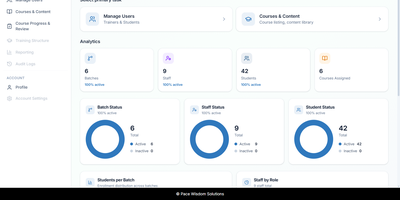
A training institute can run its courses, batches, trainers, and students from a single self-hosted TutorLoom installation it fully controls. One deployment serves many organizations at once, and every query is scoped to the organization, so trainers and learners only ever see their own data. Institute admins manage people and time-boxed batches, inviting trainers and students one by one or in bulk from CSV and Excel files. Courses are built as levels, chapters, and steps mixing videos, documents, tasks, and quizzes, with prerequisites and sequential unlocking so learners follow the path you designed instead of wandering. Students work through a guided step-by-step roadmap on the web or in the mobile app, watching completion fill in as they go and earning points and levels along the way. When learners submit work, trainers review everything in a single grading queue, approving or rejecting with a score and written feedback, then export progress to Excel when management asks for a report. Finishing a course produces a PDF completion certificate automatically. One account can hold several roles at once, so a trainer who also administers an institute switches portals without signing out. Branded email notifications keep learners informed under your own institute's name, and a documented REST API with interactive documentation powers the web app, the mobile app, and your own integrations. Running on a dedicated VPS on RepoCloud with guaranteed CPU, RAM, and SSD, full root SSH access, and a browser serial console. Apache-2.0 licensed.
Owlmail
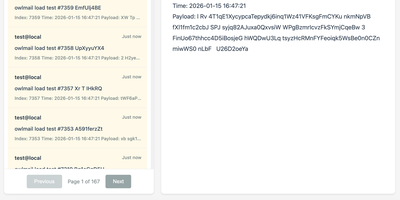
Every email your app sends while you build and test it lands in OwlMail's browser inbox instead of a customer's mailbox. Point any application's SMTP settings at OwlMail and every message is ready to open as rendered HTML, plain text, headers, or raw source. Attachments and inline images sit beside the body, and seven preset preview widths show how the message lays out on phones, tablets, and desktops before anyone real sees it. A Verify panel checks subject, body, and link hosts against expectations, while CI pipelines use the REST API with delivery cursors to wait for exactly the messages their test run produced, assert on them, and clean up afterwards. Coding agents get the same inbox read-only over MCP, so an assistant can confirm a signup email arrived without touching your mail server. When a message proves itself, relay it onwards to a real SMTP server, by hand or automatically under filtering rules, or fire webhooks with HMAC signatures and retry queues into the rest of your automation. Everything stores as plain .eml files on disk, with optional SQLite indexing, S3 attachment storage, and ZIP exports for archiving. Running on a dedicated VPS on RepoCloud with guaranteed CPU, RAM, and SSD, full root SSH access, and a browser serial console. MIT licensed.
Tunnel Panel
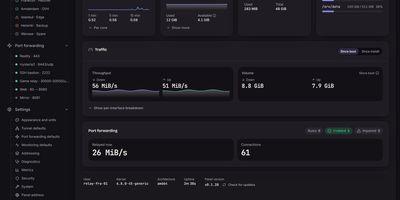
Tunnel Panel manages GRE tunnels and port forwarding on Linux servers from a web panel that previews every change before it runs and verifies the result against the kernel. Create GRE, GRETAP, IP6GRE, and IP6GRETAP tunnels and see the exact commands, unit file, and rollback before anything is applied. The far end configures itself from a pairing code, as text or QR, with the sides flipped automatically so the two ends cannot disagree by a typo. Native ICMP probing with hysteresis keeps a single dropped packet from flapping a tunnel between down and back, and when ICMP is filtered the panel knocks over TCP and says so instead of crying wolf. Forward any TCP or UDP port, or a whole range, with round-robin, source-hash, or weighted balancing across destinations, and a backend that stops answering its health knock leaves the ruleset until it recovers. Watch every connection crossing the relay, who connected, which destination took them, and how much has moved, and set traffic limits per tunnel, rule, or destination. When something breaks, diagnostics reach a verdict with evidence and a suggested fix, backed by a streaming manual probe and a path-MTU search that offers to apply its findings. The panel reads your kernel's relay limits, recommends values from the host's memory and cores, and refuses changes that would lock you out of your own server. Running on a dedicated VPS on RepoCloud with guaranteed CPU, RAM, and SSD, full root SSH access, and a browser serial console. AGPL-3.0 licensed.

Hatchdoor
Hatchdoor gives your Markdown notes two front doors at once: a fast web interface for you, and an MCP endpoint where AI agents read and edit the very same vault. Point it at any folder of Markdown files, an existing Obsidian vault included, and it indexes everything into a disposable SQLite read model that rebuilds itself from your files if deleted. In the browser you browse folders, follow wikilinks that survive renames, explore backlinks and graph views, and search by keyword or meaning across every vault you mount. The live editor shows Markdown syntax only on the line you are editing and saves automatically, while concurrency checks refuse a save when the note changed underneath you. Agents connect with their own token and start read-only; turn writes on and Claude Code, Codex, Cursor, or Hermes can create, edit, move, and link notes through the same checked operations the interface uses. Saved queries in Obsidian's Bases syntax render as live tables, attachments preview inline, and optional git integration commits and pushes every change back to your vault's repository. Running on a dedicated VPS on RepoCloud with guaranteed CPU, RAM, and SSD, full root SSH access, and a browser serial console. AGPL-3.0 licensed.
Wally
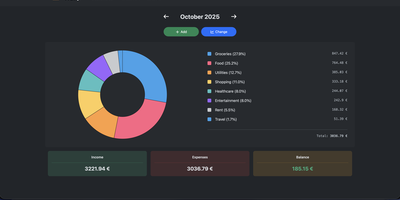
Started as an ExpenseOwl-inspired project, Wally grew into a lightweight, self-hosted expense tracker more capable in every direction its author touched. The backend is Python FastAPI over SQLite, which means every deployment ships a full REST API with interactive documentation at /api/docs - automating imports or wiring in external tools requires no reverse engineering, and when the optional login page is enabled you can mint scoped API keys from the Settings page for token-based integrations. The transactions view is built on AG Grid, bringing real search, column sorting, and per-column filtering to your ledger, with a footer totaling rows, income, and expenses for whatever slice you have filtered. Dashboards go beyond the usual monthly doughnut: a Change button swaps in year-scale line graphs so you can track a single category - restaurants, say - across time. Recurring transactions edit intelligently, letting you apply changes to all instances or only future ones. CSV import and export use a simple six-column format handled from Settings, the refined dark theme is genuinely easy on the eyes, and the interface is translated into more than ten languages. The whole thing runs from one small container with a single data volume.
TradingAgents GUI
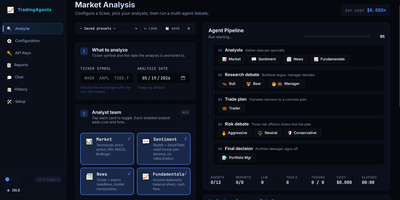
Built atop the TauricResearch TradingAgents framework with nearly 100,000 GitHub stars, TradingAgents GUI transforms a CLI-only multi-agent LLM stock analysis pipeline into a polished web application accessible at localhost:5000. The system deploys twelve specialized AI agents — fundamental analysts, sentiment experts, technical analysts, bull and bear researchers, a trader, risk management team, and portfolio manager — who collaboratively debate market conditions through structured LangGraph workflows before producing a final BUY, SELL, or HOLD recommendation. The interface supports ten LLM providers including OpenAI, Anthropic, Google, OpenRouter, DeepSeek, Ollama, xAI, Qwen, GLM, and MiniMax, with a first-run wizard that auto-detects configured API keys and tests connections. A live pipeline visualization shows each agent's status with real-time progress bars, while the tabbed output area separates Live Feed, Reports preview, and Tool calls into dedicated panes. The three-pane Reports tab provides searchable indexing, table-of-contents navigation, and export to Markdown, HTML, or PDF formats. Report length control across Concise, Standard, and Comprehensive modes saves up to 50% on token costs. Multi-session chat allows pinning past reports as grounding context with live token counting and context-window warnings. Three built-in themes — Terminal, Modern, and Bloomberg — persist per browser. Docker Compose deployment maps port 5000 with persistent report storage. Running on a dedicated VPS on RepoCloud with guaranteed CPU, RAM, and SSD, full root SSH access, and a browser serial console. Apache 2.0 licensed.

Gray Duck Mail
Email discussion lists - the venerable listserv pattern where one address relays to a whole group - without the notorious setup pain of Mailman or Sympa: that is Gray Duck Mail. Its architectural trick is requiring no mail server of your own: the C#/ASP.NET Core app monitors a POP3 inbox at any external email host supporting POP3/SMTP and aliasing, relays each incoming message to all list members via SMTP, and archives it for browsing in the web interface. Replies route back to the entire group automatically. The tedious parts of list management are handled by convention: dedicated aliases process join requests, subscription confirmations, and unsubscribes, while a bounce alias in the return-path catches delivery failures so dead addresses get handled instead of silently rotting. The web administration interface creates and removes lists, manages contacts, browses message archives, and imports or exports the local database for backup. GPLv3-licensed, Docker-distributed, and fully code-documented, it targets exactly the groups email still serves best - neighborhoods, schools, congregations, workplaces, and families - where one message keeping everyone in the loop beats yet another app nobody wants to install.
BlogFactory
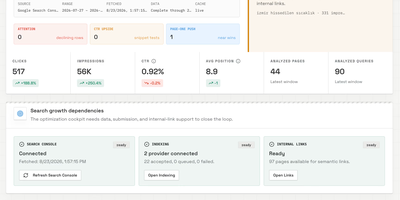
BlogFactory is the first open-source agent control plane purpose-built for multi-site content operations, shipping 16 distinct capabilities across four operational pillars — Operate, Grow, Control, and Deliver — in its v0.1.0 release. The platform keeps source evidence, AI-generated drafts, revisions, SEO metadata, human review, preflight checks, and CMS delivery destinations in one workspace while enforcing a server-side authority ceiling that prevents agents from ever publishing live content, accessing credentials, or performing administrative actions. AI agents connect through a Streamable HTTP MCP endpoint with OAuth authentication and site-scoped tool discovery, compatible with Codex, ChatGPT, and any MCP-capable client. Content creation supports single articles from keywords, titles, URLs, PDFs, text, or YouTube sources, batch campaigns, and programmatic content via reusable templates with structured data rows. The Search Growth module connects Google Search Console complete-day data to ranked optimization opportunities, 30-day growth plans, content classification by signal type (growing, low-CTR, almost-ranking, page-two, zero-click), indexing checks, and semantic internal-link suggestions. Brand Voice separates global voice rules, writer profiles, knowledge context, and brand guidelines from article mechanics. Approved drafts are delivered as CMS drafts to WordPress, Ghost, Wix, or Framer through idempotent, optimistic-locking-protected handoffs with explicit destination selection and preflight validation. The stack runs on React/Vite, a Hono/TypeScript API, PostgreSQL, and MinIO via Docker Compose, with providers including OpenRouter, OpenAI, and Google services under a bring-your-own-AI model. Running on a dedicated VPS on RepoCloud with guaranteed CPU, RAM, and SSD, full root SSH access, and a browser serial console. AGPL-3.0 licensed.
Githome
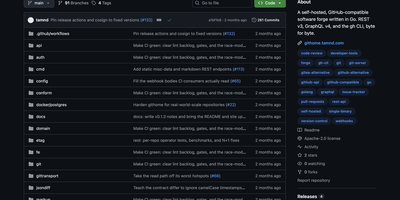
Point the gh CLI at your private Githome server and it works identically to github.com, because every REST v3 and GraphQL v4 endpoint returns byte-for-byte compatible JSON shapes, headers, Link pagination, and ETag caching. A single compiled Go binary serves the REST API under /api/v3, GraphQL under /api/graphql, git smart-HTTP transport, and a server-rendered web UI implementing the GitHub Primer design system with full functionality when JavaScript is disabled. The web interface provides repository browsing with Markdown rendering and syntax highlighting, issue tracking, pull requests with unified diffs and inline code review threads, full-text search, user profiles, and a notifications inbox. Authentication supports personal access tokens with prefix-based identification, OAuth device and web flows, and scoped permissions on every response header with only token hashes stored. The pull request system implements the complete lifecycle including async mergeable state computation, squash, merge, and rebase strategies, commit statuses, check runs, and statusCheckRollup fields. Webhooks deliver events with X-Hub-Signature-256 verification, SSRF protection, and at-least-once retry semantics. Storage supports SQLite for single-node deployments or PostgreSQL for production configurations. Performance optimizations include batch loaders replacing N+1 queries, keyset pagination, FTS-backed search, and GraphQL dataloaders. Docker deployment pulls the official multi-arch container image from GitHub Container Registry. Running on a dedicated VPS on RepoCloud with guaranteed CPU, RAM, and SSD, full root SSH access, and a browser serial console. Apache-2.0 licensed.