Cooktrace
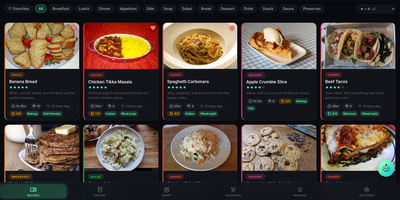
Every home cook keeps a graveyard of recipes scattered across bookmarks, screenshots, chat threads, and one stained index card, and CookTrace gathers the whole mess into one self-hosted library that knows what is in your pantry. Import recipes from URLs, files, or photos, or bring entire Mealie, Paprika, and Tandoor archives in bulk, then cook with live scaling that does fraction-aware ingredient math, per-step photos, and an inline unit converter. A pantry-match pill on every recipe card tells you at a glance what you can actually cook tonight, while barcode scanning and expiration digests keep stock honest. The cook diary and meal planner move from list to month calendar with drag-to-re-plan, and the shopping list generates itself from planned recipes, skipping items you already own and grouping the rest by aisle. Households organize into cookbooks and shared Kitchens with public links, and an optional conversational assistant can log a cook, plan a meal, or import a recipe for you. An opt-in MCP server even exposes your recipes and lists to external AI agents under token-scoped tool tiers. Running on a dedicated VPS on RepoCloud with guaranteed CPU, RAM, and SSD, full root SSH access, and a browser serial console. AGPL-3.0 licensed.
RushDB
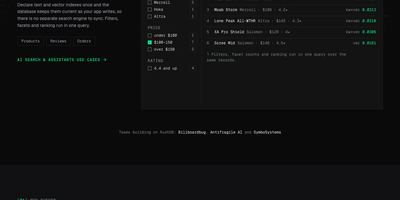
RushDB is a database your AI agents can actually understand, because it remembers the shape of everything you write. Send nested JSON and each object becomes a record, automatically linked to its parent, while field names, types, and values are cataloged on every write. Agents introspect that catalog before querying, so they ask questions the data can answer instead of hallucinating tables that never existed. The same records answer five query styles: a JSON query language, SQL over the PostgreSQL wire protocol, Cypher over HTTP or Bolt, Gremlin, and Mongo-style document queries. Vector, full-text, and hybrid search run against the same store, so an agent can find the record that mentions a phrase and the records merely similar to it. Everything ships as one binary with one data directory, speaking HTTP on port 3000, PostgreSQL on 5432, and Bolt on 7687 to the drivers and tools you already use. Point your SDKs, SQL clients, BI tools, or local MCP-connected agents at it, and back it up, replicate it, or restore to a point in time with the engine's own tooling. Running on a dedicated VPS on RepoCloud with guaranteed CPU, RAM, and SSD, full root SSH access, and a browser serial console. Apache-2.0 licensed.

Nowen Video
Nowen Video turns the hard drive of films and series sitting on your NAS into a streaming service your family actually wants to open, posters, seasons, and all. Point it at your media folders and it scans the usual formats, reads streams with FFprobe, and scrapes rich metadata from TMDb, Douban, TheTVDB, Bangumi, and Fanart.tv, recognizing movie, season, and episode naming as it goes. NFO files and external subtitles are honored, filesystem watching keeps the library current, and collections plus episode navigation make a big archive feel curated rather than dumped. Pressing play is where the engineering shows: a server-side planner decides per client whether to direct play, remux, or transcode to HLS on demand, with automatic fallback when the first choice fails. Hardware acceleration through the GPU keeps transcoding cheap, subtitle and speed controls ride along in the player, and a local analysis pass can surface highlight clips from your own footage. Every family member gets favorites, watch history, and continue-watching progress under their own account, while library permissions decide who sees what. An Emby-compatible API even lets clients like Infuse connect as if it were an Emby server. Running on a dedicated VPS on RepoCloud with guaranteed CPU, RAM, and SSD, full root SSH access, and a browser serial console. GPL-3.0 licensed.
Garage UI
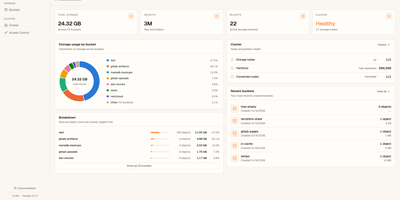
Garage UI is the web dashboard that Garage object storage never shipped, turning an admin API that speaks JSON over HTTP into screens your whole team can use. Create and configure buckets, browse objects with drag-and-drop uploads, and preview images, video, PDFs, and text inline instead of downloading files just to check what they are. A recursive search finds objects across a whole bucket, and bucket settings carry size and object-count quotas so one tenant cannot quietly eat the cluster. Access keys are created in the UI and assigned per-bucket permissions, replacing error-prone command-line key surgery. The cluster overview watches node status, layout configuration, and storage usage, so a degrading node shows up in the dashboard before it shows up as an outage. Sign-in flexes to your setup: no auth on a trusted network, basic admin credentials, the Garage admin token, or OIDC single sign-on through providers like Keycloak and Authentik. With OIDC teams enabled, access control maps token claims to bucket prefixes with named permission presets, and unmatched users are denied by default rather than promoted. Zero-config startup reads your existing garage.toml, so the first login takes minutes. Running on a dedicated VPS on RepoCloud with guaranteed CPU, RAM, and SSD, full root SSH access, and a browser serial console. MIT licensed.
HotHost
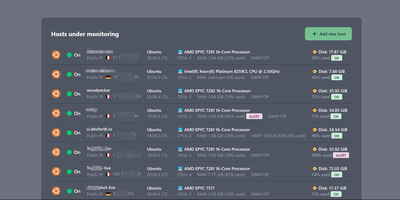
HotHost answers the only two questions that matter about every server you own, is it up and is the disk about to fill, before your users ask them instead. One web container collects metrics from a tiny agent you paste onto each host as a Docker or shell snippet, and the fleet lands in a single table: hostname, public IP, RAM and disk usage, CPU model and cores, swap state, and country. Disk and RAM get loud ALERT badges at a configurable threshold, ninety percent by default, and notifications fire on failure and again on recovery, so a resolved incident closes its own loop. The same console watches your websites directly, requesting each URL on your interval and checking the status code, a required keyword in the response, or basic auth behavior. SSL certificates get an expiration reminder fourteen days out by default, long before the browser warnings start. When memory climbs, the top ten RAM-consuming processes are charted over the last two days, turning "something is eating the box" into a named culprit. Alerts route through Email, Slack, Telegram, or Gmail plugins, and the plugin system accepts your own notifiers. Running on a dedicated VPS on RepoCloud with guaranteed CPU, RAM, and SSD, full root SSH access, and a browser serial console. MIT licensed.
Fail2Ban Report
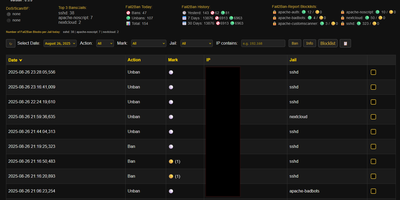
Fail2Ban quietly bans thousands of bots on a typical VPS and just as quietly keeps the whole story buried in a log file nobody reads, and Fail2Ban Report digs that story out into a dashboard you will actually open. Shell scripts convert each day of fail2ban.log into JSON, and the web interface lays every ban and unban on a searchable, filterable timeline you can slice by jail, server, or time window. Aggregated statistics for today, yesterday, seven days, and thirty days show which jails absorb the most attacks, while markers flag repeat offenders and escalating ban counts so persistent scanners stand out from one-time noise. Blocklists live per jail and per server as plain JSON, and ban or unban actions execute through UFW, giving you permanent bans that survive independently of jail restarts. Bulk actions handle whole ranges at once, with a pending state until the next sync applies them. Multiple servers feed one console through a pull-based HTTPS endpoint, so a fleet of small machines reports to a single pane without exposing SSH. Optional AbuseIPDB and IP-Info lookups add reputation and region context to any address. Running on a dedicated VPS on RepoCloud with guaranteed CPU, RAM, and SSD, full root SSH access, and a browser serial console. GPL-3.0 licensed.
CortenDesk
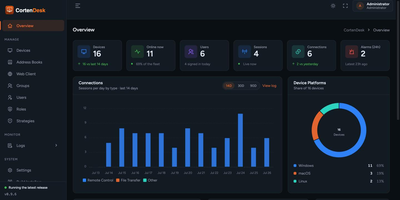
Point your RustDesk clients at CortenDesk and the bare open-source server turns into a managed fleet console with a real address book, real access control, and a remote client that lives in the browser. One container runs the ID server, the relay, and the console together, and existing key pairs and device IDs move in unchanged, so migration is a hostname change rather than a rebuild. The fleet view shows live presence, platform, aliases, owners, and last-seen for every machine, organized into folders that double as the unit of access control. People see only their own devices plus the groups granted to them, and the same scoping is enforced in the RustDesk client API, not just the web pages. Policies push client settings over the heartbeat, covering permissions, password rules, and capture behavior, and enforced policies revert local changes automatically. Five audit logs record connections, file transfers, sign-ins, security alarms, and console actions, all filterable and exportable to CSV. When a browser is all you have, the built-in web client views and controls machines with file transfer, clipboard, audio, and multi-monitor switching, no installer required. Running on a dedicated VPS on RepoCloud with guaranteed CPU, RAM, and SSD, full root SSH access, and a browser serial console. AGPL-3.0 licensed.

GroupOffice
GroupOffice checks your whole company in at one address: mail, meetings, projects, invoices, and files behind a single login on your own server. The built-in mail client saves messages straight onto projects or contacts, signs and encrypts with S/MIME, and shares folders and accounts across the team. Shared calendars offer team views, bookable resources, and video meetings, while address books carry custom fields and comments so customer knowledge survives staff changes. Projects gather their tasks, files, and discussions in one place, track hours as work happens, and turn those hours and costs into invoices and reports. Support tickets arrive from your website or by email and stay organized by team, and newsletters compose campaigns from templates filled with your own data. Files co-edit in the browser through OnlyOffice or Collabora, connect to desktops over WebDAV, and sync to native phone and computer apps over open protocols. Two-factor authentication, encryption, and a module system you can extend with your own tools keep the office private and shaped to how you actually work. Running on a dedicated VPS on RepoCloud with guaranteed CPU, RAM, and SSD, full root SSH access, and a browser serial console. AGPL-3.0 licensed.
Storyden
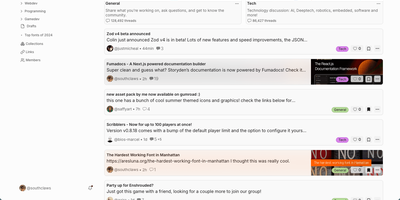
Think of Storyden as running your own small Reddit, except the knowledge your community produces does not scroll away and die in the feed. Discussion happens in threaded forums organized by categories and tags, where posts collect replies, likes, emoji reactions, and saves into personal collections. Beside the chatter sits the Library, a tree of rich pages your members build together into wikis, directories, catalogs, and guides that stay findable. Library pages carry typed properties, attached files, and table views, so a car club can track vehicles as data instead of arguing over a spreadsheet. Threads can reference Library pages and pages can link back to threads, letting a great answer graduate into permanent knowledge. Optional AI assistance helps organize titles, tags, and summaries, while the recommendation engine surfaces posts each member is likely to care about. The first account registered becomes admin, roles and permissions govern who can post or moderate, and community settings live in the admin panel rather than config files. One container starts everything with an embedded database and local file storage, and OpenAPI documentation is served from the same address. Running on a dedicated VPS on RepoCloud with guaranteed CPU, RAM, and SSD, full root SSH access, and a browser serial console. MPL-2.0 licensed.
Marble
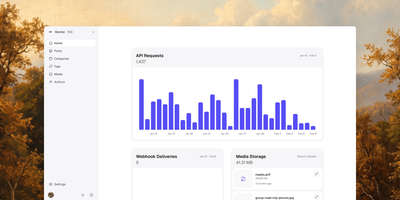
Marble gives your blog, changelog, or product updates a calm editorial home, then hands clean JSON to whatever website you already built. Writers work in a focused rich-text editor with headings, lists, code blocks, images, video, and embeds, while a readability score quietly grades each draft as it grows. Every post carries authors, one category, tags, a cover image, and typed custom fields, so a changelog entry and a long guide can share one predictable structure. Your frontend pulls sanitized HTML or Markdown through the REST API or typed SDK, filtering by category, tag, or search in a single request. Read-only public keys serve published posts safely, while scoped private keys unlock drafts and write access for the tools you trust. Uploads of images, video, audio, and documents land in a media library with alt text and dimensions, ready to embed anywhere. Signed webhooks announce every change to your site, Slack, or Discord with retries and a delivery log, and an MCP server lets AI agents search and draft content too. Running on a dedicated VPS on RepoCloud with guaranteed CPU, RAM, and SSD, full root SSH access, and a browser serial console. AGPL-3.0 licensed.
VyManager
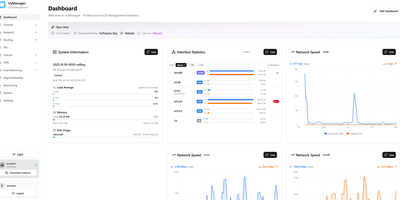
VyManager puts every VyOS router you run, across every site, into one web control plane with live dashboards and per-site permissions. Organize instances into logical sites, from the datacenter core to the smallest branch office, and add or remove routers without touching a command line. Live dashboards stream interface counters, system information, network graphs, and WireGuard peer status, so a saturated link announces itself before your users do. Configuration adapts to each router's VyOS version, with 1.4, 1.5, and rolling releases supported side by side during the longest upgrade cycle. Access is granted per site with OWNER, ADMIN, and VIEWER roles, API keys authenticate the machines, and SSH credentials stay encrypted at rest. A setup wizard walks a fresh deployment to its first managed router, and light, dark, and custom themes keep the night shift comfortable. For automation, AI assistants can be connected through the companion MCP integration, and the whole stack arrives as Docker Compose services you can redeploy in minutes. Running on a dedicated VPS on RepoCloud with guaranteed CPU, RAM, and SSD, full root SSH access, and a browser serial console. GPL-3.0 licensed.
SourceWeft
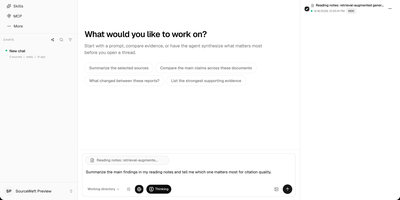
SourceWeft is an AI workstation you host yourself, where agents, your documents, and your model keys work in one place instead of scattering across chat tabs you do not control. Describe a job and a lead agent breaks it down, handing research, exploration, and execution to focused sub-agents that share the same working context and files. Agents draw on a skill library covering presentations, HTML pages, images, meeting summaries, and study guides, and you can add your own skills so good workflows become repeatable. MCP servers, web search, and web extraction connect agents to outside tools, while approved commands run inside a sandboxed environment that cannot touch the rest of your server. Feed it PDFs, web pages, notes, YouTube videos, Notion, Drive, Gmail, or Slack, then follow citations from any answer back to the source material it came from. Bring your own keys for the chat and indexing models you prefer, organize the team into workspaces with roles and access controls, and pick up any conversation from the web app or desktop clients. Running on a dedicated VPS on RepoCloud with guaranteed CPU, RAM, and SSD, full root SSH access, and a browser serial console. Apache-2.0 licensed.
LaraOwl
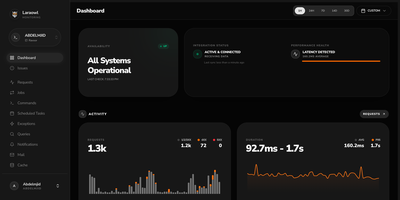
LaraOwl watches your Laravel applications from your own server, streaming every request, exception, slow query, and attack attempt into one live dashboard. Install one Composer package in each app, point it at your LaraOwl server, and requests arrive with method, path, status, duration, and middleware timing attached. Exceptions group themselves by fingerprint with stack traces, occurrence counts, and first and last seen times, so a resolved bug that comes back announces itself. Slow queries and N+1 patterns are flagged with execution times, jobs report failures and retries, and scheduled tasks check in like heartbeats that complain when they stop. A built-in security lens scores threats such as SQL injection, cross-site scripting, and path traversal, tracks hostile IPs, and can push a block into your Cloudflare firewall in one click. Uptime checks run every thirty seconds, alerts fan out to Slack, Discord, Telegram, email, or any webhook, and throttles keep a bad night from becoming a thousand messages. Teams organize multiple projects with their own tokens, thresholds, and retention policies, and daily pruning keeps last quarter's noise from filling the disk. Running on a dedicated VPS on RepoCloud with guaranteed CPU, RAM, and SSD, full root SSH access, and a browser serial console. Apache-2.0 licensed.
Noisedash
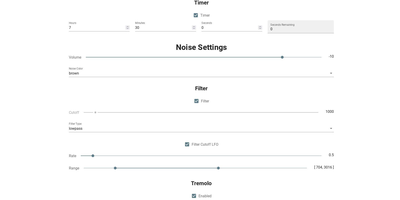
Noisedash is a self-hosted soundscape studio that generates the ambient noise you wish your surroundings made, from steady fan hums to layered rainstorms, and plays it in any browser. Start from white, pink, or brown noise and shape it with filters, LFOs, and effects until the hum in your head goes quiet. Upload your own recordings of rain, wind, thunder, or a café at noon, set loop points and fade-ins, and drop them into the mix as a continuous bed or an occasional sprinkle. Add reverb to a sample, let a thunderclap wander in every few minutes instead of looping, and balance every layer until the room feels right. Save the result as a noise profile, keep one for sleeping and another for deep work, and switch between them with a tap. Profiles travel: export one to share with a friend, import theirs, or record the generated audio to take the soundscape somewhere else entirely. An instance can host the whole household, with admin tools managing users, and the interface works as happily on a phone beside the bed as on a desktop. Running on a dedicated VPS on RepoCloud with guaranteed CPU, RAM, and SSD, full root SSH access, and a browser serial console. AGPL-3.0 licensed.
MyCompany
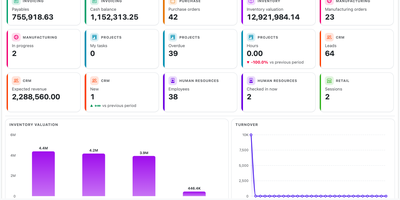
MyCompany runs the whole back office of a small business, sales, stock, production, invoices, projects, payroll, and the shop till, as one application sharing one database. A lead arrives and moves across a kanban board with calls and emails logged on its card, then becomes a sales order and an invoice without retyping a single field. Purchasing raises supplier orders, receives goods into the right warehouse, and watches stock move between locations with full movement history, reservations, lots, and serial numbers. Manufacturing plans production orders from bills of materials with operations and work centers, tracking the materials actually consumed and what each finished batch cost. Projects track tasks and time with supervisor timesheets, HR keeps employee records, hourly rates, and payslips, and the retail point of sale handles barcodes, payments, register sessions, and discounts. Because every module reads and writes the same records, the invoice knows what the warehouse shipped and the project knows what the customer was billed. When your business outgrows a standard screen, customizations live in separate extension modules, so vendor updates never collide with the workflows you adapted. Running on a dedicated VPS on RepoCloud with guaranteed CPU, RAM, and SSD, full root SSH access, and a browser serial console. Apache-2.0 licensed.

Lunarr
Lunarr turns the movie and TV folders you already store into a private streaming service with posters, progress tracking, and play-anywhere convenience. Point it at local disks or at libraries living on SFTP and WebDAV servers, and it scans, identifies, and decorates everything with TMDb artwork, cast pages, similar titles, and because-you-watched recommendations. Press play and the file either streams directly or is transcoded on the fly into seekable HLS, generating only the segments around the moment you are watching instead of converting whole films up front. Continue watching follows you between sessions, sidecar subtitles are picked up automatically, and known intros and credits can be skipped. Send the picture to the big screen with Chromecast or AirPlay, pair new devices without typing passwords, and hand a guest a share link instead of your account. Underneath, an admin console manages users, roles, and which libraries each person may see, watches background jobs, and holds API keys and registration settings. Rescans run on schedules you set from minutes to a month, local folders can be watched live for new arrivals, and metadata refreshes itself on a timer. Running on a dedicated VPS on RepoCloud with guaranteed CPU, RAM, and SSD, full root SSH access, and a browser serial console. Apache-2.0 licensed.
Shelfarr
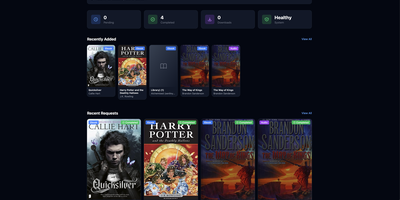
Shelfarr is the request button your book library was missing: anyone in your household can search millions of ebooks and audiobooks, request the format they want, and let automation fetch and shelve it. Discovery searches Open Library, Hardcover, and Google Books with covers, series, editions, and narrator details, so picking between the ebook and the audiobook takes a glance. Hardcover shelves and public reading lists can be previewed and requested, and following an author means their next release surfaces without a manual search. Requests wait for an admin's approval or move straight to searching, where your indexers are queried and every result is scored against your preferred formats, bitrate, and language. The winning release goes to the download client you route it to; finished files are renamed with your templates and delivered into your library's watched folders, which are told to rescan. Nothing found is not the end: searches retry with back-off and flag the request for attention instead of losing it. Family members get their own accounts with roles, two-factor authentication or single sign-on, notifications in the app or on Discord and Telegram, and admins keep manual uploads, API tokens, and download routing under their control. Running on a dedicated VPS on RepoCloud with guaranteed CPU, RAM, and SSD, full root SSH access, and a browser serial console. GPL-3.0 licensed.
Vocero CRM
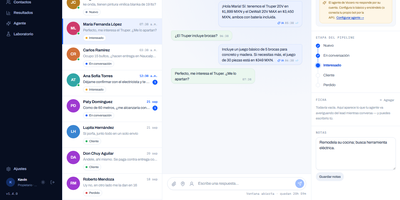
Vocero CRM turns WhatsApp into your sales floor, with a shared team inbox, a visual pipeline, and an AI agent that answers customers using only what your business taught it. Incoming messages land in a three-column inbox within two seconds, showing sent, delivered, and read states, enforcing the official 24-hour window, and offering approved templates when it closes. Every person who writes becomes a contact automatically and enters a Kanban pipeline you can rename, where dragging a card, adding notes, or archiving a lead takes seconds. The AI agent learns from question-and-answer pairs and free-text knowledge blocks, and answers only from what it knows. It bundles message bursts into one reply and hands the conversation to a human whenever the customer asks or the rules say so. Before the agent ever meets a real customer, the Laboratory sends six simulated customers at it, from the decided buyer to the angry one, and an independent judge scores each conversation from 0 to 100 with findings and one-click fixes you can re-test after every change. Owners create team accounts, message templates sync their approval status from Meta, and WhatsApp tokens sit encrypted at rest while every customer record stays on hardware you own. Running on a dedicated VPS on RepoCloud with guaranteed CPU, RAM, and SSD, full root SSH access, and a browser serial console. MIT licensed.