PsiTransfer
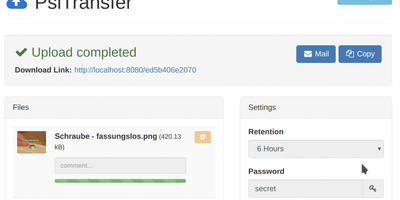
Upload files, get a share link, let it expire: PsiTransfer is a self-hosted WeTransfer with no accounts, no logins, and no third-party cloud with size caps and metadata harvesting. The engineering focus is large files over imperfect networks. Uploads use the tus.io resumable protocol, so a dropped connection on a multi-gigabyte video resumes exactly where it stopped once you're back online; downloads support HTTP range headers for the same resilience, and everything streams, so file size is bounded by your disk rather than memory. Files organize into upload buckets with retention you control: expire after a set time (up to weeks) or after a one-time download, with automatic cleanup when links lapse. Recipients need nothing installed - they open the link, preview files in modal views, and grab everything as a zip or tar.gz archive with one click. Buckets can be password-protected (AES-encrypted download lists), and security-through-obscurity is done properly: bucket URLs use hashed UUID tokens and stored filenames are replaced with UUIDs. An optional admin page (enabled by setting an admin password) lists bucket information and storage. The Vue.js frontend ships under 100 KB gzipped and is fully responsive. Honest caveat from the author: no end-to-end payload encryption yet. BSD-licensed, Docker-ready.
TRIP
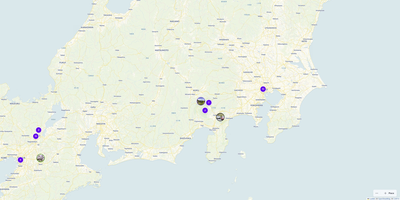
Plan multi-day expeditions, map custom waypoints, and coordinate shared group travel itineraries with TRIP, a private self-hosted journey management platform free from commercial tracking. Travelers can drop custom pins across global topographic or satellite maps, tagging locations with categories, visit durations, cost estimates, accessibility notes, and pet-friendly attributes. The visual trip builder organizes individual stops into ordered daily schedules, helping you calculate travel intervals and rearrange destination sequences using intuitive drag-and-drop tools. You can attach reference photos, booking confirmations, external links, and packing checklists directly to each itinerary milestone. Shared workspace controls enable travel companions to collaborate on upcoming road trips, leave comments on specific attractions, and coordinate shared responsibilities in real time. Dynamic filtering lets you isolate culinary destinations, outdoor hikes, or cultural landmarks by budget and travel style. Offline caching ensures your navigational routes and saved coordinates remain accessible in remote backcountry areas with spotty cellular coverage. Running on a dedicated VPS on RepoCloud with guaranteed CPU, RAM, and SSD, full root SSH access, and a browser serial console. MIT licensed.
BeaverHabits
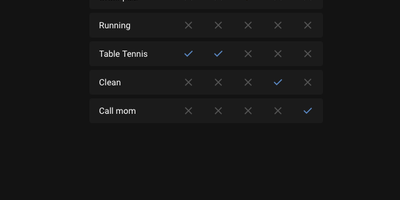
No targets, no gamification spiral, no motivational nagging: Beaver Habit Tracker is a self-hosted habit tracker deliberately built without "Goals". The core loop is honest: add habits, check them off each day, watch streaks accumulate on a calendar view. Its design follows behavioral-science basics - make it obvious (visual streak cues), make it attractive (progress is the motivator), make it satisfying (tracking becomes its own reward). Beyond the daily checklist it supports per-day notes intelligently grouped per habit, periodic habits, habit categories and tags, drag-to-reorder (manual or automatic), dark mode, and detailed streak and frequency views. Data lives where you choose: a single SQLite database or flat JSON files on a mounted volume, with JSON export and import for full portability. A REST API opens automation - community integrations already cover Stream Deck buttons, Home Assistant triggers, and CalDAV. The Python app ships as one Docker container with no external dependencies; environment variables tune everything from first day of week and index-page columns to iOS standalone PWA mode, and single-user setups can bypass the login entirely with TRUSTED_LOCAL_EMAIL. BSD-3-Clause licensed with no commercial restrictions - a well-executed single-purpose tool whose mobile PWA works anywhere a browser does.
Sirius Scan
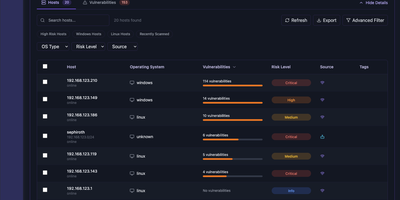
Point Sirius Scan at a network range and it finds live hosts, fingerprints their services, and lists every matching CVE with its CVSS score in a live web dashboard. The Vulnerability Navigator groups findings by severity, filters on CVSS, and exports results for remediation tracking. Scans run on Nmap with NSE scripts kept in sync with upstream, alongside Naabu port scanning. Lightweight remote agents connect back over gRPC from other networks, so segments the central scanner cannot reach still get assessed, and the same agents can run YAML detection templates locally in CLI mode with no server connection at all. An operator console runs PowerShell commands against connected agents and keeps command history beside the scan results. Real-time progress, severity trend charts, host detail pages, and an environment overview show what changed between scans. A REST API on port 9001 with API key authentication feeds results into existing security workflows, while service health monitoring and centralized logging confirm the platform itself is behaving. An installer generates fresh secrets and an initial admin password, and production overlays tighten the deployment further. Running on a dedicated VPS on RepoCloud with guaranteed CPU, RAM, and SSD, full root SSH access, and a browser serial console. MIT licensed.
Friendica
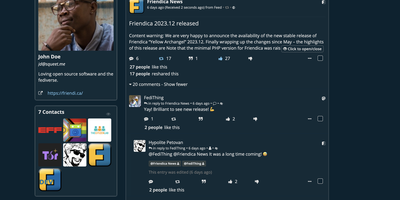
Friendica connects to more federation protocols than any other single platform: ActivityPub reaches Mastodon, Pleroma, Misskey, Lemmy, Pixelfed, and PeerTube; the Diaspora protocol bridges that network; and OStatus provides legacy compatibility. But protocol reach is just the foundation. Where most fediverse platforms stop at microblogging, Friendica offers long-form posts, photo albums, event calendars with RSVP, group discussions, and rich multimedia content. BlueSky and Tumblr connectors extend your reach into non-federated networks, while RSS import pulls content from any blog or news source into your timeline. Privacy controls let you scope each post to specific contacts, groups, or public visibility with per-post granularity rather than account-wide settings. Multiple themes customize the interface from Facebook-like layouts to minimal designs, and Fedilab provides native mobile access. Under the hood, the PHP application with MariaDB runs as either an Apache or FPM Docker image with Redis caching and background cron workers handling federation delivery, media processing, and notification dispatch. One of the oldest fediverse projects (1,650+ stars, 160+ contributors since 2010), Friendica has weathered every protocol evolution and platform migration the decentralized web has thrown at it, making it one of the most battle-tested social networking platforms available.
GZCTF
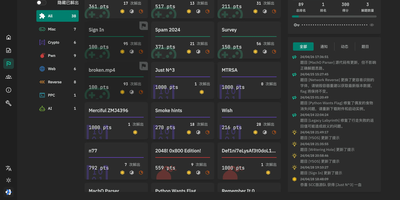
When cybersecurity instructors and competition organizers host Capture The Flag tournaments, GZCTF orchestrates isolated per-team challenge containers, dynamic anti-cheat flags, and live exponential scoreboards from a single web platform. Event administrators can configure four distinct challenge modes covering static attachments, team-specific dynamic attachments, shared static containers, and isolated dynamic containers where unique flags are injected into each team's environment at launch. A customizable exponential scoring engine adjusts point values automatically as more teams solve a problem while awarding first, second, and third blood bonuses to top contenders. Built-in flag-sharing detection monitors every submission in real time, flagging suspicious cross-team flag reuse alongside live event streams and container logs. Participants can group into divisions, track their ranking trajectory on interactive score timelines, and upload post-game writeups directly into the portal for organizer review and batch archiving. Built-in network proxying forwards challenge traffic over WebSocket tunnels with optional packet capture so referees can audit exploit payloads during active matches. Multi-language localization, customizable branding, invitation gates, and email domain restrictions adapt the portal to university courses, corporate security drills, or international tournaments. Running on a dedicated VPS on RepoCloud with guaranteed CPU, RAM, and SSD, full root SSH access, and a browser serial console. AGPL-3.0 licensed.
Kima
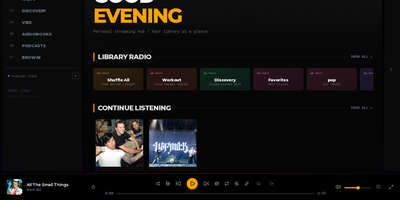
Streaming personal music collections with neural discovery and intelligent playlist curation is what Kima accomplishes as a modern self-hosted audio server that replaces Spotify and Apple Music. Listeners organize their FLAC, MP3, and AAC audio files into responsive grid layouts that scale up to eight columns on ultra-wide displays while automatically fetching album covers, artist biographies, and synchronized line-by-line lyrics. The built-in Vibe System utilizes CLAP neural network audio embeddings to map an entire music collection across two-dimensional clusters and three-dimensional interactive galaxy views, enabling users to explore acoustic relationships or queue smooth sonic paths between distant tracks. Music fans can import playlists directly from Spotify, Deezer, and YouTube using deterministic ISRC matching, while automated Made For You mixes generate era-specific playlists, workout stations, and discovery queues based on individual listening habits. Integrated podcast search pulls subscriptions from iTunes with automatic episode tracking across devices, while native Audiobookshelf connectors synchronize spoken-word chapter positions and playback progress directly into the unified web player. OpenSubsonic API endpoints allow mobile users to stream libraries through native clients like Symfonium and DSub using scoped authentication tokens, while administrators manage multi-user accounts with time-based two-factor authentication. Running on a dedicated VPS on RepoCloud with guaranteed CPU, RAM, and SSD, full root SSH access, and a browser serial console. GPL-3.0 licensed.
Shaper
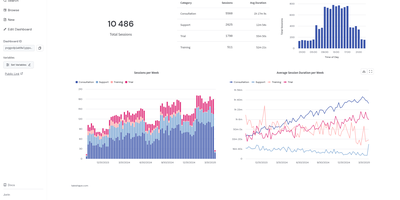
Write standard SQL queries and watch Shaper turn them into interactive dashboards, scheduled reports, and customer-facing analytics widgets without maintaining a heavy business intelligence stack. Every query maps directly to a visual component through simple type casts like BARCHART, LINECHART, GAUGE, BOXPLOT, or DROPDOWN. Analysts can attach external PostgreSQL and MySQL databases, read Parquet, CSV, JSON, and Excel files straight from S3 object storage, or stream live events into the HTTP ingest API. Interactive filter controls let viewers slice metrics by date ranges, multi-select dropdowns, and dynamic parameter variables that automatically re-evaluate downstream charts. Teams version-control their entire reporting layer as plain SQL files in Git, making dashboard updates auditable in pull requests and simple for AI coding assistants to generate. Product engineers embed white-labeled analytics directly into customer web apps without iframes, issuing per-tenant JWT tokens to enforce row-level data isolation. Need scheduled deliverables for stakeholders? Configure SQL-driven background tasks that transform datasets on a cron schedule, send threshold alerts to Slack or Microsoft Teams, and generate downloadable PDF, PNG, Excel, or CSV reports. External collaborators can also view live metrics through password-protected sharing links. Running on a dedicated VPS on RepoCloud with guaranteed CPU, RAM, and SSD, full root SSH access, and a browser serial console. MPL-2.0 licensed.
Z-Wave JS UI
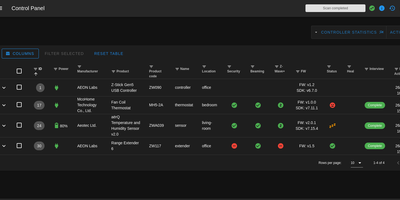
Managing dozens of smart locks, dimmers, thermostats, and sensors across a Z-Wave mesh often leaves homeowners blind to routing hops, sleepy battery devices, and firmware bugs; Z-Wave JS UI solves this by delivering a comprehensive browser control panel and MQTT gateway for your USB or network Z-Wave controller. Provision new devices with SmartStart QR scanning or S2 authenticated inclusion, inspect every Command Class parameter, and push over-the-air manufacturer firmware updates straight to switches and sensors. Interactive network topology graphs map live routing neighbors, link quality, and background RSSI signal strength, while built-in health checks and an integrated Zniffer packet analyzer pinpoint RF interference before automations fail. Operators can configure direct node-to-node association groups and multicast broadcast groups so wall switches trigger lights even when the central hub is offline. Scheduled Non-Volatile Memory controller backups and pre-inclusion restore points protect your mesh against hardware failure, and the configurable MQTT Discovery and WebSocket server bridges every entity seamlessly into Home Assistant, OpenHAB, Domoticz, Jeedom, and ioBroker. Running on a dedicated VPS on RepoCloud with guaranteed CPU, RAM, and SSD, full root SSH access, and a browser serial console. MIT licensed.
Gerrit Code Review
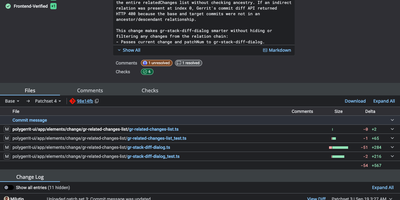
Unlike pull-request forges, Gerrit reviews every Git change as a series of patchsets, and nothing merges until the required approvals are in. Developers upload with a plain git push to a refs/for ref, adding push options for topics, hashtags, work-in-progress, or private changes. Each change gets a page listing reviewers, CCs, an attention set that flags who must act next, and submit requirements driven by labels such as Code-Review and Verified, with a quick approve button for the last missing vote. Side-by-side diffs with syntax highlighting take inline comments written in Markdown, saved as drafts and published together. A Checks tab shows CI runs reported by plugins, and integrations reach Jenkins, GitHub Actions, Zuul, and webhooks. Access rights attach to groups and branch patterns, including regular expressions, and inherit from parent projects and All-Projects. Sign-in works with LDAP, OAuth, OpenID, or HTTP single sign-on, and SAML through a plugin. A query language filters changes by status, owner, reviewer, label, file path, and reviewer count. Projects pick a submit strategy: merge if necessary, fast forward only, rebase if necessary, rebase always, merge always, or cherry pick. A REST API, SSH commands, and a plugin system extend the server, and an optional Review Agent chat panel can summarize a change once an AI provider plugin is installed. Running on a dedicated VPS on RepoCloud with guaranteed CPU, RAM, and SSD, full root SSH access, and a browser serial console. Apache-2.0 licensed.
Vvveb
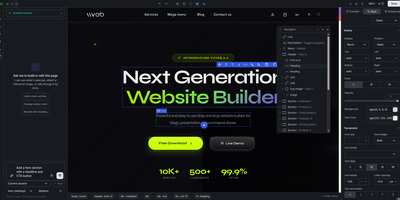
Vvveb, an open-source CMS with a drag-and-drop page builder and a built-in store, runs a blog, a portfolio, and a webshop from one dashboard, with every page edited visually on a true WYSIWYG canvas. Reusable blocks, page revisions, a code editor, and an optional AI assistant plugin sit alongside media management, custom fields, custom posts, and custom products that shape content well beyond plain pages. The store handles one-page checkout, subscriptions, digital downloads, vouchers, coupons, product options, attributes, variants, reviews, and Q&A across multiple payment methods and currencies. Content can be published in several languages, the admin interface switches with language packs, many sites or subdomains share one installation, and action-level permissions are assigned to each user role. A bundled SEO plugin generates sitemaps, robots.txt, Open Graph tags, hreflang links, and schema markup, and hybrid headless mode serves the same content to any frontend through GraphQL and REST endpoints. A randomized admin login URL, two-factor authentication, brute-force defenses, and a built-in integrity check guard the dashboard, and manual or automatic backups plus import and export tools cover recovery and migration. Any HTML template converts into a theme in minutes, a demo importer loads sample content for a fast start, and plugins and themes install with one click from the admin dashboard. Running on a dedicated VPS on RepoCloud with guaranteed CPU, RAM, and SSD, full root SSH access, and a browser serial console. AGPL-3.0 licensed.
Invio
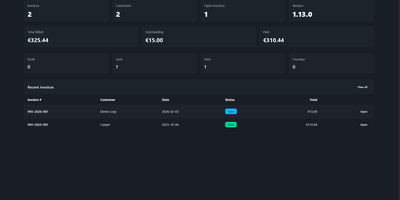
Create an invoice, share a secure link, get paid — that's the entire workflow, no client portals or account registrations required. Invio distills billing into its absolute minimum viable surface while still producing legally compliant EU electronic invoices in Factur-X/ZUGFeRD 2.2 BASIC, UBL 2.1, and Italian FatturaPA formats, all embedded as XML attachments inside WeasyPrint-rendered PDFs. The Deno 2 backend uses Hono v4 for HTTP routing with SQLite persistence, while the SvelteKit 2 frontend styled with Tailwind CSS v4 and DaisyUI v5 delivers a responsive interface that stays out of your way. The team access system includes a permission matrix, TOTP-based two-factor authentication, and OIDC integration with configurable auto-provisioning — drop it into existing identity infrastructure without manual user management. Preset products let you build invoices from reusable catalog items. A change history log tracks every modification for audit purposes. Rate limiting protects the API behind reverse proxies. The entire stack ships as a single multi-stage Docker image containing Deno, Bun, Node, WeasyPrint, and all required font packages — zero external service dependencies beyond the container itself. Running on a dedicated VPS on RepoCloud with guaranteed CPU, RAM, and SSD, full root SSH access, and a browser serial console. Unlicense licensed.

Easy Invoice PDF
Freelancers, contractors, and small shops can turn a short form into a client-ready PDF invoice, with a live preview that redraws on every keystroke and no account to create. Fill in seller and buyer details, then add line items with quantity, unit, net price, and tax rate; net amounts, tax, totals, and the amount in words are calculated automatically. Item discounts take a percentage or fixed amount off any line under a custom label, and tax applies to the discounted figure. Pick a classic layout or a Stripe-style template, and add your logo as a JPEG, PNG, or WebP file. Invoices can be written in 13 languages, including Brazilian Portuguese, with 122 currencies, 18 date formats, and a number format setting that survives a language switch. Tax labels can read VAT, GST, Sales Tax, or anything else, or the tax columns can be dropped entirely. Bank account, SWIFT/BIC, payment method, due date, and notes sit alongside an optional QR code that can carry a payment link, UPI details, or contact information. Long invoices flow onto extra pages automatically. Saved seller and buyer profiles fill in the next invoice for you, and the data stays in the browser. Download the PDF or copy a shareable link that opens the same invoice for your client. Running on a dedicated VPS on RepoCloud with guaranteed CPU, RAM, and SSD, full root SSH access, and a browser serial console. AGPL-3.0 licensed.

Bar Assistant
Turn your scattered collection of liquor bottles and bar tools into a master mixology station with an intelligent digital cellar. Bar Assistant tracks your personal liquor cabinet, inventory levels, and available mixers against a catalog of more than 500 cocktail recipes. The platform calculates exact alcohol by volume ratings, computes ingredient costs per serving, and dynamically highlights every cocktail you can craft with on-hand supplies. Built-in recipe scrapers extract formula details, measurements, and glassware requirements directly from web links, JSON payloads, or YAML files. Multi-bar workspaces allow home mixologists and commercial venues to separate private collections from communal drink menus while handling complex ingredient substitutions, custom infusions, and shopping lists. Integrated Meilisearch indexing powers instant typo-tolerant searches across spirit categories, flavor tags, and cocktail strengths. Visual cocktail cards display high-resolution drink photography, user ratings, glassware requirements, and step-by-step garnish instructions. Deploy Bar Assistant on RepoCloud with dedicated VPS compute, full root SSH credentials, and in-browser console access, backed by an open-source MIT license.

Kurrier
Kurrier unifies email, calendars, contacts, and file storage in a single web interface that connects to any email provider you already use. The Next.js frontend with Nitro API worker deploys via Docker Compose on PostgreSQL and Redis, delivering a cohesive workspace where IMAP/SMTP mailboxes from Gmail, Outlook, or corporate servers sit alongside transactional providers like AWS SES, SendGrid, Mailgun, and Postmark. Automatic inbox building handles threads, attachments, sent items, and deletion sync through persistent background polling. The CalDAV backend enables full two-way calendar synchronization with iOS, macOS, Android via DAVx5, and Thunderbird, supporting event invitations, RSVP processing through the inbox, timezone-aware scheduling, and contact-aware attendee linking. CardDAV contacts sync bidirectionally across all devices with unified name, avatar, and email resolution. Kurrier Drive provides integrated file storage through WebDAV locally or S3-compatible backends for cloud storage. Multiple identities and domains let you manage several email accounts from different providers in one interface, with fast local search indexing subjects, senders, and content without dependency on external APIs. The API-first architecture exposes clean endpoints for automation and custom integrations. Running on a dedicated VPS on RepoCloud with guaranteed CPU, RAM, and SSD, full root SSH access, and a browser serial console. AGPL-3.0 licensed.
DockPanel
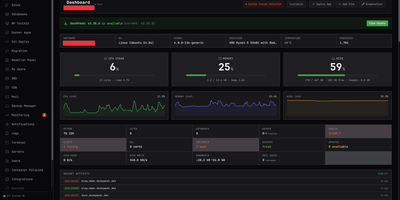
Created in March 2026 and rapidly gaining traction in self-hosting communities, DockPanel delivers the most feature-dense free server panel available — 811 API endpoints, 153 one-click Docker app templates across 14 categories, and full multi-server management, all running on three Rust binaries consuming under 50MB of combined RAM. The panel handles the complete server lifecycle: sites with automatic SSL via Let's Encrypt, MySQL and PostgreSQL databases in Docker containers, Git push-to-deploy using Nixpacks for automatic language detection without Dockerfiles, blue-green zero-downtime deployments with automatic rollback on failed health checks, DNS management, mail servers, monitoring dashboards, and encrypted backups to S3, SFTP, Backblaze B2, or Google Cloud Storage. Security receives production-grade attention with per-image CVE scanning that gates deployments, a built-in WAF, passkey authentication alongside Argon2 password hashing, HttpOnly JWT sessions with blacklist-on-logout, rate limiting on auth endpoints, and fail2ban integration — all verified through an 18-vulnerability pentest with zero remaining issues. Infrastructure as Code support exports your entire server configuration to YAML, and the developer CLI provides status, diagnose, and export commands for automation. GPU passthrough enables AI workload hosting, reseller accounts support white-label branding for agencies, and ARM64 compatibility covers Raspberry Pi and Oracle Cloud free-tier deployments. Running on a dedicated VPS on RepoCloud with guaranteed CPU, RAM, and SSD, full root SSH access, and a browser serial console. AGPL-3.0 licensed.

Chief-Onboarding
New hires fail from information overload and IT bottlenecks, not lack of goodwill - the observation behind ChiefOnboarding, a free, open-source employee onboarding platform (Django, Celery, PostgreSQL, Redis). Its answer is sequences - drag-and-drop timelines that drip-feed to-do items, resources, courses, forms, and badges to each new hire, triggered by dates or by completing a previous item, so nobody faces everything at once. Onboarding starts before day one: preboarding pages welcome hires early, and colleagues can leave personal messages that appear there. The account provisioning module creates the new hire's Slack, Google, Asana, and other accounts automatically on the scheduled day via a library of integrations plus custom webhooks - the IT ticket queue never gets involved. Everything works through two equivalent interfaces: a full web dashboard and a Slack bot, either usable standalone. Slack can even auto-create new hire accounts when someone joins the workspace and assign default sequences with zero manual action. Colleague tasks with comments and collaboration, a searchable people directory, scheduled introductions, and per-hire timezone awareness (no 3 a.m. notifications) round it out. No trackers, no phoning home - third-party credentials sit in encrypted fields on your server.

Glean
Information overload is the default state of the modern internet, and Glean exists to tame it by pulling every blog, newsletter, and news source you follow into a single, organized reading experience with an interface that prioritizes clarity over clutter. Subscribe to RSS and Atom feeds, import your existing subscriptions via OPML, and organize everything into multi-level folders with a flexible tagging system that lets you slice your reading list by topic, priority, or mood. A three-pane layout presents your feed list, article summaries, and full content side by side, with one-click actions for marking articles as read, saving them for later, bookmarking favorites, or archiving what you have already processed. Background workers fetch new articles every 15 minutes so your feeds stay current without manual refreshes. The preference learning engine (backed by Milvus vector embeddings) scores incoming articles against your reading history and surfaces a personalized Smart Feed of content you are most likely to care about, reducing the time spent scrolling past irrelevant posts. A built-in MCP server lets AI assistants like Claude Desktop search and interact with your feed library directly. The admin dashboard on a separate port provides user management, system monitoring, and configuration controls for multi-user deployments. Bookmark external URLs from any browser with the Chrome extension, or access your feeds on mobile through the Progressive Web App. Running on a dedicated VPS on RepoCloud with guaranteed CPU, RAM, and SSD, full root SSH access, and a browser serial console. AGPL-3.0 licensed.