Gollum
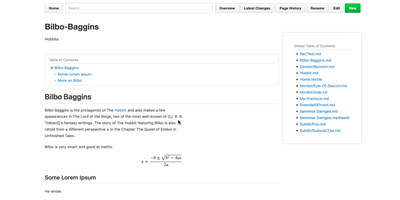
Every wiki page lives as a plain-text file in a standard Git repository, giving you full version history, branching, merging, and the freedom to edit with any text editor or IDE alongside the web interface. Originally built by GitHub's founders as the engine behind GitHub's own wiki feature, Gollum supports Markdown, AsciiDoc, reStructuredText, Org-mode, Textile, MediaWiki, Creole, and Pod markup formats with live preview rendering as you type. PlantUML and Mermaid diagrams render inline for architecture documentation, MathJax handles mathematical notation, and BibTeX integration via Pandoc provides academic citation management. YAML frontmatter controls per-page sidebars, headers, footers, and table of contents generation. CriticMarkup annotations enable editorial review workflows with tracked insertions, deletions, substitutions, and comments. Macros extend pages with dynamic content injection, file includes, and navigation helpers. The wiki maintains compatibility with GitHub and GitLab wiki repositories, so teams can clone existing platform wikis for local editing and offline access. The official Docker image at gollumwiki/gollum exposes port 4567 with volume-mounted repositories, requiring roughly 170 MB of container storage and minimal RAM. Authentication integrates via OmniAuth supporting GitHub, GitLab, Google, and other OAuth providers. Over 14,300 stars on GitHub since 2009. MIT licensed.
Draw a UI
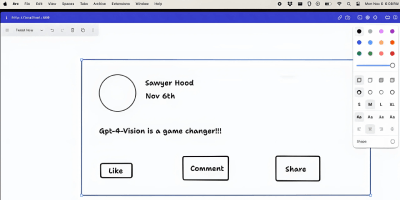
Sketch a wireframe, get working code: Draw a UI turns hand-drawn layouts into web interfaces. It pairs the open-source tldraw canvas with an OpenAI vision model: you sketch a layout - boxes, labels, buttons, arrows, whatever communicates the idea - select the drawing, and click Make Real. The app snapshots your selection as a PNG, sends it to the vision API with instructions to return a single HTML file styled with Tailwind CSS, and renders the result in an iframe directly on the canvas next to your sketch. The loop is iterative: annotate the generated prototype or redraw parts of it, select both the sketch and the previous result, and generate again - the model receives the earlier HTML as context and produces an updated version. Built by Figma engineer Sawyer Hood as one of the first viral GPT-4 Vision demos and the basis for tldraw's "Make Real", it is a Next.js app that runs against your own OpenAI API key. Self-hosting matters here: the upstream demo ships without authentication, so a private deployment keeps your API key from being drained by strangers. MIT-licensed.
Manticore Search
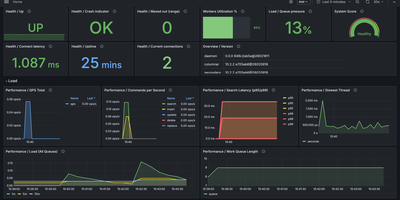
With nearly 12,000 GitHub stars and a lineage tracing back to Sphinx Search, Manticore Search is the C++ search database that delivers the full-text, vector, and hybrid search capabilities of Elasticsearch at a fraction of the resource cost — starting in under a second and consuming just 40MB RAM for an empty instance. The SQL-first interface speaks the MySQL wire protocol, meaning mysql client, MySQL Workbench, and any MySQL-compatible driver connects natively without adapters, while the HTTP JSON API provides RESTful access for modern applications. Over 20 full-text operators handle proximity search, quorum matching, field-start and field-end constraints, MAYBE operators, and regex patterns, backed by stemming, lemmatization, stopwords, synonyms, wordforms, and advanced morphology in 70+ languages. Vector search with HNSW indexing enables semantic similarity queries, and hybrid mode combines keyword relevance with vector distance in a single ranked result set using a cost-based query optimizer. Real-time indexing delivers sub-second document availability after insert, sharded tables distribute data across nodes, and Galera-based synchronous replication ensures high availability. Conversational search via CREATE CHAT MODEL and CALL CHAT integrates LLM-backed responses with KNN retrieval and conversation history directly inside the database. Client libraries ship for PHP, Python, JavaScript, TypeScript, Java, Go, Rust, and Elixir. Columnar storage via the Manticore Columnar Library handles analytical workloads on large datasets. Running on a dedicated VPS on RepoCloud with guaranteed CPU, RAM, and SSD, full root SSH access, and a browser serial console. GPLv3 licensed.
Scira
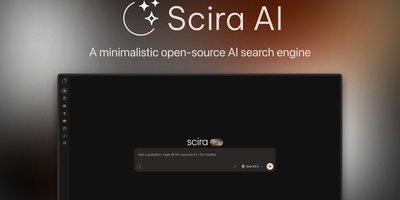
Scira is an AI search engine that breaks complex research questions into sub-tasks, retrieves grounded answers from live sources, and cites every claim with clickable links to the original evidence. Formerly known as MiniPerplx and now backed by nearly 12,000 GitHub stars, the platform implements agentic research planning where language models decompose queries, select appropriate tools, retrieve information in parallel, and synthesize responses with inline citations. Seventeen distinct search modes cover Web, Academic, Extreme, X (Twitter), Reddit, GitHub, Stocks, Crypto, YouTube, and Prediction markets, each activating a curated subset of the 28 built-in tools. The Extreme mode deploys a deep research agent with multi-step planning, parallel source retrieval, code execution in sandboxed Daytona environments, and R2 artifact storage for generated charts. Model routing spans 50+ AI providers through a unified configuration layer supporting OpenAI, Anthropic, Google, xAI Grok, and custom models, with per-mode model assignment based on task requirements. The web search tool supports Exa, Tavily, and Firecrawl as interchangeable providers via a Strategy pattern. Lookouts schedule recurring research agents on cron schedules that monitor topics, track changes, and email summaries using Upstash QStash for reliable execution. PostgreSQL stores chat history, user preferences, and custom instructions while Redis handles caching and rate limiting. Running on a dedicated VPS on RepoCloud with guaranteed CPU, RAM, and SSD, full root SSH access, and a browser serial console. AGPL-3.0 licensed.

Thumbor
Born at Brazilian media giant Globo.com, Thumbor answers imaging CDNs like Imgix and Cloudinary with an HTTP service where every image variant is just a URL. Ask for /300x200/smart/your-image.jpg and Thumbor fetches the original, crops and resizes on demand, and caches the result - one source file, unlimited renditions, no batch pre-generation pipeline. The "smart" in the URL is the signature feature: OpenCV-based face detection finds people in the frame and crops around them (no more thumbnails with severed heads), and when no faces exist, feature detection finds visually important corners and computes a weighted center of mass as the focal point. Beyond cropping, a chainable filter pipeline handles brightness, contrast, grayscale, blur, red-eye removal, rounded corners, rotation, watermarks, and format conversion with quality control - applied in order via URL segments. All common image formats work out of the box, and every layer is pluggable: loaders (HTTP, local, S3), storages and result storages (local, S3, Ceph, and community backends), engines, optimizers, filters, and even custom detectors, with the awesome-thumbor list cataloging the ecosystem. URL signing prevents abuse of your processing capacity. Integrations exist for Django, Rails, Node, WordPress, and most frameworks. MIT-licensed, battle- tested for over a decade.

pgweb
Inspect a PostgreSQL database right now, without installing pgAdmin or exposing Postgres to the internet - pgweb answers that recurring need. It's a Go application from Dan Sosedoff, a decade in development, shipped as a single statically-linked binary with zero dependencies - the Docker image is essentially just the executable - that puts a clean browser UI in front of any PostgreSQL 9.1+ server. Connect via URL string or host/port credentials, and browse tables, views, and sequences from the sidebar; selecting a table shows its rows immediately alongside tabs for structure, indexes, and constraints. The Query tab executes arbitrary SQL with query history, and the Explain Query button renders the query plan - estimated cost, row counts, execution strategy - which makes pgweb a quick performance-triage tool, not just a browser. Results and entire tables export to CSV, JSON, or XML in a click. Connectivity is more flexible than its size suggests: native SSH tunneling (password or key) reaches databases behind firewalls, server bookmarks make switching instances instant, and an optional multi-session mode handles several databases concurrently. For a RepoCloud stack full of Postgres-backed apps, one pgweb instance is the universal inspection hatch. MIT-licensed, actively maintained.
Tiddlywiki
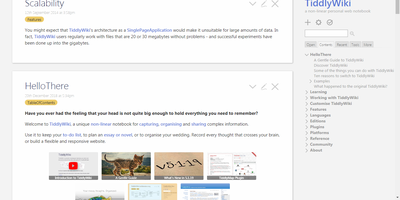
The entire wiki - content, code, and interface - is built from "tiddlers," small addressable units of information that link, transclude, tag, and filter into each other: TiddlyWiki is a non-linear personal notebook with a design philosophy unlike anything else in this catalog. Instead of pages in a hierarchy, you compose views by pulling tiddlers together on demand, which is why researchers, zettelkasten practitioners, and GTD devotees have sworn by it for two decades. The whole application is JavaScript, and the UI itself is written in hackable WikiText - customization goes as deep as rewriting the interface from inside the wiki. Self-hosting runs the Node.js version, which upgrades the classic single-HTML-file architecture in the ways that matter for a server: every tiddler is stored as an individual text file (Git-friendly, organizable), edits save through the HTTP API from any modern browser including phones, and one installation can serve multiple wikis blending shared and unique content. The plugin ecosystem covers graph visualizations, themes, languages, and hundreds of community extensions, declared per-wiki in a simple tiddlywiki.info file; the newer MultiWikiServer plugin adds multi-user accounts and tiddler sharing. Your notes stay usable for decades, independent of any corporation - the project's founding promise. BSD-licensed.
Papercups
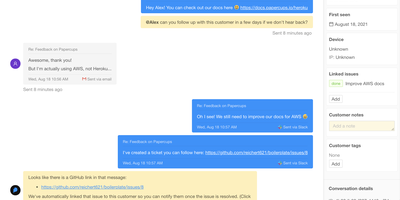
Companies with privacy and security concerns about piping customer conversations through Intercom or Zendesk run Papercups - open-source live customer chat. The stack is a deliberate strength: an Elixir/Phoenix API over PostgreSQL, with real-time messaging powered by Phoenix Channels and Presence - the same BEAM foundation trusted by Discord and PagerDuty for fault-tolerant, low-latency messaging. Customers see a customizable chat widget that embeds in any site as an HTML snippet, a React component, or even inside React Native apps, with configurable colors, greetings, and away messages. Your team sees a dashboard for managing conversations - close, assign, and prioritize - with Markdown and emoji in replies. The killer workflow is the reply-channel integration: connect Slack or Mattermost and every customer conversation becomes a synced thread your team answers without leaving the tool they already live in, with two-way message syncing handled by webhooks. Email and SMS channels extend intake beyond the widget, an analytics dashboard tracks communication patterns, and the Storytime feature adds real-time screen sharing to watch users navigate while you help them. A documented API supports fully custom chat UIs in Svelte, Flutter, or Vue. MIT-licensed and GDPR-conscious - customer data stays in your PostgreSQL.

Open Canvas
Open-source alternative to OpenAI's Canvas — a collaborative writing and coding environment where AI agents help you draft, edit, and refine documents through an agentic architecture built on LangGraph. The dual-mode editor combines a BlockNote rich text editor for live-rendered markdown with a CodeMirror-based code editor supporting syntax highlighting across multiple programming languages, letting you switch between prose and code artifacts within the same session. The built-in reflection agent automatically generates style rules and user insights from your chat history, storing them in a shared LangGraph memory store that persists across sessions for increasingly personalized assistance. Pre-built quick actions provide one-click access to common writing transformations including summarize, expand, simplify, and translate, while coding actions offer explain, refactor, add comments, and convert between languages. The monorepo architecture separates the Next.js 14 frontend from the LangGraph agent backend, connecting via HTTP and WebSocket protocols through the @langchain/langgraph-sdk client. Seven LLM providers are supported out of the box — OpenAI, Anthropic Claude, Google Gemini, Fireworks AI, Groq, Azure OpenAI, and local Ollama models — with Supabase handling authentication and data persistence. Deploy via Docker or build from source. Running on a dedicated VPS on RepoCloud with guaranteed CPU, RAM, and SSD, full root SSH access, and a browser serial console. MIT licensed.
Your Spotify
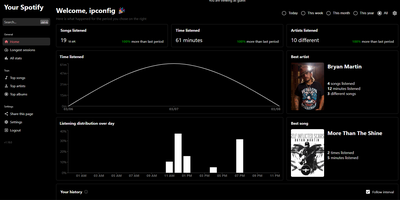
To explore years of personal music streaming habits without waiting for an annual year-end summary, Your Spotify continuously tracks your listening history and presents it inside a private analytics dashboard. Music enthusiasts use the interface to inspect daily, weekly, monthly, and custom date-range breakdowns of their most played tracks, top artists, favorite albums, and total listening duration. Listeners who want their complete historical archive from day one can upload official Spotify privacy data exports, including both past-year StreamingHistory JSON files and multi-year Extended Streaming History archives, directly through the settings panel. Friends and family sharing an instance can use the collaborative affinity view to compare overlapping listening habits across multiple accounts in intersection or union mode. From any historical table, top-tracks ranking, or multi-user affinity comparison, you can generate new playlists directly inside your Spotify account or trigger track playback on active devices. Administrators can manage user registrations, generate shareable public guest tokens for read-only dashboard access, blacklist specific artists from skewing statistics, and expose ingestion metrics to Prometheus. Running on a dedicated VPS on RepoCloud with guaranteed CPU, RAM, and SSD, full root SSH access, and a browser serial console. GPL-3.0 licensed.
Paisa
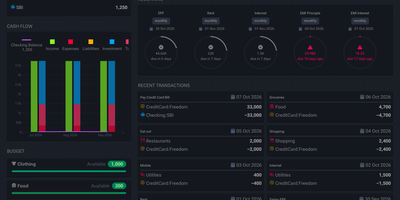
A plain text journal is all Paisa needs to put your net worth, cash flow, expenses, and investment returns on one set of dashboards. Write entries in the built-in editor. It brings syntax highlighting, auto completion, error checking, and auto formatting to double-entry journals. Bank and credit card statements in CSV, Excel, or PDF import through reusable templates that categorize every transaction. Price providers track mutual funds, NPS holdings, and stocks. Manual prices revalue a house, a car, or a plot of land. Budgets set a limit for each category and track spending against it. Allocation targets show how far a debt and equity split has drifted. Goals compute a completion date from monthly savings. The retirement planner works from a safe withdrawal rate and yearly expenses. A calendar marks recurring bills as cleared, late, past due, or upcoming, and Liabilities pages cover credit cards, loan repayment, and interest. Live Sheets calculate taxes and EMIs from ledger data. Journals and settings stay in plain text files that can be version controlled or shared, and ledger, hledger, and beancount are all supported. Running on a dedicated VPS on RepoCloud with guaranteed CPU, RAM, and SSD, full root SSH access, and a browser serial console. AGPL-3.0-or-later licensed.
Jellystat
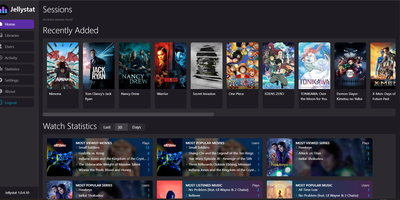
Jellystat is a self-hosted media analytics and live session monitoring dashboard for Jellyfin and Emby servers that turns raw streaming activity into detailed user, library, and playback insights. Media server administrators use the live dashboard to watch active streams in real time, inspecting transcoding status, client devices, bitrates, and playback progress as sessions happen. Every completed or partial stream is logged automatically so you can browse chronological watch histories, filter by library or stream type, and analyze peak concurrent streaming hours across the week. Dedicated library and user views break down total watch duration, play counts, and most popular movies, episodes, or music albums per account. If you already use the official Jellyfin Playback Reporting or Statistics plugins, you can import existing historical records directly into your instance without losing past data. Built-in database backup and restore tools, automatic library synchronization tasks, IP geolocation via MaxMind GeoLite, and interactive Swagger API documentation at the /swagger endpoint round out the administrative toolkit. Running on a dedicated VPS on RepoCloud with guaranteed CPU, RAM, and SSD, full root SSH access, and a browser serial console. MIT licensed.
Chitchatter
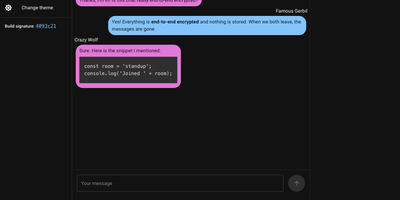
Chitchatter is a browser-based chat room for text, voice, video, screen sharing, and file transfers that exists only while its members are connected and keeps no record of what was said. Every visit starts with a random room name generated on your device, a UUID or a readable passphrase, and you invite people with the link or a QR code. Public rooms admit anyone with the link; private rooms also require a matching password. Messages support Markdown, multiline text, and code blocks, and clicking a name opens a direct conversation. Newcomers to public rooms receive the earlier conversation from peers already there, and typing indicators show who is writing. Start an audio or video call, share your screen to walk a relative through a settings problem, or hand over a file of any size, encrypted before it leaves your browser. Public-key checks verify each peer automatically, with a green lock marking everyone who passes and an icon showing whether the link is direct or relayed. Embed a room in any web page with an iframe or a web component that takes a room name, user name, and color mode. Light and dark themes are built in, and notifications and sounds announce new messages while you work in another tab. Close the tab and the transcript disappears. Running on a dedicated VPS on RepoCloud with guaranteed CPU, RAM, and SSD, full root SSH access, and a browser serial console. GPL-2.0 licensed.

OpenHAB
Over 400 technologies and thousands of smart devices from any manufacturer, unified under one roof: openHAB is the vendor-neutral home automation platform with a pluggable binding architecture. Each binding translates a device or service into openHAB's clean abstraction: Things expose Channels, Channels link to Items, and Items feed a rules engine that runs your home. That engine meets you at your skill level: Blockly gives non-programmers drag-and-drop visual logic, JS Scripting (GraalJS with the openhab-js library) is the modern text-based standard, the classic Rules DSL remains supported, and JSR223 opens the door to Python, Ruby, and Groovy. Time- and event-based triggers, scripts, notifications, and voice control compose into automations of any complexity, and users report decade-old rule sets still running rock solid. The Main UI handles configuration, semantic modeling, and now built-in charting - no external Grafana required. Built in Java on Apache Karaf's OSGi runtime and stewarded by the non-profit openHAB Foundation, it requires no cloud to function: everything runs locally, talking directly to your devices. Optional connectors bridge to Alexa, Google Assistant, and HomeKit, with iOS, Android, and web apps for control from anywhere.
Lingva Translate
What Nitter was to Twitter and Invidious is to YouTube, Lingva Translate is to Google Translate: a privacy front-end delivering the service's full capability while cutting Google out of the loop between you and your text. Built on Next.js with TypeScript and Chakra UI, it uses the purpose-built Lingva Scraper to fetch translations from Google Translate without your browser ever touching a Google-related service - no cookies, no tracking, no account, while retaining what makes Google Translate hard to give up: 100+ languages with the translation quality of Google's production models, unlike offline engines that trade privacy for accuracy. The clean interface covers automatic source-language detection, text-to-speech audio playback for pronunciations, definitions and examples, and light/dark themes. For developers, every instance doubles as a translation API: a RESTful endpoint at /api/v1/:source/:target/:query returns JSON translations, an audio endpoint serves TTS buffers, and a full GraphQL API at /api/graphql exposes translations, audio, and language lists for richer integrations - all unmetered on your own instance. Deployment is a single stateless container with one environment variable for the site domain; defaults for theme and language pair are configurable. GPL-licensed, and popular as the translation backend for privacy-respecting apps.
Multiwoven
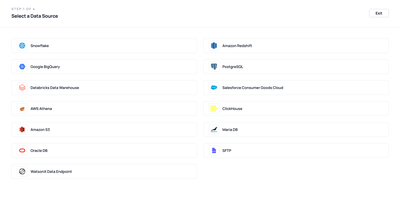
When warehouse data never reaches the CRM, ad platform, or help desk that needs it, Multiwoven is the open-source reverse ETL platform that syncs it there on a schedule. Sources include Snowflake, BigQuery, Redshift, Databricks, PostgreSQL, ClickHouse, MariaDB, Oracle, Amazon S3, and SFTP. Models define what to move: write SQL with a 100-row preview, pick tables in a visual selector, or reuse existing dbt models. Destinations span Salesforce, HubSpot, Klaviyo, Mailchimp, Zendesk, Slack, Airtable, Google Sheets, Stripe, Facebook Custom Audiences, HTTP endpoints, and vector stores such as Pinecone, Qdrant, and Weaviate. Each sync maps model columns onto destination objects like Salesforce Account, Contact, or Opportunity, then runs as a full refresh or as an incremental sync that moves only new or changed rows, optionally tracked by a cursor field. Schedules can be manual, an interval from minutes to weeks, or a cron expression. A dashboard reports sync activity, each run records its status with successful and failed row counts, and failed runs can trigger status emails. Workspaces keep sources, models, syncs, and destinations separate for each team, while Admin, Member, and Viewer roles and email invitations control access. A connector framework lets teams add sources or destinations that are not yet supported. Running on a dedicated VPS on RepoCloud with guaranteed CPU, RAM, and SSD, full root SSH access, and a browser serial console. AGPL-3.0 licensed.
Kuzzle
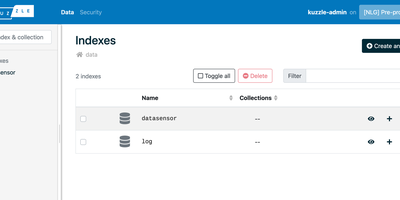
Kuzzle ships a production-ready backend from day one: data storage with Elasticsearch search, real-time pub/sub notifications, user authentication, role-based permissions, and a multi-protocol API serving HTTP, WebSocket, and MQTT simultaneously on port 7512. Rather than rebuilding these standard features from scratch for each project, you get a ready-made backend that accepts connections from web applications, mobile clients, and IoT devices through one unified API surface. Elasticsearch provides persistent document storage with full-text search, geospatial queries, and aggregation pipelines, while Redis handles internal caching and memory storage operations. The Koncorde real-time engine powers pub/sub messaging and database notifications, enabling clients to subscribe to document changes with filter conditions that trigger instant updates when matching data is created, modified, or deleted. User management includes JWT-based authentication, role-based access control with granular permissions at the controller and action level, and pluggable authentication strategies via Passport.js. The extensible plugin framework allows developing custom business logic, additional authentication providers, storage connectors, and protocol handlers. Client SDKs for JavaScript, Dart, Kotlin, and C++ accelerate frontend development, while the Kourou CLI provides command-line API access and project scaffolding. The Vue.js Admin Console offers a web interface for managing indexes, collections, documents, users, profiles, and roles. Horizontal scaling through masterless cluster mode targets 99.99% uptime without single points of failure. Running on a dedicated VPS on RepoCloud with guaranteed CPU, RAM, and SSD, full root SSH access, and a browser serial console. Apache 2.0 licensed.
ExpenseOwl
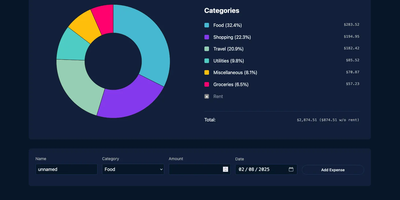
Log a date, amount, and category; get a clean monthly pie chart and a cashflow strip showing income, expenses, and net balance - ExpenseOwl is expense tracking stripped to what actually matters. The MIT-licensed Go application deliberately is not a budgeting system - no envelopes, no accounts, no double-entry, no bank sync - because its author found tools like Firefly III and Actual too heavy for the simple question "where did this month's money go?" The dashboard makes that question fast: click a pie slice to exclude fixed costs like rent and see discretionary spending clearly, then drill into a chronological table view to inspect or delete individual transactions. Recurring transactions handle salaries and subscriptions automatically, optional tags add a second classification axis, and settings cover custom categories, currency symbol, and a configurable month start date for non-calendar pay cycles. CSV import migrates data from virtually any other tool, and CSV export keeps your data portable. It ships as a self-contained binary and multi-architecture Docker image with zero internet interaction, stores data in flat JSON files by default (PostgreSQL optional), and installs as a PWA on phones. Single-user by design; pair it with an authenticating reverse proxy if exposed publicly.