Odoo
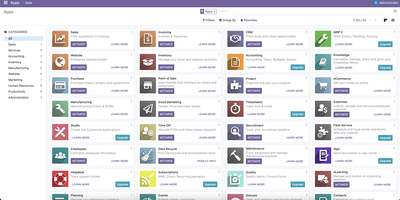
Roughly 40 integrated business apps forming a full ERP: Odoo's open-source suite runs companies end to end. The Community Edition, licensed LGPL-3.0, ships roughly 40 apps covering CRM, sales, invoicing, basic accounting (journals, chart of accounts, taxes, reconciliation), inventory and warehouse management with multi-step routes, manufacturing with BOMs and work orders, purchasing, project management, timesheets, HR, a website builder, and eCommerce. Each app works standalone, but they share one PostgreSQL database and one data model, so a confirmed sale updates stock, triggers procurement, and posts invoices without integration glue. The modular design means you enable only the apps you need and extend with 40,000+ community modules from the Odoo app store covering nearly any vertical requirement. Inventory supports multi-warehouse stock, reordering rules, and lot and serial tracking with barcode-ready operations; manufacturing ties BOMs, work orders, and work-center routing directly to sales demand and stock levels; and the website builder sells straight from your product catalog with payment provider integrations. You can start with just CRM and invoicing on day one and switch on inventory or eCommerce later - new apps integrate with existing data instantly because the schema is shared. The server is Python with an XML/JavaScript view layer, and because data lives in plain PostgreSQL there is no proprietary format: you can query, back up, migrate, and extend business data directly, with unlimited users and no per-seat licensing - where enterprise ERP pricing is per user per month, headcount here costs nothing.
Dockpeek
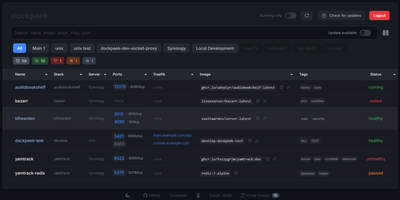
Fleet-wide container discovery, live log streaming, and Traefik reverse-proxy routing converge into Dockpeek, a lightweight Docker dashboard built for multi-host server environments. System administrators can launch web applications with one click through automatic port binding detection and integrated Traefik label parsing that extracts public routing hostnames directly from container configurations. The platform monitors multi-host environments through encrypted Docker socket proxies, letting operators inspect running containers, query published network ports, and trigger image updates from a unified control panel. Native Docker Swarm integration auto-detects active cluster managers, mapping swarm services and replicated tasks alongside standalone workloads while flagging degraded service replicas. Built-in log inspectors stream stdout and stderr outputs in real time with line-filtering controls to diagnose crashed services without opening remote SSH terminals. Operators can track image registries for newer digest tags, review pending updates across container fleets, and trigger graceful rolling container recreations directly from the dashboard. Running on a dedicated VPS on RepoCloud with guaranteed CPU, RAM, and SSD, full root SSH access, and a browser serial console. MIT licensed.
CockroachDB
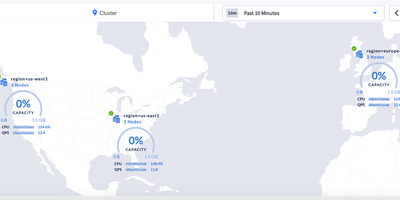
With over 32,000 GitHub stars and adoption by DoorDash, Netflix, and Bose, CockroachDB is the distributed SQL database designed to survive disk failures, machine outages, rack losses, and entire datacenter failures while maintaining strongly-consistent ACID transactions with serializable isolation by default. The architecture layers SQL on a transactional key-value store using the Raft consensus protocol for synchronous replication, automatically splitting data into ranges that distribute and rebalance without manual sharding. PostgreSQL wire protocol compatibility means existing drivers, ORMs, and tools including psycopg2, pgx, ActiveRecord, Django ORM, GORM, Hibernate, and Prisma work without modification. Multi-region capabilities include configurable survival goals at region or zone level, table-level locality settings for pinning data to specific geographies for GDPR compliance, and follower reads for low-latency global queries. The built-in DB Console provides cluster overview dashboards, node maps showing geographical distribution, SQL activity pages tracking statement fingerprints, transaction latency percentiles, session details, and real-time metrics for queries per second, storage capacity, and replication status. Change data capture streams row-level changes to Apache Kafka, Google Cloud Pub/Sub, or webhook endpoints for event-driven architectures. Online schema changes execute ALTER TABLE without locking or downtime, and distributed backup supports full and incremental snapshots to S3, GCS, Azure Blob, and NFS. Running on a dedicated VPS on RepoCloud with guaranteed CPU, RAM, and SSD, full root SSH access, and a browser serial console. CockroachDB Software License (source-available).
Element
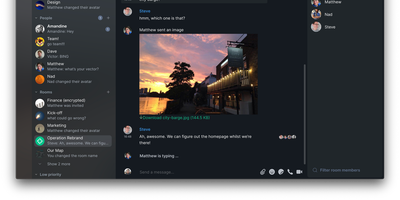
Matrix's flagship client, built by the protocol's creators: Element brings the decentralized open standard for real-time communication to web, desktop, iOS, and Android. Paired with a Matrix homeserver, it delivers Slack-quality team messaging where you own every message, file, encryption key, and byte of metadata. End-to-end encryption is on by default, built on Olm and Megolm - the Double Ratchet algorithm family Signal popularized, extended for large-room scalability and publicly audited by NCC Group. Messages encrypt per-device with cross-signed device verification, so even a compromised server yields nothing readable. Federation is the defining capability: like email, users on different homeservers converse seamlessly, and 30+ bridges connect Matrix rooms to Slack, Discord, WhatsApp, and Telegram, so moving to sovereign infrastructure doesn't sever contact with anyone. Rooms support threads, reactions, file sharing, and voice and video calls via Element Call. The result is digital sovereignty chosen by governments and enterprises across Europe: your data sits on your server in your jurisdiction, portable to any other Matrix host because the protocol is an open standard. Apache-2.0 licensed, with no per-user fees at any scale.

Calcom
Scheduling infrastructure, not just a booking page - Cal.com is the leading open-source scheduling platform. Share a link, attendees pick a slot, and real-time sync against Google Calendar, Outlook, and CalDAV prevents double-booking. Beyond the basics it covers team workflows: round-robin distribution, collective availability across multiple hosts, recurring meetings, and routing forms that ask bookers questions and send them to the right team member - the feature sales and support teams usually pay enterprise prices for. Paid bookings run through Stripe, video calls through the built-in Cal Video (Daily.co) or Zoom and Google Meet, and an app store connects 100+ tools including HubSpot, Zapier, and n8n. The API-first architecture with webhooks and embeds makes it practical to build scheduling into your own product, white-labeled with your domain and branding. Built on Next.js and Prisma over PostgreSQL, translated into 65+ languages, with the self-hostable community codebase maintained under an open-source license.
UptimeKuma
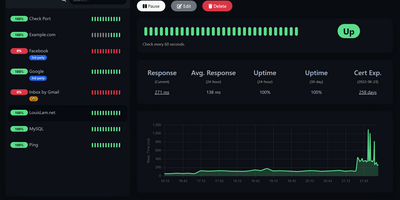
Sixty-thousand-plus GitHub stars make Uptime Kuma the most popular self-hosted monitoring tool - MIT-licensed, Node.js, and the standard replacement for UptimeRobot, Pingdom, and Freshping. It watches a dozen monitor types: HTTP(S) endpoints with keyword and JSON-query content validation, TCP ports, ICMP ping, DNS records, WebSockets, Docker containers via the socket, Steam game servers, MQTT brokers, gRPC services, and push-based heartbeats for cron jobs and internal workers. Checks run at intervals as tight as 20 seconds - versus UptimeRobot's 5-minute free tier - with unlimited monitors and unlimited data retention. When something fails, alerts fan out through 90+ notification channels: Slack, Discord, Telegram, email with LiquidJS templating, PagerDuty, OpsGenie, ntfy, Gotify, Matrix, and dozens more via native providers plus the Apprise library. Unlimited public or password-protected status pages - mappable to specific domains and organized into monitor groups - communicate health to customers, with maintenance windows that suppress alerts during planned work. The reactive dashboard graphs response times, tracks SSL certificate expiry with advance warnings, supports proxies and 2FA, and ships in dozens of languages. One Docker container with a SQLite volume covers an entire infrastructure.
Mealie
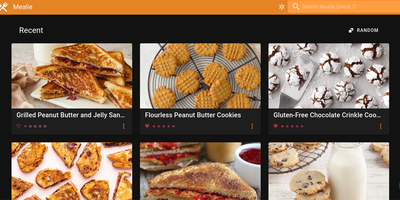
A recipe manager that feels like a consumer product rather than a homelab experiment: Mealie pairs a FastAPI backend with a reactive Vue frontend for the most polished self-hosted meal planning around. The killer feature is the recipe scraper: paste a URL from hundreds of supported cooking sites and Mealie imports the ingredients, steps, times, and photos automatically. Structured HTML/JSON paste, a Markdown-capable manual editor, and imports from other recipe apps (like Tandoor) cover everything else. Meal planning uses a drag-and-drop calendar with breakfast, lunch, dinner, and snack slots, plus rule-based random recipe insertion - constrain the pool by tags or categories per meal type or weekday. Shopping lists link recipes so all ingredients land in one place, organized into supermarket sections, and update in real time for everyone in the household. The multi-tenancy model is genuinely thought through: isolated Groups can host multiple tenants, and Households within a group share recipes and organizers while keeping meal plans and shopping lists private. Cookbooks group recipes by your own criteria, a cooking mode stays readable on a phone propped against the backsplash, and 35+ language translations ship built-in. A fully documented REST API and scheduled webhooks (e.g., today's meal plan to Home Assistant) make it automatable, with SQLite or PostgreSQL storage and automatic backups.
3X-UI
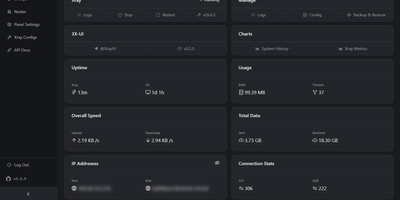
3X-UI is the most popular open-source Xray management panel, providing a full-featured web interface for deploying and monitoring proxy and VPN protocols on Linux servers. The Go backend manages Xray-core instances supporting VLESS, VMess, Trojan, Shadowsocks, WireGuard, Hysteria2, HTTP, SOCKS, Dokodemo-door, and TUN inbounds across TCP, mKCP, WebSocket, gRPC, HTTPUpgrade, and XHTTP transports secured with TLS, XTLS Vision, and REALITY. The Clients page tracks each user with individual traffic quotas, expiration dates, concurrent connection limits, and live online status indicators, while one-click share links, QR codes, and a built-in subscription server distribute configurations in multiple output formats. The multi-node architecture manages and scales deployments across multiple servers from a single panel instance. The Panel Settings page configures listen address, port, URI path, session duration, trusted proxy CIDRs, authentication, and Telegram bot integration for remote monitoring and management alerts. Outbound routing supports WARP, NordVPN, custom rules, load balancers, and proxy chaining. Xray Configs provides template-level control over the core configuration, while the API Docs page exposes a complete RESTful API with in-panel Swagger documentation. Data persists in SQLite by default or PostgreSQL for larger deployments, with database export and import from the panel. Fail2ban integration enforces per-client IP limits. On RepoCloud, deploy 3X-UI on a dedicated VPS with Docker, root SSH access, and complete control over your proxy infrastructure, all under the GPL-3.0 license.
InsForge
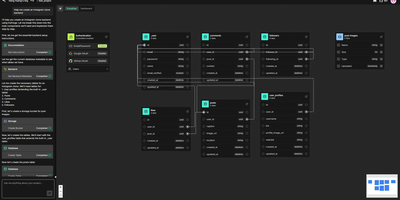
With 12,600 GitHub stars and 52 releases in under a year of development, InsForge is the fastest-growing open-source backend platform purpose-built for AI coding agents — giving Claude, Cursor, and any MCP-compatible tool direct access to database, authentication, storage, compute, and AI model infrastructure through a single self-hosted stack. The native MCP server exposes every InsForge operation as callable tools, letting coding agents autonomously create database tables, manage user authentication, upload files, deploy edge functions, and ship complete full-stack applications without human intervention. The Model Gateway provides an OpenAI-compatible API that routes requests across multiple LLM providers (OpenAI, Anthropic, Google, and open-source models) with unified billing, rate limiting, and fallback logic. PostgreSQL with pgvector handles both relational data and vector embeddings for RAG pipelines, while S3-compatible storage manages file uploads and static assets. Edge Functions run serverless TypeScript code on Deno with sub-millisecond cold starts for API endpoints, webhooks, and scheduled tasks. The authentication system provides user management, OAuth2 flows, sessions, and magic links with JWT token handling built in. Site Deployment builds and serves frontend applications with automatic SSL and custom domain configuration. The CLI paired with Agent Skills enables terminal-based workflows where agents invoke InsForge operations directly from the command line. Deploy via Docker with PostgreSQL as the only required external dependency. Running on a dedicated VPS on RepoCloud with guaranteed CPU, RAM, and SSD, full root SSH access, and a browser serial console. Apache-2.0 licensed.
CTFd
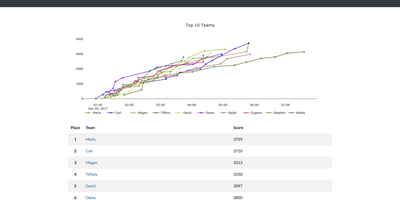
Starred by over 6,500 users on GitHub and trusted by organizations including Toyota, CTFd has been the leading open-source platform for hosting cybersecurity competitions since 2015, providing everything needed to run professional Capture The Flag events through a clean web-based administration panel without touching a database query. The framework supports both individual and team-based competitions with automatic tie resolution, configurable score freezing, and scoregraphs comparing the top teams with detailed progress tracking. Challenge creation offers static and regex-based flags, dynamic scoring that adjusts point values based on solve count, unlockable hints purchasable with points, file attachments uploaded to local storage or Amazon S3-compatible backends, and challenge attempt limits with automatic bruteforce protection. Version 3.8 introduced challenge logic fields controlling flag submission behavior with any, all, and team modes, integrated dynamic scoring into the standard challenge type, participant ratings and reviews on challenges, and admin-stored challenge solutions viewable after competition. The Markdown-based content management system enables custom pages for rules, FAQs, and resources, while SMTP and Mailgun integration handles email confirmation and password recovery. The plugin architecture supports custom challenge types, flag validators, and scoring algorithms, while the theme system provides complete visual customization. Import and export functionality preserves entire competition configurations for archival and reuse across events. Running on a dedicated VPS on RepoCloud with guaranteed CPU, RAM, and SSD, full root SSH access, and a browser serial console. Apache 2.0 licensed.
Super Productivity
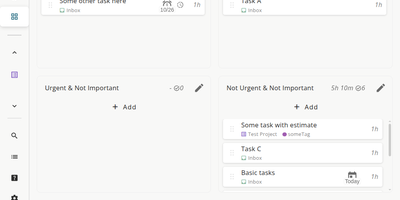
Super Productivity eliminates the context switching between issue trackers, calendars, and timer apps that fragments developer focus, pulling tasks from Jira, GitHub, GitLab, Gitea, OpenProject, Linear, ClickUp, Trello, and Azure DevOps into one local-first interface. With 21,000+ stars and availability across web, desktop, Android, and iOS, it syncs issue status, subtasks, and time logs bidirectionally so sprint planning and worklog submission happen without leaving the app. CalDAV integration pulls calendar events into your task timeline for visual timeboxing. Built-in Pomodoro and Flowmodoro timers enforce focused intervals with configurable break schedules. Data stays under your control in browser IndexedDB by default, with optional AES-encrypted sync via WebDAV, Nextcloud, Dropbox, or the SuperSync server ensuring no task data touches infrastructure you do not own. The extensible plugin system supports JavaScript-based custom panels, automations, and MCP plugins for AI workflows. A REST API on port 3876 enables external script integration for desktop automation. Time tracking generates exportable timesheets compatible with corporate reporting systems. The Docker container serves the Angular PWA through Nginx on port 80, consuming roughly 50 MB of RAM. Running on a dedicated VPS on RepoCloud with guaranteed CPU, RAM, and SSD, full root SSH access, and a browser serial console. MIT licensed.
TencentDB Agent Memory
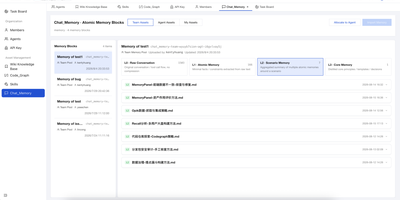
TencentDB Agent Memory provides a team-level memory hub that transforms AI agent conversations, documents, and codebases into four governed, shareable memory assets: Chat Memory for conversation history, Skills extracted from completed tasks, LLM-Wiki built from document ingestion, and Code-Graph generated from codebase analysis. The four-tier semantic pyramid structures long-term memory from L0 raw conversation capture through L1 episodic extraction and L2 scenario aggregation to L3 persona synthesis, enabling hierarchical drill-down via node and result references instead of flat vector recall. The Node.js Gateway sidecar handles capture, extraction, storage, recall, and pipeline scheduling through RESTful HTTP v2 endpoints on port 8420, while the Memory Proxy intercepts Anthropic-format API calls to inject team memory context into Claude Code, CodeBuddy, and other coding agents transparently. Local SQLite with the sqlite-vec extension provides the default storage backend with hybrid BM25 keyword plus vector embedding plus reciprocal rank fusion retrieval requiring zero external API dependencies. Teams manage ownership, versions, status, visibility, usage counts, and agent bindings through the Memory Hub dashboard with role-based access control separating System Admin and team-level Admin and Member permissions. Official TypeScript and Python SDKs provide programmatic access for custom framework integration beyond the built-in OpenClaw plugin and Hermes Agent adapter. Running on a dedicated VPS on RepoCloud with guaranteed CPU, RAM, and SSD, full root SSH access, and a browser serial console. MIT licensed.
Affine Pro
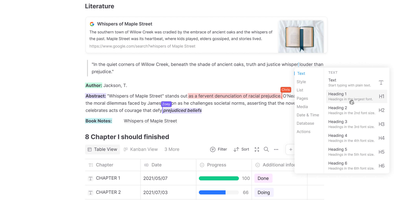
Gaining over 71,000 GitHub stars as one of the fastest-rising knowledge management platforms, AFFiNE merges the document editing capabilities of Notion, the infinite canvas of Miro, and the structured data of Airtable into a single cohesive workspace. The block-based editor built on the custom BlockSuite framework supports rich text, code blocks, embeds, tables, kanban boards, and database views with drag-and-drop composition. The whiteboard mode provides an infinite canvas where users can freely mix documents, sticky notes, shapes, connectors, and hand-drawn elements, enabling visual thinking alongside structured note-taking. Real-time collaboration allows multiple users to edit documents and whiteboards simultaneously with cursor presence, comment threads, and version history. The local-first architecture stores all data on your device by default using CRDT-based synchronization, ensuring offline access and data sovereignty, with optional cloud sync for cross-device availability. Workspaces organize content into hierarchical page trees with full-text search, favorites, tags, and trash management. The platform supports Markdown import and export, PDF export, and HTML export for interoperability. AI features powered by configurable LLM providers enable writing assistance, summarization, translation, and content generation directly within documents. The theming system supports light and dark modes with customizable accent colors. Running on a dedicated VPS on RepoCloud with guaranteed CPU, RAM, and SSD, full root SSH access, and a browser serial console. Licensed under MIT with an open-source self-hosted edition.
Wanderer
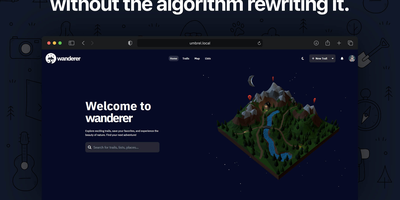
Wanderer provides a privacy-first alternative to AllTrails and Komoot, giving outdoor enthusiasts complete ownership of their GPS data on a self-hosted server. The platform accepts uploads in GPX, KML, FIT, and TCX formats, automatically extracting distance, elevation gain and loss, duration, and speed statistics to build a searchable trail catalogue. The built-in route planner uses the Valhalla routing engine to calculate hiking, cycling, and walking routes directly on the map, while MapLibre GL renders smooth vector tiles from OpenStreetMap data with configurable tile sources and overlay layers. Each trail supports rich metadata including difficulty ratings, categories, waypoints with descriptions, photo galleries, and summit log entries that track completion dates with optional GPS data. Meilisearch powers instant full-text search across trail names, descriptions, and tags, complemented by map-based spatial filtering and advanced date, distance, and elevation filters. The ActivityPub integration follows the same federation protocol as Mastodon, allowing users to follow explorers on other Wanderer instances and see their public trails, comments, and summit logs in a unified feed without requiring cross-instance accounts. The WASM-based plugin system enables third-party extensions for custom integrations. The Docker Compose stack runs three containers — SvelteKit frontend on port 3000, PocketBase backend with embedded SQLite, and Meilisearch — with startup completing in under 90 seconds. On RepoCloud, deploy Wanderer on a dedicated VPS with root SSH access, persistent storage for your trail database and uploaded photos, and complete control over routing, geocoding, and tile server configurations, all under the AGPL v3 license.
Redis
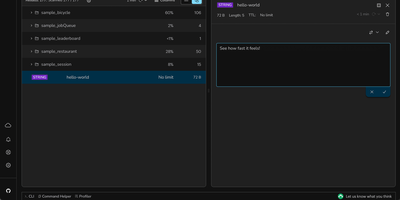
Processing billions of operations per second across companies like Twitter, GitHub, Snapchat, and Stack Overflow, Redis is the world's fastest and most widely deployed in-memory data store. Redis 8 unifies previously separate modules into a single distribution: RediSearch for full-text indexing with BM25 scoring and vector similarity search via HNSW and FLAT algorithms, RedisJSON for native JSON document storage with JSONPath queries, RedisTimeSeries for timestamped data with configurable downsampling compaction rules, and RedisBloom for probabilistic data structures including Bloom filters, cuckoo filters, count-min sketches, top-k, and t-digest. The core engine provides strings, lists, sets, sorted sets, hashes, streams, HyperLogLog, bitmaps, bitfields, geospatial indexes, and the new array data structure introduced in Redis 8.8. Pub/Sub delivers lightweight real-time messaging between publishers and subscribers, while Streams provide an append-only log with consumer groups for event sourcing and complex consumption patterns. Redis Cluster distributes data across nodes with automatic sharding using 16,384 hash slots, and Sentinel provides high availability with automatic failover monitoring. Lua scripting and Redis Functions enable server-side computation, and ACL-based security provides granular per-command, per-key access control. Official clients exist for Python, Node.js, Java, Go, .NET, Rust, and PHP. Running on a dedicated VPS on RepoCloud with guaranteed CPU, RAM, and SSD, full root SSH access, and a browser serial console. AGPLv3 licensed.
IRONSIGHT
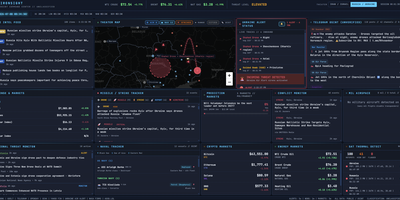
IRONSIGHT fuses over 50 publicly available intelligence sources into a single real-time dashboard that requires zero API keys and zero configuration. The Live Intel Feed aggregates 20+ RSS news sources with keyword relevance filtering from outlets including Reuters, Al Jazeera, and Kyiv Post. The Telegram OSINT module scrapes 27 channels every 60 seconds with automatic translation from Hebrew, Arabic, and Farsi. The interactive Leaflet Theater Map plots military aircraft positions via ADS-B transponder data, naval vessel locations in the Persian Gulf and Eastern Mediterranean, strike markers extracted from news and Telegram, missile trajectory arcs with range rings, and country-border overlays with a distance measurement tool. A header toggle switches the entire dashboard between Iran/Israel and Russia/Ukraine theaters, re-pointing every panel, map layer, and data feed to the selected conflict. The Israel Alert module streams live Pikud HaOref missile alerts with audio notifications, while the Conflict Monitor categorizes events into strikes, defense, diplomatic, and nuclear. Financial panels track defense contractor stocks, S&P 500, VIX, gold, Bitcoin, Ethereum, energy commodities via Yahoo Finance, and Polymarket prediction odds on conflict outcomes. NASA FIRMS satellite thermal detection flags fire and explosion signatures. The Next.js 16 App Router handles server-side data fetching for RSS and API endpoints while client-side React state management drives real-time polling updates. On RepoCloud, deploy IRONSIGHT on a dedicated VPS with persistent storage, root SSH access, and full control over your intelligence monitoring environment, all under the MIT license.

Pocket ID
Backed by over 8,700 GitHub stars and OpenID Connect certification, Pocket ID delivers what enterprise identity platforms like Keycloak provide but without the configuration complexity — a passkey-only OIDC provider purpose-built for homelabs and small deployments. The core design decision is radical simplicity: no passwords exist in the system, only WebAuthn-based passkeys using hardware security keys, TouchID, FaceID, or device PINs, making phishing attacks structurally impossible rather than merely discouraged. The Go backend built on the Gin framework serves a compiled SvelteKit frontend as static assets, running as a single Docker container with SQLite as the default database and optional PostgreSQL for larger deployments. User management supports manual creation, signup links, and open registration, with group-based access control that restricts which OIDC clients each group can access and attaches custom claims for downstream role mapping. LDAP synchronization pulls users and groups from OpenLDAP or Active Directory, while SCIM support enables automated provisioning from compatible identity sources. Federated client credentials handle machine-to-machine authentication for service-to-service communication patterns. The audit system logs every authentication event with GeoIP enrichment, sends email notifications for sign-ins from unknown devices, and provides one-time login codes for accessing accounts from devices without passkey support. TLS with HTTP/2 is built in, PKCE adds code exchange protection, and OpenTelemetry provides tracing and metrics integration. Running on a dedicated VPS on RepoCloud with guaranteed CPU, RAM, and SSD, full root SSH access, and a browser serial console. BSD 2-Clause licensed.
Bigcapital
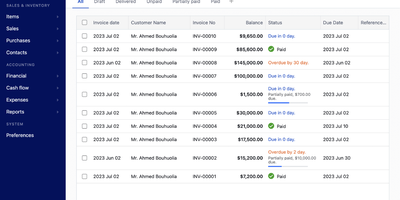
Bigcapital gives small and medium businesses a complete double-entry accounting, invoicing, and inventory management platform they can self-host for free, replacing the per-seat subscriptions of QuickBooks, Xero, and Wave. Every transaction records debits and credits across your chart of accounts, automatically generating balance sheets, profit and loss statements, trial balances, general ledger reports, journal entries, accounts receivable and payable summaries, cash flow analysis, inventory valuation, and inventory summary reports. Sales invoicing supports recurring schedules, customer payment tracking, estimate-to-invoice conversion, and configurable GST/VAT tax rates. Purchase invoicing handles vendor bills with expense categorization for payroll, rent, and operational costs. The inventory module tracks stock levels using FIFO and average cost methods, automatically adjusting quantities on every sale or purchase and providing reorder alerts. Multi-currency accounting converts transactions at real-time exchange rates and consolidates them under customer or vendor profiles with detailed currency reports. The platform deploys via Docker Compose with multi-tenant isolation giving each organization its own separate database, requiring as little as 2GB RAM for the complete production stack. A headless REST API with Postman collections lets developers embed the accounting engine into external applications for programmatic transaction management. Role-based permissions control access for team members and invited accountants across organizations. Running on a dedicated VPS on RepoCloud with guaranteed CPU, RAM, and SSD, full root SSH access, and a browser serial console. AGPL-3.0 licensed.