OpenCode Manager
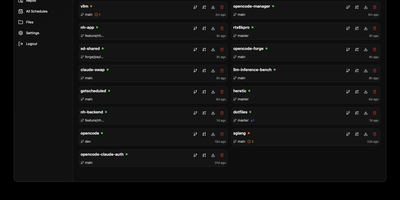
OpenCode Manager is a mobile-first command center for AI coding agents. Install the PWA on your phone or tablet and you get real-time streaming chat, multi-repository Git operations, and scheduled automation right in your pocket. Git integration handles SSH-authenticated repo cloning, worktree management, unified diffs, and branch operations across all your projects in one dashboard. Chat with coding agents through Server-Sent Events streaming that supports slash commands, @-mentions for files, Plan and Build modes, and Mermaid diagram rendering for architecture discussions. Schedule reusable prompts to run against any repository on intervals or cron expressions, with each run tracking history and linking to sessions so you can pick up exactly where automation left off. MCP server configuration adds local and remote HTTP servers with OAuth support, plugging into the broader Model Context Protocol ecosystem. A dedicated assistant workspace provides an isolated AI environment with auto-provisioned skills for managing schedules, notifications, and settings. Multiple AI providers are supported including Anthropic, GitHub Copilot, and OpenAI-compatible services, each configurable with custom system prompts and granular tool permissions. Push notifications alert you to session events, agent questions, errors, and task completions across all managed repositories.
LobeHub
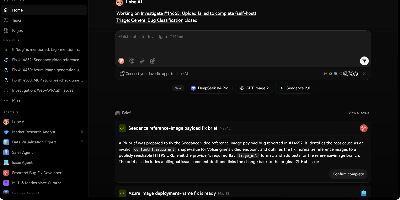
With over 82,000 GitHub stars and 700,000+ downloads, LobeHub has evolved from its origins as LobeChat into a comprehensive multi-agent AI collaboration platform where humans and autonomous agent teams co-evolve. The platform's Agent Harness architecture functions as an operating system between AI models and applications, handling prompt presets, tool orchestration, lifecycle hooks, planning, filesystem access, and sub-agent management across 25+ model providers including OpenAI, Anthropic Claude, Google Gemini, DeepSeek, Mistral, Groq, AWS Bedrock, Azure OpenAI, and local models through Ollama. Agent Groups enable sophisticated collaboration with sequential, parallel, iterative, and debate orchestration modes, allowing multiple specialized agents to tackle complex workflows simultaneously. The Agent Builder creates production-ready agents from natural language descriptions with auto-configuration, drawing from a marketplace of 505+ pre-built agents and 10,000+ MCP-compatible skills and plugins. Pages provide collaborative document editing with multi-agent co-authoring, while Schedules automate agent runs around the clock without human supervision. The knowledge base leverages PostgreSQL with pgvector for RAG-powered retrieval, and Personal Memory gives agents transparent, editable context that evolves through continual learning. The full self-hosted stack deploys via Docker Compose with PostgreSQL, Redis, RustFS for S3-compatible storage, and SearXNG for private web search, all configurable through environment variables. Running on a dedicated VPS on RepoCloud with guaranteed CPU, RAM, and SSD, full root SSH access, and a browser serial console. LobeHub Community licensed.
Polaris Control Plane
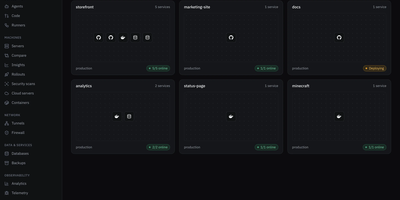
Polaris puts app deploys, file storage, team chat, tasks, and a password vault behind one login on a server you control. Deploy from a Git repository or an image with databases, volumes, environment variables, logs, a terminal, and a domain, published through your own domain, a Cloudflare tunnel, or DuckDNS. Enroll more machines over SSH with one generated command, then watch their containers and metrics and schedule backups with restore. Drive spans local disks, SFTP, S3-compatible storage, SMB, NFS, Google Drive, OneDrive, and Dropbox, with password-protected public links, expiry, and drop points for people without an account. Vault works with the Bitwarden apps and extensions and encrypts in the browser, so the server never sees your master password. Chat brings channels, threads, direct messages, voice and video calls, screen sharing, and a soundboard, while Tasks adds lists, boards, sprints, goals, and time tracking, and can hand work to coding agents over MCP. Calendar syncs both ways with Google, Microsoft 365, and CalDAV and offers booking pages. Game servers run Minecraft, ARK, and FiveM, a firewall blocks countries, networks, and bots, and one-click Marketplace installs add more apps. The interface comes in English and Spanish. Running on a dedicated VPS on RepoCloud with guaranteed CPU, RAM, and SSD, full root SSH access, and a browser serial console. AGPL-3.0 licensed.
Dagger
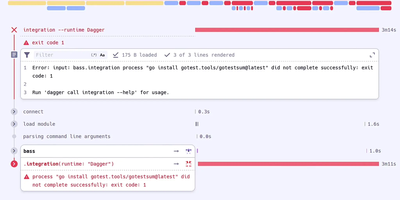
With 16,100 GitHub stars and created by Solomon Hykes (co-founder of Docker), Dagger eliminates proprietary YAML DSLs from CI/CD by letting developers write pipelines as real programs in their preferred language — then executing them identically on a laptop, in GitHub Actions, in GitLab CI, or on any machine with a container runtime. The BuildKit-based Dagger Engine runs every pipeline operation inside OCI containers, constructing a directed acyclic graph where each node is cached by default, parallelized automatically, and produces bit-for-bit reproducible outputs regardless of execution environment. Native SDKs generated from the GraphQL API schema provide Go, Python, TypeScript, PHP, Java, .NET, Elixir, and Rust developers with full type safety, IDE autocomplete, and the ability to unit-test CI pipelines using the same testing frameworks as application code. The module ecosystem enables cross-language composition where a Python team can invoke a Go team's build functions without learning Go, while filesystems, secrets, git repositories, and network tunnels are passed between functions as strongly-typed objects. Pipeline operations cache at container-layer granularity with content-addressed deduplication, and the interactive REPL enables step-by-step pipeline debugging with live container inspection. Host dependencies are explicit and strictly typed, eliminating implicit environment coupling that causes "works on my machine" failures. Running on a dedicated VPS on RepoCloud with guaranteed CPU, RAM, and SSD, full root SSH access, and a browser serial console. Apache 2.0 licensed.
ComfyUI
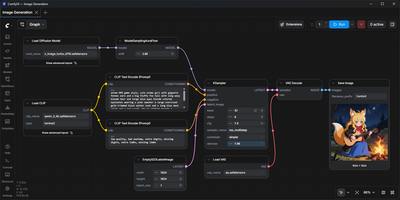
With over 126,000 GitHub stars and adoption across professional studios, research labs, and independent creators, ComfyUI has become the most widely used node-based interface for generative AI workflows — supporting image, video, audio, and 3D content creation through a single visual canvas. The graph editor natively supports Stable Diffusion 1.5, SDXL, SD3.5, Flux.1, Flux.2, HunyuanDiT, Lumina Image 2.0, HiDream, Qwen Image, and Pixart for image generation, plus Wan 2.1 and 2.2, LTX-Video, HunyuanVideo 1.5, CogVideoX, and Mochi for video, ACE-Step and Stable Audio for audio, and Hunyuan3D 2.0 for 3D models. Built-in tools handle inpainting, outpainting, ControlNet conditioning, LoRA and Hypernetwork loading, ESRGAN upscaling, area composition, model merging, and GLIGEN spatial control without writing code. The execution engine implements asynchronous queue processing with partial graph re-execution, running only changed nodes between iterations, and smart VRAM management that offloads models on GPUs with as little as 1 GB of memory. API nodes optionally connect to closed-source models through Comfy API while the core runs fully offline. Reusable subgraphs and App Mode expose complex workflows as simplified interfaces for non-technical users. The V3 custom node schema enables stateless execution with async support and process isolation. The TypeScript and Vue frontend ships as a PyPI package with stable releases every two weeks. Workflows save as JSON and embed in generated PNG, WebP, and FLAC files for reproducibility. Running on a dedicated VPS on RepoCloud with guaranteed CPU, RAM, and SSD, full root SSH access, and a browser serial console. GPL v3.0 licensed.
AstrBot
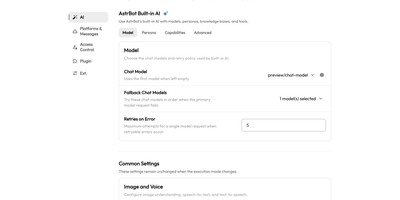
Getting a language model into the chat apps people already use takes a single self-hosted server running AstrBot, which answers in QQ, Telegram, Discord, Slack, Lark, DingTalk, LINE, and WeCom. The model itself is a setting. OpenAI-compatible endpoints, Anthropic, Google Gemini, DeepSeek, Ollama, and LM Studio all work, with fallback models and retry limits for failed requests, and Dify, Coze, or Alibaba Cloud Bailian can take over a conversation too. A bare model cannot act, so the built-in agent calls MCP servers and Skills, delegates to SubAgents, runs scheduled tasks, and executes code in an isolated sandbox. It cannot read your files either, so a knowledge base takes PDF, Word, Markdown, and EPUB uploads and searches them with hybrid dense and BM25 retrieval. Personas shape each bot's personality, and Whisper or Edge TTS adds speech. When an answer looks wrong, the ChatUI shows thinking, tool calls, token counts, and latency, and a per-message trace timeline shows how the bot got there. Because the panel steers the bot, administrator IDs, session whitelists, optional TOTP login, and HTTPS protect it. Backups live under System Settings, and the plugin market installs any of more than 1,000 extensions in one click. Running on a dedicated VPS on RepoCloud with guaranteed CPU, RAM, and SSD, full root SSH access, and a browser serial console. AGPL-3.0 licensed.
Jitsi Meet
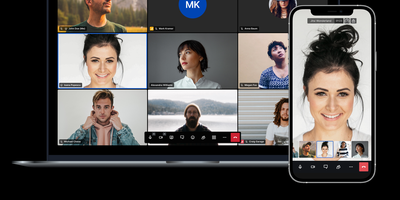
Backed by nearly 30,000 GitHub stars and powering millions of meetings through meet.jit.si, Jitsi Meet is the open-source video conferencing platform that runs entirely in the browser with no plugins or downloads required. The WebRTC-based architecture delivers HD audio and video through the Jitsi Videobridge selective forwarding unit, while Prosody handles XMPP signaling and Jicofo manages conference focus and orechestration. End-to-end encryption uses AES-GCM 128-bit keys exchanged via the Olm protocol, protecting audio, video, and screen sharing through the Insertable Streams API in Chromium-based browsers. Moderators can split participants into breakout rooms with individual password protection, enable lobby waiting rooms for admission control, set meeting passwords, and track speaker statistics with per-participant talk time metrics. Virtual backgrounds leverage TensorFlow.js body segmentation with WebGPU and WebGL acceleration, automatically adapting quality through device tier detection. Server-side recording and YouTube live streaming run through Jibri, while Jigasi provides a SIP gateway for PSTN dial-in and speech-to-text transcription. The platform includes in-meeting chat with private conversations, polls, raise-hand functionality, emoji reactions, and tile and speaker view layouts. Mobile applications for iOS and Android complement the web client, and both web and native SDKs enable embedding video conferences into custom applications. Running on a dedicated VPS on RepoCloud with guaranteed CPU, RAM, and SSD, full root SSH access, and a browser serial console. Apache-2.0 licensed.
AzuraCast
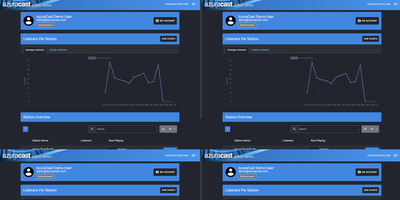
AzuraCast is a solution for running internet radio stations, packaging the entire broadcast stack into a single Docker installation that gets you on air in minutes. Built on PHP with a Vue.js frontend, it uses Liquidsoap as the AutoDJ engine to compile media from playlists, live DJ inputs, and scheduled programming into composited output streams, then broadcasts via Icecast-KH, SHOUTcast 2 DNAS, or Rocket Streaming Audio Server to thousands of concurrent listeners. The media library supports drag-and-drop uploads with automatic metadata extraction, while playlist management handles sequential, random, weighted, and time-scheduled rotations. Live DJ accounts let remote broadcasters connect via BUTT, Mixxx, or any Icecast-compatible software, with automatic crossfade transitions between AutoDJ and live input. The built-in Web DJ tool enables broadcasting directly from the browser without additional software. Each station includes public-facing player pages with now-playing metadata, album art, song history, and embeddable widgets for external websites. The listener request system lets audiences queue songs through the public interface. Multi-station administration hosts unlimited stations on a single server with individual user accounts and granular role-based permissions. Comprehensive analytics track listener counts, geographic distribution, unique listeners, and listening duration with exportable reports. HLS streaming delivers adaptive bitrate broadcasts for mobile compatibility. LADSPA audio plugins enable professional equalization and processing in the stream pipeline. Running on a dedicated VPS on RepoCloud with guaranteed CPU, RAM, and SSD, full root SSH access, and a browser serial console. AGPL-3.0 licensed.
ProjectSend
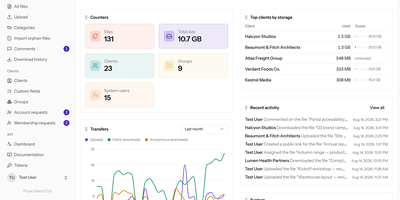
ProjectSend gives every client a private, signed-in page on your own server where only the files you assigned to them appear, so contracts, photo shoots, and quarterly reports skip the third-party file-sharing service. You upload once, then share a file or a whole folder with one client, a group, or anyone holding a public link, with an optional expiry date or download limit. Clients search, preview, and download files one by one or as a zip, whole folders included, comment on a document so questions stay beside it, and send files back within the quota you set. Uploads of up to 2 GB travel in resumable pieces, so a dropped connection pauses a transfer instead of ruining it. Folders, categories, custom client fields, and linked file versions keep a growing library tidy, while roles with granular permissions let staff work without becoming administrators. The activity log and download history record who received what and when, and the log exports to CSV. Sign-in works with email and password, LDAP, or Google and Microsoft accounts, with optional two-factor authentication. Your logo, watermark, themes, and editable email templates carry your brand, and the interface is translated into 16 languages. Optional virus scanning quarantines suspicious uploads, and a REST API with scoped tokens automates uploads, sharing, and account management. Running on a dedicated VPS on RepoCloud with guaranteed CPU, RAM, and SSD, full root SSH access, and a browser serial console. GPL-2.0-or-later licensed.
Chatterbox TTS
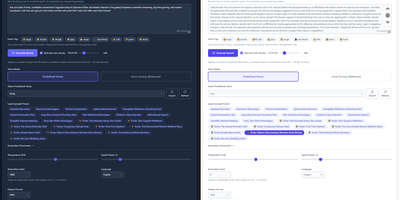
With 26,000 GitHub stars and consistent victories over ElevenLabs in blind evaluations, Chatterbox delivers state-of-the-art text-to-speech with zero-shot voice cloning requiring only 5 seconds of reference audio. The model family spans three architectures: Chatterbox Multilingual V3 (500M parameters, 23+ languages including Arabic, Chinese, Japanese, Korean, Hindi, French, German, Spanish, and Portuguese), Chatterbox-Turbo (350M parameters optimized for voice agents with a single-step distilled decoder achieving ~200ms time-to-first-speech), and Chatterbox-Nano (110M parameters running 3x faster than realtime on 8 CPU cores for edge deployment). Unique among open-source TTS systems, Chatterbox introduces emotion exaggeration control — adjusting intensity from monotone to dramatically expressive via a single parameter — and native paralinguistic tagging where tokens like [laugh], [cough], [chuckle], and [gasp] inject natural vocal reactions inline without post-processing. The alignment-informed inference pipeline eliminates hallucinations and repetition artifacts common in autoregressive TTS. Built-in PerTh neural watermarking embeds imperceptible forensic identifiers in generated audio for provenance tracking. Trained on 500,000 hours of cleaned speech data across all supported languages. Voice conversion scripts enable transforming existing audio into any cloned voice. Deploy via pip install with PyTorch, serve through Gradio interfaces or custom FastAPI endpoints, and expose via HTTP streaming or WebSocket for sub-200ms conversational applications. Running on a dedicated VPS on RepoCloud with guaranteed CPU, RAM, and SSD, full root SSH access, and a browser serial console. MIT licensed.
OpenViking
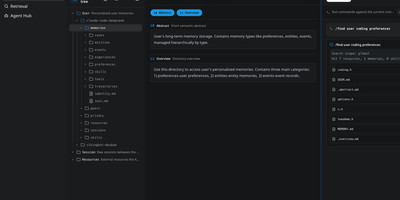
OpenViking is a self-hosted context database that gives AI agents persistent, structured memory by organizing knowledge, skills, and session history into a hierarchical virtual filesystem accessible through the viking:// URI protocol. Instead of dumping everything into a flat vector store and hoping semantic search finds the right chunks, agents navigate their context with familiar commands like ls, tree, and find, locating exactly the information they need through deterministic paths combined with semantic search. Every resource is automatically processed into three layers: a 100-token L0 abstract for quick filtering, a 2,000-token L1 overview for content navigation, and the full L2 detail loaded only when confirmed necessary. This tiered approach cuts token consumption by 83 to 96 percent compared to conventional RAG while improving task completion rates by 15 to 49 percent on benchmark tests. The built-in memory self-iteration loop automatically analyzes task execution and user feedback, updating agent memory directories so the system continuously learns and improves. You can connect to any LLM provider, including Ollama for fully local inference, OpenAI, or compatible gateways. The Web Studio UI at the /studio endpoint provides visual browsing of the entire context filesystem, and the REST API on port 1933 supports programmatic access. Deploy via Docker, Kubernetes with the included Helm chart, or as a standalone service. Running on a dedicated VPS on RepoCloud with guaranteed CPU, RAM, and SSD, full root SSH access, and a browser serial console. AGPL-3.0 licensed.
JupyterHub
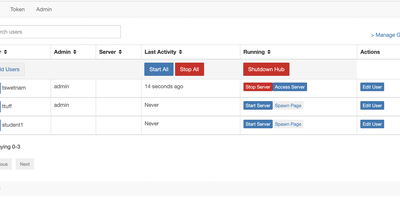
One server, a login for everyone, and a private JupyterLab in every browser tab: that is the whole pitch, and for classrooms and research teams it is transformative. JupyterHub authenticates each user against your existing identity system (campus OAuth, GitHub, Google, LDAP, or local accounts), then spawns a dedicated single-user server just for them, with their files, their kernels, and their compute allocation. Users open notebooks, terminals, and extensions in JupyterLab without installing anything, and their environment is identical whether they log in from a lab workstation or a laptop at home. The Spawner decides where those servers live: plain processes on one machine for a small class, Docker containers for isolation, or Kubernetes pods that scale across a cluster for a whole university. Administrators manage users, groups, and named servers from the admin panel, grant precise permissions through roles and scopes, and watch start times and profiles for every running server. External services plug into the Hub API, so dashboards, autograders, and portals can authenticate through the same OAuth machinery. When a user disappears for the semester break, culling stops their idle server and frees the resources. Running on a dedicated VPS on RepoCloud with guaranteed CPU, RAM, and SSD, full root SSH access, and a browser serial console. BSD-3-Clause licensed.
Tau
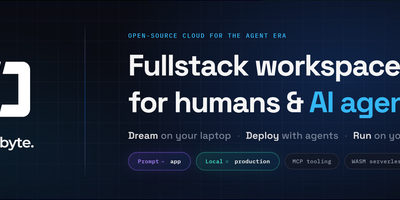
Tau delivers a complete self-hosted cloud platform where Git is the control plane and WebAssembly is the runtime. The Go binary deploys as interconnected nodes that form a P2P network using libp2p for automatic service discovery, eliminating Kubernetes entirely. Serverless functions compile to WebAssembly for secure multi-tenant execution with automatic horizontal scaling — write in Go, Rust, AssemblyScript, or C and deploy by pushing to Git. Branch-based environments map Git branches to isolated deployments, so staging and production run identical infrastructure from different refs. Static website hosting serves frontends with global distribution and automatic content-addressed deduplication via IPFS-derived storage. The built-in K/V database provides distributed storage with automatic replication across nodes, while object storage handles file management with content addressing. Pub/Sub messaging enables real-time communication between functions and external services including WebSocket support. Spore Drive automates multi-host deployment and rolling updates from a single command across bare metal or VMs running Ubuntu. The Dream CLI provides a complete local development environment that mirrors production exactly — same services, same routing, same deployment flow. Zero-configuration HTTPS provisions TLS certificates automatically for custom domains. The web console at console.taubyte.com provides visual project management, or use the tau CLI for Git-native workflows. Running on a dedicated VPS on RepoCloud with guaranteed CPU, RAM, and SSD, full root SSH access, and a browser serial console. BSD-3-Clause licensed.
Redmine
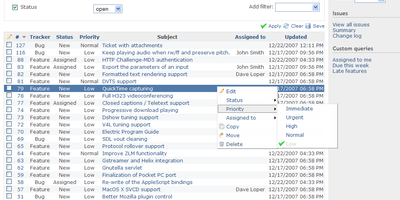
Nearly two decades running engineering organizations: Redmine is the veteran open-source project management and issue tracker, a Ruby on Rails application (GPLv2) still in active development. Its core strength is configurability: define your own trackers (bug, feature, task, or anything else), issue statuses, and role-based workflows that control exactly which transitions each role may perform, then extend records with custom fields of every type. Issues support subtasks, relations (blocks, precedes, duplicates), watchers, categories, and full journaled history, with saved custom queries and cross-project filtering for slicing the backlog any way you need. Around the tracker sit Gantt charts and calendars, a roadmap driven by versions, per-project wikis, forums, news, and document repositories, plus time tracking with estimated versus spent hours and activity-based reporting. Multi-project support runs deep - subprojects, per-project modules, and granular role-based permissions - and repository integration (Git, Subversion, Mercurial) links commits to issues automatically. Email notifications, inbound email-to-issue creation, LDAP authentication, a REST API, and a large plugin and theme ecosystem round it out. Recent 6.x releases brought substantial query and rendering optimizations. Self-hosting keeps your entire project history in your own database, free of per-seat licensing.
Casdoor
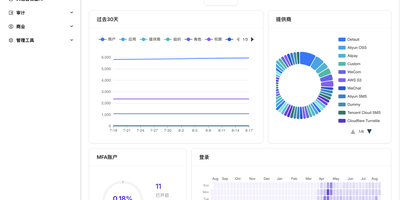
With 13,800+ GitHub stars and active releases through 2026, Casdoor is the open-source identity platform that ships OAuth 2.0, OIDC, SAML 2.0, CAS, LDAP, SCIM 2.0, WebAuthn passkeys, TOTP multi-factor authentication, and Face ID biometric login in a single Go binary with a React web console — covering every authentication protocol your organization will ever need. Social login connects 50+ identity providers including Google, GitHub, Microsoft Azure AD, Facebook, WeChat, DingTalk, Apple, Twitter, and LinkedIn without custom code. The AI-first architecture includes a Model Context Protocol gateway for AI agent authentication and Agent-to-Agent protocol support for securing LLM-powered workflows. Built-in Casbin integration delivers authorization primitives beyond basic RBAC: attribute-based access control, relationship-based access control, and custom policy models through a unified engine. The organization-scoped multi-tenancy model isolates users, applications, and identity providers per tenant with customizable login pages, branding, and SMTP configuration. SCIM 2.0 endpoints automate user provisioning from HR systems and Active Directory. Official SDKs for Go, Java, Node.js, Python, and PHP accelerate application integration. The RESTful API exposes every resource for programmatic management. Comprehensive audit logs record authentication events and administrative actions. Deploy via Docker Compose with MySQL or PostgreSQL, the all-in-one SQLite Docker image for quick trials, or the official Kubernetes Helm chart for production clusters. Running on a dedicated VPS on RepoCloud with guaranteed CPU, RAM, and SSD, full root SSH access, and a browser serial console. Apache 2.0 licensed.
OSIRIS
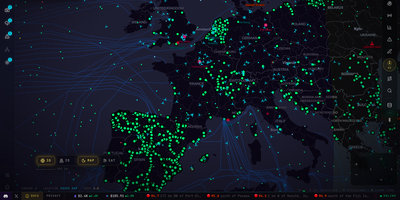
Plotting live flights, earthquakes, wildfires, satellites, and news streams on one night-mode map, OSIRIS gives open-source intelligence work a single browser tab to live in. Sixteen layers toggle on and off with live entity counts. Aviation covers commercial, private, and military traffic. Ports and chokepoints, severe weather, space weather, and 15 hand-curated conflict zones get layers too. More than 17,000 public cameras open in a viewer when you click a pin. Draw a region, list every camera inside it, and export the set as GeoJSON. Twenty-three live news streams open from dots on the map. Double right-click anywhere for a Region Dossier with the place, country facts, head of state, and a Wikipedia summary. A Markets terminal follows indices, stocks, oil, commodities, currencies, and crypto, with a watchlist. Live Alerts sorts headlines, warnings, and quakes into searchable tabs. The Recon toolkit runs DNS, WHOIS, certificate, and subdomain lookups, searches the OFAC sanctions list, and traces BTC and ETH wallets. OI, the built-in assistant, flies the map to a place and switches layers on from typed or spoken requests. Its Forecast mode plays competing actors against each other in parallel simulated worlds and writes a sourced prediction on your own model key. Six preset themes restyle the whole interface. Running on a dedicated VPS on RepoCloud with guaranteed CPU, RAM, and SSD, full root SSH access, and a browser serial console. MIT licensed.
Autobase
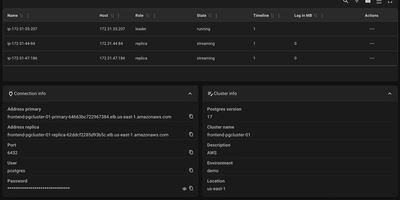
Provisioning, scaling, and maintaining production-grade PostgreSQL clusters becomes completely automated with Autobase, an internal database-as-a-service control plane. Through a unified web console, database administrators provision multi-node replication topologies, execute non-disruptive minor version updates, and orchestrate automated failovers without manual intervention. Operators can configure continuous physical backups and point-in-time recovery to S3-compatible object storage, ensuring resilient disaster recovery for mission-critical workloads. The integrated dashboard provides granular visibility into cluster topology, replication lag, connection pool saturation, and query throughput across primary and replica instances. Teams can scale read capacity on demand by provisioning dedicated read replicas and load-balanced query endpoints managed by intelligent routing layers. Comprehensive backup verification routines run scheduled restore rehearsals to confirm data integrity before emergencies occur. Automated maintenance playbooks handle index reindexing, vacuum scheduling, and parameter tuning without requiring custom shell scripts. Running on a dedicated VPS on RepoCloud with guaranteed CPU, RAM, and SSD, full root SSH access, and a browser serial console. MIT licensed.
Bex
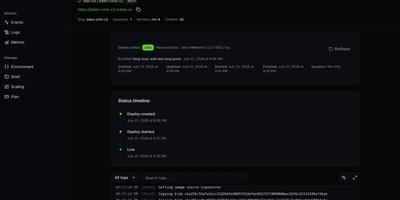
To give engineering teams a Render-style workflow of connecting a repository and getting a live HTTPS URL on infrastructure they control, Bex builds and runs web services, private services, background workers, cron jobs, and static sites from Git or container images. Dockerfiles and native builds for Node.js, Python, Go, Ruby, Rust, and Elixir deploy from public or private GitHub repositories with push-to-deploy, health checks, pre-deploy commands, and manual or policy-driven autoscaling. Blueprints in render.yaml format describe multi-resource environments in one file, and a Render-compatible CLI and API let existing tooling carry over where supported. Deploy history with cancel and rollback, live log tailing with search and filters, CPU and memory charts marked with deploy events, and suspend, resume, restart, native SSH, and browser shell controls cover daily operations. Custom domains receive automatic TLS certificates, and environment variables and secret files save and deploy in one step. Managed PostgreSQL provides backups with point-in-time recovery, high availability, and read replicas, and managed Valkey-compatible Key Value adds persistence and backups. Workspaces, projects, and environments come with OpenFGA roles, OAuth 2.1, API keys, audit logs, and signed outbound webhooks. Coding agents operate the same control plane through a remote or stdio MCP server with OAuth consent, deploy-from-chat, managed sandboxes, and structured machine-readable status, since no action is dashboard-only. Running on a dedicated VPS on RepoCloud with guaranteed CPU, RAM, and SSD, full root SSH access, and a browser serial console. Apache-2.0 licensed.