MediKeep
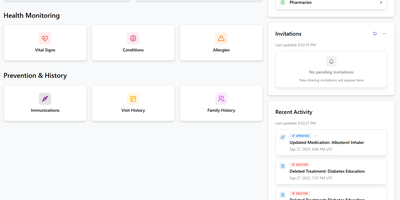
Your medical history, fragmented across a dozen patient portals, in one place on your server: MediKeep (formerly Personal Medical Records Keeper) is a self-hosted health record system. Built with a React frontend and FastAPI backend over PostgreSQL, it organizes 14 categories of medical data - medications with dosages and schedules, conditions, procedures, allergies, immunizations, symptoms, injuries, doctor visits and encounters, treatments, lab results, and even medical equipment with service dates and supplier info. Treatment management is genuinely sophisticated: an advanced mode links treatments to their medications with per-medication overrides for prescriber, pharmacy, and effective dates, and reverse lookup shows which treatments use a given medication. A dashboard summarizes records and recent activity, file uploads attach documents to records, and tagging works across categories. When a new specialist asks for your history, the report builder assembles custom reports by category and exports to PDF, JSON, or CSV - a curated, portable summary instead of a folder of photocopies. Authentication supports Google and GitHub SSO with OIDC providers like Keycloak and Authelia expected to work, and the built-in backup system protects the archive. Health data is exactly what should never live in someone else's cloud.

Tautulli
Plex's own dashboard shows current streams and forgets everything else - which is why every Plex server admin eventually installs Tautulli, the analytics layer. This Python web application (descended from PlexWatch and Headphones) logs complete watch history - what was watched, who watched it, when, where, from which device and IP, and whether it played directly or transcoded - and turns it into clean Highcharts graphs of daily plays, concurrent streams, bandwidth, and platform breakdowns. The home page surfaces top statistics over configurable windows: most-watched content, most active users, stream type ratios. For running a server shared with family and friends, this is operational truth: spot the user forcing 4K transcodes on a phone, see which libraries earn their disk space, and track sync activity across users. The notification engine triggers on server events - playback starts, transcode decision changes, recently added media, server down - through dozens of agents (Discord, Telegram, Slack, email, webhooks) with fully customizable text and conditions, plus arbitrary script execution. Scheduled newsletters email your users a styled digest of recently added content. A comprehensive API exposes every statistic for dashboards like Homarr, and an official mobile app monitors activity on the go. Themed to match Plex/Web. GPL-licensed.
Strapi
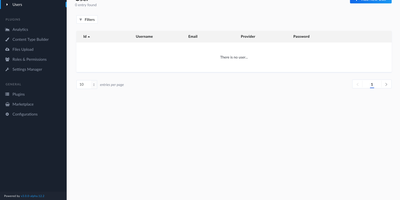
The leading open-source headless CMS with over 72,800 GitHub stars and more than 20 million npm downloads, Strapi has powered content APIs for thousands of organizations since its creation in 2015, providing a complete backend for websites, mobile applications, IoT devices, and any frontend framework through auto-generated REST and GraphQL endpoints. The visual Content-Type Builder lets editors define collections, single types, components, dynamic zones, and relations without code, while Strapi AI introduced in 2026 generates complete content schemas from natural language descriptions, Figma file uploads, or existing JavaScript application code analysis. Version 5 rewrote the platform with a TypeScript-first architecture, replacing the Entity Service with the Document Service API, switching admin panel builds from Webpack to Vite, and integrating internationalization directly into core with unlimited locale support. Database flexibility spans PostgreSQL, MySQL, MariaDB, and SQLite with automatic migration handling. The media library manages uploads to local storage, Amazon S3, or Cloudinary with image optimization and responsive formats. Granular role-based access control defines permissions per content type, field, and locale. The plugin marketplace extends functionality with GraphQL, SEO, email, custom fields, and community contributions, while lifecycle hooks, custom controllers, and middleware enable arbitrary backend logic. Draft and publish workflows, webhooks for external system integration, API token authentication, data import and export, and CRON job scheduling round out a platform that handles content operations from prototype to production. Running on a dedicated VPS on RepoCloud with guaranteed CPU, RAM, and SSD, full root SSH access, and a browser serial console. MIT licensed.
XWiki
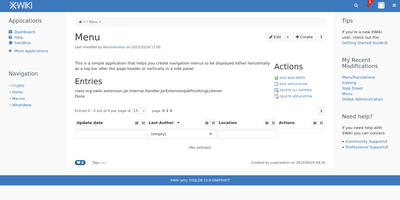
With over 140,000 code commits, 1,200+ GitHub stars, and continuous development since 2004 spanning more than two decades of active maintenance through version 18.6.0 released in July 2026, XWiki operates as a second-generation wiki platform that goes beyond static pages by enabling teams to build custom collaborative applications directly inside wiki pages using structured data forms and in-page scripting. The Java backend runs on Apache Tomcat with PostgreSQL, MySQL, or Oracle database storage, serving a responsive web interface with a WYSIWYG editor featuring real-time collaborative editing, link and macro editors, user mentions, inline comments, annotations, and complete version history with diff comparison. The App Within Minutes extension lets non-developers create custom data-driven applications using drag-and-drop form builders that generate filterable live tables for structured data browsing without writing code. Over 900 extensions from the built-in Extension Manager add functionality including blogs, task trackers, forums, diagram editors, and Confluence migration tools. Enterprise integration features include LDAP and Active Directory authentication, SAML and OIDC single sign-on, fine-grained per-page and per-space permissions with nested page hierarchies, and multi-wiki support for hosting multiple independent wikis from a single installation. The RESTful API provides programmatic access to pages, spaces, objects, attachments, and properties with XML and JSON representations. Office document import converts Word and Excel files directly into wiki pages while PDF export generates formatted documents from wiki content. Running on a dedicated VPS on RepoCloud with guaranteed CPU, RAM, and SSD, full root SSH access, and a browser serial console. LGPL-2.1 licensed.
AnythingMCP
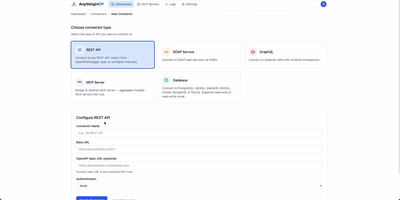
Connecting autonomous AI assistants to internal enterprise databases and legacy systems is streamlined by AnythingMCP, a visual Model Context Protocol gateway with automated knowledge graph generation and granular access controls. Engineers can import OpenAPI specifications, Postman collections, SOAP WSDL files, or raw database credentials to generate standardized Model Context Protocol tools in minutes without writing custom code. The built-in knowledge graph automatically maps entity relationships across disparate databases and software platforms, teaching agents how to correlate customer records in CRM tools with live order histories in enterprise resource planning software. System administrators can enforce fine-grained access policies by restricting tool execution permissions to specific roles and scoping database operations to read-only queries with strict row limits. An interactive web console provides real-time tool inspection, payload testing, request tracing, and comprehensive audit logs that capture every upstream invocation with full parameter visibility. Enterprise teams can integrate identity providers through OAuth2, SAML single sign-on, and SCIM automated user provisioning while protecting sensitive credentials using AES-256-GCM encryption at rest. Running on a dedicated VPS on RepoCloud with guaranteed CPU, RAM, and SSD, full root SSH access, and a browser serial console. GNU AGPLv3 licensed.
Veritas Kanban
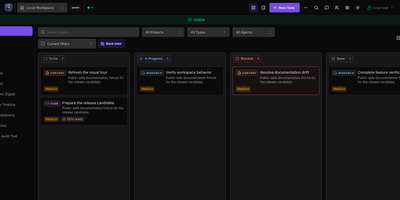
A drag-and-drop task board that works fine on its own and can also hand cards to AI coding agents, Veritas Kanban shows what each agent is doing, what it changed, and what is waiting for your approval. Start with no agents at all. Cards move through To Do, In Progress, Blocked, and Done, and each one carries subtasks, dependencies, time tracking, comments, and an activity log. When you are ready, connect Codex, Claude Code, Copilot CLI, Hermes, or OpenClaw, give every agent an Intern, Specialist, or Lead permission level, and follow each agent's status and model on a live dashboard. Let a task run in its own Git worktree, read the diff, leave inline comments, approve or request changes, and open a GitHub pull request from the task panel. Squad Chat gives agents one shared channel that posts spawned, completed, and failed events. Workflows chain steps with parallel branches, loops, and human approval gates. Policy rules allow, deny, or hold agent actions for review. Assistants reach the board through an MCP server, a command-line client, or a REST API. Running on a dedicated VPS on RepoCloud with guaranteed CPU, RAM, and SSD, full root SSH access, and a browser serial console. MIT licensed.
Payload CMS
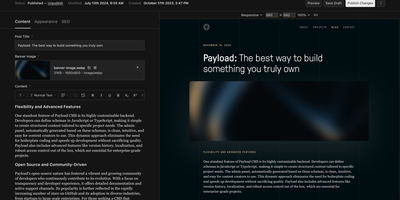
Backed by 44,000 GitHub stars and now part of Figma, Payload is the first headless CMS that installs natively into your Next.js application's /app directory rather than running as a separate service. The code-first architecture uses TypeScript config files to define collections, globals, and field schemas — from which Payload auto-generates database tables with migrations, a fully customizable React admin panel, REST and GraphQL endpoints, and type-safe Node.js local APIs you can call directly in React Server Components. The Lexical-based rich text editor supports block-based layout building, inline media embeds, and nested field structures, while the built-in localization engine handles unlimited locales with field-level translations. Authentication ships out of the box with HTTP-only cookie sessions, CSRF protection, role-based access control definable at the document, field, and operation level, and support for OAuth providers. Version history tracks every document change with full draft and publish workflows, and Live Preview renders content edits in real-time using server components. The job queue system manages background tasks and multi-step workflows deployable via Vercel Cron or standalone workers. Database flexibility spans PostgreSQL, MongoDB, and SQLite through swappable adapters, and the plugin ecosystem includes official modules for SEO, form builders, redirects, nested documents, and search alongside hundreds of community extensions. Running on a dedicated VPS on RepoCloud with guaranteed CPU, RAM, and SSD, full root SSH access, and a browser serial console. MIT licensed.
Wanderer
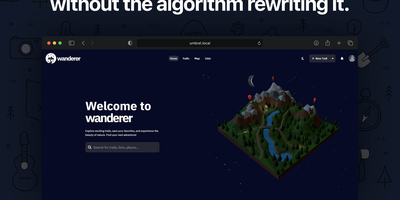
Wanderer provides a privacy-first alternative to AllTrails and Komoot, giving outdoor enthusiasts complete ownership of their GPS data on a self-hosted server. The platform accepts uploads in GPX, KML, FIT, and TCX formats, automatically extracting distance, elevation gain and loss, duration, and speed statistics to build a searchable trail catalogue. The built-in route planner uses the Valhalla routing engine to calculate hiking, cycling, and walking routes directly on the map, while MapLibre GL renders smooth vector tiles from OpenStreetMap data with configurable tile sources and overlay layers. Each trail supports rich metadata including difficulty ratings, categories, waypoints with descriptions, photo galleries, and summit log entries that track completion dates with optional GPS data. Meilisearch powers instant full-text search across trail names, descriptions, and tags, complemented by map-based spatial filtering and advanced date, distance, and elevation filters. The ActivityPub integration follows the same federation protocol as Mastodon, allowing users to follow explorers on other Wanderer instances and see their public trails, comments, and summit logs in a unified feed without requiring cross-instance accounts. The WASM-based plugin system enables third-party extensions for custom integrations. The Docker Compose stack runs three containers — SvelteKit frontend on port 3000, PocketBase backend with embedded SQLite, and Meilisearch — with startup completing in under 90 seconds. On RepoCloud, deploy Wanderer on a dedicated VPS with root SSH access, persistent storage for your trail database and uploaded photos, and complete control over routing, geocoding, and tile server configurations, all under the AGPL v3 license.
LinguaCafe
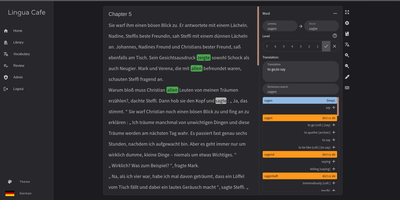
LinguaCafe turns your own reading material, novels, news sites, ebooks, and video subtitles, into a private language tutor that lives entirely on your server. Import a text and every word starts out highlighted as new; as you read and mark words known, the highlighting thins out until whole pages sit clean. When an unknown word stops you, the built-in vocabulary search shows its dictionary form, so inflected verbs surface as their infinitive and nouns carry their gender, while optional DeepL translation covers anything the dictionaries miss. Marking a word adds it to your vocabulary, and multi-word selections become phrases that stay highlighted everywhere they appear again. Chapters track how many new, highlighted, and known words they contain, which makes judging a text's difficulty a glance instead of a guess. The review system cycles highlighted words through Leitner-style spaced repetition, and anything you collect can be exported or pushed straight into Anki through AnkiConnect for study on your phone. Japanese learners get kanji and radical breakdowns beside the reading pane. Everything stays local: your books, your words, and your progress never leave the machine. Running on a dedicated VPS on RepoCloud with guaranteed CPU, RAM, and SSD, full root SSH access, and a browser serial console. GPL-3.0 licensed.
DAC
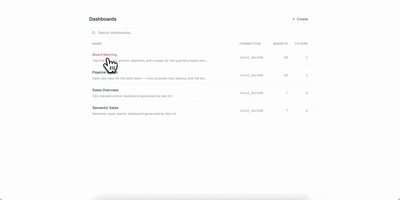
Your dashboards deserve version control, code review, and reproducible builds, just like the rest of your stack. DAC lets you define interactive data dashboards in YAML or TSX, validate them in CI, and serve them from a single Go binary that embeds a full React frontend. Choose from 21 chart types including line, bar, area, pie, scatter, bubble, funnel, sankey, heatmap, calendar, sparkline, waterfall, gauge, treemap, radar, and candlestick, plus metric cards, data tables, text blocks, and image widgets. The built-in semantic layer lets you define metrics and dimensions once in reusable model files, then reference them from any widget while DAC generates the SQL automatically. Connect to Postgres, MySQL, Snowflake, BigQuery, Redshift, Databricks, and DuckDB through standard Bruin connection configs. Interactive filters with date pickers, dropdowns, multiselects, and search inputs inject values via Jinja templating and re-execute only affected widgets. Live reload via Server-Sent Events refreshes connected browsers instantly when you save a file. Export dashboards as self-contained static HTML with baked-in query results for S3, GitHub Pages, or offline sharing, and render slide decks via the Google Slides export command. On RepoCloud, deploy DAC on a dedicated VPS with root SSH access and persistent storage for your dashboard definitions and database connections under the AGPL-3.0 license.
Wallos
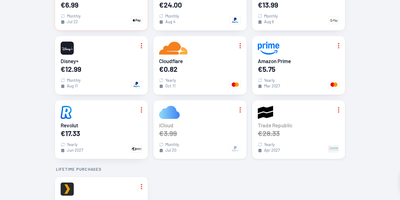
Track every recurring payment you have, from streaming services to SaaS tools, and get AI-powered recommendations on where to cut costs. Wallos manages subscriptions with automatic due date reminders delivered through email, Discord, Telegram, Pushover, Gotify, or custom webhooks so renewal charges never catch you off guard. Multi-currency support handles international subscriptions while the Fixer API converts everything to your primary currency for unified budget visibility. The statistics dashboard breaks down monthly and yearly spending by customizable categories, revealing consumption patterns and highlighting savings opportunities. AI analysis via ChatGPT, Gemini, or a locally-hosted Ollama instance reviews your subscription portfolio and suggests alternatives or consolidation strategies. Logo search automatically fetches brand imagery so your subscription list stays visually organized without manual uploads. Authentication supports OIDC with OAuth for enterprise environments, and the mobile-responsive interface works on any device with customizable themes and multi-language support. The PHP 8.3 application with SQLite backend runs from a single Docker container (bellamy/wallos image) with two persistent volumes for database and logos on port 8282. Deploy on RepoCloud with a dedicated VPS, keeping all financial data private under the GPL-3.0 license.
Knowhere
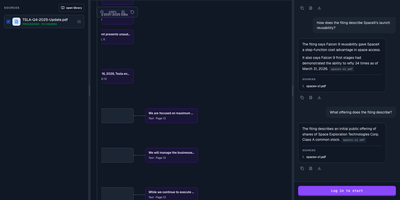
With 2,600+ GitHub stars since its May 2026 open-source launch, Knowhere solves the last-mile problem of document intelligence for AI systems — transforming complex unstructured PDFs, reports, and multi-page documents into structured JSON chunks that LLMs can consume without hallucination. The platform processes documents through an AI-native parsing pipeline that handles 20+ page documents with deep hierarchies, intricate tables, and multimodal content including images with OCR, achieving 95% precision in information extraction while reducing token costs by 50% compared to raw document ingestion. The knowledge tree architecture maintains historical context across multiple documents, enabling cross-document graph navigation for agentic retrieval that goes beyond simple chunk-based RAG. Built on Python 3.11+ with MinerU as the default PDF parser, the backend API runs alongside async workers that process document ingestion, graph construction, and embedding generation. The self-hosted Docker Compose stack packages the API server, processing workers, and Next.js dashboard for managing API keys, webhooks, and document-processing jobs, backed by PostgreSQL and Redis. Both Python and Node.js SDKs provide programmatic access for integration into existing AI pipelines and agent frameworks. LLM providers include DeepSeek and Alibaba Cloud DashScope with configurable key rotation for rate-limit management. Deploy on a dedicated VPS on RepoCloud with guaranteed CPU, RAM, and SSD, full root SSH access, and a browser serial console. Apache 2.0 licensed.
Liwan
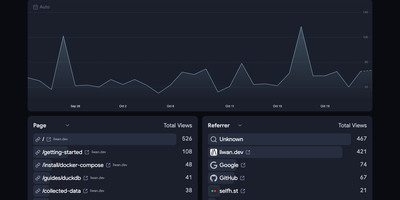
When you want honest traffic numbers without tracking cookies or stored IP addresses, Liwan puts a real-time analytics dashboard on your own server. The dashboard ranks pages, referrers, countries, browsers, platforms, and devices, charts visitors over time, and filters out bot traffic by default. Session metrics add bounce rate, average time on site, and entry and exit pages, while UTM fields attribute visits to campaigns. Collection is adjustable globally and per site: choose how visitors are grouped, whether to store country and city, country only, or no location, and how long events are kept. Drop rules discard internal, test, and local traffic before storage, and a pruning tool applies new settings to history after a dry-run preview. Tracking is one line of HTML, or your own server can send events with custom names and properties. Location can come from a MaxMind database or from Cloudflare, Vercel, and other proxy headers. One instance holds several projects and sites, with team accounts and single sign-on through Google Workspace, Microsoft Entra ID, or an OpenID Connect provider such as Keycloak or Dex. Running on a dedicated VPS on RepoCloud with guaranteed CPU, RAM, and SSD, full root SSH access, and a browser serial console. Apache-2.0 licensed.
MeshCentral
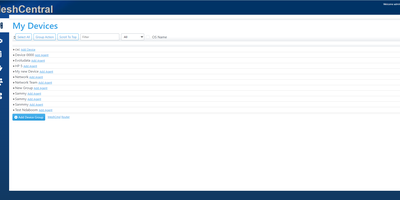
With over 7,000 GitHub stars and continuous development since 2017 by former Intel engineer Ylian Saint-Hilaire, MeshCentral has become the go-to self-hosted alternative to ConnectWise Control and Splashtop for managing devices remotely without per-seat licensing fees. The Node.js server installs via a single npm command and manages Windows, macOS, Linux, and FreeBSD endpoints through lightweight agents that maintain persistent WebSocket connections for real-time remote desktop, terminal access, and file transfer directly in the browser. Intel AMT integration provides out-of-band hardware management including power control and BIOS access even when the operating system is unresponsive. Device groups organize endpoints by location, customer, or function with granular role-based access control for multi-technician environments. Session recording captures remote desktop interactions for compliance auditing, while Wake-on-LAN powers on machines remotely across subnets. The server supports MongoDB for production deployments handling thousands of agents or the embedded NeDB for smaller setups under 200 devices, with a single 8GB VPS comfortably managing 1,500 concurrent agents. Security features include mandatory TLS with automatic Let's Encrypt certificate provisioning, multi-factor authentication via TOTP and FIDO2, SAML-based single sign-on, IP filtering, and HashiCorp Vault integration for secrets management. The web console provides real-time device monitoring with hardware and software inventory, network topology visualization, and customizable branding. TacticalRMM uses MeshCentral as its remote access layer. Running on a dedicated VPS on RepoCloud with guaranteed CPU, RAM, and SSD, full root SSH access, and a browser serial console. Apache-2.0 licensed.
Lingva Translate
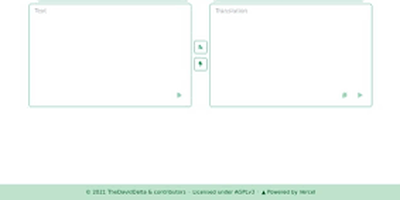
What Nitter was to Twitter and Invidious is to YouTube, Lingva Translate is to Google Translate: a privacy front-end delivering the service's full capability while cutting Google out of the loop between you and your text. Built on Next.js with TypeScript and Chakra UI, it uses the purpose-built Lingva Scraper to fetch translations from Google Translate without your browser ever touching a Google-related service - no cookies, no tracking, no account, while retaining what makes Google Translate hard to give up: 100+ languages with the translation quality of Google's production models, unlike offline engines that trade privacy for accuracy. The clean interface covers automatic source-language detection, text-to-speech audio playback for pronunciations, definitions and examples, and light/dark themes. For developers, every instance doubles as a translation API: a RESTful endpoint at /api/v1/:source/:target/:query returns JSON translations, an audio endpoint serves TTS buffers, and a full GraphQL API at /api/graphql exposes translations, audio, and language lists for richer integrations - all unmetered on your own instance. Deployment is a single stateless container with one environment variable for the site domain; defaults for theme and language pair are configurable. GPL-licensed, and popular as the translation backend for privacy-respecting apps.
Kan
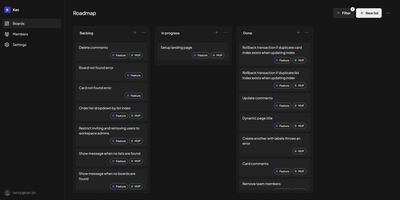
What Trello fans wanted Trello to stay: Kan (kan.bn) is a minimalist, frills-free kanban board capturing the original vision before the enterprise pivots - and then adds the things 2025 actually demands. The core is exactly right: drag-and-drop cards across lists, labels and filters to find work fast, comments for discussion on cards, checklists, a detailed activity log tracking every change, and reusable board templates. Workspaces gather your team with member invites and role management, and board visibility controls decide who can view or edit each board. Migration is first-class: a built-in Trello importer brings existing boards over, so switching costs an afternoon, not a quarter. The standout differentiator is the bundled Model Context Protocol server exposing 46 tools across workspaces, boards, lists, cards, comments, checklists, labels, and members - meaning Claude Desktop, Cursor, Copilot, or any MCP client can read and manage your boards in natural language: "move everything assigned to me into Done" becomes a sentence, not a click marathon. The stack is modern TypeScript - Next.js, tRPC, Drizzle ORM over PostgreSQL, Better Auth (credentials or OAuth), Tailwind - with optional SMTP email and S3 file storage. Unlimited boards, lists, and cards; AGPL-licensed.
Thingport
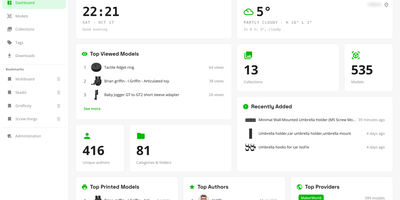
Authors delete listings, and the 3D models go with them, so Thingport stores its own copy of every printable file you import, in a self-hosted library you control. Ten sites feed the library, including MakerWorld, Printables, Thingiverse, and MyMiniFactory: paste a link or use the browser extension, and a model arrives with its files, photos, description, tags, author, and source link. Synced collections add newly bookmarked models as often as every hour. Files you already own come in as STL, 3MF, STEP, OBJ, or LightBurn uploads, ZIPs, folder trees, or drops into a watched consume folder. Each model gets an interactive 3D viewer with a thumbnail for every plate of a multi-plate 3MF. On first open, a check flags surface holes, non-manifold edges, flipped faces, and loose fragments before you slice. Sort with nested categories, collections, and tags, mark favourites, and find anything with full-text search. Optional AI sorts imports into your categories and tidies descriptions, using a local Ollama model or a cloud API. Open any file in Bambu Studio, OrcaSlicer, PrusaSlicer, Cura, or Creality Print, or download a model, tag, or collection as one ZIP. Every user gets a separate library, with invite-only registration, email verification, and single sign-on. A dashboard shows library statistics, profiles show a year-long activity heatmap, and MCP lets an AI assistant work with the collection. Running on a dedicated VPS on RepoCloud with guaranteed CPU, RAM, and SSD, full root SSH access, and a browser serial console. AGPL-3.0 licensed.
nopCommerce
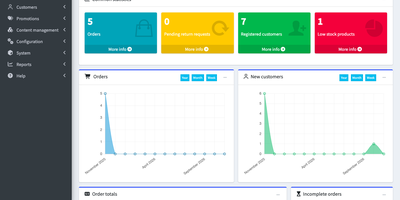
nopCommerce is a self-hosted shopping cart and merchant back office for selling physical goods, downloads, rentals, and gift cards from a storefront you fully control. The catalog covers simple, grouped, downloadable, rental, recurring, and gift card products, with categories, manufacturers, tier prices, product and specification attributes, stock tracking, and Excel import with Excel or XML export. Shoppers get a one-page checkout, wishlists, product comparison, reviews, reward points, gift card redemption, and return requests. Run several stores or outside vendors from a single back office; vendors can apply for accounts and manage their own products, orders, and shipments. Orders move through status changes, offline refunds, shipments, recurring payments, and PDF invoices, while built-in reports surface bestsellers, low stock, country sales, and top-spending customers. Multiple languages and currencies, tax and shipping providers, warehouses, pickup points, and EU Omnibus and GDPR settings support selling abroad. Discounts, affiliates, newsletters, campaigns, SEO-friendly page names, blog, news, forums, and polls cover promotion and content. Customer roles and an access control list set who can manage what, and multi-factor authentication protects sign-ins. Plugins and themes add payment gateways, social sign-in, search, and exchange rates, and the Web API plugin exposes store functions over REST for mobile apps, ERP, CRM, and accounting systems. Running on a dedicated VPS on RepoCloud with guaranteed CPU, RAM, and SSD, full root SSH access, and a browser serial console. nopCommerce Public License 4.0 licensed.