OpenStatus
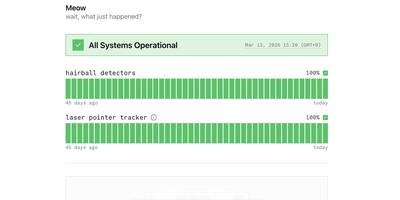
Trusted by Cal.com, WhiteBIT, and Documenso and backed by 8,800+ GitHub stars, OpenStatus delivers the open-source status page and uptime monitoring platform that replaces Atlassian Statuspage, Better Stack, and Instatus with a single self-hosted deployment. The monitoring engine runs Go-based probes across 28 global regions on three cloud providers checking HTTP, TCP, and DNS endpoints in parallel with configurable intervals and multi-region consensus to eliminate false-positive alerts. Status pages ship with custom domain support, password and email-domain access controls, maintenance windows, grouped monitor components, and subscriber notifications via email and RSS. Incident management provides structured status reports with investigating, identified, monitoring, and resolved timeline phases that publish automatically to affected status pages. The monitoring-as-code workflow supports YAML configuration synced through the CLI, a GitHub Actions integration for CI/CD pipelines, and a Terraform provider for infrastructure-as-code deployments. The typed ConnectRPC JSON-over-HTTP API exposes a published OpenAPI specification with a Node SDK for programmatic access, while an MCP server connects AI assistants like Claude, ChatGPT, and Cursor directly to workspace data. The tech stack combines Next.js with shadcn/ui for the dashboard, Hono for the API server, Drizzle ORM over Turso for application data, and Tinybird for analytics. Private monitoring locations deploy as a single 8.5MB Docker image behind firewalls to check internal services. Running on a dedicated VPS on RepoCloud with guaranteed CPU, RAM, and SSD, full root SSH access, and a browser serial console. AGPL-3.0 licensed.
Ever Gauzy
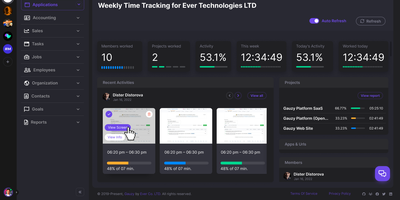
Ever Gauzy consolidates ERP invoicing, CRM sales pipelines, HRM employee records, applicant tracking, and project management into one full-stack TypeScript platform, eliminating the need to stitch together five separate SaaS subscriptions. Over 4,300 GitHub stars and 3,800+ releases back a CQRS architecture that separates command and query responsibilities across modules for invoices, expenses, payments, inventory, contacts, leads, deals, employee onboarding, candidate interviews, hiring workflows, sprints, goals, and KPI tracking. Time tracking captures hours via web timer, Electron desktop timer with activity monitoring and automatic screenshot capture, or browser extension, with timesheet submission and approval workflows supporting billable hour classification across Hubstaff and Upwork integrations. The multi-tenant architecture provides automatic tenant scoping with role-based permissions, while dual ORM support through TypeORM and MikroORM with Knex query builder ensures database flexibility across PostgreSQL, MySQL, and MariaDB. REST APIs documented with OpenAPI and Swagger expose every module for headless operation, complemented by an MCP server offering 323 tools for AI assistant integration. The Angular 19 dashboard provides dark, light, corporate, and material themes with i18n across 10 languages via Crowdin. Supports Docker, Kubernetes, Terraform, and Pulumi deployment with Redis caching and OpenSearch full-text indexing. Running on a dedicated VPS on RepoCloud with guaranteed CPU, RAM, and SSD, full root SSH access, and a browser serial console. AGPL-3.0 licensed.
Marmot
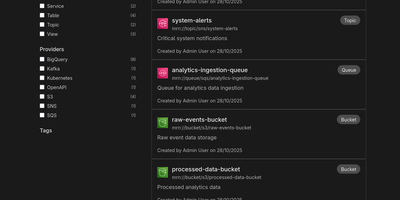
Cataloging tables, topics, queues, and APIs across fragmented data stacks usually demands heavyweight enterprise governance suites, yet Marmot delivers fast full-text asset discovery and AI-ready metadata context in a single self-hosted service. Data engineering and platform teams use its 71 official plugins to automatically ingest schemas, run histories, and dependencies from Apache Kafka, Airflow, Iceberg, Superset, PostgreSQL, BigQuery, and AsyncAPI specifications without moving raw table rows or message payloads. From the web interface, analysts can run structured boolean queries, filter assets by custom tags or PII classifications, and inspect column-level schemas in seconds. Interactive upstream and downstream lineage graphs let engineers trace how events flow from message brokers into warehouse tables and BI dashboards so they can assess what breaks before renaming a column or deprecating an endpoint. Shared business glossaries, bidirectional ownership assignments, and curated data product bundles ensure every department speaks the same language and knows exactly which team maintains each pipeline. Through the built-in Model Context Protocol server, AI assistants in Cursor, Claude Desktop, and LibreChat can invoke tools like discover_data, find_ownership, and lookup_term to answer natural-language questions against live catalog metadata instead of guessing. Platform administrators can also manage catalog resources declaratively using the REST API, CLI, Terraform provider, or Pulumi integration. Running on a dedicated VPS on RepoCloud with guaranteed CPU, RAM, and SSD, full root SSH access, and a browser serial console. MIT licensed.
Frappe Helpdesk
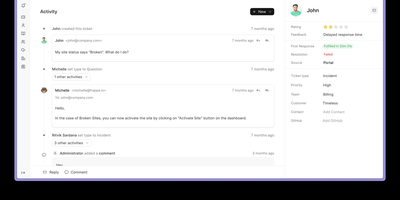
With over 3,200 GitHub stars, 900 forks, and backing from the team behind ERPNext, Frappe Helpdesk delivers a modern, streamlined alternative to Zendesk and Freshdesk with unlimited agents, no per-seat pricing, and full source code access under the AGPL-3.0 license. Built on the Frappe Framework with a Python backend and Vue 3 frontend using Frappe UI, the application collects customer inquiries from email, web forms, and the customer portal into a centralized ticketing queue with complete conversation history and threaded replies. Customizable SLA rules define response and resolution timelines by ticket type or team, triggering automatic alerts and escalations when deadlines approach or are missed. Assignment rules route incoming tickets to the appropriate agents based on priority, issue type, or workload balancing, while manual reassignment and transfer between teams remains available at any time. The customer self-service portal lets users submit tickets, track status, and search a knowledge base of published help articles that reduce repetitive support requests. Agents access saved reply templates for consistent, rapid responses to common queries. Custom fields, configurable workflows, and saved views adapt the interface to match each organization's support process. Real-time updates via WebSocket push ticket changes instantly to all connected agents. The PWA-compatible interface provides mobile access without a native app. Frappe Framework compatibility spans versions 15 and 16. Running on a dedicated VPS on RepoCloud with guaranteed CPU, RAM, and SSD, full root SSH access, and a browser serial console. AGPL-3.0 licensed.
Fluxer
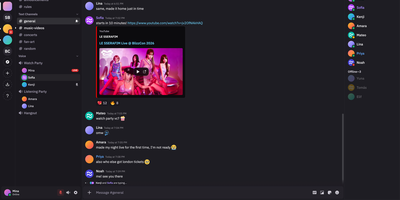
Fluxer gives friends, gaming groups, and private communities their own self-hosted instant messaging and VoIP platform that replaces Discord with private text channels, voice rooms, video calls, and screen sharing. Members can chat one-on-one in direct messages, form multi-person group conversations, or organize large community servers into categorized text and voice channels with threaded replies, reactions, and typing indicators. When a conversation moves to voice, participants can join low-latency audio and video rooms from multiple devices simultaneously, share application windows or full screens, and rely on built-in noise suppression and echo cancellation for clear calls. Rich media support allows users to share file attachments, preview embedded links, search animated GIFs through KLIPY, and upload custom community emojis and stickers. Server administrators control access through role-based permission hierarchies, member timeouts, kicks, bans, and detailed moderation audit logs that track every configuration change across the community. Integrated full-text search lets members quickly locate historical messages, code snippets, and shared files across every channel they can access. Running on a dedicated VPS on RepoCloud with guaranteed CPU, RAM, and SSD, full root SSH access, and a browser serial console. AGPL-3.0 licensed.
Miniflux
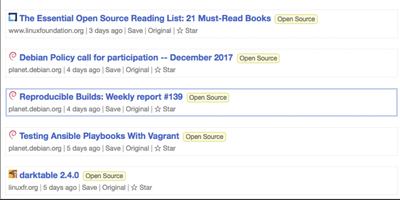
One statically-compiled Go binary over PostgreSQL, no ORM, no framework, static assets embedded in the executable: Miniflux is the minimalist, opinionated feed reader. The opinions are the feature: page layout, fonts, and colors are tuned for reading, and everything else is treated as noise. It consumes Atom, RSS, and JSON Feed formats with OPML import/export, organizes articles with categories and bookmarks, fetches original full-text content for summary-only feeds, and provides Postgres-powered full-text search. Privacy work happens automatically: pixel trackers are stripped, tracking parameters removed from URLs, a media proxy blocks third-party tracking, referrers are never forwarded, and there is zero telemetry. Navigation is keyboard-first - j/k through items, o to open, f to star - with touch gestures on mobile. Podcast, video, and music enclosures are supported, and YouTube videos play inline. Over 25 integrations save articles onward to Wallabag, Readwise Reader, Pinboard, Linkding, Instapaper, Notion, Telegram, Matrix, Ntfy, and more, plus webhooks and a REST API with Go and Python clients; the Google Reader API endpoint supports existing mobile reader apps. Authentication spans local passwords, passkeys (WebAuthn), Google OAuth2, OpenID Connect, and reverse-proxy headers. It is Apache 2.0 licensed, translated into 20 languages, and updates feeds on an internal scheduler.
Wiki-Go
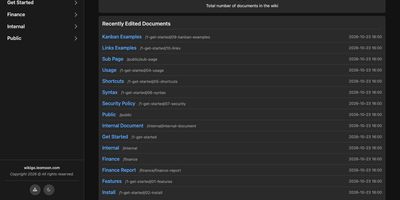
Wiki-Go turns a folder of Markdown files into a searchable team wiki with page history, comments, and access rules, and never asks you to run a database. Pages live in a nested tree with a sidebar and breadcrumbs, and an editor with a preview toggle handles emoji shortcodes, highlighted code, LaTeX math, Mermaid diagrams, collapsible sections, GitHub-style alerts, and embedded YouTube, Vimeo, or MP4 video. Full-text search supports exact phrases in quotes and term inclusion or exclusion, and highlights each match. Each save keeps a revision, up to a configurable limit, and any stored version can be restored later. Attachments such as PDFs, spreadsheets, images, and archives sit beside the page they belong to. Drop a Kanban board into any document for drag-and-drop task tracking with nested tasks, or build a categorized link library that fills in page metadata automatically. Signed-in users comment in Markdown, and admins can remove comments. Admin, editor, and viewer roles, user groups, path-based public or private rules, and an optional private-wiki mode decide who sees what. Branding comes from a custom logo, banner, and favicon, shortcodes such as stats insert live site statistics, and readers can switch between dark and light themes or print any page. A REST API opens content to scripts, and a community tool imports Notion exports. Running on a dedicated VPS on RepoCloud with guaranteed CPU, RAM, and SSD, full root SSH access, and a browser serial console. GPL-3.0 licensed.
Codel
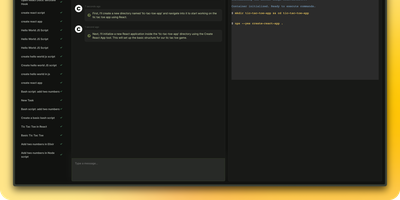
Meet your new digital sidekick, the Fully Autonomous AI Agent! This isn't just any AI; it's like having a superhero in your terminal, browser, and editor. Ready to tackle complex tasks and projects with a single command, this AI Agent is your go-to for making tech magic happen. And with RepoCloud, you're not just saving on costs, you're also joining a league of extraordinary users harnessing the power of open-source collaboration. Get ready to elevate your productivity to legendary levels!
Coral
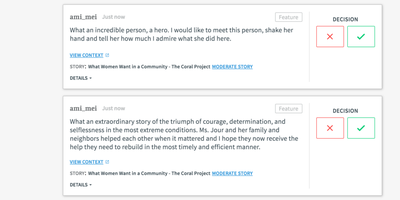
Comment sections at the Washington Post, the Wall Street Journal, and newsrooms across 30 countries run on Coral (also known as Talk) - the platform built by journalists' technologists, started under the Mozilla Foundation and now stewarded by Vox Media as an Apache-2.0 project serving 23 languages. Its founding premise is that online comments are broken and moderation is the fix. Moderators get a full queue system - reported comments, system-held pending comments, and configurable pre-moderation - backed by AI toxicity scoring that warns commenters before posting and holds high-scoring comments for review, Akismet spam detection, banned and suspect word lists, and automatic repeat-offender handling that pre-moderates users whose rejection rate crosses a threshold. Readers get features designed for healthier conversation: journalist badges in threads, muting of annoying voices, notifications, instant new-comment alerts, and timeouts rather than just bans. For publishers the economics are the point - no ads, no trackers, no hidden pixels anywhere in the code, full ownership of audience data, and GDPR compliance beyond requirements. Integration is one embedded script; SSO connects existing registration, and a GraphQL API supports customization and extension.
ERPNext
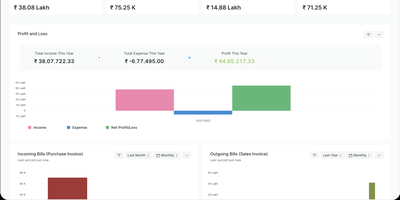
With over 37,800 GitHub stars and active development since its first release in 2008, ERPNext is the most-starred open-source ERP system — delivering accounting, inventory management, manufacturing, CRM, project tracking, asset management, HR, and point-of-sale capabilities through a unified web interface built on the Frappe Framework's metadata-driven architecture. The accounting module handles multi-company consolidation, multi-currency transactions, tax templates for GST and VAT, bank reconciliation, and automated journal entries with real-time profit and loss, balance sheet, and cash flow reporting. Manufacturing covers production planning with multi-level bill of materials, work order scheduling, capacity planning, subcontracting, and quality inspection at each production stage. Inventory tracks stock across multiple warehouses with batch and serial number tracing, automatic reorder levels, landed cost calculations, and perpetual inventory valuation using FIFO or moving average methods. The CRM module manages leads, opportunities, and customer communication with email integration, while project management tracks tasks, timesheets, and Gantt-based scheduling with budget controls. Custom applications extend functionality through the Frappe ecosystem without forking the core codebase, and the REST API enables integration with payment gateways, shipping providers, and third-party services. Deployable via Docker Compose or the bench CLI tool with MariaDB and Redis. Running on a dedicated VPS on RepoCloud with guaranteed CPU, RAM, and SSD, full root SSH access, and a browser serial console. GPL-3.0 licensed.
pgAdmin
pgAdmin 4 is the reference administration GUI for PostgreSQL, bundled by virtually every Linux distribution and supporting versions 14 through 18 including EDB Advanced Server — browse schemas in a hierarchical tree, write and optimize queries with AI assistance, design entity-relationship diagrams visually, monitor live sessions, and run backup/restore operations entirely from the browser. Built on Python Flask with a ReactJS frontend, version 9.17 delivers a comprehensive web-based platform accessible from any device. The Query Tool provides syntax highlighting, auto-completion, query history, an EXPLAIN plan visualizer with graphical node representation, AI-powered SQL generation from natural language prompts, and AI Insights for execution plan analysis that identifies performance bottlenecks. The Graph Visualiser renders query results as line charts, bar charts, stacked charts, and pie charts directly in the interface. The ERD Tool auto-generates entity-relationship diagrams from existing schemas for visual database design. The Schema Browser presents databases, schemas, tables, views, functions, sequences, roles, and extensions in a navigable hierarchy. Server monitoring dashboards display real-time active sessions, locks, transaction throughput, and vacuum status. GUI-driven backup and restore wraps pg_dump and pg_restore with format and compression options. Authentication supports internal, LDAP, Kerberos, OAuth2/OIDC, and webserver modes. The Helm chart includes an HTTPRoute template for Kubernetes Gateway API deployments. Bundled pg_dump, pg_restore, and psql utilities version 18.4. Deploy via Docker with the official dpage/pgadmin4 image. Running on a dedicated VPS on RepoCloud with guaranteed CPU, RAM, and SSD, full root SSH access, and a browser serial console. PostgreSQL License.
MikroDash
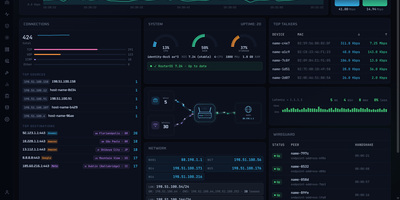
Watching a MikroTik RouterOS v7 router in real time is what MikroDash is for: live traffic, connections, Wi-Fi clients, DHCP leases, and WireGuard peers reach the browser the moment anything changes. Cards drag into any layout, and the arrangement follows your account to every browser. Managing a fleet happens on the Devices page, which shows routers as cards, a list, or a world map with 24-hour connectivity, last backup, open alerts, and pending updates. Rolling out a change starts in Config Management: choose one of 20 ready-made templates or capture your own, then deploy to one router or the fleet with a restore point, a canary router, and an automatic revert if a change cuts MikroDash off. Scheduled backups are kept only when something changed, with a diff and a guarded restore. New sites join through a generated script that calls home over a built-in WireGuard tunnel, even from behind NAT. Alerts reach SMTP, Telegram, ntfy, Discord, Slack, Gotify, Pushover, and Apprise. Troubleshooting stays in the browser with ping, traceroute, torch, bandwidth tests, a packet sniffer, and a RouterOS terminal. Read-only API access covers every page and alert, while roles, OpenID Connect sign-in, and an audit trail of every write govern shared use. Off by default, an optional assistant answers from live router data and asks before changing anything. Running on a dedicated VPS on RepoCloud with guaranteed CPU, RAM, and SSD, full root SSH access, and a browser serial console. MIT licensed.
Shlink
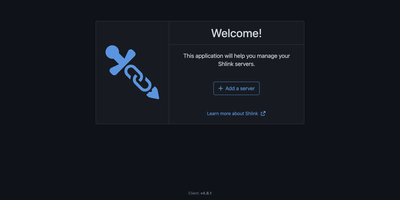
With over 5,100 GitHub stars and eight years of active development since 2016, Shlink has become the definitive self-hosted URL shortener for teams that need unlimited links, full visitor analytics, and complete data ownership without per-link pricing or monthly caps. The PHP backend built on the Mezzio framework with Doctrine ORM serves redirects through any number of custom domains on a single instance, generating unique short codes or accepting custom slugs including multi-segment paths and emoji characters. Every click is tracked with anonymized visitor data including geolocation by country, city, and coordinates, browser and operating system identification, referrer source, and device type classification, all stored in your choice of MySQL, MariaDB, PostgreSQL, Microsoft SQL Server, or SQLite. Dynamic redirect rules route visitors to different destinations based on geolocation, device type, or browser language, enabling targeted campaigns from a single short URL. The REST API exposes every operation with OpenAPI documentation and an interactive sandbox at api-spec.shlink.io, while the CLI provides equivalent functionality for scripting and automation. The official progressive web app at app.shlink.io manages multiple Shlink instances from a single interface with URL creation, tag management, and detailed visit charts. Real-time event integration supports both Mercure and RabbitMQ for webhook-style notifications on new visits. Third-party imports migrate existing short URLs from Bitly and YOURLS with visit history preserved. Running on a dedicated VPS on RepoCloud with guaranteed CPU, RAM, and SSD, full root SSH access, and a browser serial console. MIT licensed.
Canvix
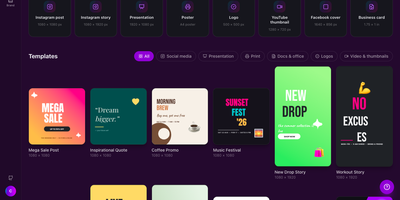
Canvix is a self-hosted design studio that lets anyone create social posts, presentations, posters, logos, and thumbnails in the browser with a drag-and-drop editor, 110 ready-made templates, and exports with no watermarks. You start from a template sized for the platform you are publishing to, then drag in shapes, lines, stickers, and your own images, moving, resizing, and rotating everything directly on the canvas. Text gets proper typography controls, with bundled fonts, styles, spacing, alignment, and curved text that arcs across the design. Layers can be reordered and locked while smart guides snap elements into alignment, and a full undo history plus autosave means a closed tab never costs you the work. Finished designs export as PNG, JPG, SVG, PDF, or video at up to three times resolution, ready to publish anywhere. Free accounts keep each person's designs private to them, while share links open a design for anyone to view or continue editing. Version snapshots let you roll a design back when an experiment goes wrong. The AI tools, magic edit, magic write, background removal, and translation, run against your own API keys, so nothing is metered. An optional MCP endpoint even lets AI assistants create and edit designs for you. Running on a dedicated VPS on RepoCloud with guaranteed CPU, RAM, and SSD, full root SSH access, and a browser serial console. MIT licensed.
Infisical
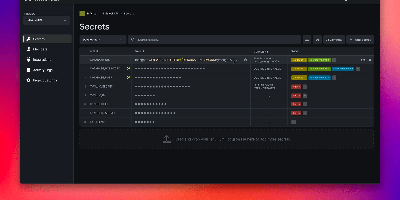
API keys hardcoded in repos, database passwords pasted into CI variables, .env files emailed between developers - Infisical, the open-source platform for secrets, certificates, and privileged access management, is the answer to all three. Secrets live in versioned stores scoped by project, environment, and path, with fine-grained identity-aware access control and full audit logging on every read and change. Delivery covers every consumption pattern: CLI injection into local dev, SDKs for Go, Node.js, and Python, an HTTP API, agents, a Kubernetes Operator, and secret syncs that push to GitHub, GitLab, AWS Secrets Manager, and Vercel. Automatic rotation replaces credentials for PostgreSQL, MySQL, MSSQL, LDAP, AWS IAM, and Azure on a rolling schedule - new credentials issue while old ones stay temporarily valid, so nothing breaks mid-rotation. Dynamic secrets go further, generating ephemeral, time-bound database credentials on demand, and SSH access replaces static keys with short-lived CA-signed certificates that expire automatically. Secrets scanning catches hardcoded credentials in code and pipelines, certificate management automates X.509 issuance and renewal, and a built-in KMS handles encrypt/decrypt with central key control. Self-hosting keeps the keys to everything else on your own infrastructure.
LinkBreeze
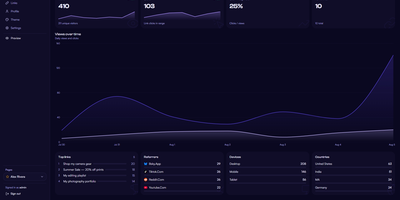
LinkBreeze is a self-hosted link-in-bio platform that lets you publish unlimited, fully themed link pages from your own server instead of renting one by the month. A guided setup wizard covers the admin credentials, profile, and theme, then a floating phone-frame preview refreshes as you edit while autosave stores your changes. Each page gets its own slug, theme, SEO tags, QR code, and analytics, so one install can serve a personal profile, a band, and a shop. Eleven built-in themes cover Aurora, Glassmorphism, Neon Cyberpunk, and Terminal Mono, backed by a token customizer for fonts, backgrounds, card styles, and raw CSS. Links pull in favicons automatically, accept thumbnails, and can be scheduled to appear and vanish on set dates, while embed widgets drop in YouTube, Spotify, SoundCloud, Vimeo, and Bandcamp players. A migration wizard imports profiles from Linktree, Bento, Hopp.bio, LittleLink, or an HTML or JSON export. Visitors can subscribe with an email address that you export to CSV, save your page as a vCard contact, or scan a QR code that downloads as SVG or PNG. Cookieless analytics track views, clicks, referrers, devices, and countries with hashed visitor IPs, and Plausible, Umami, Matomo, or Google Analytics can be added with one paste. The admin panel supports TOTP two-factor authentication, a UTM builder, JSON backup and restore, and seven interface languages. Running on a dedicated VPS on RepoCloud with guaranteed CPU, RAM, and SSD, full root SSH access, and a browser serial console. MIT licensed.
Marketing Dashboard
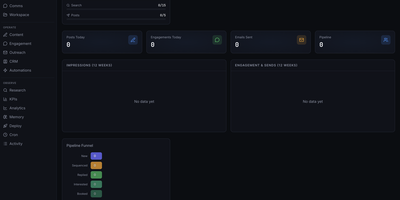
This is a marketing operations control center that replaces fragmented CRM, outreach, content, and analytics tools with a unified self-hosted interface designed for AI agent-assisted go-to-market teams. The CRM module manages leads through a configurable pipeline funnel with stages from New through Sequenced, Replied, Interested, and Booked, tracking source attribution, industry segments, company size, lead quality scores, and LinkedIn URLs per contact. Outreach sequencing supports email campaigns with pause controls, audit endpoints, suppression workflows, and engagement tracking. The content operations surface provides calendar views, content item management, performance metrics, and approval queues for editorial control. Analytics and KPI dashboards show impressions, engagement, and send volumes over configurable time periods, with optional connectors to Plausible, Google Analytics 4, X, and LinkedIn for cross-platform reporting. The OpenClaw-native agent runtime enables dynamic agent and squad discovery, workspace management, session monitoring, and communications surfaces. Automation scheduling uses cron job templates with OpenClaw-compatible schedule variants including cron expressions, every intervals, and at timestamps. The tech stack combines Next.js 16 App Router with React 19, Tailwind CSS 4, Recharts, and Zustand for state management. Authentication supports session cookies, API keys, and optional Google OAuth with role-based access controls. All state persists locally in SQLite via better-sqlite3 with no required external infrastructure. On RepoCloud, deploy Marketing Dashboard on a dedicated VPS with persistent SQLite storage, root SSH access, and complete control over your marketing operations data, all under the MIT license.

Karakeep
Previously known as Hoarder and now holding 28,000+ GitHub stars, Karakeep is the most popular open-source bookmark-everything application — combining AI-powered automatic tagging with full-text search, page archival, and cross-platform access for digital content hoarders who refuse to let valuable links disappear. The Next.js frontend with tRPC communication delivers a responsive interface for saving links, notes, images, and PDFs, while Puppeteer crawls bookmarked pages to fetch titles, descriptions, and images automatically. LLM-based auto-tagging supports OpenAI, Anthropic, or local models via Ollama for privacy-first deployments that never send data to external services. Meilisearch powers full-text and semantic search across all stored content including OCR-extracted text from images. A rule-based automation engine triggers custom actions based on bookmark properties — automatically sorting, tagging, or archiving content matching defined conditions. Full page archival via Monolith preserves complete page snapshots against link rot, while yt-dlp integration archives videos from YouTube and other platforms. RSS feed ingestion automatically captures new articles from subscribed sources. Collaborative lists enable teams to build shared bookmark collections, with per-list permissions and real-time sync. Native iOS and Android apps, Chrome and Firefox extensions, and browser bookmark sync via Floccus ensure capture from any device. Importers migrate data from Chrome, Pocket, Linkwarden, Omnivore, and Tab Session Manager. Running on a dedicated VPS on RepoCloud with guaranteed CPU, RAM, and SSD, full root SSH access, and a browser serial console. AGPL-3.0 licensed.