OpenDeepWiki
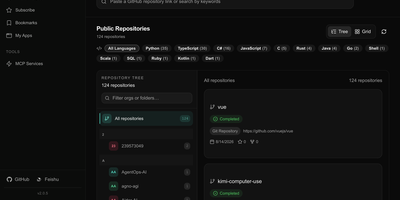
OpenDeepWiki transforms code repositories from GitHub, GitLab, Gitee, Gitea, and AtomGit into structured, searchable knowledge bases by leveraging Microsoft's Semantic Kernel for AI orchestration across OpenAI, Azure OpenAI, Anthropic, and DeepSeek providers. The three-phase Gather-Think-Write pipeline analyzes repository tree structures, generates README summaries, project overviews, wiki catalogs, and document content while producing Mermaid mind maps and optional Graphify visualization artifacts. Repository-scoped MCP endpoints at /api/mcp/{owner}/{repo} expose indexed knowledge to external AI tools, while the built-in chat assistant, embedded chat APIs, and share links provide conversational access to repository understanding. The Next.js 16 frontend serves public documentation on SEO-friendly routes with multi-language translation support, and the admin console manages repositories, users, roles, API keys, AI provider and model configuration, skills, and GitHub App imports. Background workers handle incremental updates using LibGit2Sharp to keep documentation synchronized with evolving codebases, while Polly integration provides transient failure retry handling for LLM requests. The platform supports SQLite, PostgreSQL, and MySQL database backends with Entity Framework Core providers. Running on a dedicated VPS on RepoCloud with guaranteed CPU, RAM, and SSD, full root SSH access, and a browser serial console. MIT licensed.
Sourcebot
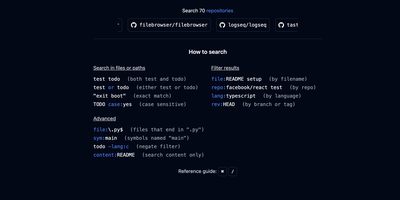
Point Sourcebot at your GitHub, GitLab, Bitbucket, Azure DevOps, Gerrit, or Gitea repositories and get regex, symbol, and filtered search results in under a second across thousands of repos and branches. Backed by Y Combinator with production deployments at NVIDIA, Shutterstock, SeatGeek, Arista, and Red Hat, the Zoekt-powered engine deploys as a single Docker container with zero external data transmission. Ask Sourcebot connects reasoning models like Claude Opus to your entire codebase, enabling natural language questions that return structured answers grounded with inline citations and navigable code snippets, backed by automatic tool calls that search code, follow references, and read files across all indexed repositories. Ask connectors extend this to Jira, Slack, Linear, and Confluence via MCP, pulling external context alongside code for debugging and documentation. IDE-level code navigation provides goto definition and find all references across repository boundaries without local cloning. The built-in file explorer renders any indexed file with syntax highlighting, breadcrumb navigation, and git blame showing per-line commit attribution. An analytics dashboard tracks daily, weekly, and monthly search activity. Permission syncing from GitHub and GitLab enforces access control lists so users only see repositories they are authorized to access. Running on a dedicated VPS on RepoCloud with guaranteed CPU, RAM, and SSD, full root SSH access, and a browser serial console. Other licensed.
Jetlog
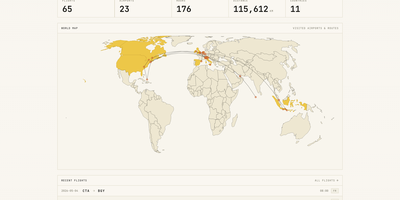
A personal flight logbook you host yourself, Jetlog draws every route you have flown on a pannable world map and turns the totals into charts. The home page opens with counts of flights, airports, hours, distance, and countries above that map, where dots mark visited airports and lines trace each trajectory. Settings let markers and lines grow with visit frequency and shade the countries where you have landed. Logging a flight takes only two airports and a date. Type a flight number and press Fetch to pre-fill the origin, destination, and airline, and a utility links connection flights automatically. Duration and distance are calculated for you and stay editable, with an option to use airport time zones. The All Flights table lists route, times, duration, distance, seat, class, and airline with filters and configurable columns, and each flight opens a detail page with airport data, a route map, tail number, and aircraft. A Statistics page charts flights per month, cumulative distance, most visited airports, most common airlines, ticket class, and seat for any time frame. History arrives through MyFlightRadar24 or custom CSV imports and leaves as CSV or iCal. Family members can share one install with separate logbooks, an admin manages the accounts, and the responsive layout works on a phone at the gate. Running on a dedicated VPS on RepoCloud with guaranteed CPU, RAM, and SSD, full root SSH access, and a browser serial console. GPL-2.0 licensed.
Frappe CRM
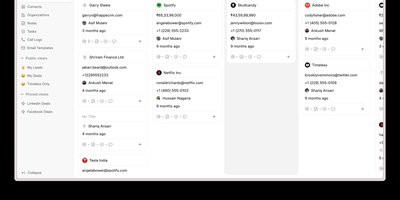
With 3,300+ GitHub stars, 200+ releases, and v1.77 shipping in July 2026, Frappe CRM delivers enterprise CRM capabilities without per-seat licensing costs that plague Salesforce and HubSpot deployments. The Python backend running on Frappe Framework v15/v16 with MariaDB and Redis pairs with a Vue 3 frontend using Pinia state management, Vue Router, and the Frappe UI component library styled with Tailwind CSS v3. All-in-one lead and deal pages consolidate activities, comments, notes, tasks, call logs, and email history into a single scrollable view while the drag-and-drop Kanban board provides visual pipeline tracking across configurable stages. Built-in Twilio integration enables click-to-call with recording directly from deal pages, Exotel routes calls through agent mobile phones, and WhatsApp messaging connects via the Frappe WhatsApp module for conversational sales. A visual field layout editor lets non-technical users customize CRM forms, sidepanels, and grid views with real-time drag-and-drop without writing code. The Service Level Agreement engine tracks first-response and rolling-response times against configurable policies with automatic escalation. Meta integration captures leads from Facebook and Instagram ad campaigns directly into the pipeline. ERPNext connectivity extends CRM into invoicing, accounting, inventory, and purchasing with native data flow. Docker Compose deployment with a single command provisions a production-ready instance. Running on a dedicated VPS on RepoCloud with guaranteed CPU, RAM, and SSD, full root SSH access, and a browser serial console. AGPL-3.0 licensed.
Coder
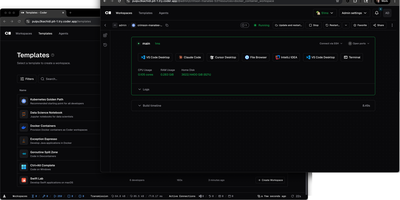
With over 14,000 GitHub stars and enterprise adoption by security-conscious organizations, Coder transforms how development teams provision, manage, and secure their coding environments. Every workspace is defined as a Terraform template, meaning infrastructure engineers can standardize development environments across EC2 instances, Kubernetes pods, Docker containers, or any combination, while developers get self-service provisioning that launches in seconds rather than days of manual setup. The WireGuard-based networking layer establishes encrypted tunnels between developer machines and remote workspaces, providing low-latency access without exposing ports or configuring VPN concentrators. Automatic idle detection shuts down unused workspaces after configurable periods, directly reducing cloud compute costs for organizations running hundreds of developer environments. The Coder Agents feature introduces native AI coding capabilities where the agent loop executes entirely within the control plane on self-hosted infrastructure, keeping LLM API credentials out of individual workspaces and eliminating credential exfiltration risks. Centralized model governance allows platform teams to approve specific AI providers and models, set per-user spend limits, and maintain complete audit logs of all prompts, tool calls, and agent activity. IDE integration supports VS Code through a dedicated extension, JetBrains IDEs via Gateway and Toolbox plugins, and browser-based code-server for web access. The template registry provides pre-built configurations for common development stacks. DevContainer support builds environments from standard devcontainer.json specifications. Deploy on a dedicated VPS on RepoCloud with guaranteed CPU, RAM, and SSD, full root SSH access, and a browser serial console. AGPL-3.0 licensed.
Tiny File Manager
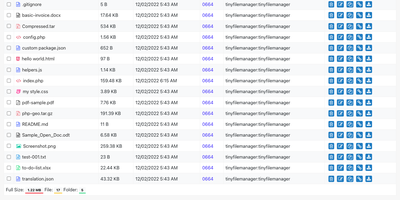
Browse, upload, edit, preview, and archive the files on your server from any web browser, with no FTP client, no shell session, and no database to set up. Tiny File Manager lists every folder in a sortable table showing size, modified date, permissions, and owner, with a search box that filters as you type. Drag files into the upload zone, send several at once, or paste a URL for the server to fetch. Rename items, select several to copy, move, delete, or pack into a zip or tar archive, and extract uploaded archives on the server. Click any text file to open the built-in editor, which offers syntax highlighting for 150+ languages and 35+ color themes, so quick fixes to configs and scripts happen where the files live. Images, audio, video, and text open in a preview without downloading, and every file has a copyable direct link. Give teammates or clients their own accounts, each locked to a root folder you choose, mark accounts read-only, and limit uploads to approved file extensions. Hide folders you never want listed, restrict access with IP allow and block lists, switch between light and dark themes, pick from 35+ interface languages, and use the responsive layout on a phone. Setup is one file copied to a web server, or one Docker container. Running on a dedicated VPS on RepoCloud with guaranteed CPU, RAM, and SSD, full root SSH access, and a browser serial console. GPL-3.0 licensed.
Wazuh
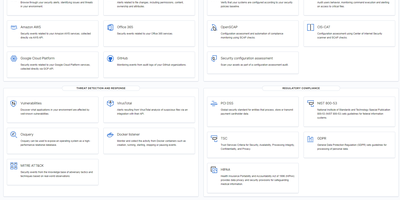
Protecting over 10,000 organizations worldwide with 16,000+ GitHub stars, Wazuh delivers enterprise-grade security operations through a fully open-source platform with zero feature gating. The unified XDR and SIEM solution deploys lightweight agents across Linux, Windows, macOS, Solaris, AIX, and HP-UX endpoints that stream security telemetry to a centralized cluster built on OpenSearch for indexing and the Wazuh Dashboard for visualization and management. Core capabilities include real-time file integrity monitoring with inotify-based detection and who-data attribution, automated vulnerability assessment that correlates software inventories against continuously updated CVE databases, Security Configuration Assessment against CIS benchmarks, rootkit detection, and log data analysis with a rules engine supporting over 3,000 built-in detection rules mapped to MITRE ATT&CK tactics and techniques. Wazuh monitors cloud infrastructure at the API level with native modules for AWS, Azure, and Google Cloud, detects container anomalies through Docker engine integration, and ingests third-party telemetry via syslog and REST APIs from sources like VirusTotal, TheHive, YARA, Suricata, and PagerDuty. Pre-built compliance dashboards and reports cover PCI DSS, HIPAA, NIST 800-53, GDPR, and TSC frameworks. Active response capabilities automatically trigger countermeasures including firewall rule updates, account lockouts, and endpoint isolation when threats are detected. The platform scales horizontally with multi-node clustering for high availability. Running on a dedicated VPS on RepoCloud with guaranteed CPU, RAM, and SSD, full root SSH access, and a browser serial console. GPL-2.0 licensed.
CapRover
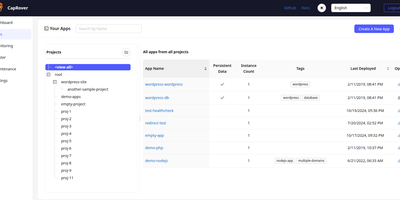
With over 15,000 GitHub stars and nearly nine years of active development, CapRover is the self-hosted PaaS that replaces Heroku's pricing with your own infrastructure while keeping the deploy-and-forget simplicity. The web dashboard manages application lifecycle from deploy through scaling — configure custom domains, environment variables, persistent volumes, instance counts, and nginx templates without touching config files or SSH. The CLI tool enables scriptable deployments with a single command from your terminal or CI/CD pipeline, while webhook-based deployment triggers automated builds from Git pushes. The one-click app marketplace provides over 100 pre-configured services including WordPress, Ghost, PostgreSQL, MySQL, MongoDB, Redis, Grafana, Portainer, and dozens more, each deployed as a Docker container with volumes and environment variables preconfigured. Automatic HTTPS provisions and renews Let's Encrypt certificates for every custom domain with one-click HTTP-to-HTTPS redirects. Under the hood, Docker Swarm orchestrates containers across multiple nodes for horizontal scaling and load balancing, while nginx handles routing with fully customizable EJS-generated configuration templates per application. Deployment supports four methods: CLI push, tarball upload through the web UI, Docker image reference, and Git repository connection. The build system supports Dockerfiles, captain-definition files with build packs, and direct Docker image pulls. NetData integration provides real-time server monitoring dashboards. Running on a dedicated VPS on RepoCloud with guaranteed CPU, RAM, and SSD, full root SSH access, and a browser serial console. Apache 2.0 licensed.
Mailu
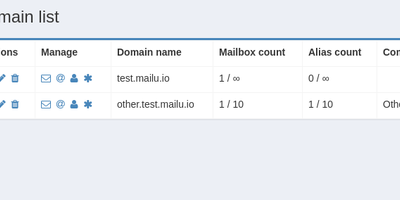
With over 7,100 GitHub stars and 200 contributors since 2016, Mailu has become one of the most popular self-hosted email solutions, delivering a complete production-ready mail server stack as pre-configured Docker containers that eliminate weeks of manual setup. The platform bundles Postfix for SMTP and Submission with auto-configuration profiles for Thunderbird, Outlook, and mobile clients, Dovecot for IMAP and POP3 with full-text search across email attachments, Rspamd for intelligent spam filtering with auto-learn Bayesian classification, greylisting, SPF and DMARC validation, and ClamAV for antivirus scanning of attachments with configurable malicious file blocking. The web administration interface provides global admin controls, per-domain delegation, user quota management, domain aliases, custom routing rules, and announcement capabilities. Users access self-service features including aliases, auto-reply, auto-forward, fetched accounts from external mailboxes via fetchmail, and Sieve filter management through ManageSieve. Security features include enforced TLS on all connections, automatic Let's Encrypt certificate provisioning, outgoing DKIM signing, DANE and MTA-STS support for transport security, and Snuffleupagus PHP hardening for the web interface. The setup wizard at setup.mailu.io generates complete Docker Compose configurations tailored to specific deployment requirements. All components are free and open-source software with zero proprietary dependencies and no tracking. Running on a dedicated VPS on RepoCloud with guaranteed CPU, RAM, and SSD, full root SSH access, and a browser serial console. MIT licensed.
Chartbrew
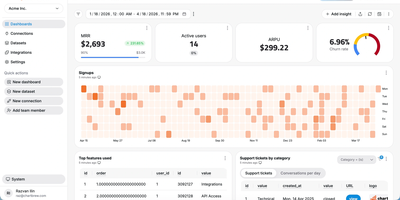
Chartbrew transforms raw database queries and API responses into polished, shareable dashboards without requiring a data engineering team. Connect to MySQL, PostgreSQL, MongoDB, Firestore, or any REST API, then build datasets using the visual query editor with syntax highlighting and auto-completion. Charts render through Chart.js with line, bar, pie, donut, radar, polar, KPI card, and table visualizations, each customizable with colors, legends, filters, and goal indicators. An AI assistant accelerates dashboard creation by generating queries and suggesting chart configurations from natural language descriptions of the metrics you want to track. Reusable datasets let teams prepare data transformations once and share them across multiple charts, while automatic scheduling through BullMQ and Redis refreshes data at intervals from every 10 minutes to monthly. The embed feature generates standalone chart URLs for insertion into external websites, internal tools, or customer portals, and the Reporting API enables programmatic dashboard management and automated report delivery. Team workspaces with role-based permissions control who can view, edit, or manage data connections. Nearly 4,000 GitHub stars reflect steady community adoption. The platform runs on Node.js with Express and Sequelize ORM, supporting MySQL or PostgreSQL as its application database. Running on a dedicated VPS on RepoCloud with guaranteed CPU, RAM, and SSD, full root SSH access, and a browser serial console. FSL-1.1-MIT licensed (converts to MIT two years after each release).
HabitSync
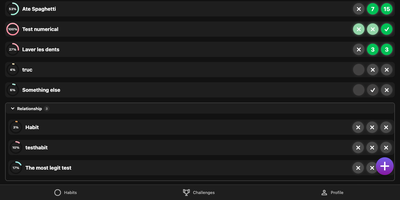
HabitSync treats habit tracking as a team sport, because willpower alone rarely survives February. Set each habit up the way life actually works: daily, weekly, monthly, on chosen weekdays, or at a custom interval, with a target value to reach or a ceiling to stay under for the habits you are trying to quit. Logging takes one tap, or a long press when today's effort deserves a custom number or a stopwatch. Share a habit with a partner, a sibling, or the whole household and everyone's progress sits side by side, which turns "did you go to the gym" into a question the dashboard answers. Monthly challenges raise the stakes with community voting, leaderboards, and medals for the top performers, while gentle automation watches your back: scheduled reminders when a habit goes unlogged, an alert when your completion slips under a threshold, and a quiet nudge when a friend overtakes you. Years of Loop Habit Tracker history import instead of being abandoned, and the installable web app keeps the streak one tap away on any device. Running on a dedicated VPS on RepoCloud with guaranteed CPU, RAM, and SSD, full root SSH access, and a browser serial console. BSD-3-Clause licensed.
CliRelay
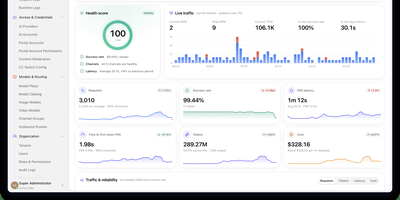
Anyone who pays for Claude Code, Codex, and Gemini CLI separately ends up juggling three endpoints, three sets of keys, and three kinds of rate-limit surprise, and CliRelay collapses all of that into one self-hosted gateway with a control panel. Clients speak the OpenAI Chat or Responses, Anthropic Messages, or Gemini protocol, and CliRelay translates each request for whichever upstream account is healthy. Channel groups limit where each key may send traffic, round-robin, fill-first, and session-sticky scheduling spread it, and cooldowns with automatic failover move requests off accounts that have run out of quota. Add upstreams from the /manage console through browser sign-in, device codes, or bulk credential import, covering Claude, Codex, Gemini, Antigravity, Vertex AI, AWS Bedrock, Grok, Qwen, Kimi, and any OpenAI-compatible service. Portal accounts own client keys with daily, period, and lifetime quotas, RPM and TPM limits, and per-model pricing. A monitor center scores health and charts live traffic, P50 to P99 latency, and time to first token, while every request lands in a searchable log with tokens, latency, and cost. Tenants, roles with resource.action permissions, content moderation profiles, an outbound proxy pool, and an audit trail make shared deployments workable, and the console speaks English, Simplified Chinese, and Russian. Running on a dedicated VPS on RepoCloud with guaranteed CPU, RAM, and SSD, full root SSH access, and a browser serial console. MIT licensed.
NutriTrace
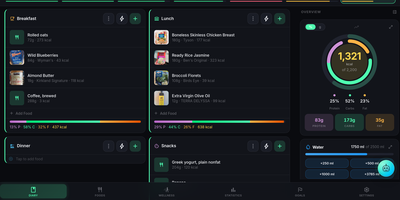
Stop handing your daily food diary, body weight history, and biometric sleep data to ad-funded fitness clouds: NutriTrace brings complete calorie, macro, micronutrient, and wellness tracking to your own server with an offline-capable web PWA and native Android app. Log meals across customizable slots using live Open Food Facts and USDA FoodData Central lookups, barcode scanning, AI nutrition label OCR, or direct recipe imports from Mealie and CookTrace. Calorie and macro targets adjust automatically through three goal engines, including an inspectable Adaptive TDEE algorithm that regresses 35 days of intake against scale weight at 7,700 kcal per kilogram. Connect Fitbit via Google Health, Garmin, Withings, and Android Health Connect to pull steps, heart rate variability, sleep stages, and body composition into unified Sleep, Readiness, and Resilience scores. An integrated Trace AI assistant and Smart Log let you log meals by voice, text, or meal photo, while the opt-in Model Context Protocol server exposes 20 read, write, and management tools to Claude Desktop, Cursor, and Codex. Multi-user households get OpenID Connect SSO and one-step migration from MyFitnessPal, Cronometer, Lose It, and Waistline. Running on a dedicated VPS on RepoCloud with guaranteed CPU, RAM, and SSD, full root SSH access, and a browser serial console. AGPL-3.0 licensed.
Velociraptor
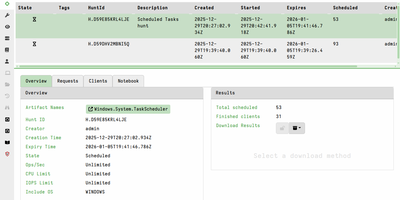
Hunting for a suspicious file, process, or registry key across every endpoint becomes a single hunt in Velociraptor, an endpoint visibility and digital forensics platform. A web console sends tasks to clients on Windows, Linux, and macOS machines, which hold a persistent connection and run each task as soon as it is issued. A hunt runs a VQL artifact, one of more than 400 built in, across selected endpoints, picks up machines that reconnect later, and tracks which hosts have answered. Each hunt and collection opens into a notebook where markdown and live VQL cells group, filter, and timeline the results. A virtual file system browses a client's directories and fetches files through file, NTFS, and registry accessors, with hex and text viewers. Offline collectors bundle chosen artifacts into one binary that writes an optionally encrypted container for later import, suiting machines that never reach the server. Client event queries stream telemetry such as DNS lookups to the server, and server event queries can alert Slack, email, Elastic, or Splunk. Quarantine confines a host's network traffic to the Velociraptor server, and the Shell page runs commands on it. Sign-in works through Google, Azure, GitHub, OIDC, or SAML, with reader, analyst, investigator, and administrator roles. Responders reach for it during threat hunts, compromised host triage with KapeFiles targets, and dead disk image analysis. Running on a dedicated VPS on RepoCloud with guaranteed CPU, RAM, and SSD, full root SSH access, and a browser serial console. AGPL-3.0 licensed.
Tracely
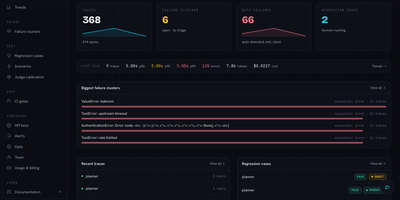
When an AI agent breaks in production, Tracely freezes that exact run into a replayable regression test and blocks the pull request that would ship the bug again. Span soup hides the failure. OTLP/HTTP traces group into conversation threads, and a waterfall marks the failing span in red with its input and output. Nobody knows if an answer was good. Evaluators sit as columns on the trace table, mixing model-free checks with LLM judges at conversation, run, or span level. Thirty-one broken runs, one issue. Clustering turns them into a single counted issue and can suggest the evaluator that would have caught it. A fix nobody can prove. One click promotes a failing trace into a hermetic case with recorded fixtures and a fail-to-pass contract, and scenarios send a red-team model after an adversarial goal. Model bills on every CI run. The suite replays offline with no API keys and no model spend, and tracely gate posts a commit status, comments on the pull request, and blocks regressions. No warning when it breaks again. Alert flows drawn on a canvas react to failed gates, broken conversations, unseen failure modes, or rising failure rates by messaging Slack, sending email, calling a webhook, or prompting an LLM. Coding agents can read traces and write evaluators through an MCP endpoint. Running on a dedicated VPS on RepoCloud with guaranteed CPU, RAM, and SSD, full root SSH access, and a browser serial console. MIT licensed.
Metabase
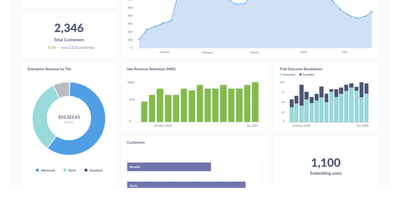
The most widely deployed open-source BI tool, Metabase is a visualization and query layer that sits on top of your existing databases without ingesting or copying data. Non-technical users ask questions through a visual query builder with drill-through menus that answer follow-ups like "broken down by month" without writing a new query, while analysts use the native SQL editor with variables and templates for complex work. Questions assemble into interactive dashboards with filters, auto-refresh, fullscreen mode, and custom click behavior, and dashboard subscriptions email or Slack scheduled reports to stakeholders. It connects to 20+ data sources including PostgreSQL, MySQL, MongoDB, SQL Server, BigQuery, Snowflake, Redshift, and ClickHouse - always querying in place, so there is no second data store to secure, sync, or pay for, and results are always current. Models and metrics let a data team define official, reusable starting points so self-service stays consistent, collections with permissions organize content, and alerts fire when a metric crosses a threshold. The practical effect is cutting the ad-hoc query queue that lands on the data team, since non-technical staff can answer their own questions. Written in Clojure, licensed AGPL, and shipped as a single JAR or Docker image with an embedded application database - a working BI instance runs before most tools finish their installer - the open-source edition has no limits on users, dashboards, or connected databases, where commercial BI platforms price per viewer as well as per creator.
Otter Wiki
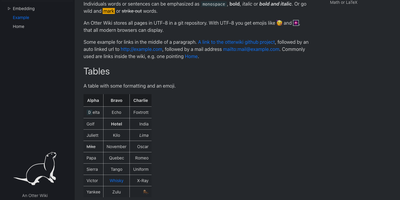
Every page in Otter Wiki is a plain Markdown file and every save is a git commit, so a small team gets a simple wiki whose history never goes missing. The editor highlights Markdown as you type, offers a toolbar for headings, lists, tables, code, alerts, and images, and can show a live preview beside the source. Paste or drop an image into the editor and it is stored as a page attachment. History, blame, and changelog views, with RSS and Atom feeds, show who changed what and when. Beyond standard Markdown you get footnotes, task lists, math formulas, Mermaid diagrams, alert boxes, and spoiler or folded blocks, plus experimental embeddings such as sortable data tables, info boxes, image frames, videos, and included pages. A customizable sidebar shows a menu, a page index, or both. Search offers case-sensitive and regular expression options. Dark mode is built in. Admins decide whether anonymous visitors, registered users, or approved users may read, write, or upload, grant rights per user, close registration, or require email confirmation. An optional, experimental git web server lets people clone, pull, and push the wiki, and changes can be pushed to or pulled from a remote repository over SSH. Running on a dedicated VPS on RepoCloud with guaranteed CPU, RAM, and SSD, full root SSH access, and a browser serial console. MIT licensed.
Larasend
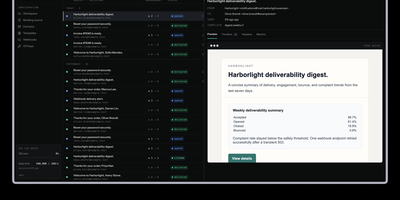
Larasend gives Laravel teams a self-hosted transactional email platform that sends through their own Amazon SES or Cloudflare account while keeping the dashboard, delivery logs, and message data on their own servers. Send mail with a simple POST to the emails API, or point existing mailables and notifications at the Larasend transport with one environment variable and no code rewrite. Every message lands in an activity dashboard where you can filter by status, search recipients and message IDs, open a preview with headers and metrics, and resend failures in one click. Delivery, bounce, complaint, open, and click events stream back from the provider and update each message timeline, so a missing receipt becomes a traceable record instead of a support mystery. Suppression lists build themselves from bounces and complaints, and guardrails watch complaint rates and verified domains before reputation damage can spread. Scoped API keys with expiration and rotation keep each project separate, while workspace roles control who can view, send, and administer. When replies arrive, the shared inbox threads inbound and outbound mail into conversations your team can assign, snooze, annotate, and answer with attachments and drafts. Webhooks notify your other systems about deliveries and inbound mail, and reusable templates keep recurring notices consistent across projects. Running on a dedicated VPS on RepoCloud with guaranteed CPU, RAM, and SSD, full root SSH access, and a browser serial console. MIT licensed.