Open Source App Cloud Marketplace
Deploy, host, and scale with one click, at half the cost. Then customize with AI agents.
SQL Chat
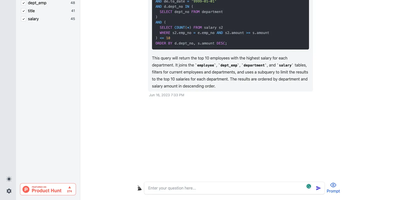
Describe what you want in plain language and get real SQL against your real schema: SQL Chat is an open-source, chat-based SQL client from the Bytebase team. Instead of writing queries in a traditional editor, you connect a database and describe what you want in plain language; the AI reads your schema automatically, generates SQL that references real table and column names, executes it, and returns tabular results in the conversation. Follow-up messages refine the query, so exploration becomes a dialogue - narrow a result set, add a join, change an aggregation - without retyping statements. It supports MySQL, PostgreSQL, SQL Server, TiDB Cloud, and OceanBase from one interface, and covers modification as well as reads: insert, update, and delete operations phrased conversationally. Built with Next.js and TypeScript, it deploys as a single stateless Docker container in single-user mode - connection profiles live in the browser, so there is nothing server-side to maintain. A custom AI endpoint setting routes inference through any OpenAI-compatible API, including self-hosted models, and an optional database-backed mode adds accounts and quotas for offering the tool to a team. MIT-licensed.
Gibbon
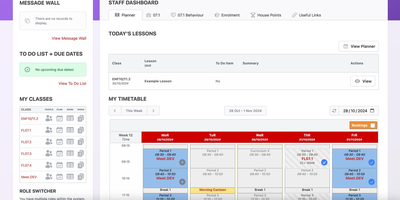
Running a school means juggling lesson plans, timetables, attendance, behaviour notes, and grades all at once; Gibbon gives teachers, students, parents, and administrators one shared web system for that daily work. Teachers build lessons from reusable Smart Blocks, assemble them into units with learning outcomes, set and collect homework online, and grade the results in a colour-coded markbook that stays linked to every class. The timetabling engine builds schedules from reusable day structures, ties them to real calendar dates, handles exceptions, books rooms and facilities, and shows every student and teacher exactly where they should be. Attendance can be taken by form group, class, or individual student, with future absences recorded ahead of time and reports ready for emergencies or truancy follow-up. Behaviour records log the good alongside the bad using your school's own descriptors and severity levels, notify form tutors when something needs attention, and surface patterns across a student's history. Each student's profile pulls timetable, attendance, behaviour, library, and assessment information into one page, while activities sign-ups, a school-wide resource library, and departmental scope-and-sequence views keep the wider community connected. Because every module can be switched on or off per role and extended with community modules, the same platform fits a small primary school and a large secondary school in 26 languages. Running on a dedicated VPS on RepoCloud with guaranteed CPU, RAM, and SSD, full root SSH access, and a browser serial console. GPL-3.0 licensed.
AKHQ
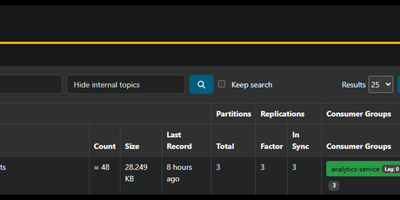
AKHQ puts every Kafka cluster your team runs into one browser console, so topics, messages, consumer lag, schemas, and connectors stop being command-line archaeology. Browse live data inside any topic with search and Live Tail, inspect records by key or partition, and produce test messages without touching a console producer. Consumer group views show lag per partition, and offset resets take a couple of clicks instead of a maintenance window. Multiple clusters sit side by side in the same interface, each with its own Schema Registry, Kafka Connect, and ksqlDB connections attached. Schemas can be created, updated, and versioned from the UI, and Connect clusters report connector and task status you can pause, restart, or reconfigure. Administrators manage ACLs and cluster configuration from the same screens developers use to explore data. Access control goes deep: roles bundle resources and actions, groups scope them with topic patterns and cluster restrictions, and sign-in plugs into OIDC, LDAP, or basic authentication. Point it at your brokers with one configuration file, run it as a single container, and the whole platform team shares one safe window into production Kafka. Running on a dedicated VPS on RepoCloud with guaranteed CPU, RAM, and SSD, full root SSH access, and a browser serial console. Apache-2.0 licensed.
Nimbus
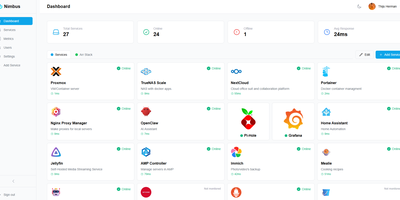
Nimbus is a self-hosted homelab dashboard that turns your scattered pile of services into a polished, organized command center with real-time health monitoring for every endpoint you care about. The dashboard displays live status cards for each registered service, tracking response times down to the millisecond and graphing uptime history so you can spot degradation before it becomes an outage. Health checks run on configurable intervals with smart self-signed certificate handling, meaning your internal services with self-issued TLS do not trigger false alarms. Multi-user support comes standard: local accounts authenticate via JWT, while OAuth2 integration with Google, GitHub, and Discord lets team members sign in with existing credentials. Role-based access control and a built-in admin panel give you granular authority over who sees what. Each user personalizes their view with custom backgrounds, light or dark mode, accent color themes, and drag-and-drop service tile arrangement. Services group into named categories and cards resize to fit your preferred layout, with both grid and list view modes available. Prometheus metrics export feeds your existing Grafana stack, and webhook notifications alert you instantly when a service goes offline. Custom service icons upload directly or auto-fetch from the Dashboard Icons collection. Zero-config Docker deployment gets you running in under 30 seconds with a single docker-compose command. Running on a dedicated VPS on RepoCloud with guaranteed CPU, RAM, and SSD, full root SSH access, and a browser serial console. AGPL-3.0 licensed.
Open DroneLog
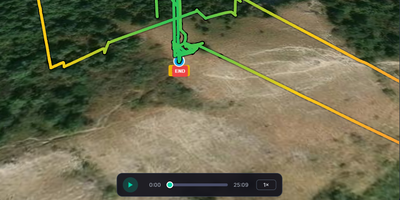
Every DJI and Litchi flight you have ever logged becomes a searchable dashboard on your own server with Open DroneLog, a free, open-source alternative to DroneLogbook, Airdata UAV, and Flight Reader. Drop in DJI .txt logs, Litchi CSV files, or Airdata CSV exports and units are detected automatically, while deduplication on drone serial, battery serial, and start time lets you re-import a folder without duplicate flights. Each flight opens as a 3D terrain map with satellite, topographic, and OpenStreetMap layers, then replays from 0.5x to 16x speed with live telemetry and an RC joystick overlay. Synchronized charts plot height, speed, battery cell voltages, attitude, RC signal, GPS, and distance to home, with drag-to-zoom. Filters narrow flights by date, drone, battery, controller, duration, altitude, distance, tag, or map area, and automatic tags such as Night Flight and Low Battery arrive with offline reverse-geocoded locations. The overview dashboard adds an activity heatmap, per-drone and per-battery charts, and a cluster map. Battery health bars track cycle counts and capacity history, and maintenance thresholds show as color-coded progress bars. Export flights as CSV, JSON, GPX, or KML, build printable HTML flight reports that save as PDF, or generate a FlyCard image for social media. A sync folder imports new logs automatically, pilot profiles can sit behind passwords, and full-database backup and restore moves data between desktop and Docker. Running on a dedicated VPS on RepoCloud with guaranteed CPU, RAM, and SSD, full root SSH access, and a browser serial console. AGPL-3.0 licensed.
QuickVoice
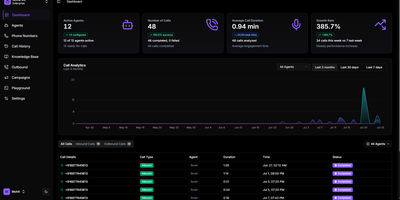
Your front desk phone rings at midnight and nobody sane is awake; QuickVoice answers it with an AI agent you configured, on servers you own, with call recordings you control. Build agents in the web console: write the prompt, pick speech-to-text, language model, and voice, set the first message, then link a real phone number from Twilio or Telnyx through LiveKit SIP trunks. Inbound callers get a receptionist that answers questions from your uploaded knowledge base, PDFs and web pages chunked and embedded for live retrieval, while outbound mode fires single quick calls or batch campaigns for reminders and follow-ups. Agents can invoke allowlisted MCP tools mid-call, so checking an order status or booking a slot happens inside the conversation instead of after it. Every call lands in the log with transcript, recording, and metadata, searchable from the analytics dashboard, and privacy controls redact personal data by default, can suppress recordings entirely, and sweep old transcripts on a retention schedule. Multi-language voices, per-agent runtime overrides for campaigns, organization accounts with API keys and audit logs, and Stripe billing hooks round out a platform built for teams who would rather inspect their voice stack than rent a black box. Running on a dedicated VPS on RepoCloud with guaranteed CPU, RAM, and SSD, full root SSH access, and a browser serial console. MIT licensed.
Proval
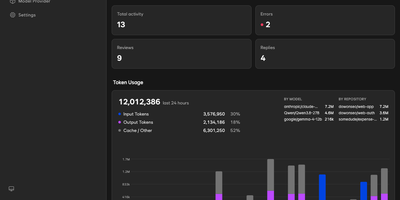
Proval is a self-hosted AI code review agent that reads every pull request on your GitLab, Forgejo, or GitHub server and posts a consolidated, severity-grouped review with inline comments, using a model you run yourself. When a pull request gets a meaningful push, a planning agent groups changed files into review units and dispatches specialist sub-agents in parallel, each exploring the codebase so cross-file issues surface. A writing agent merges their findings into one review, with comments on the affected lines, including multi-line ranges. Reply to any Proval comment and it reads the thread context and answers, and it works on issues too, greeting new ones and answering follow-ups on every message or only when mentioned. Choose per repository whether reviews run on first push only, every push, or not at all, skipping drafts until they are marked ready. Every review, reply, and issue comment is logged with its token usage, so each model's cost shows in the dashboard instead of hiding in an API bill. Your code is never stored; review context goes only to the LLM endpoint you configure, whether that is a cloud API or a local Ollama or llama.cpp server on your own network. Connect GitLab or Forgejo with an access token and webhooks, or GitHub through a GitHub App; Gitea and Codeberg use the same Forgejo-compatible path. Running on a dedicated VPS on RepoCloud with guaranteed CPU, RAM, and SSD, full root SSH access, and a browser serial console. AGPL-3.0 licensed.

Huntly
Capture every article you read, RSS feed you follow, X/Twitter thread you scroll past, and GitHub repository you star into one searchable, AI-enhanced personal knowledge base with Huntly. Auto-save visited web pages through the companion browser extension, extract distraction-free article text using Mozilla Readability and Defuddle, and highlight passages with inline notes that remain anchored in your library. Reconstruct multi-post X/Twitter threads automatically with embedded media preserved intact. Subscribe to RSS and Atom feeds via OPML import, organize subscriptions into custom folders, and triage unread stories alongside your read-it-later queue and hierarchical collections. Synchronize starred GitHub repositories with their README documentation and repository tags so you can filter tools by topic without leaving your dashboard. Run custom AI shortcuts to summarize long-form essays, translate foreign articles, or query your entire archive from external AI coding agents through the built-in MCP server and Agent Skills integration. Execute boolean, phrase, and bilingual fuzzy queries across every saved document or export your entire library to portable Markdown files. Running on a dedicated VPS on RepoCloud with guaranteed CPU, RAM, and SSD, full root SSH access, and a browser serial console. Apache-2.0 licensed.
CliRelay
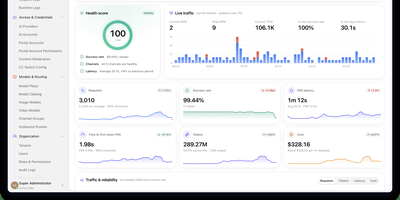
Anyone who pays for Claude Code, Codex, and Gemini CLI separately ends up juggling three endpoints, three sets of keys, and three kinds of rate-limit surprise, and CliRelay collapses all of that into one self-hosted gateway with a control panel. Clients speak the OpenAI Chat or Responses, Anthropic Messages, or Gemini protocol, and CliRelay translates each request for whichever upstream account is healthy. Channel groups limit where each key may send traffic, round-robin, fill-first, and session-sticky scheduling spread it, and cooldowns with automatic failover move requests off accounts that have run out of quota. Add upstreams from the /manage console through browser sign-in, device codes, or bulk credential import, covering Claude, Codex, Gemini, Antigravity, Vertex AI, AWS Bedrock, Grok, Qwen, Kimi, and any OpenAI-compatible service. Portal accounts own client keys with daily, period, and lifetime quotas, RPM and TPM limits, and per-model pricing. A monitor center scores health and charts live traffic, P50 to P99 latency, and time to first token, while every request lands in a searchable log with tokens, latency, and cost. Tenants, roles with resource.action permissions, content moderation profiles, an outbound proxy pool, and an audit trail make shared deployments workable, and the console speaks English, Simplified Chinese, and Russian. Running on a dedicated VPS on RepoCloud with guaranteed CPU, RAM, and SSD, full root SSH access, and a browser serial console. MIT licensed.
Basjoo
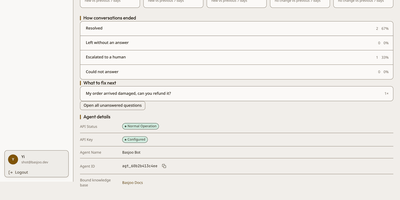
Support tickets that repeat the same twelve questions all week can answer themselves when Basjoo turns your website and documents into an embeddable AI support agent you host yourself. Knowledge bases are built independently of agents, fed by crawling a single page or an entire site, or by uploading PDF, Word, Excel, HTML, and text files that are parsed into searchable chunks. Visitors chat through a widget added with one script tag, in a floating bubble, inline frame, or iframe, and answers stream back with source citations so people can verify what the bot claimed. A curated question and answer index is matched before retrieval, which means correcting a wrong answer takes effect immediately without reindexing the whole collection, and a keyword fallback mode can answer matched questions with no model key at all. When a conversation needs a person, operators watching the live session wall can take over, reply with saved macros, release the chat back to the bot, or resolve it, with business hours deciding when the bot is off duty. Lead capture forms, an unanswered question queue that groups repeats into future answers, thumbs feedback rolled into analytics, and signed outbound webhooks for seven event types round out the operator side. Running on a dedicated VPS on RepoCloud with guaranteed CPU, RAM, and SSD, full root SSH access, and a browser serial console. MIT licensed.

Tasterr
Tasterr is a self-hosted discovery front end that learns what each person in your household actually likes and fills the home screen with movie and show rails picked for them. It reads the TMDB catalog in your chosen metadata language and merges it with your Plex, Jellyfin, Seerr, and Trakt accounts, so library titles, requests, and watch history shape every recommendation. Continue Watching pulls resumable movies, episodes, and next-up picks from Plex and Jellyfin into one rail, and Because You Watched rails spin off new suggestions from finished titles. Watched titles disappear from discovery by default, a Not interested button banishes titles for good, and My List keeps the maybes one tap away. When the household gathers, Something for Everyone Tonight blends member profiles into one shared shortlist, and Picks You Wouldn't Usually Watch deliberately wanders outside each profile. Requests flow into Seerr under the signed-in member's name, availability badges show where a title already lives, and admins tune regions, streaming services, rails, language, theme, and accent color. Running on a dedicated VPS on RepoCloud with guaranteed CPU, RAM, and SSD, full root SSH access, and a browser serial console. AGPL-3.0 licensed.
BrightBean Chat
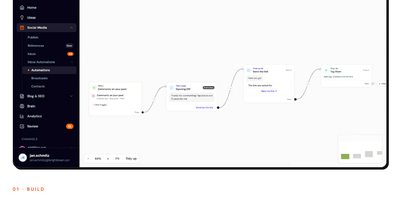
BrightBean Chat is a self-hosted chat automation platform that builds visual flows once and runs them across Instagram, WhatsApp, Messenger, Telegram, SMS, and email, so your audience automations live on your server instead of a per-contact subscription. You drag conditions, delays, randomizers, data collection, and message nodes onto a canvas, test the draft while the live version keeps running, then set it live with every save versioned. Flows start from keywords, comment-to-DM triggers, story mentions and replies, follows, ref URLs, QR codes, or calls to the public API. Every channel lands in one shared inbox where teammates assign conversations, label them, schedule replies, and take over from the bot, which pauses the automation for that contact. Contacts carry custom fields, tags, and segments that stay unified across channels, and imports and exports keep the list portable. Broadcasts and multi-step drip sequences check opt-outs and each platform's 24-hour messaging window before sending, pace themselves per channel, and show exactly who will receive a message and who is skipped. Per-node counters track sent, delivered, failed, and clicked, while a bearer-authenticated REST API and signed webhooks hand leads to Make, Zapier, n8n, or your own systems. Running on a dedicated VPS on RepoCloud with guaranteed CPU, RAM, and SSD, full root SSH access, and a browser serial console. AGPL-3.0 licensed.
Antares
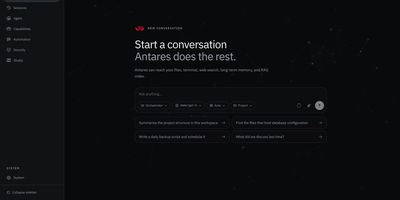
Most AI agents are a chat box with confidence; Antares is a working security specialist that shows its evidence. Point it at a target you are authorized to test and its specialist agents map the surface, test web applications against OWASP, probe APIs, and record every confirmed finding with its reproduction steps. When the run ends, the findings are already compiled into a report, because the agent kept the evidence as it went instead of reconstructing it afterward. The same workspace handles ordinary work between engagements: it reads and writes files, runs your shell, drives a real browser, searches the web, and retrieves from a built-in memory and RAG index that remembers what matters across sessions. Give it a goal and it holds to that goal across turns, schedules its own follow-up work, and answers from Telegram and Discord when you are away from the dashboard. Bring your own models, since everything runs on your machine or server from one binary, with the dashboard, terminal UI, and API served by a single process. Running on a dedicated VPS on RepoCloud with guaranteed CPU, RAM, and SSD, full root SSH access, and a browser serial console. Apache 2.0 licensed.
zrok
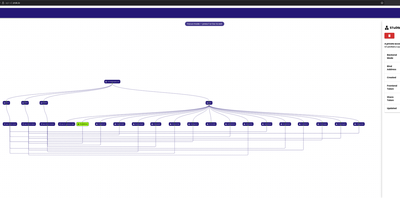
zrok puts services that live behind NAT and firewalls onto the public internet with a shareable URL, without opening a single inbound port. The machine being shared dials out to an OpenZiti overlay network, so a web app on your desk, a Raspberry Pi at home, or a staging box inside a corporate network becomes reachable through your instance while its firewall stays closed. One command shares an HTTP service publicly; add a name from one of your namespaces and the URL stays stable even when you move the backend to a different machine, and an ephemeral name can be promoted to a reserved one when a quick demo turns into a keeper. Private shares skip the public internet entirely and reach only the users you grant, including raw TCP and UDP services, while web and drive backend modes publish static sites or whole folders, with OAuth, password auth, and an interstitial warning page available on public shares. The long-running agent keeps every share and access under one process, restarts the named ones after a reboot, and offers a localhost console for point-and-click sharing; the account-wide web console maps your environments, shares, and accesses as a navigable graph or a sortable table with live activity. Operators get invite-based accounts, InfluxDB-backed usage metrics, and configurable limits that warn or cut off accounts that exceed their quotas. Running on a dedicated VPS on RepoCloud with guaranteed CPU, RAM, and SSD, full root SSH access, and a browser serial console. Apache-2.0 licensed.
Azimutt
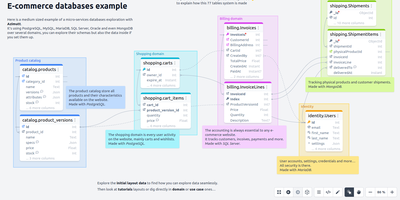
Inheriting a sprawling database with hundreds of undocumented tables usually means weeks of guesswork, unless you open it in Azimutt to visually map schemas, trace relationships, and inspect live rows in one workspace. Instead of dumping every table onto a cluttered canvas that crashes your browser, the visual explorer starts clean so you can search across entity names, column types, and SQL comments to reveal only the tables relevant to your investigation. Clicking foreign-key or primary-key indicators expands incoming and outgoing relations step by step, while the graph path-finder automatically calculates the shortest join route between any two distant entities. When debugging production issues or answering support tickets, you can query live records across PostgreSQL, MySQL, MariaDB, SQL Server, Oracle, SQLite, MongoDB, Couchbase, Snowflake, and BigQuery, then click directly through foreign keys in the result rows to follow data lineage visually. Architects and developers also design new schemas at typing speed using Azimutt Markup Language (AML), attach contextual markdown notes, tags, and memos to saved layouts for team onboarding, and run automated schema analysis that flags missing primary keys, implicit foreign keys, inconsistent column types, and oversized tables. Running on a dedicated VPS on RepoCloud with guaranteed CPU, RAM, and SSD, full root SSH access, and a browser serial console. MIT licensed.
Courselit
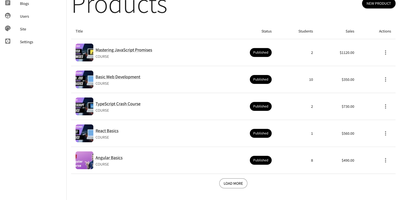
Course creators, educators, and training academies use CourseLit to launch branded digital schools, host interactive curricula, and monetize recurring memberships without paying platform revenue cuts. The visual course builder organizes multimedia lectures, downloadable workbooks, interactive quizzes, and gated content sections with customizable release schedules. Educators can package content into multi-tiered memberships, bundled digital downloads, or individual paywalled courses with direct Stripe billing and localized currency checkouts. Built-in email marketing automation allows creators to trigger welcome broadcasts, schedule lesson drip sequences, and re-engage inactive learners based on module completion milestones. An integrated site editor builds customizable sales pages, student dashboards, and community discussion boards to foster peer engagement and lesson feedback. Administrators can monitor enrollment analytics, review customer transaction logs, issue customized completion certificates, and manage learner permissions from a centralized control panel. Granular access controls let instructors grant free preview lessons to boost conversion rates while protecting premium educational materials behind secure authentication. Running on a dedicated VPS on RepoCloud with guaranteed CPU, RAM, and SSD, full root SSH access, and a browser serial console. AGPL-3.0 licensed.
OpenBoxes
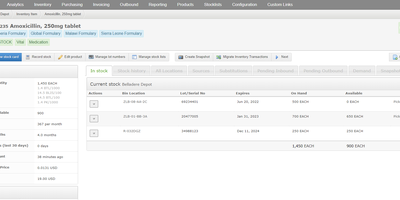
OpenBoxes is an open-source warehouse management system that keeps medication and supplies visible from central depot to clinic cabinet, so staff always know what is in stock, where it sits, and when it expires. The product catalog holds medications, medical devices, office supplies, and fixed assets, with suppliers, manufacturers, pricing, classifications, and custom attributes on every item. Inventory is tracked by facility and bin location down to lot and expiration date, and every adjustment, transfer, and removal leaves a full transaction history. Reorder points and stock alerts flag low stock, overstock, and expiring items before they become emergencies. Inbound, purchase orders, invoices, and budget codes manage procurement; goods receipt captures lots and expiry dates, and suggested putaway directs stock to the right bins. Outbound, requisitions and stock lists drive requests from upstream facilities, FEFO picking pulls the earliest-expiring lots first, and packing produces packing lists with customs documentation. Cycle counting keeps records honest without closing the warehouse, and dashboards surface stock value, fast movers, and expiring stock. Barcode scanners and a mobile-friendly interface speed up receiving and counting on the floor, and spreadsheet imports load products, locations, and opening stock in bulk. A REST API and webhooks connect OpenBoxes to ERPs, DHIS2 health information systems, and integration platforms like n8n and OpenFn, and location-restricted roles keep each facility on its own shelves. Running on a dedicated VPS on RepoCloud with guaranteed CPU, RAM, and SSD, full root SSH access, and a browser serial console. EPL-1.0 licensed.
Marble
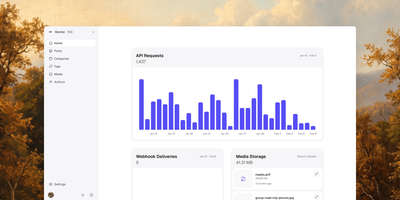
Marble gives your blog, changelog, or product updates a calm editorial home, then hands clean JSON to whatever website you already built. Writers work in a focused rich-text editor with headings, lists, code blocks, images, video, and embeds, while a readability score quietly grades each draft as it grows. Every post carries authors, one category, tags, a cover image, and typed custom fields, so a changelog entry and a long guide can share one predictable structure. Your frontend pulls sanitized HTML or Markdown through the REST API or typed SDK, filtering by category, tag, or search in a single request. Read-only public keys serve published posts safely, while scoped private keys unlock drafts and write access for the tools you trust. Uploads of images, video, audio, and documents land in a media library with alt text and dimensions, ready to embed anywhere. Signed webhooks announce every change to your site, Slack, or Discord with retries and a delivery log, and an MCP server lets AI agents search and draft content too. Running on a dedicated VPS on RepoCloud with guaranteed CPU, RAM, and SSD, full root SSH access, and a browser serial console. AGPL-3.0 licensed.