Open Source App Cloud Marketplace
Deploy, host, and scale with one click, at half the cost. Then customize with AI agents.
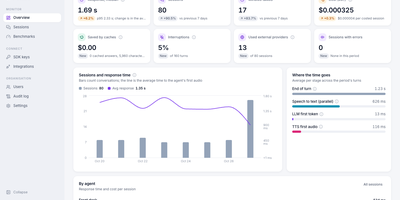
Euron Open VoiceOS
Every second of a voice conversation gets a timestamp and a price tag in Euron Open VoiceOS, a platform for building real-time voice agents that listen, think, and speak. Start from a template, such as receptionist, tutor, or meeting assistant, and talk to it in the browser. Each turn is split into end of turn, speech to text, the model's first token, and first audio, and each session adds usage and an estimated cost, so you see where time and money went. Local Whisper hears and local Kokoro speaks, so a new agent needs no cloud account, and any stage can switch to Deepgram, Sarvam, ElevenLabs, Cartesia, Anthropic, or any OpenAI-compatible endpoint. Callers can interrupt at any moment, and a failing provider earns a spoken apology instead of silence. No audio is ever stored, transcripts are redacted for emails, phone numbers, and cards, and callers are told up front when a provider runs outside your servers. A phrase cache, a response cache, and small-model routing for short turns trim the bill. Developers mint SDK keys scoped to agents and website origins, trade them for one-minute session tickets, and connect from any browser over WebRTC or WebSocket. Hindi templates come ready to use, and a bundled benchmark scores word error rate for English, Hindi, and Marathi. Running on a dedicated VPS on RepoCloud with guaranteed CPU, RAM, and SSD, full root SSH access, and a browser serial console. MIT licensed.
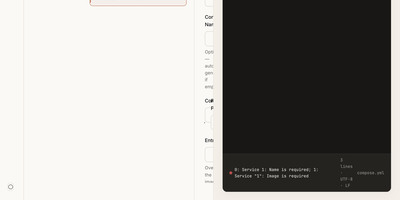
Dock-Dploy
Visual drag-and-drop assembly replaces manual text editing in Dock-Dploy, a Docker Compose builder and configuration management suite that turns complex multi-service container topologies into validated YAML manifests. DevOps engineers and self-hosters can visually assemble application stacks by selecting container base images, defining healthcheck probes, mapping bridge networks, and assigning persistent volume mounts through a reactive web interface. An integrated marketplace catalog allows teams to search, preview, and import battle-tested templates for services like PostgreSQL, Redis, and Nginx with one click. Real-time Zod schema validation inspects every service parameter as you type, flagging port collisions, missing environment variables, and malformed volume syntax before deployment. A split-screen CodeMirror editor provides continuous synchronization between graphic form fields and generated YAML definitions with automatic code sanitization and clipboard exports. Beyond Compose stacks, operators can design blueprint templates, generate reverse proxy routing profiles, and assemble recurring cron schedules for automated backup and maintenance routines. Running on a dedicated VPS on RepoCloud with guaranteed CPU, RAM, and SSD, full root SSH access, and a browser serial console. AGPL-3.0 licensed.
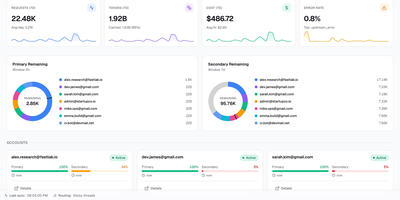
Codex LB Enhanced
Codex LB Enhanced is a session-aware gateway that pools your ChatGPT accounts so a long Codex session survives quota limits, dropped connections, and paused accounts without losing the conversation. It serves Codex desktop, CLI, and IDE clients through the native Responses protocol and WebSocket transport, and answers any OpenAI-compatible client through the familiar /v1 endpoints. When an account runs out of quota, gets suspended, times out, or drops mid-stream, the gateway classifies the failure, removes that account from the current request, and selects the next one through your load-balancing policy. Verified request history, including interrupted tool-call context, is replayed across the account switch when it is safe, so the client sees a slower answer instead of a dead stream. Every API key carries its own policy: time windows from five hours to monthly, limits by credits, tokens, or cost, and model-specific rules. Usage appears in native Codex quota headers and in a /v1/usage view backed by the same data, so editors and automation agree on what is left. Diagnostics correlate each request with its upstream account, transport, failover stage, and retry count, and a web dashboard manages accounts, keys, usage windows, request logs, and recovery reports. Running on a dedicated VPS on RepoCloud with guaranteed CPU, RAM, and SSD, full root SSH access, and a browser serial console. MIT licensed.
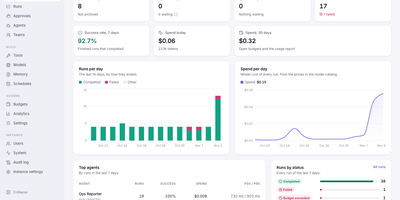
Euron Open AgentOS
Euron Open AgentOS is a runtime for AI agents that checks every model call against a budget before it is sent and pauses risky tool calls for human approval. Define an agent with instructions, tools, memory, limits, and a model from OpenAI, Anthropic, Gemini, Ollama, or any OpenAI-compatible endpoint, then start it from the dashboard, the API, the Python SDK, a schedule, or a webhook. Budgets cap tokens and cost for a run, an agent's day, a project's day or month, and an organization's month, and a delegated team shares one pool. Any tool can require approval always or only when its arguments match a rule, and reviewers can approve, reject, or edit its arguments. Code, shell, git, and browser tools run in a separate sandbox that holds no credentials and limits browsing to an allowlist of domains. Every step is checkpointed, so a crash or a pause resumes the run where it stopped instead of repeating finished work. Teams work in sequence, in parallel, under a supervisor, or in collaborative rounds, and the Run Inspector shows every delegation as a child run. Built-in tools cover web search, files, CSV and JSON queries, read-only SQL, and email; custom HTTP tools and MCP servers add more. Organizations, projects, roles, API keys, OIDC sign-in, and an audit trail keep teams apart. Running on a dedicated VPS on RepoCloud with guaranteed CPU, RAM, and SSD, full root SSH access, and a browser serial console. MIT licensed.
Euron Open AgentGuard
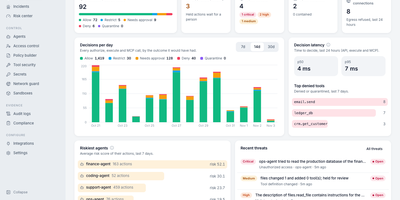
Euron Open AgentGuard decides every action an AI agent takes before it happens, so a poisoned web page cannot talk one into refunding the wrong account. Credentials for HTTP tools, MCP calls, and sandboxed code never reach the agent: AgentGuard runs them itself, and agents authenticate with short-lived identities. A YAML policy answers allow, restrict with row limits or field redaction, hold for a person, deny, or quarantine the agent, and an explicit deny always wins. Drafts can be dry-run on one request, replayed over recorded decisions, or tried in audit mode, which logs what enforcement would have done. Approvals are tied to a hash of the agent, tool, action, and parameters, and one changed byte starts a new request. Nobody approves their own. Once a run reads content that tries to command the agent, it is tainted and its next high-risk action waits for a human. Registered MCP servers share one governed endpoint that hides forbidden tools, scans outputs for injected instructions, and holds a changed tool definition for review. Secrets are written once and injected only for the hosts they are bound to, and an egress proxy limits each agent's destinations. Records are hash-chained and verifiable on demand, with incident reports and an OWASP agentic Top 10 report. SDKs for LangGraph, CrewAI, and Express treat any error as a deny. Running on a dedicated VPS on RepoCloud with guaranteed CPU, RAM, and SSD, full root SSH access, and a browser serial console. MIT licensed.
Euron BrowserAgent
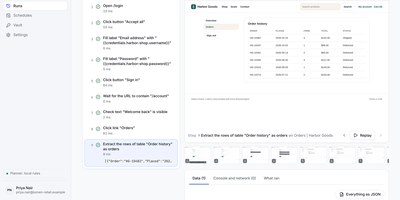
Turning a repeated browser chore into a reviewed list of steps lets Euron BrowserAgent run it the same way every time, on demand or on a schedule. Tasks are lists of steps (open, click, fill, choose, wait, extract text or a table, check, screenshot) and each target lists up to five selectors as ordered fallbacks. Describe a job in a sentence and the planner drafts steps from the real page, offline or through an OpenAI-compatible model or Ollama. Pick from page offers a page's fields, buttons, and tables as ready steps. A run opens a fresh headless Chromium context and keeps a screenshot of every step, the page's console and network errors, and extracted data as JSON or CSV. The replay steps through any run beside the page after each action, and a failed run names the step and the reason. Runs start by hand, from an API key, or on cron schedules in any time zone, with overlap rules and missed fires merged into one run. Logins are sealed in a vault, typed into pages by the worker, masked in screenshots, and scrubbed from records, with TOTP codes for two-factor sign-ins. An egress policy blocks cloud metadata and private networks unless a host is allowed. Workspaces add owner, editor, and viewer roles, an activity log, and run limits. Running on a dedicated VPS on RepoCloud with guaranteed CPU, RAM, and SSD, full root SSH access, and a browser serial console. MIT licensed.
SoftJL
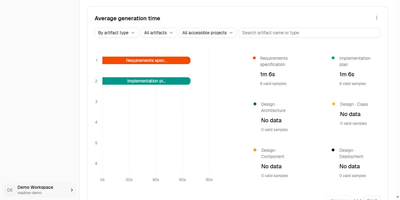
SoftJL turns a system description into the UML diagrams, test cases, and Word specifications a software project is supposed to produce, and keeps every artifact traceable back to the requirement it came from. Describe your system in chat and confirm the extracted requirement rules, then work through feasibility analysis with system context, business and system flows, and implementation options weighed by cost, benefit, and risk. From the confirmed rules it builds requirement and design models: functional structure, use cases, domain concepts, architecture, design classes, database and deployment diagrams, all editable as PlantUML with SVG export. Tests follow the same thread, with normal, exceptional, and boundary cases mapped to requirement rules in coverage and traceability matrices that show exactly which requirements lack design or test support before you submit. When a requirement changes, dependencies and update status point at the models, tests, and documents that need review, instead of leaving you to rediscover them by hand. Specifications generate from the saved models as versioned, editable DOCX files, a feasibility report, a requirements specification, and a design description, ready to compare against the diagrams and revise. An optional read-only MCP endpoint lets a coding agent read your designs and acceptance criteria, and the whole workspace runs on your own OpenAI-compatible model service. Running on a dedicated VPS on RepoCloud with guaranteed CPU, RAM, and SSD, full root SSH access, and a browser serial console. Apache-2.0 licensed.
HabitSync
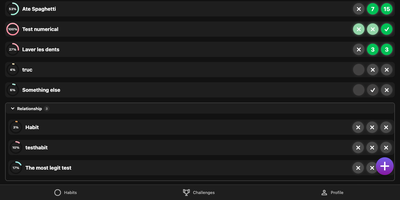
HabitSync treats habit tracking as a team sport, because willpower alone rarely survives February. Set each habit up the way life actually works: daily, weekly, monthly, on chosen weekdays, or at a custom interval, with a target value to reach or a ceiling to stay under for the habits you are trying to quit. Logging takes one tap, or a long press when today's effort deserves a custom number or a stopwatch. Share a habit with a partner, a sibling, or the whole household and everyone's progress sits side by side, which turns "did you go to the gym" into a question the dashboard answers. Monthly challenges raise the stakes with community voting, leaderboards, and medals for the top performers, while gentle automation watches your back: scheduled reminders when a habit goes unlogged, an alert when your completion slips under a threshold, and a quiet nudge when a friend overtakes you. Years of Loop Habit Tracker history import instead of being abandoned, and the installable web app keeps the streak one tap away on any device. Running on a dedicated VPS on RepoCloud with guaranteed CPU, RAM, and SSD, full root SSH access, and a browser serial console. BSD-3-Clause licensed.
Euron Open AI Chat
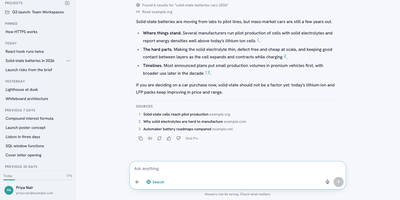
Your own ChatGPT-style assistant for a team or community runs on servers you control when Euron Open AI Chat answers from the models you enable. Admins add OpenAI, Anthropic, Gemini or any OpenAI-compatible endpoint, from OpenRouter and Groq to a local Ollama, and the picker lists only models whose provider has a key. Answers stream in and keep going when a tab closes or a phone drops its connection, and regenerated or edited messages stay as versions one click apart. Questions that need fresh facts trigger web search through SearXNG, Tavily, Exa or Brave, page reading, and answers with numbered citations. Attached images, PDFs, Word and Excel files, CSVs and code are read, and vision models describe photos. Image generation and editing work in the chat or in a studio with a gallery. Projects bundle shared instructions and knowledge files for a group of chats, and the assistant searches them and says where it looked. A memory page lists what the assistant remembers and who saved it, with a way to forget each fact. Voice means dictation and read-aloud. Shared conversations are frozen public links that an owner or admin can revoke. The /admin control plane manages users, roles, daily token and image allowances by tier, providers and models, sign-up rules, feature switches and an audit log, and never shows anyone's chats. Running on a dedicated VPS on RepoCloud with guaranteed CPU, RAM, and SSD, full root SSH access, and a browser serial console. MIT licensed.

Moocup
Drop your screenshot, a base style is applied, style it however you wish, and export - "that's basically it," says Moocup's own author, and the description holds. The workflow is genuinely seconds long. Drag an image in and it lands on an attractive backdrop immediately; from there you adjust backgrounds, gradients, padding, borders, shadows, and framing with live preview until it matches your taste, then export a high-quality image ready for a portfolio page, README, blog post, tweet, or slide deck. There are no accounts, no watermarks, and no upload to anyone's cloud - as a self-hosted static app, your screenshots never leave your infrastructure, which matters when the screenshot shows a proprietary dashboard or unreleased product. It runs entirely in the browser from a tiny nginx container, works on any device, and requires zero design skill: the smart defaults do the heavy lifting, and everything else is optional tinkering.

Shortlink
Shortlink is a self-hosted platform for short links and live QR codes that keeps every printed, shared, or forwarded entry point under your control long after it leaves your hands. A code printed on ten thousand flyers cannot be recalled when the campaign page moves, so the destination behind it changes while the printed image stays exactly the same. Create short links with custom codes, a choice of 301, 302, 307, or 308 redirects, expiry dates, visit caps, and a fallback target for when the main destination is down. Build live QR codes backed by a pool of destinations that rotates by order, weight, random pick, or least-shown strategy, with transactional saves so a half-finished edit never goes live. Style each code in classic, rounded, or dot patterns with your own colors and a center logo, preview it in real time, and download print-ready SVG, PNG, or WEBP files. New links and codes land in an approval queue that an admin reviews before anything goes public, and every change is written to an audit log. Teammates sign in with an emailed magic link or GitHub, manage only the resources they own, and watch thirty days of visit trends, unique IPs, and device and browser breakdowns roll in. Running on a dedicated VPS on RepoCloud with guaranteed CPU, RAM, and SSD, full root SSH access, and a browser serial console. AGPL-3.0 licensed.
Retinue
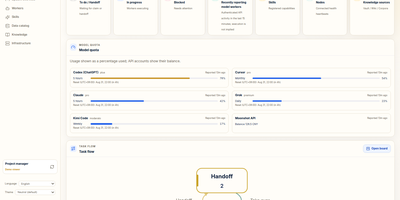
Retinue shows who is doing what across a fleet of AI agents, on a shared board where every task is a card with exactly one holder, a written acceptance check, and a receipt chain that cannot be rewritten. Operators publish cards, agents claim them through MCP or a token-scoped HTTP API, report progress, and hand off, and an agent that is not the holder gets a refusal when it tries to write. The Home dashboard counts what is waiting, running, and blocked, charts task flow and dispatch, and shows quota gauges for Claude, Codex, Cursor, Grok, and Kimi subscriptions. A collaboration workspace draws delegation graphs, device and model timelines, module contributions, and message conversations for any selected task. Operations pages report token usage by worker, and a data health page flags stale reports and duplicate identities. Read-only importers pull session data from Claude Code and Codex, and optional Lark, Feishu, and Telegram bridges turn chat messages into intents. The interface switches between English and Simplified Chinese. Running on a dedicated VPS on RepoCloud with guaranteed CPU, RAM, and SSD, full root SSH access, and a browser serial console. AGPL-3.0 licensed.
AutonomousSDR
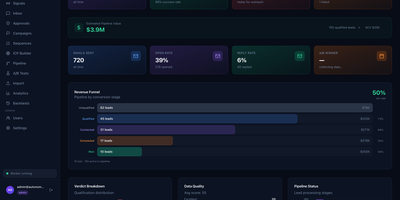
A lead fills in your form at midnight, and by morning AutonomousSDR has researched it, scored it, and queued a fact-checked email for you to approve. Leads come in from six channels, including web forms, ads, inbound email, LinkedIn signals, and a universal webhook for Zapier and Make. A research agent looks the company up online, then BANT scores, whose weights learn from won and lost deals, sort the lead as hot, warm, or cold. Hot leads receive a Cal.com booking link, warm ones enter an A/B-tested outreach sequence, and cold ones sync to HubSpot. Factual claims in a draft are matched to the research snippet behind them, and anything unsupported is flagged in the approval queue. An autonomy dial per organization switches between draft-only, approve-each-email, and full-auto modes. A campaign agent takes a quota, diagnoses why you are behind pace, and proposes strategy changes for your approval. Mailboxes rotate per rep with warm-up ramps and SPF, DKIM, and DMARC checks, sends honor recipient-local windows and daily caps, and any reply stops the cadence. Unsubscribe works in one click, and do-not-contact lists and GDPR erasure are included. Free Groq or local Ollama models work with no paid keys. Last quarter's won and lost deals can backtest the qualifier, and cost per meeting is compared with a human SDR. Running on a dedicated VPS on RepoCloud with guaranteed CPU, RAM, and SSD, full root SSH access, and a browser serial console. MIT licensed.
DispatchMail
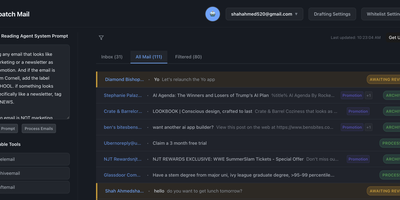
DispatchMail is an SuperHuman alternative and delivers a self-hosted AI email assistant that processes your Gmail inbox through configurable OpenAI prompts without sending data to third-party cloud services beyond the LLM API itself. The Flask backend connects to Gmail via IMAP, retrieves new messages according to your schedule, and routes them through customizable whitelist rules based on sender address, subject keywords, or natural language descriptions before AI processing begins. Two distinct prompt configurations control behavior — the Reading Prompt instructs how the AI should analyze and classify incoming messages, while the Draft Prompt defines how responses should be composed, letting you maintain consistent tone and policy across all automated replies. Whitelist filtering ensures the AI only processes messages you explicitly authorize, preventing unnecessary API costs and keeping sensitive emails out of the LLM pipeline entirely. The React web interface provides inbox management with message previews, AI-generated summaries, draft editing with human-in-the-loop approval before sending, and configuration panels for prompts and rules. Automatic labeling and archival organize processed messages into categories without manual intervention. The sender research feature uses LLM-powered deep analysis to build background profiles of email contacts. All email content, credentials, and processing results persist in a local SQLite database with zero cloud storage dependencies. Running on a dedicated VPS on RepoCloud with guaranteed CPU, RAM, and SSD, full root SSH access, and a browser serial console. Apache-2.0 licensed.
Nginx-Love
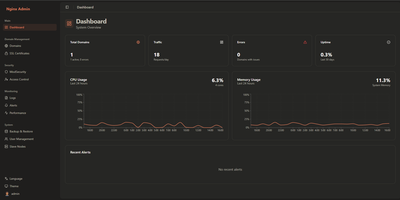
Hand-editing nginx configuration files to run a firewall is nobody's idea of a good afternoon, and Nginx-Love turns that chore into a dashboard. You manage domains, load balancing upstreams, and HTTPS backends through forms instead of config syntax, and the platform writes and reloads the underlying configuration for you. A ModSecurity firewall with the OWASP Core Rule Set inspects traffic to your sites, and you tune its rules from the interface rather than a text editor. Certificates arrive two ways: automated through Let's Encrypt, or uploaded manually when you bring your own. A Bot Manager fingerprints visitors with JA4 signals so you can welcome good crawlers, challenge suspicious automation, and block hostile bots by policy. Access lists filter by IP address, geography, and user agent, and multi-user roles let administrators, moderators, and viewers each see the controls appropriate to their job. Monitoring watches performance and attack patterns, sending alerts by email or Telegram when something needs attention. Configuration exports back up your setup, restores bring it back, and multi-node sync keeps a cluster of servers enforcing the same policy. Running on a dedicated VPS on RepoCloud with guaranteed CPU, RAM, and SSD, full root SSH access, and a browser serial console. Apache-2.0 licensed.
Netmon
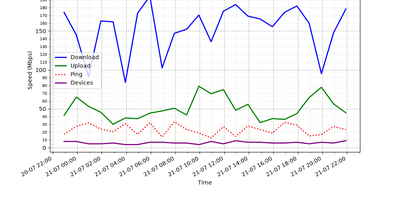
Every half hour, Netmon speed-tests your internet connection, counts the devices on your local network, and reports to your Telegram or Discord with charts and a sarcastic AI-written verdict. Each cycle measures download, upload, ping, ISP, and test server with a single-connection test that mimics one real download, then scans the subnet to tally phones, laptops, and mystery gadgets. Results land in a local SQLite database, building the trend history behind every report. Every four hours you get the full picture: a 24-hour speed graph plus an AI analysis that notices the evening drop, counts the new devices, and names the likely bandwidth hog in plain language. Between reports, short status alerts keep you posted with a simple all-good or line-is-dying. The AI commentary can run on a cloud model or a local one through Ollama or LM Studio, graphs and alerts convert cleanly between Telegram formatting and Discord embeds, and the whole bot runs unattended as a background service. Running on a dedicated VPS on RepoCloud with guaranteed CPU, RAM, and SSD, full root SSH access, and a browser serial console. MIT licensed.
TaskBrigade
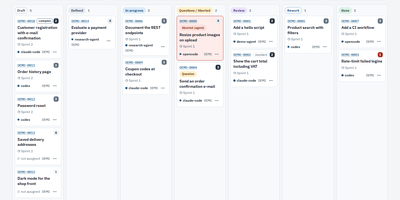
TaskBrigade is agile project management for teams of AI agents: a backlog, kanban board, sprints and pull request review where Claude Code, Codex, OpenCode and human teammates all pick up assigned work. Tasks carry acceptance criteria and their own branch, and finished work arrives as a pull request that a human or a reviewer agent approves, rejects or returns with change requests. An inbox gathers open questions, results waiting for review and aborted runs in one place. Workflows turn a chain of tasks into a reusable template that starts by hand, on a cron or workday schedule, or on an event, with approval steps, parallel groups and token budgets that pause a run at 100 percent. Projects marked local-only hand work exclusively to agents whose model runs on your own hardware, which keeps confidential material away from cloud models. Telegram and email notifications follow a per-event matrix with quiet hours, and from Telegram you can approve a review or answer an agent's question. Orchestrator agents, or OpenClaw messages in Telegram, create, split and assign tasks across several machines, each with its own work directory and parallel-task limit. Claude Desktop and Codex Desktop connect through MCP to draft and assign tasks straight from a chat. The interface speaks English or German and folds into a bottom tab bar and single-column board on phones. Running on a dedicated VPS on RepoCloud with guaranteed CPU, RAM, and SSD, full root SSH access, and a browser serial console. Apache-2.0 licensed.

Ambry
Ambry is a personal audiobook streaming server that keeps a collection you own on hardware you control, ready to stream to any browser or phone. Upload your audiobook files once, and the library becomes streamable to any device through a browser or the native mobile application. The server reads durations, tags, and chapter markers straight from the audio files, so a long novel arrives with its structure intact instead of as one anonymous ten-hour blob, and the original files are served untouched. First boot walks you through creating the initial administrator account, after which the instance restarts ready for listening. Households can open registration to family members or close it entirely, keeping the library an invitation-only shelf. Forgotten passwords and registration messages go out through the configured mail provider, so account recovery works without manual intervention. The collection itself lives in PostgreSQL with uploads on a persistent volume, and the whole service runs from a container image on a configurable port. Put a commute listen on your phone, a history title on a kitchen tablet, and a shared family library behind one address, all served from hardware you control. Running on a dedicated VPS on RepoCloud with guaranteed CPU, RAM, and SSD, full root SSH access, and a browser serial console. MIT licensed.