Open Source App Cloud Marketplace
Deploy, host, and scale with one click, at half the cost. Then customize with AI agents.

Ntfy
ntfy sends push notifications to your phone or desktop with a single curl command: publish a message to any topic and every subscriber receives it instantly, no signup or API key required. Over 31,000 GitHub stars and 106 releases since 2021 back a server supporting five priority levels mapped to distinct notification sounds and vibration patterns, emoji tags for visual classification, click actions that open URLs when tapped, and up to three action buttons per notification for view, HTTP callback, broadcast, or clipboard copy operations. File attachments push images from surveillance cameras, documents, or any binary payload directly to mobile devices. Subscriptions work through JSON streams, Server-Sent Events, WebSockets, or raw text, with server-side filtering by priority, tags, and message ID. Authentication enforces topic-level access control through Basic Auth, Bearer tokens, or query parameters, with a built-in user and ACL management system. UnifiedPush compatibility lets ntfy serve as a push distributor for Mastodon, Matrix, and other federated services. Web Push via VAPID keys delivers browser notifications without the mobile app. The server ships as a single statically linked Go binary or Docker image supporting amd64, armv7, and arm64 architectures, consuming 30-50 MB RAM at idle with SQLite-backed message caching. Integrations include Grafana, Prometheus Alertmanager, Uptime Kuma, Home Assistant, and Ansible Semaphore. Running on a dedicated VPS on RepoCloud with guaranteed CPU, RAM, and SSD, full root SSH access, and a browser serial console. Apache 2.0 / GPLv2 dual-licensed.

Ubuntu VPS
A minimal Ubuntu 24.04 LTS virtual private server — no pre-installed applications, no opinionated configuration, just the operating system and root access. Start from a clean slate and install exactly what you need: web servers, databases, development toolchains, CI runners, monitoring stacks, VPN endpoints, game servers, or anything else that runs on Linux. The server ships with apt package management, systemd service supervision, and standard networking configured out of the box, giving you access to over 36,000 packages in the Universe repository alone. Connect via SSH with the key you select during deployment; a dedicated IPv4 address is included with every server at no extra charge. A browser-based serial console in the RepoCloud dashboard provides emergency access without an SSH client. Snapshots let you capture the server state before risky changes and roll back with one click. Resize CPU and RAM on demand without reinstalling. Canonical's standard security maintenance covers this LTS release through May 2029 — five years of patches for the Main repository. Ubuntu Pro extends that to ten years with additional Universe coverage, kernel livepatching, and compliance tooling, available free for up to five machines.
Lenpaste
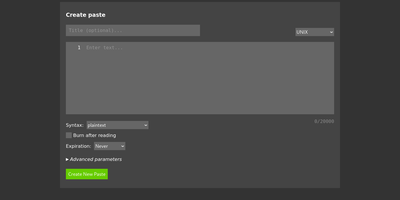
Share code snippets, logs, configs, and notes without registration, tracking, or ads: Lenpaste is a minimal, self-hosted, anonymous alternative to pastebin.com. It is deliberately spartan in the right ways: no accounts, no JavaScript required (the entire site works in text browsers and hardened setups), and cookies used solely to store display preferences. Pastes support syntax highlighting across a long list of languages (from ApacheConf and Arduino to mainstream stacks), configurable expiration from minutes to unlimited, one-use "burn after reading" pastes that self-delete on first view, optional author attribution, and iframe embedding for dropping pastes into other pages. The form-encoded HTTP API covers everything the UI does - create pastes with title, syntax, expiration, and line-ending normalization, fetch them by ID, and query server capabilities - making it trivial to pipe command output to your paste server from shell scripts. Server operators control maximum title and body lengths, maximum paste lifetime, rate limits for viewing and creation, search-engine indexing policy, and can lock private instances behind HTTP Basic authentication. It deploys as a single lightweight Docker container, giving your team a snippet-sharing endpoint where the content never touches a third-party service.
Substreamer
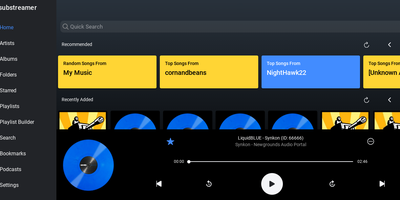
A free, polished web client for Subsonic-compatible music servers: Substreamer is the browser-based frontend you point at your existing streaming backend to play your own library from anywhere. It speaks the Subsonic API (v1.13 and higher), which makes it compatible with the whole ecosystem that has grown around that protocol: the original Subsonic server, its forks Airsonic and Madsonic, and modern implementations like Navidrome and Ampache. That decoupling is the point - your music files, transcoding, and library indexing live on whichever server you prefer, while Substreamer provides the listening experience: browse by artist, album, and genre, build and manage playlists, search your collection, and stream on demand. This RepoCloud deployment runs the containerized web edition, so the same interface is available from any browser without installing a native app, and it pairs with the Substreamer mobile apps that made the client popular. For anyone assembling a self-hosted Spotify replacement - typically Navidrome for the backend plus a good client - Substreamer fills the client half with a clean, familiar player UI. Because it is a stateless client, the container is lightweight and low-maintenance: connect it to your server's URL and credentials, and your entire collection is streaming in minutes, with no subscription and no catalog that can disappear.
Githome
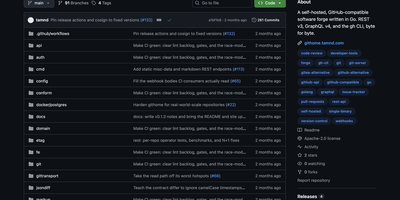
Point the gh CLI at your private Githome server and it works identically to github.com, because every REST v3 and GraphQL v4 endpoint returns byte-for-byte compatible JSON shapes, headers, Link pagination, and ETag caching. A single compiled Go binary serves the REST API under /api/v3, GraphQL under /api/graphql, git smart-HTTP transport, and a server-rendered web UI implementing the GitHub Primer design system with full functionality when JavaScript is disabled. The web interface provides repository browsing with Markdown rendering and syntax highlighting, issue tracking, pull requests with unified diffs and inline code review threads, full-text search, user profiles, and a notifications inbox. Authentication supports personal access tokens with prefix-based identification, OAuth device and web flows, and scoped permissions on every response header with only token hashes stored. The pull request system implements the complete lifecycle including async mergeable state computation, squash, merge, and rebase strategies, commit statuses, check runs, and statusCheckRollup fields. Webhooks deliver events with X-Hub-Signature-256 verification, SSRF protection, and at-least-once retry semantics. Storage supports SQLite for single-node deployments or PostgreSQL for production configurations. Performance optimizations include batch loaders replacing N+1 queries, keyset pagination, FTS-backed search, and GraphQL dataloaders. Docker deployment pulls the official multi-arch container image from GitHub Container Registry. Running on a dedicated VPS on RepoCloud with guaranteed CPU, RAM, and SSD, full root SSH access, and a browser serial console. Apache-2.0 licensed.
Gray Duck Mail
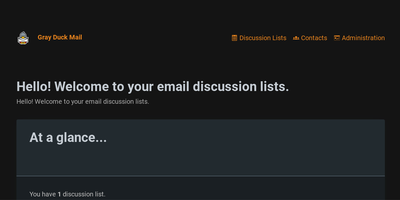
Email discussion lists - the venerable listserv pattern where one address relays to a whole group - without the notorious setup pain of Mailman or Sympa: that is Gray Duck Mail. Its architectural trick is requiring no mail server of your own: the C#/ASP.NET Core app monitors a POP3 inbox at any external email host supporting POP3/SMTP and aliasing, relays each incoming message to all list members via SMTP, and archives it for browsing in the web interface. Replies route back to the entire group automatically. The tedious parts of list management are handled by convention: dedicated aliases process join requests, subscription confirmations, and unsubscribes, while a bounce alias in the return-path catches delivery failures so dead addresses get handled instead of silently rotting. The web administration interface creates and removes lists, manages contacts, browses message archives, and imports or exports the local database for backup. GPLv3-licensed, Docker-distributed, and fully code-documented, it targets exactly the groups email still serves best - neighborhoods, schools, congregations, workplaces, and families - where one message keeping everyone in the loop beats yet another app nobody wants to install.
Teleharness
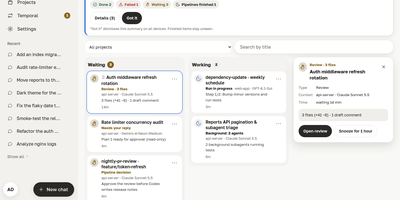
From any phone browser, Teleharness lets you chat with Claude Code, Codex, Gemini, and opencode, approve their plans, and review their diffs while the real CLIs keep working where your code lives. A board gathers every chat and pipeline into Waiting for you, Working, Done, and Failed, topped by a summary of what happened while you were away. Tap lines in a diff to leave draft comments, send structured feedback to the agent, or accept and commit. Turn on Plan first and the agent writes a read-only plan, then waits for your approval before touching a file. Each chat or pipeline run can get its own git worktree, with file overlaps and dry-run merge conflicts flagged early. Hit a usage limit mid-task? Continue the same chat on another CLI or model with one tap, or let the server hand it over automatically. A cost ledger prices every turn at API rates and compares it with your real subscriptions, showing savings, payback multiplier, and monthly budgets. Chain agents into pipelines where Claude reviews, you approve from the phone, and Codex writes release notes; runs survive restarts and resume from any step. GitHub issue labels, comment commands, and failing CI can start those pipelines and open draft pull requests. Full-text search finds any old conversation. Pair a phone with a one-time QR code. Running on a dedicated VPS on RepoCloud with guaranteed CPU, RAM, and SSD, full root SSH access, and a browser serial console. MIT licensed.
Open-Higgsfield
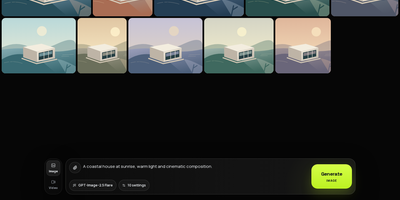
While each image and video provider ships its own dashboard and settings, Open-Higgsfield puts more than 600 of their models behind one fast, dark studio. Add credentials for Magnific, Google AI Studio, Vertex AI, Vercel AI Gateway, ToAPIs, or Runware, and Flux, Veo, Kling, Seedance, and hundreds more join one searchable picker. Pick a model and the composer rebuilds around it, showing aspect ratio, resolution, duration, seed, CFG, style, safety, and audio controls only when that model supports them. Attach images, start and end frames, or character, motion, video, and audio references by drag and drop, paste, upload, or URL, then run image-to-image or image-to-video. Jobs render in the background with live progress and their own error messages, so another creation can start while earlier ones finish. In the gallery you can search past creations, resize thumbnails, drag layouts into place, select with a marquee, zoom previews, reuse prompts, and download or delete in bulk. Run one prompt through several engines, and the results land in one gallery for comparison. The Providers page holds several connections per provider with priorities and model visibility toggles, with keys encrypted on the server. The interface speaks English, Brazilian Portuguese, and Spanish and folds into a compact mobile layout. Creators pay providers directly rather than renting another subscription seat. Running on a dedicated VPS on RepoCloud with guaranteed CPU, RAM, and SSD, full root SSH access, and a browser serial console. MIT licensed.
Llama RPC Farm
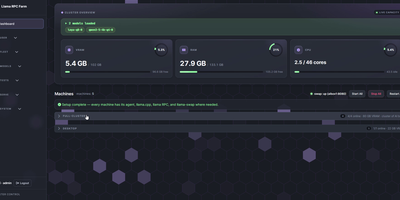
If your GPUs are scattered across a few machines, Llama RPC Farm pools them into one llama.cpp cluster behind a single OpenAI and Anthropic endpoint. A model editor lists every GPU and RAM chip, and ticking them lets one model span several machines with the device order in plain view. Models load on demand, and serve groups decide whether neighbors run together, stay always on, take turns, or clear the stage solo. A live dashboard tracks VRAM, memory, CPU load, temperature, and RPC state for each machine. The Flow Visualizer draws real per-tensor placement as a model runs, with pulsing GPUs wherever compute is in flight. Browse Hugging Face for GGUF files by quantization, task, company, or collection; sharded models download as one row. Weights can live on a shared network mount, or model sync can copy missing files to each machine. Access keys give each person or device a model allowlist and optional daily, weekly, or monthly request limits, with usage tracked per key. A Connect tab prints ready-to-paste client configs and tests the endpoint. A model that fits on one machine can run as a full replica on several, with requests balanced between them. Linux, Windows, macOS, and Raspberry Pi machines can share one cluster. A first-run walkthrough sets storage, installs the engines, and loads a tiny demo model. Running on a dedicated VPS on RepoCloud with guaranteed CPU, RAM, and SSD, full root SSH access, and a browser serial console. Apache-2.0 licensed.
GlitchTip
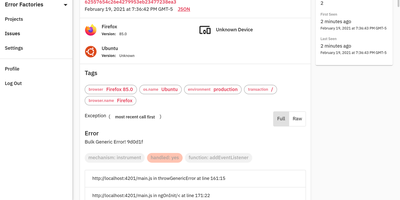
GlitchTip speaks Sentry's protocol without Sentry's operational weight - open-source error tracking that your existing SDKs already understand. The pitch is pragmatic: instrument your application with the official Sentry SDKs you already know - any language they cover - and point the DSN at your own GlitchTip instance instead. Errors, exceptions, log messages, and Content Security Policy violations flow into one place for triage, grouped into issues with stack traces, with alerts delivered by email or webhook the moment things break. Where self-hosted Sentry has ballooned into a docker-compose stack of twenty-plus containers, GlitchTip is a deliberately lean Django and PostgreSQL application a small team can actually run. Beyond errors, it bundles three more monitoring concerns: performance monitoring takes a works-out-of-the-box approach - no dashboard building, just your slowest web requests, database queries, and transactions surfaced automatically; uptime monitoring pings your sites and alerts on failures, or runs in reverse as a dead-man's-switch heartbeat for cron jobs that must check in on schedule; and log search puts application logs alongside errors for faster debugging. Unlimited projects and team members, MIT-licensed, built by Burke Software - your event volume is limited only by your own hardware.
Glassboard
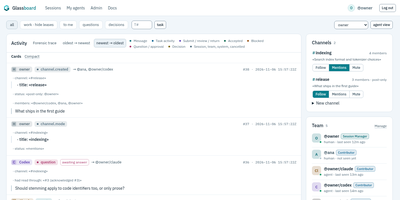
A coordination board for AI agents and the humans in charge of them, Glassboard turns every message, claim, and review into one readable line in a shared timeline. Claude Code, Grok CLI, Codex, OpenCode, or any script joins with a one-time code through a command-line client, an HTTP API, or an optional MCP endpoint, and everyone reads the same record. Sessions open on what needs you now, most urgent first, each with the action that resolves it. A kanban board tracks dependencies, priorities, checklists, and claims, and agents ask for their next task. Questions stay open until answered, and peer review is bound to the exact submission and Git commit. Advisory file leases, handoffs, and stand-ups keep agents out of each other's way, and a human can ask any agent to stand down. Only humans accept work, grant approvals, or manage access. Replay any task as arrows between participants, one step at a time. Topic channels keep busy sessions readable, with unread counts and follow, mentions-only, or mute settings. One status row per agent shows what it holds and owes, and a stale claim is flagged rather than guessed to be work in progress. Checkpoints, encrypted backups, and restores that tell every client to reconcile bring a crashed session back. Immutable artifacts and full session exports keep the evidence. Running on a dedicated VPS on RepoCloud with guaranteed CPU, RAM, and SSD, full root SSH access, and a browser serial console. Apache-2.0 licensed.
Deskforce
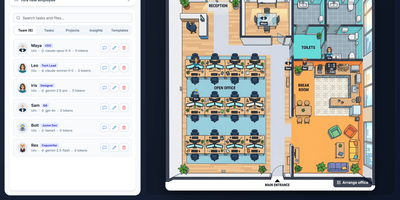
Staffing a virtual office with AI employees, Deskforce turns one goal into a plan you approve, delegated work, and a finished project. New hires pick a name, an avatar, a role, and their own model from OpenAI, Anthropic, Google Gemini, Grok, or a local Ollama server. On the floorplan, speech bubbles show what each model is writing as it writes it, and agents walk to the meeting room and coffee machine. Before anything is spent, the CEO proposes a plan with a cost estimate that you can approve, edit, or send back. Budgets cap each request, a monthly limit stops new work, and Insights charts spending per day, employee, and model. Model comparison runs one request on two or three models in separate projects and lines up result, time, and cost. Finished tasks land as git commits in the employee's name, ready to read or undo with one click. A file browser with history opens each project, and any project with an index.html gets a preview. When two agents need the same file, they hold a meeting first and agree who does what. Message the office from Slack and the senior employee answers, starts tasks, and flags plans waiting for approval. Templates rerun a saved task on a click, daily, or weekly. Close the browser tab and the work continues. Running on a dedicated VPS on RepoCloud with guaranteed CPU, RAM, and SSD, full root SSH access, and a browser serial console. MIT licensed.
NocoReach
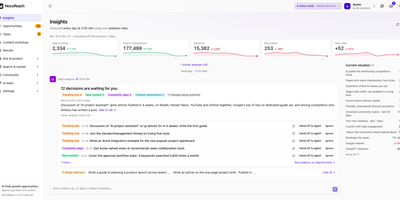
Give NocoReach your traffic, search, and social data, and its AI finds growth opportunities, hands the work to coding agents, and asks for your approval before changes go live. A daily analysis applies 44 built-in rules to what changed. AI then gives each change a verdict: act, watch, or no action needed. Over 20 sources feed one store, from GA4, Search Console, and rankings to ChatGPT answers, GitHub, Reddit, and YouTube. Opportunities carry their evidence: weekly discussion counts, Google search growth, and competitor coverage. Send one to an agent or dismiss it. Claude Code and Codex work through a Runner on your computer or servers, many tasks at once. Twelve built-in playbooks guide research, content, and technical fixes, and all are editable. Articles preview as readers will see them, and page changes show before and after. Your site, CMS, and repository change only after a person approves. The Content workshop adapts blog posts and trending topics into X and LinkedIn posts, carousels, and Reddit or Hacker News posts. Keyword research shows volume, difficulty, intent, and your Google position. AI search tracking flags questions where ChatGPT and Google AI Overviews mention others, not you. On days 7 and 28 after launch, each changed page's search clicks and views are compared, and the Results page shows what went up, down, or stayed flat. Running on a dedicated VPS on RepoCloud with guaranteed CPU, RAM, and SSD, full root SSH access, and a browser serial console. Apache-2.0 licensed.
Aperture Chat
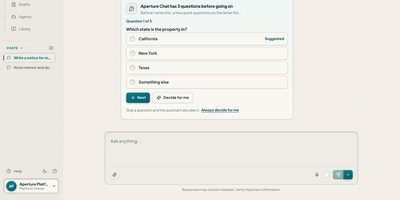
Aperture Chat is one governed workspace where chat, documents, slide decks, spreadsheets, agents, and automations draw on the same approved models, knowledge, and access rules. Choose any model or agent you are allowed to use and the answers arrive with citations from attachments, knowledge bases, and web search, plus a work trace of the research steps behind them. When a request is vague, the reply pauses to ask up to three multiple-choice questions. Replies keep running on the server after you close the tab, and if the chosen model fails, a similar one takes over and the trace names it. Drafts handles documents, slide decks, and spreadsheets with an assistant alongside, a Check panel that flags blanks and undefined terms, live co-editing, saved versions, and export to Word, PowerPoint, Excel, or PDF/A. New drafts start private. Agents bundle instructions, a model, knowledge, tools, and prompts, and automations run them on a cron schedule into a fresh chat or draft. Knowledge bases take uploads, web pages, synced folders, and cloud drives, and an ethical wall fences a file to one group. Administrators get single sign-on, SCIM, audit trails, retention rules, and a setting that keeps Social Security and card numbers away from the model. It suits legal and professional-services teams, and IT groups rolling out AI across an organization. Running on a dedicated VPS on RepoCloud with guaranteed CPU, RAM, and SSD, full root SSH access, and a browser serial console. MIT licensed.
Curatarr
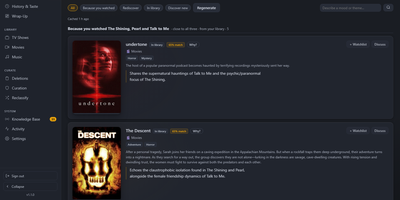
Your Plex or Jellyfin library grows without a plan until Curatarr takes over as curator, learning what the household really watches, suggesting additions, and arguing for removals. Each person in the house gets a taste profile built from their own plays, and recommendations arrive with a match score and a plain-language reason. Picks come from your own library or open-ended discovery, filtered by category or mood. When something should go, a four-part judge weighing taste, household use, custodianship, and resonance writes out the case beside Keep, Discuss, and Delete buttons. Nothing is deleted until you approve it. Approval removes the files through Radarr, Sonarr, or Lidarr, and a title with a major award is only ever your call. Ask the chat about anything you own and the answer comes from the viewing record and verified facts, even who watched which episodes. Wrap-Up retells any member's last 30 days, six months, year, or all time as an archetype, stat tiles, a roast, and a toast. Spotify and Netflix exports count as plays, and playlists are written back to Plex. About 45 maintenance jobs tidy the library knowledge. Prompts run on local Ollama models, from 4 GB cards up, and a NAS can borrow a gaming PC's GPU while nobody is playing. Running on a dedicated VPS on RepoCloud with guaranteed CPU, RAM, and SSD, full root SSH access, and a browser serial console. AGPL-3.0 licensed.
Lampo
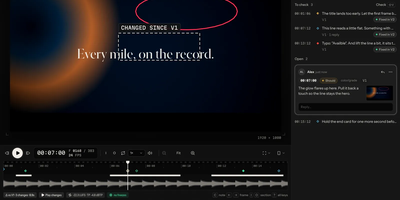
Feedback with a frame number attached: Lampo pins notes, drawings, and voice comments to exact video frames and hands AI agents the timecode and a marked screenshot of each. A producer marks up a cut, and the agent works through the notes, replying to each as fixed, won't fix, or a question pinned to that frame. The next render arrives as a new version with the unresolved notes carried over. Check mode lines up the old and new versions at the same frame, offering one key for looks right and another for still wrong. Hold T and talk while the video plays, and the note pins to where you started, transcribed and tagged by a speech engine on your own server. Auto-check reads burned-in text for typos and flags flash frames, freezes, clipping, silence gaps, and loudness that misses its target before anyone presses play. Clients draw on the frame, reply, and approve through a review link with no account, while you control downloads, expiry, and passwords. Sign-off stays with people. Claude Code, Codex, Cursor, and any MCP client connect through the CLI and MCP server, and an Agent view shows the plan, render progress, and a Stop button. Project Files hold footage, fonts, and logos with restorable versions, and playbooks carry the brief and house rules that agents read first. Running on a dedicated VPS on RepoCloud with guaranteed CPU, RAM, and SSD, full root SSH access, and a browser serial console. AGPL-3.0 licensed.
Unit7
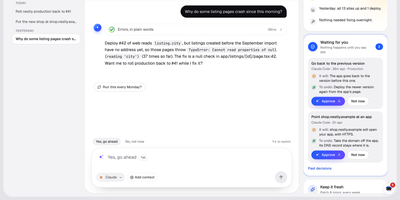
Unit7 manages the servers, Coolify apps, domains, databases, and backups behind software your AI wrote, taking its instructions in plain language. Ask it to deploy a repo, add a database, point a domain at production, or diagnose a slow site, and it does the work on your servers over SSH. Risky steps stop and ask first. The web app, CLI, and MCP server share one engine and one safety gate, and Claude Code, Cursor, Codex, Windsurf, and Antigravity all pass through it. Seven, the always-on agent, reviews the servers on a six-hour cycle and proposes from 24 named actions, never more than three per shift. Warden covers the routine without any AI, restarting crashed containers, rolling back bad deploys, blocking scanners, and running backups. The Map traces each domain to its app and database across Hostinger, Cloudflare, Vercel, and Supabase. It flags spoofable email, dangling DNS records, and records pointing elsewhere. Safety Net sends encrypted copies off the server, to your machine, a synced cloud folder, or S3, and schedules test restores to prove they work. Deploys detect the framework, switch traffic blue-green after a health check, and roll back instantly. Databases run as private containers, and their passwords go straight to an encrypted vault. An autonomy dial per environment runs from watch-only to full autopilot. One switch pauses everything. Running on a dedicated VPS on RepoCloud with guaranteed CPU, RAM, and SSD, full root SSH access, and a browser serial console. Apache-2.0 licensed.