Open Source App Cloud Marketplace
Deploy and scale your favorite open source apps with one click, at half the cost.
Apache APISIX
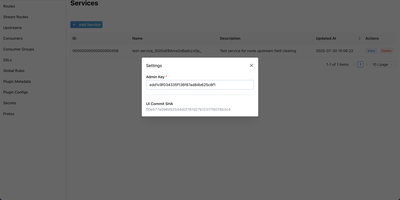
With 17,000 GitHub stars, 460+ contributors, and deployments across telecommunications, automotive, and financial services running on over 10,000 CPU cores at the largest known installations, Apache APISIX delivers a fully dynamic API gateway achieving 140,000 QPS on eight cores with sub-millisecond latency through NGINX's event-driven architecture and LuaJIT-compiled plugin execution. The 100+ open-source plugins cover authentication (JWT, OAuth 2.0, OIDC, Keycloak, LDAP), observability (Prometheus, Datadog, SkyWalking, OpenTelemetry), traffic management (rate limiting, circuit breaking, canary releases, traffic splitting), and security (CORS, IP restriction, CSRF protection) — all hot-reloadable without process restarts via etcd-based real-time configuration synchronization. Multi-protocol support handles HTTP, gRPC, MQTT, TCP, UDP, and WebSocket traffic for both north-south API access and east-west service mesh communication. AI gateway capabilities proxy requests to 20+ LLM providers with semantic caching, token-aware rate limiting, provider failover routing, and content moderation. Custom plugins extend the gateway in Lua, Go, Java, Python, or WebAssembly. Radixtree route matching handles 100,000+ routes without performance degradation. Functions as a Kubernetes ingress controller with native service discovery for Consul, Nacos, and Eureka. Deploy via Docker or Helm charts with horizontal scaling through etcd cluster coordination. Running on a dedicated VPS on RepoCloud with guaranteed CPU, RAM, and SSD, full root SSH access, and a browser serial console. Apache 2.0 licensed.
Hanko
Backed by 9,000+ GitHub stars and developed by a Germany-based team with deep FIDO2 expertise, Hanko delivers the open-source authentication platform that replaces Auth0, Clerk, and Firebase Auth with a passkey-first architecture built on phishing-resistant WebAuthn credentials. The Go backend exposes both public and administrative HTTP APIs handling passkey registration and login, password authentication, email passcodes, TOTP-based MFA, security key verification, server-side sessions with remote revocation, and JWT issuing with configurable expiry and refresh policies. OAuth SSO connects Apple, Google, GitHub, Microsoft, and custom OIDC providers, while SAML Enterprise SSO integrates corporate identity providers for single sign-on across the organization. Hanko Elements provides framework-agnostic web components that embed complete onboarding, login, and user profile flows into any application with two lines of code, fully customizable via CSS variables and supporting i18n with custom translations. The JavaScript frontend SDK handles API communication, credential management, and session state for teams building custom authentication UIs without the pre-built components. Webhooks notify external services of authentication events including user creation, login, email verification, and password changes. Privacy-first design principles enforce data minimalism with user-deletable passwords and configurable identifier strategies supporting email-only, username-only, or combined approaches. Docker deployment starts the backend with PostgreSQL or MySQL, serving both APIs on configurable ports. Running on a dedicated VPS on RepoCloud with guaranteed CPU, RAM, and SSD, full root SSH access, and a browser serial console. AGPL-3.0 (backend) / MIT (frontend) licensed.
Ory Kratos
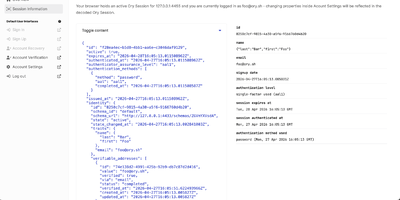
With 13,800 GitHub stars, adoption by OpenAI for ChatGPT's authentication infrastructure serving 800 million weekly active users, and governance under the Ory open-source ecosystem, Ory Kratos provides enterprise-grade identity management as a headless API server that separates authentication logic from user interface — enabling any frontend framework to consume standardized self-service flows for registration, login, recovery, verification, and profile management. Multi-factor authentication supports passkeys, WebAuthn security keys, TOTP authenticator apps, SMS one-time codes, email magic links, and backup recovery codes with configurable Authenticator Assurance Levels enforcing step-up authentication for sensitive operations. Social sign-in connects to any OpenID Connect provider including Google, GitHub, Apple, and Microsoft, plus enterprise SAML 2.0 federation for B2B single sign-on. Customizable identity schemas using JSON Schema define user profiles with flexible trait structures, while pre- and post-flow webhooks enable integration with CRMs, analytics, and compliance systems. The courier system handles email and SMS delivery for verification codes and password recovery links. Session management provides device tracking, forced logout, and configurable lifespans with privileged session elevation. Deploy alongside Ory Hydra for OAuth2/OIDC token issuance and Ory Keto for fine-grained permissions to build a complete identity platform. Docker Compose deployment with PostgreSQL. Running on a dedicated VPS on RepoCloud with guaranteed CPU, RAM, and SSD, full root SSH access, and a browser serial console. Apache 2.0 licensed.
Forem
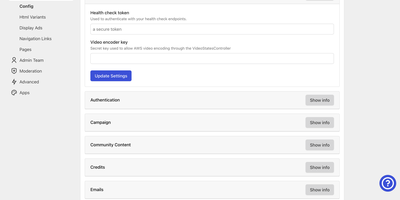
With 22,700 GitHub stars, 4,100+ forks, and proven scale powering dev.to — one of the largest developer communities serving millions of monthly users — Forem provides a complete community platform for building engaged audiences around shared interests, whether for developer documentation, customer communities, fan bases, or professional networks. The Rails backend with Preact frontend delivers article publishing with a rich Markdown editor, threaded discussions, user profiles with portfolio links, tag-based content organization, podcast hosting, classified listings for jobs and events, and social interactions including reactions, bookmarks, and following. AI-powered semantic search using PostgreSQL pgvector embeddings surfaces relevant content across articles and concepts, while scheduled automations enable community bots to create automated roundups, republish curated content, and trigger time-based moderation actions. Score-based content ranking replaces simple reaction counts with nuanced algorithms that resist gaming. The admin dashboard provides user management, content moderation, community settings, analytics, and organization controls. OAuth integration supports GitHub, Twitter, Apple, and configurable OIDC providers for frictionless sign-up. Dynamic open-graph image generation creates branded social cards automatically. Deploy with Kamal 2 to any cloud provider or bare metal server with PostgreSQL and Redis. Running on a dedicated VPS on RepoCloud with guaranteed CPU, RAM, and SSD, full root SSH access, and a browser serial console. AGPLv3 licensed.
Redpanda
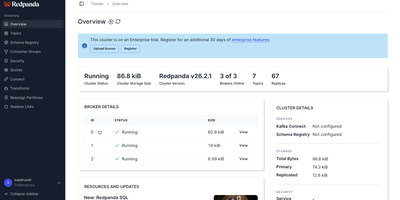
With 12,400 GitHub stars and adoption across enterprises processing billions of events daily, Redpanda delivers a complete Kafka wire protocol implementation in C++ that existing Kafka producers, consumers, Kafka Connect connectors, and Kafka Streams applications connect to without code changes — eliminating JVM garbage collection pauses and ZooKeeper coordination overhead through a single binary architecture built on the Seastar framework's thread-per-core model. The integrated schema registry supports Avro, Protobuf, and JSON Schema validation directly within the broker without separate infrastructure. Tiered storage automatically offloads cold data to object storage while maintaining seamless consumer access across the full retention window. Redpanda Console provides a web-based management interface for topic inspection, consumer group monitoring, schema management, and ACL configuration. Redpanda Connect extends the platform with 200+ pre-built connectors for data pipelines between databases, cloud services, and streaming systems. Exactly-once semantics with idempotent producers and transactional guarantees ensure data integrity for financial, healthcare, and compliance workloads. The Adaptable Data Plane in version 26.1 enables per-topic performance profiles balancing throughput, latency, and durability within a single cluster. Deploy via Docker or Kubernetes with official Helm charts — a three-node cluster starts with a single rpk command. Running on a dedicated VPS on RepoCloud with guaranteed CPU, RAM, and SSD, full root SSH access, and a browser serial console. BSL 1.1 licensed (converts to Apache 2.0 after four years).
Crawl4AI
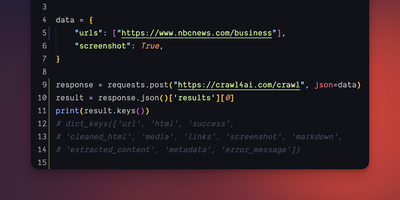
With over 77,000 GitHub stars, Crawl4AI is the most-starred open-source web crawler on GitHub and the go-to tool for converting the web into AI-ready data. Built on Python and Playwright, it transforms any website into clean Markdown with headings, tables, code blocks, and citation hints optimized for LLM ingestion, or extracts structured JSON via CSS selectors, XPath expressions, or direct LLM-based schema extraction through OpenAI, Anthropic, and Ollama providers. The self-hosted Docker server exposes a REST API on port 11235 with endpoints for crawling, streaming results, screenshots, PDF generation, JavaScript execution, and LLM-powered extraction. Version 0.9.x introduced secure-by-default operation with mandatory JWT authentication, strict request validation, declarative hooks replacing inline code, and bounded job queues. Adaptive crawling uses information foraging algorithms to determine when sufficient data has been gathered, while deep crawl mode traverses link graphs intelligently. The async browser pool manages concurrent sessions with stealth plugins, proxy rotation, custom headers, and session persistence for authenticated scraping. A built-in MCP server enables direct integration with Claude, ChatGPT, and Cursor for AI-driven web research workflows. Content filtering applies BM25 and TF-IDF relevance scoring to extract only pertinent sections from noisy pages. Running on a dedicated VPS on RepoCloud with guaranteed CPU, RAM, and SSD, full root SSH access, and a browser serial console. Apache 2.0 licensed.

Novu
Powering notification delivery for thousands of organizations with over 39,000 GitHub stars, Novu is the open-source communication infrastructure that eliminates the need to build separate integrations for every messaging channel. The TypeScript-based platform provides a single API endpoint that routes notifications across In-App Inbox, Email via SendGrid, Mailgun, AWS SES, and Postmark, SMS through Twilio, Vonage, and Plivo, Push via Firebase Cloud Messaging, Expo, and APNS, and Chat through Slack, Discord, Microsoft Teams, and WhatsApp. The embeddable React Inbox component delivers real-time WebSocket-powered notifications with read/unread states, action buttons, and user-controlled preferences directly inside your application. The workflow engine orchestrates complex multi-channel delivery with conditional branching, time delays, digest batching to reduce notification fatigue, throttle controls, and per-step channel fallbacks. Novu Connect introduces Agent Communication Infrastructure enabling AI agents built with LangChain, Claude, or custom frameworks to hold threaded two-way conversations with humans across any supported channel through a single conversation model with identity resolution and credential management. The backend runs on Node.js with NestJS, MongoDB for notification storage, Redis with BullMQ for job queuing, and Socket.io for real-time delivery. Self-hosting deploys via Docker Compose with the dashboard accessible at port 4200. Running on a dedicated VPS on RepoCloud with guaranteed CPU, RAM, and SSD, full root SSH access, and a browser serial console. MIT licensed.
Maxun
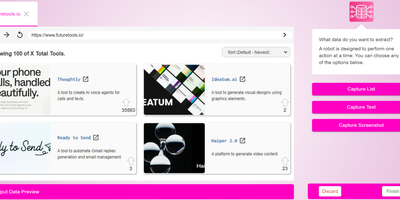
With over 16,800 GitHub stars and growing rapidly, Maxun has become the go-to open-source platform for teams who need structured web data without writing scrapers. The TypeScript-based platform provides a no-code visual recorder that captures point-and-click interactions in real-time browser sync, automatically generating reusable extraction robots that handle pagination, infinite scrolling, and dynamic content. LLM-powered extraction accepts natural language prompts like "Extract 10 companies from the Y Combinator website" without requiring a URL — Maxun identifies the source and performs the extraction autonomously. The platform handles authentication-protected pages, adapts automatically to website layout changes through self-healing selectors, and exports directly to Google Sheets, Airtable, or any destination via webhooks. Robots run on configurable schedules with cron-based timing, turning any website into a perpetually fresh RESTful API endpoint. The crawl engine discovers and processes linked pages across entire domains with configurable depth and URL filtering, while the search capability runs automated queries across multiple engines. Official Node.js and Python SDKs provide programmatic control over robot creation, execution, and data retrieval, with MCP integration enabling direct connection to AI tools like Claude. The n8n community node enables workflow automation without custom code. Running on a dedicated VPS on RepoCloud with guaranteed CPU, RAM, and SSD, full root SSH access, and a browser serial console. AGPLv3 licensed.
Erxes
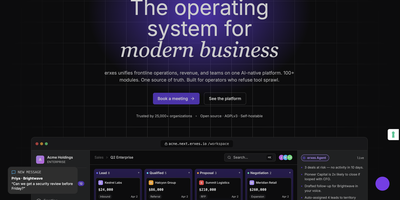
Replacing HubSpot, Zendesk, Intercom, and Linear with a single self-hosted platform, erxes delivers an Experience Operating System trusted by over 4,000 GitHub stars and built on a modern Nx-powered monorepo architecture. The core ships with six foundational modules — My Inbox for omnichannel conversations across email, web chat, voice, and Discord; Contacts for unified customer profiles; Products for catalog management; Segments for behavioral targeting; Automation for visual workflow builders; and Documents for template generation. Beyond the core, a plugin marketplace activates Frontline for ticket management and omnichannel support queues, Sales for deal pipelines and lead scoring, Operations for project boards with cycle management, Content for headless CMS and knowledge bases, and Team for employee directories, time clocks, and internal chat. The technical stack combines GraphQL Federation with Apollo Server v4 and tRPC v11 microservices on Node.js, React 18 micro-frontends via Rspack Module Federation with TailwindCSS 4, MongoDB with Mongoose for persistence, Redis for caching, BullMQ for job queues, and Elasticsearch for full-text search. Deployment supports Docker Compose orchestration with automatic service discovery across all plugin containers. The Global Profile architecture enables agencies to manage multiple client brands under a single login with separated data stores. iOS and Android SDKs embed the messenger widget directly into mobile applications. Running on a dedicated VPS on RepoCloud with guaranteed CPU, RAM, and SSD, full root SSH access, and a browser serial console. AGPLv3 licensed.

OpenSquilla
Claiming 60-80% token cost reduction compared to flat single-model deployments and backed by 6,500+ GitHub stars, OpenSquilla delivers an intelligent AI agent runtime where a local ML classifier evaluates every turn on message length, code blocks, keyword patterns, and semantic embeddings before routing it to the optimal model tier from C0 through C3. The pluggable provider layer connects natively to TokenRhythm, OpenRouter, OpenAI, Anthropic, Ollama, DeepSeek, Gemini, DashScope, Moonshot, Mistral, Groq, Zhipu, SiliconFlow, vLLM, LM Studio, and additional compatible backends with primary-plus-fallback selection. The four-tier cognitive memory architecture spans working, episodic, semantic, and raw layers with vector-semantic and BM25 retrieval powered by on-device ONNX embeddings that never leave your infrastructure. Security isolation operates at the syscall level via Bubblewrap on Linux and Seatbelt on macOS, complemented by policy-based execution controls and prompt injection protections. The unified TurnRunner executes identically across the Vue-based control console Web UI, terminal CLI, and chat channel integrations including Slack and Discord, ensuring consistent tool dispatch, retry logic, and decision logging regardless of entry point. Built-in skills cover deep research, multi-search-engine queries, document generation for DOCX, PPTX, XLSX, and PDF formats, GitHub integration, cron scheduling, and bounded subagent delegation. Per-agent workspaces with durable session storage provide transcript replay, context state management, and per-call cost tracking with automatic quota enforcement. Running on a dedicated VPS on RepoCloud with guaranteed CPU, RAM, and SSD, full root SSH access, and a browser serial console. Apache-2.0 licensed.
VictoriaMetrics
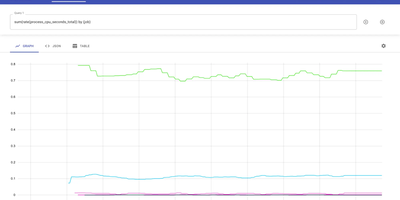
Trusted by thousands of organizations processing billions of time series data points and backed by 17,000+ GitHub stars, VictoriaMetrics delivers a monitoring and time series database that outperforms Prometheus by 16x on query speed while consuming 2.5x less disk space through its optimized compression and storage engine. The architecture supports both single-node deployments handling 10M+ active time series and a horizontally scalable cluster version with vminsert, vmstorage, and vmselect components providing multi-tenancy, replication, and independent namespace isolation. Data ingestion accepts both push protocols including InfluxDB line protocol, Graphite plaintext, OpenTSDB HTTP, CSV, and OpenTelemetry OTLP alongside pull-based Prometheus scraping and remote write, enabling drop-in replacement of existing monitoring stacks without reconfiguring exporters. MetricsQL extends standard PromQL with additional functions, subqueries, and implicit time range alignment while maintaining full backward compatibility with existing Prometheus alerts and Grafana dashboards. The vmalert component processes recording and alerting rules with Alertmanager integration, while vmbackup and vmrestore enable point-in-time snapshots to S3, GCS, and Azure Blob Storage. Stream aggregation operates as a StatsD alternative for pre-aggregating high-cardinality metrics before storage. NFS-compatible storage backends including Amazon EFS and Google Filestore allow shared persistent volumes across cluster nodes. Running on a dedicated VPS on RepoCloud with guaranteed CPU, RAM, and SSD, full root SSH access, and a browser serial console. Apache-2.0 licensed.