Open Source App Cloud Marketplace
Deploy and scale your favorite open source apps with one click, at half the cost.
Exceptionless
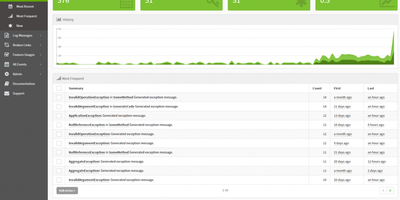
Exceptionless has earned over 2,400 GitHub stars and has been processing production errors since 2014 as the real-time event monitoring platform that captures far more than crashes. Built with ASP.NET Core on Elasticsearch for storage and Redis for caching, Exceptionless ingests exceptions, log messages, feature usage events, broken links, and custom event types through official SDKs for JavaScript, Node.js, .NET Core, ASP.NET, WPF, Web API, WebForms, Console apps, and React Native. Automatic event stacking groups related occurrences by exception type, message, and call stack into single actionable items, while manual stacking keys let developers create custom groupings for specific features or workflows. The real-time dashboard displays Most Frequent, Most Recent, and New event views with filtering by project, date range, environment, and custom tags. Stack management tracks resolution status with version-aware regression detection that automatically reopens resolved issues when the same error surfaces in a newer release. Webhook integrations connect to Slack, Discord, and external services through Zapier for automated issue tracking in GitHub Issues and Jira. Per-project notification settings control email and chat alerts for new errors, regressions, and critical events. OpenTelemetry support captures distributed traces alongside error data. The v8.6.0 release introduced a hosted Model Context Protocol server at the /mcp endpoint, enabling AI tools to query error data via OAuth-authenticated access. Deploy via Docker with the exceptionless/exceptionless image alongside Elasticsearch and Redis. Running on a dedicated VPS on RepoCloud with guaranteed CPU, RAM, and SSD, full root SSH access, and a browser serial console. Apache 2.0 licensed.
ArchiveBox
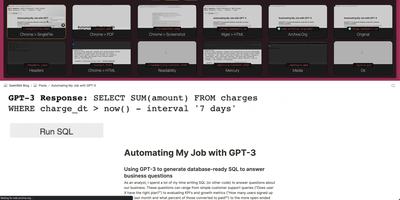
Backed by 27,700+ GitHub stars and actively developed with the v0.9.x architectural overhaul introducing an event-driven plugin ecosystem, ArchiveBox delivers the open-source self-hosted web archiving platform that preserves websites, bookmarks, social posts, media, source code, and research material in durable formats before link rot, platform shutdowns, and censorship erase them permanently. Feed it URLs one at a time or schedule automated imports from browser history, RSS feeds, Pocket, Pinboard, Instapaper, Wallabag, Shaarli, JSON, CSV, HTML bookmark exports, and browser extension captures. Each snapshot stores redundant copies as original HTML, rendered single-file HTML via SingleFile, full-page PDF, screenshot PNG, WARC archive, article text via Readability, favicons, HTTP headers, media files via yt-dlp, git repository clones, and structured metadata in SQLite. The Docker Compose deployment bundles Chrome, wget, curl, yt-dlp, SingleFile, and Readability parsers with automatic dependency management and isolation. Interact through the self-hosted web UI with search, tagging, and admin controls, the comprehensive CLI for batch operations, the REST API for programmatic access, or the Python API for custom integrations. The new abx-plugins system enables community extractors with per-plugin configuration, while the append-only-log architecture provides resumable crawls and audit trails. S3, B2, and Google Cloud storage backends sync archives to remote storage via rclone. Running on a dedicated VPS on RepoCloud with guaranteed CPU, RAM, and SSD, full root SSH access, and a browser serial console. MIT licensed.
HolaOS
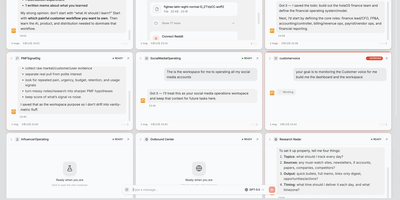
With over 6,500 GitHub stars, HolaOS bills itself as an "open agent computer" that reimagines the traditional operating system as a shared workspace where humans and AI agents collaborate across files, browsers, and 100+ integrated tools simultaneously. Unlike chat-only interfaces, HolaOS places live application UIs—Notion-style editors, browsers, custom workspace apps—side by side with the agent conversation, so operators always see what agents are doing and can intervene at any moment. The persistent memory system stores workspace knowledge locally as Markdown files and embedded vectors via SQLite vec, enabling RAG-powered recall that survives session boundaries without the typical context window bloat. Safe Session Compaction reserves roughly 70% of the model context window for fresh reasoning while folding older history into structured checkpoints that retain goals, constraints, progress, and decisions. Agents connect to Linear, GitHub, Slack, Jira, HubSpot, Gmail, and dozens more through one-click OAuth, automatically fetching relevant signals and converting scattered app data into working memory. BYOK support for Claude, GPT, and Gemini models lets operators use their own API keys at zero markup, while built-in Kimi K3 and GLM-5.2 models provide ready-to-use alternatives. Skills package reusable workflows that any agent can invoke on demand, and scheduled triggers enable autonomous digests, monitors, and reports. The runtime supports independent server deployment alongside the desktop client. Running on a dedicated VPS on RepoCloud with guaranteed CPU, RAM, and SSD, full root SSH access, and a browser serial console. Modified Apache 2.0 licensed.
Fleetbase
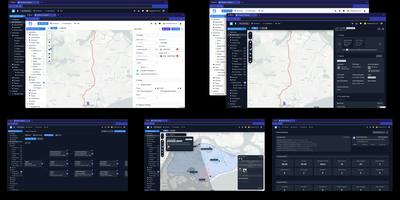
Tracking over 50,000 fleet vehicles across production deployments, Fleetbase delivers a modular logistics operating system where each module—Fleet-Ops, Storefront, Pallet, and Ledger—works independently yet shares a unified data layer that eliminates middleware between ordering, dispatch, warehousing, and accounting. The Fleet-Ops core handles real-time driver tracking through a SocketCluster-based WebSocket event bus, interactive map-based dispatch with both directed and ad-hoc driver assignment, configurable order workflows with custom rules, automation triggers, and activity flows, plus a Kanban-style order board for visual pipeline management. Service zones let dispatchers define geographic operating areas, while proof-of-delivery capture and route optimization close the last-mile loop. The Storefront module provides headless e-commerce with products, carts, and checkout that feed directly into dispatch queues, and the Ledger module records invoices and financial journal entries across all operations. The Navigator driver app—also AGPL-3.0 licensed and fully white-label—delivers turn-by-turn navigation, live order communication, and fault reporting to drivers in the field. The extension architecture pairs backend Laravel Composer packages with frontend Ember Engine modules, enabling third-party developers to build first-class platform extensions without forking. A RESTful API with full documentation, webhook delivery via Redis-backed queues, and push notification support through APNs and FCM round out the integration surface. Running on a dedicated VPS on RepoCloud with guaranteed CPU, RAM, and SSD, full root SSH access, and a browser serial console. AGPL-3.0 licensed.

Rachoon
Named after the Bosnian word for invoice (račun) with a raccoon twist, Rachoon provides a clean self-hosted invoicing platform that handles the complete billing cycle from quotation to payment reconciliation without touching a third-party SaaS subscription. The Nuxt.js frontend serves a dashboard that surfaces revenue totals, pending balances, overdue items, and client statistics at a glance, while the AdonisJS backend manages all business logic against a PostgreSQL 16 database with TypeScript throughout the full stack. Invoice templates use Nunjucks with full HTML and CSS control—including conditional logic, loops, and custom formatting—so the rendered PDFs actually match your design intent. This is possible because Rachoon delegates PDF generation to Gotenberg, which renders invoices through headless Chrome rather than a restricted drawing API, producing output that faithfully preserves complex layouts, web fonts, and CSS grid. Client records stay organized and searchable, each linked to their invoice and quotation history with payment status tracking across pending, paid, and overdue states. Multi-currency billing with flexible tax configuration supports international operations, and all data remains on your own infrastructure. The monorepo is managed by Turborepo with a CI pipeline covering linting, PostgreSQL integration tests, build verification, and multi-platform Docker image creation for both amd64 and arm64 architectures. Running on a dedicated VPS on RepoCloud with guaranteed CPU, RAM, and SSD, full root SSH access, and a browser serial console. AGPL-3.0 licensed.
HolyClaude
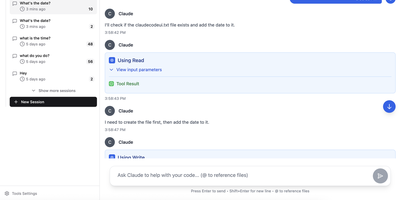
With 2,400+ GitHub stars, HolyClaude replaces a two-hour manual setup process with a single docker compose up command that launches a fully configured AI coding workstation. The container ships with Claude Code pre-installed alongside seven additional AI CLIs — Gemini CLI, OpenAI Codex, Cursor, TaskMaster AI, Junie, OpenCode with OpenRouter multi-provider support, and Pi Coding Agent — all accessible through the CloudCLI browser-based web interface on port 3001. A headless Chromium browser running on Xvfb display :99 comes pre-configured with Playwright 1.61 for automated screenshots, testing, and web scraping without additional setup. The development toolchain includes Node.js 26, Python 3, TypeScript, git, GitHub CLI, database clients for PostgreSQL, SQLite, and Redis, plus deployment CLIs for Vercel, Wrangler, Netlify, and Azure. Process management uses s6-overlay for automatic restarts and graceful shutdown, while bind mounts to ./data/claude and ./workspace ensure credentials, configuration, and project files persist across container rebuilds. The full image supports AMD64 and ARM64 architectures, running on Linux, macOS with Docker Desktop, Windows with WSL2, and Synology or QNAP NAS hardware. A slim tag at roughly 2GB omits the browser stack for environments that do not need it, while the full image at 4GB includes everything. Users authenticate with their existing Anthropic account directly through Claude Code with no credential relay or proxy involved. Running on a dedicated VPS on RepoCloud with guaranteed CPU, RAM, and SSD, full root SSH access, and a browser serial console. MIT licensed.
CyberScraper 2077
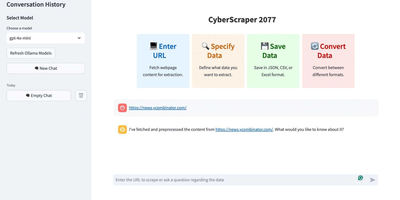
With 3,100+ GitHub stars, CyberScraper 2077 replaces brittle CSS selectors and XPath queries with natural language data extraction powered by Large Language Models. Users paste a URL, describe the data they want in plain English, and the AI extracts structured results from any website — no HTML parsing knowledge required. The tool supports three LLM backends: OpenAI GPT models for maximum accuracy, Google Gemini for cost-effective extraction, and local Ollama instances for fully private scraping where URLs and data never leave your server. Built on Python asyncio with Playwright browser automation, it handles concurrent page fetching with content-based and query-based LRU caching to minimize redundant API calls. The Streamlit web interface runs on port 8501 and provides one-click export to JSON, CSV, HTML, SQL, Excel, and direct Google Sheets upload. Tor network integration routes requests through onion routing for anonymous scraping of both clearnet and .onion hidden service sites with automatic circuit management and stream isolation. Stealth mode randomizes user agents, manages cookies, and controls JavaScript execution timing to bypass bot detection systems. Multi-page scraping navigates through paginated results with automatic URL pattern detection. Docker deployment packages all dependencies including Playwright browsers into a single container. Running on a dedicated VPS on RepoCloud with guaranteed CPU, RAM, and SSD, full root SSH access, and a browser serial console. MIT licensed.

Calibre-Web
With over 17,700 GitHub stars and continuous development since 2015, Calibre-Web has become the definitive self-hosted digital library solution for book enthusiasts who want beautiful web access to their Calibre collections. The responsive Bootstrap 3 interface delivers instant browsing, searching, and filtering across titles, authors, tags, series, book formats, and languages, with custom shelves for organizing personal reading collections. In-browser reading supports EPUB, PDF, TXT, CBR, CBT, CBZ, and DJVU formats with a configurable EPUB reader featuring multiple themes and page location tracking, while one-click email delivery sends books directly to Kindle, Kobo, and other E-Readers without leaving the interface. Native Kobo sync lets Kobo device owners synchronize their entire Calibre library wirelessly, maintaining reading progress and bookmarks across devices. Metadata management includes editing capabilities with automatic metadata downloading from Google Books, Amazon, and other configurable sources, plus eBook format conversion through Calibre binaries for on-the-fly EPUB, MOBI, AZW3, and PDF conversion. User management provides fine-grained per-user permissions controlling download access, upload rights, editing capabilities, and content visibility based on categories or Custom Column values. Authentication supports local accounts, LDAP directory integration, Google and GitHub OAuth, proxy authentication, and Magic Link login for easy E-Reader access. The OPDS catalog feed enables any compliant E-Reader app to browse and download from the library. Running on a dedicated VPS on RepoCloud with guaranteed CPU, RAM, and SSD, full root SSH access, and a browser serial console. GPL-3.0 licensed.
Airbyte
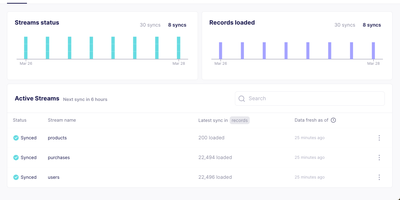
Backed by over 21,800 GitHub stars and more than 1,000 community contributors, Airbyte has become the standard open-source data movement platform, powering ELT pipelines for organizations ranging from startups to Fortune 500 enterprises. The platform provides 600+ pre-built connectors covering PostgreSQL, MySQL, MongoDB, Snowflake, BigQuery, Redshift, S3, Salesforce, HubSpot, Stripe, Shopify, Google Analytics, and hundreds of additional APIs, databases, and SaaS applications. The no-code Connector Builder lets practitioners create new source connectors in minutes by pointing at an API documentation URL, while the Python CDK enables custom connectors with full programmatic control for complex authentication flows and pagination strategies. Airbyte's AI agent capabilities include the MCP Gateway for Model Context Protocol integration, the open-source Agent SDK compatible with pydantic-ai, LangChain, OpenAI Agents, and FastMCP, and a Context Store that lets AI agents query business data across connected systems without runtime API stitching. Change Data Capture streams incremental updates from PostgreSQL, MySQL, and SQL Server using Debezium, while dbt integration handles post-load transformations within the pipeline. Self-hosted deployment uses Kubernetes via the abctl CLI tool, which bootstraps a local kind cluster with a single command, or Helm charts for production clusters with Keycloak OIDC authentication and secrets management through AWS Secrets Manager, Google Secrets Manager, or HashiCorp Vault. Running on a dedicated VPS on RepoCloud with guaranteed CPU, RAM, and SSD, full root SSH access, and a browser serial console. ELv2 licensed with MIT-licensed connectors.
Rancher
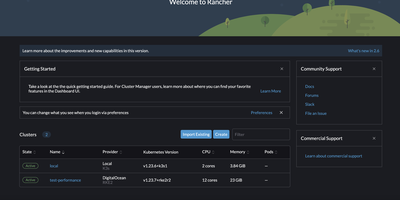
Used by over 30,000 teams and 650+ enterprise customers managing more than 5.2 million containers, Rancher has earned recognition as a Leader in the Gartner Magic Quadrant for Container Management and the Forrester Wave for Multicloud Container Platforms. The platform provides a single pane of glass for provisioning, upgrading, and securing Kubernetes clusters across Amazon EKS, Google GKE, Microsoft AKS, RKE2, K3s, and any CNCF-conformant distribution. Multi-Cluster Management enables centralized authentication via Active Directory, LDAP, SAML, GitHub, and OpenID Connect with granular role-based access control at the cluster, project, and namespace levels. Fleet, the built-in GitOps engine, delivers continuous deployment across hundreds of clusters simultaneously using Helm charts, Kustomize, or raw YAML manifests from any Git repository. The integrated app catalog provides one-click deployment of Prometheus monitoring, Grafana dashboards, Longhorn persistent storage, Istio service mesh, and hundreds of community Helm charts. Rancher supports air-gapped installations for disconnected environments, CIS benchmark scanning for security compliance, and automated backup and restoration of cluster configurations. The dashboard offers real-time workload monitoring, log aggregation, pod shell access, and namespace-scoped resource quotas. Cluster templates enforce organizational standards through Helm-based provisioning policies that ensure consistent configurations across environments. Running on a dedicated VPS on RepoCloud with guaranteed CPU, RAM, and SSD, full root SSH access, and a browser serial console. Apache 2.0 licensed.
1Panel
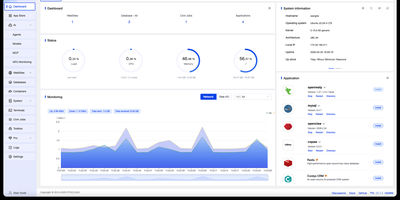
Backed by over 36,000 GitHub stars and 120 contributors with 123 releases since 2022, 1Panel has rapidly become the go-to open-source alternative to cPanel and Plesk for modern Linux server management. The platform delivers a clean Vue.js dashboard powered by a Go backend using the Gin framework, providing visual management of Docker containers, images, networks, and volumes without touching the command line. Its curated app marketplace offers one-click installation of 165+ trusted open-source applications including Nextcloud, Bitwarden, Umami analytics, WordPress, and NocoBase, each running in isolated containers for maximum security. Native AI capabilities set 1Panel apart from every competing panel: deploy Ollama LLMs directly from the dashboard, spin up OpenClaw personal agents, monitor GPU utilization, and manage AI models through a unified interface. Website management includes automatic domain binding, Let's Encrypt SSL certificate provisioning, and Nginx configuration with zero manual setup. Security runs deep with built-in firewall rules, fail2ban integration, container isolation, WAF protection, and comprehensive audit logging enabled from day one. Automated backups support AWS S3, Cloudflare R2, and local storage with one-click restore from any snapshot. The panel supports Debian, Ubuntu, CentOS, and Rocky Linux across x86_64, aarch64, armv7l, ppc64le, and s390x architectures. Running on a dedicated VPS on RepoCloud with guaranteed CPU, RAM, and SSD, full root SSH access, and a browser serial console. GPL-3.0 licensed.
Huginn
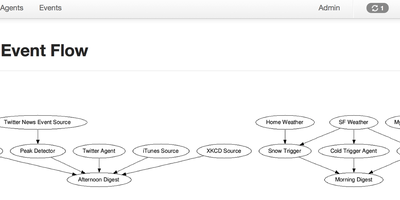
With nearly 50,000 GitHub stars and over 230 contributors since 2013, Huginn has established itself as the definitive open-source automation engine for developers who refuse to hand their workflow data to third-party cloud services. The platform lets you build agents that scrape websites, monitor RSS feeds, track weather via APIs, watch Twitter streams, aggregate news, detect price changes, and trigger notifications through email, SMS via Twilio, Slack webhooks, or social media posts to Twitter and Tumblr. Each agent creates and consumes JSON events, propagating them along a directed graph where complex multi-step workflows emerge from simple single-purpose components. The web interface provides visual agent management with drag-and-drop scenario building, real-time event logs, scheduling controls, and a built-in agent library covering dozens of use cases out of the box. Huginn supports Liquid templating for dynamic event transformation, regex-based content extraction, JavaScript-based data manipulation, and HumanTaskAgent for crowd-sourced workflow steps. Custom agents can be packaged as Ruby gems and loaded via the ADDITIONAL_GEMS environment variable without modifying core code. Deployment options include Docker with the official huginn/huginn all-in-one image or huginn/huginn-single-process for production multi-container setups with PostgreSQL or MySQL backends, plus native support for Heroku and OpenShift PaaS platforms. Running on a dedicated VPS on RepoCloud with guaranteed CPU, RAM, and SSD, full root SSH access, and a browser serial console. MIT licensed.
Yopass
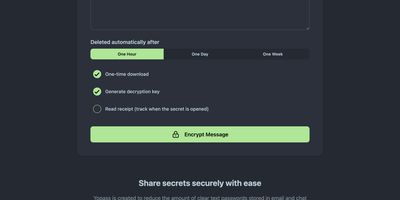
With nearly 3,000 GitHub stars and active development since 2014 through version 14.2.0, Yopass eliminates the universal bad habit of sharing passwords and API keys through Slack messages, email threads, and ticket systems by encrypting secrets entirely in the browser using OpenPGP before anything reaches the server. The Go backend stores only ciphertext — it never sees plaintext — while the React frontend handles all encryption and decryption client-side, generating one-time URLs that self-destruct after a single viewing or when the configured expiration of one hour, one day, or one week passes. File upload support streams encrypted files with configurable size limits, and optional custom password protection adds a second encryption layer beyond the URL-embedded key. The server supports Redis or Memcached as storage backends with automatic key expiration, deploying via Docker Compose in under five minutes or as Kubernetes manifests for production environments. Built-in TLS support works alongside reverse proxy configurations for Nginx, Caddy, and Traefik with automatic Let's Encrypt certificate provisioning. Prometheus metrics expose HTTP request counts, latency histograms, and secret lifecycle counters for Grafana dashboard integration and alerting. Read-only mode enables split-instance deployments separating secret creation from retrieval across different network zones. Multi-language support localizes the interface for international teams. The open-source core under Apache 2.0 provides full self-hosted functionality with no account management required. Running on a dedicated VPS on RepoCloud with guaranteed CPU, RAM, and SSD, full root SSH access, and a browser serial console. Apache-2.0 licensed.
Saleor
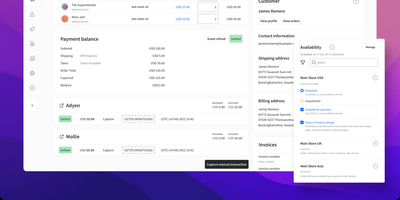
Backed by 23,000+ GitHub stars and trusted by global brands processing millions of orders, Saleor delivers the open-source headless commerce API that replaces monolithic ecommerce platforms with a composable, GraphQL-native architecture where APIs are the only way to interact with the system. The core engine built on Python and Django handles catalog management, order processing, payment orchestration, inventory tracking, and fulfillment workflows while remaining completely decoupled from any frontend technology. Native multichannel support enables per-channel control of pricing, currencies, warehouses, product availability, and payment methods, managing Instagram, Amazon, regional websites, and retail POS from a single backend. The extensibility layer provides 160+ webhooks spanning synchronous payment callbacks, asynchronous event notifications via Google Cloud Pub/Sub and AWS SQS, and subscription queries that shape webhook payloads to deliver only the data your services need. Dashboard UI Extensions offer 45+ mount points for embedding custom interfaces via iframes without forking, while the Apps system allows building payment gateways, PIM integrations, loyalty programs, and discount logic in any language. The React-based administration dashboard provides product management, order processing, customer segmentation, and analytics with multi-language and multi-currency support. OIDC integration connects existing identity providers for single sign-on across the merchant organization. Running on a dedicated VPS on RepoCloud with guaranteed CPU, RAM, and SSD, full root SSH access, and a browser serial console. BSD 3-Clause licensed.
Percona PMM
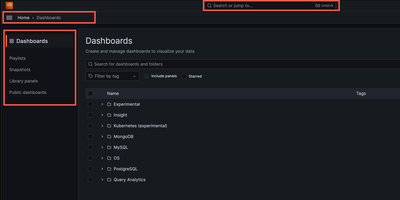
Backed by 1,080+ GitHub stars and maintained by Percona with the latest release v3.8.1 in June 2026, Percona Monitoring and Management delivers the open-source database observability platform that provides a single pane of glass across MySQL, PostgreSQL, MongoDB, Valkey, and Redis databases deployed on-premises, cloud, or hybrid environments. The Go-powered PMM Server collects metrics from lightweight PMM Client agents with minimal performance impact, storing time-series data in ClickHouse for fast querying across configurable retention periods. Query Analytics ranks every query by load across all database engines from one unified dashboard, drilling from fleet-level performance down to individual problematic queries with explain plans, per-query metrics, and anomaly detection. Real-time Query Analytics streams live MongoDB operations updated every 1-5 seconds for immediate troubleshooting of lock contention and long-running queries. Built-in Percona Advisors continuously scan connected databases for security gaps, misconfigurations, and performance problems, distilling decades of DBA expertise into automated actionable recommendations. Percona Alerting integrates with 15+ notification channels including Slack, PagerDuty, email, and webhooks to trigger on custom metric thresholds. Database-specific dashboards visualize InnoDB storage engine details, WiredTiger cache metrics, PostgreSQL tuple activity, replication lag, and cluster health with annotations for root-cause correlation. Deployment options include Docker single-container setup, Podman rootless execution, and Helm charts for Kubernetes with Ingress controller support and ConfigMap management. Running on a dedicated VPS on RepoCloud with guaranteed CPU, RAM, and SSD, full root SSH access, and a browser serial console. AGPL-3.0 licensed.
GlitchTip
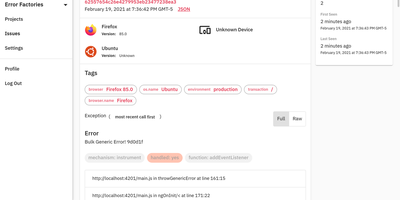
GlitchTip speaks Sentry's protocol without Sentry's operational weight - open-source error tracking that your existing SDKs already understand. The pitch is pragmatic: instrument your application with the official Sentry SDKs you already know - any language they cover - and point the DSN at your own GlitchTip instance instead. Errors, exceptions, log messages, and Content Security Policy violations flow into one place for triage, grouped into issues with stack traces, with alerts delivered by email or webhook the moment things break. Where self-hosted Sentry has ballooned into a docker-compose stack of twenty-plus containers, GlitchTip is a deliberately lean Django and PostgreSQL application a small team can actually run. Beyond errors, it bundles three more monitoring concerns: performance monitoring takes a works-out-of-the-box approach - no dashboard building, just your slowest web requests, database queries, and transactions surfaced automatically; uptime monitoring pings your sites and alerts on failures, or runs in reverse as a dead-man's-switch heartbeat for cron jobs that must check in on schedule; and log search puts application logs alongside errors for faster debugging. Unlimited projects and team members, MIT-licensed, built by Burke Software - your event volume is limited only by your own hardware.
OpenReplay
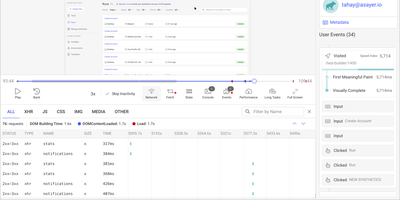
Backed by 12,400+ GitHub stars and positioned as the self-hosted alternative to FullStory and Hotjar, OpenReplay delivers the open-source session replay platform that keeps every byte of user behavior data on your own infrastructure. The JavaScript tracker captures pixel-perfect recordings of clicks, scrolls, form inputs, and navigation with automatic sensitive data masking, while simultaneously logging network requests, console errors, JavaScript exceptions, and Redux, VueX, MobX, NgRx, Pinia, and Zustand store state changes for complete technical context. DevTools mode reconstructs each session with full stack traces, GraphQL queries from Apollo and Relay, Fetch and Axios request payloads, CPU and memory metrics, and page speed waterfall charts — effectively giving developers a browser inspector tied to any user session. Product analytics surfaces conversion funnels, user journeys, click heatmaps, web vitals trends, and retention cohorts without requiring custom instrumentation. Co-browsing connects support agents to live user sessions with cursor control and WebRTC audio, enabling real-time assistance without third-party screen-sharing software. Integrations push session context into Sentry, Datadog, CloudWatch, Stackdriver, and Elastic for front-to-back debugging. Feature flags enable gradual rollouts with session-level targeting. The platform deploys to any cloud via Docker and Kubernetes with auto-scaling ingestion handling up to 50,000 sessions per month on the open-source edition. Running on a dedicated VPS on RepoCloud with guaranteed CPU, RAM, and SSD, full root SSH access, and a browser serial console. AGPLv3 licensed.
Mage
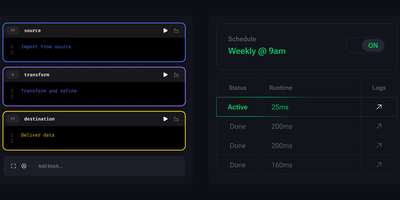
Backed by 8,700+ GitHub stars and designed as a modern alternative to Apache Airflow, Mage delivers the open-source data pipeline platform that combines the interactive flexibility of notebooks with production-grade orchestration in a single self-hosted environment accessible at port 6789. The modular block architecture lets data engineers compose pipelines from Python, SQL, and R code blocks with instant data previews, live execution logs, and visual debugging at each step. Over 100 prebuilt integrations connect sources and destinations including PostgreSQL, MySQL, Snowflake, BigQuery, Redshift, S3, Kafka, MongoDB, Amplitude, Salesforce, and Stripe with parallel stream synchronization for high-throughput data movement. Batch pipelines run on cron schedules or event triggers while streaming pipelines process real-time data from Kafka, Kinesis, and RabbitMQ with stream mode reducing memory usage by approximately 90 percent compared to batch processing. Native dbt integration builds, tests, and runs dbt models directly inside the pipeline editor alongside custom transformation blocks. Spark, Snowpark, and Databricks runtimes handle large-scale distributed processing. AI-assisted development generates code, fixes errors, and optimizes queries within the notebook interface. Monitoring dashboards track pipeline health with integrations to Datadog, Prometheus, New Relic, and OpenTelemetry. Terraform templates deploy production environments to AWS, GCP, or Azure with two commands, while Helm charts support Kubernetes clusters. Running on a dedicated VPS on RepoCloud with guaranteed CPU, RAM, and SSD, full root SSH access, and a browser serial console. Apache 2.0 licensed.