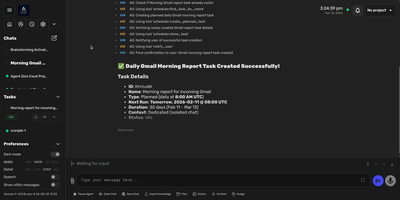
Agent Zero
Agent Zero equips large language models with a persistent virtual Linux desktop, letting autonomous AI agents write code, research the web, and execute multistep tasks without supervision. Operating within an isolated container, the system opens an interactive XFCE graphical desktop in your browser canvas where the agent interacts with GUI applications like Blender and terminal sessions directly. Its embedded browser features interactive annotation tools, letting you click web elements to inspect stylesheet hierarchies, extract component markup, or submit automated testing instructions. You can cowork on spreadsheets, presentations, and Markdown specifications in real time alongside the agent, preserving document revisions through snapshot time travel. A multi-tier memory architecture backed by FAISS vector indexing and SearXNG web discovery retains problem-solving context across projects, while hierarchical delegation spins up specialized subordinate agents to parallelize complex engineering audits. The platform connects seamlessly to commercial LLMs via OpenAI, Anthropic, or OpenRouter, runs private local models through Ollama, and integrates custom toolkits via the Model Context Protocol and community Plugin Hub. Running on a dedicated VPS on RepoCloud with guaranteed CPU, RAM, and SSD, full root SSH access, and a browser serial console. MIT licensed.
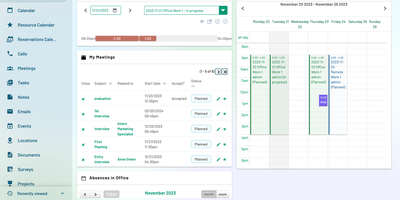
MintHCM
The first AI-enabled open-source Human Capital Management system built for the agentic era — not a legacy HRMS with AI features bolted on, but a platform architected from the ground up with native MCP, A2A, and WebMCP protocols enabling any LLM client to query employee records, create calendar entries, and orchestrate multi-step HR workflows. Built on the battle-tested SuiteCRM/SugarCRM CE foundation and extended with 17 dedicated HR modules — recruitment pipeline with candidate scoring, onboarding checklists, competency matrices, employment history tracking, leave management with accrual policies, time and attendance, resource booking, travel and expense reporting, workplace management, performance evaluations, job description builder, employer branding campaigns, offboarding workflows, and a configurable analytics engine — all controlled through granular role-based permissions. The integrated LangGraph-powered AI agent operates with human-in-the-loop confirmation before mutating data, while the MCP server layer exposes structured HR operations to Claude Desktop, GitHub Copilot, and any MCP-compatible client. Native REST API enables integration with SAP, Workday, and custom applications. Mobile apps for iOS and Android provide field access to employee data and approvals. Runs on Apache2 with PHP 8.2, MySQL 8.0 or MariaDB, and ElasticSearch 7.10+ for full-text search and list indexing. Running on a dedicated VPS on RepoCloud with guaranteed CPU, RAM, and SSD, full root SSH access, and a browser serial console. AGPL v3 licensed.
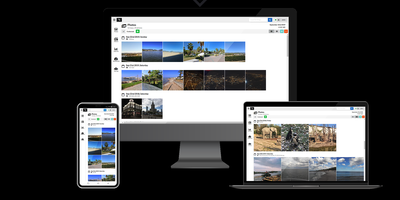
LibrePhotos
With over 8,000 GitHub stars and continuous development since 2020, LibrePhotos delivers the core intelligence of Google Photos — face recognition, object detection, semantic search, and automatic album generation — entirely on your own hardware without sending a single photo to a third-party server. The Django 5 backend processes uploaded media through a machine learning pipeline that runs face detection via the face_recognition library, clusters identified faces using scikit-learn and HDBSCAN, generates image captions through BLIP and Moondream 2, and classifies scenes using Places365 or Google's SigLIP 2 vision-language model with zero-shot classification against 900+ real-world tags. Semantic search lets you find photos by natural language queries like "sunset at the beach" without manual tagging, while metadata search filters by person, camera, lens, file type, and filesystem path. The React 18 frontend built with Vite presents a timeline view, fullscreen lightbox with slideshow mode, photo detail sidebar showing location and people, and a folder navigation view with breadcrumb paths. RAW files from any camera are converted via ImageMagick, videos processed through FFmpeg, and Live Photos paired with their RAW+JPEG counterparts as unified entries. Public album sharing via link provides fine-grained privacy controls, and duplicate detection uses perceptual hashing to identify near-identical images. Deployment runs as a single unified Docker container or via Docker Compose with Kubernetes manifests also available. Running on a dedicated VPS on RepoCloud with guaranteed CPU, RAM, and SSD, full root SSH access, and a browser serial console. MIT licensed.
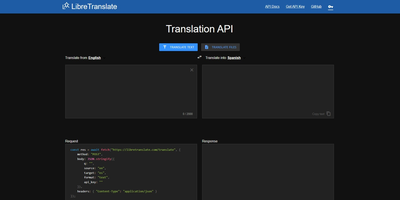
LibreTranslate
Machine translation with no Google, no Azure, no per-character billing, and no text leaving your infrastructure: LibreTranslate is a free, open-source translation API that runs entirely on your own server. The engine underneath is Argos Translate, which runs OpenNMT neural models with SentencePiece tokenization and Stanza sentence-boundary detection, all offline. Models install as portable .argosmodel packages covering dozens of languages - English, Spanish, French, German, Chinese, Japanese, Russian, Arabic, Hindi, Portuguese, and many more - and Argos handles automatic pivoting: with es-to-en and en-to-fr installed, it chains them to translate es-to-fr without a direct model. The API is a straightforward HTTP POST to /translate with source and target language codes, returning JSON - simple enough that the ecosystem has clients in every major language and integrations across tools like Weblate and Mastodon. Beyond plain text it translates HTML while preserving markup and handles whole file uploads (documents in, translated documents out), plus automatic language detection when the source is unknown. A clean bundled web UI serves interactive translation for end users, and optional API keys with rate limits control access. AGPL-licensed and trainable with custom models, it is the standard answer when translation must be private, unmetered, and self-contained - GDPR-sensitive text never touches a third party.
AgentFlux
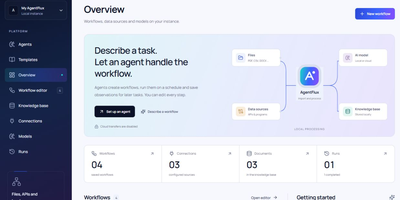
Describe the task in plain words, pick the sources and model it may use, and an agent plans the workflow before running it. That is the core loop: agents build editable visual workflows from a task description, execute them on demand or on a schedule, and keep everything traceable. Prefer building by hand and the canvas offers 17 preconfigured steps, branching, undo and redo, JSON import and export, plus eight starter templates. Feed it real work by importing PDF, DOCX, XLSX, CSV, JSON, and text files, or by connecting folders, HTTP endpoints, and approved local programs. Upload a screen recording and it identifies the actions with timestamps, turning a demonstrated process into an editable workflow you can refine. Model calls go to the endpoint you choose: Ollama, LM Studio, vLLM, or any OpenAI-compatible service, local or cloud with your own credentials. Every run can be inspected step by step, cancelled mid-flight, and exported as JSON, CSV, or Markdown reports. Observations from completed runs land in a knowledge and learnings store, where you review them and promote the useful ones into reusable skills for the next task. The Docker release bundles the application with FFmpeg and local Whisper support, and your documents stay on your own machine. Running on a dedicated VPS on RepoCloud with guaranteed CPU, RAM, and SSD, full root SSH access, and a browser serial console. Apache License 2.0 licensed.
Octop
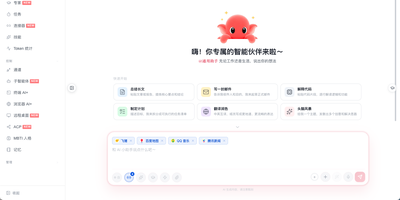
Modern engineering teams and busy households deploy Octop to run private, autonomous AI agents equipped with persistent memory workspaces, scheduled cron jobs, and direct browser automation. Users can orchestrate specialist agents tailored for software development, IT operations, content generation, and system diagnostics through an interactive React dashboard. The platform connects directly to Discord, Feishu, DingTalk, and WeCom, allowing team members to delegate complex tasks without leaving their everyday messaging apps. An integrated remote desktop and browser control engine lets agents navigate websites, capture screenshots, fill forms, and operate graphical software autonomously. Administrators can assign distinct MBTI personality profiles to agents, establish granular role-based permissions, configure scheduled cron workflows, and integrate custom Model Context Protocol servers for external tool access. Long-term memory persists across conversations through dedicated workspace files, ensuring contextual continuity whenever switching between underlying language models or team collaborators. Running on a dedicated VPS on RepoCloud with guaranteed CPU, RAM, and SSD, full root SSH access, and a browser serial console. MIT licensed.
Zero Email
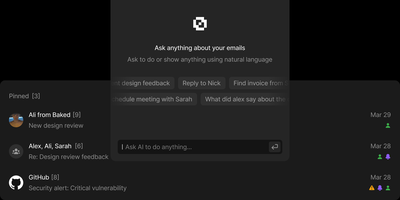
Zero unifies Gmail, Outlook, and IMAP accounts into a single AI-enhanced inbox with keyboard-driven navigation that matches premium email clients in speed. Backed by 10,000+ stars and positioned as the alternative to Superhuman, it keeps your email data in your own PostgreSQL database while LLM agents handle categorization, priority sorting, draft composition, and natural language mailbox queries. You choose whether models run locally or through cloud providers you control. The Next.js and React interface delivers customizable keyboard shortcuts for every action: reading, archiving, labeling, composing. A WorkflowEngine defines automated multi-step rules including label application, bulk archiving, and conditional routing based on sender, subject, or content analysis. Built on Drizzle ORM with Better Auth handling Google OAuth, styled with TailwindCSS and Shadcn UI components, the interface is polished without being bloated. MCP integration exposes email management tools to external AI assistants for programmatic inbox control through standardized protocols. The Nizzy CLI handles environment configuration, database synchronization, and development server orchestration. Deploys via Docker Compose with a single database initialization command. Running on a dedicated VPS on RepoCloud with guaranteed CPU, RAM, and SSD, full root SSH access, and a browser serial console. MIT licensed.
Pad
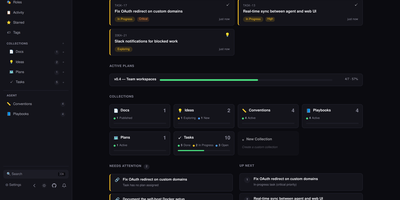
Your coding agents finish a session, close the laptop, and forget everything; Pad is where the project remembers. It holds the tasks, plans, bugs, ideas, and decisions in one workspace that you drive from a browser while your agents drive it from the terminal, so the next session, human or machine, picks up exactly where the last one stopped. You plan on boards, lists, and tables with drag-and-drop status columns, rich item pages, comment threads, and a dashboard that answers what needs attention and what to do next. Your agents read the queue, claim items, leave checkpoints, link their pull requests, and mark work fixed with the fixing PR attached. Conventions teach them the house rules once, like running tests before calling a task done, and playbooks hand them repeatable multi-step workflows they can invoke by name. Every change is versioned with its author, a person or a named agent, and new items appear in the browser the moment an agent creates them in the terminal. The same workspace is reachable three ways: the web interface, the pad CLI, and a bundled MCP server with a natural-language skill that plugs into Claude Code, Cursor, Codex, Windsurf, OpenCode, Copilot, Amazon Q, and Junie. Running on a dedicated VPS on RepoCloud with guaranteed CPU, RAM, and SSD, full root SSH access, and a browser serial console. Apache-2.0 licensed.
Oksskolten
Subscribe to a feed and Oksskolten fetches the complete text of every new article, cleans it, and files it as Markdown in a library you can read without leaving the app. About 500 cleanup patterns strip ads, navigation, and tracking, with no per-feed toggles or selectors to maintain. No feed on the site? Auto-discovery goes first, then RSS Bridge, then LLM-inferred CSS selectors, while FlareSolverr gets past bot protection. Every feed is checked on its own schedule, somewhere between every 15 minutes and every 4 hours. Inbox, Read Later, Liked, and Read views keep the queue tidy. Clip any URL as a standalone article. Likes and bookmarks feed an engagement score that shapes search ranking and recommendations. One click summarizes or translates an article through Anthropic, Gemini, OpenAI, Ollama, or vLLM, with Google Translate and DeepL as translation engines. Ask the chat questions about your archive, or point Claude Code or Codex at the built-in MCP server to use the same tools. Search forgives typos and covers every stored article. Login works with a password, a passkey, or GitHub. Pick from four layouts and fourteen color themes, import custom themes as JSON, rebind keyboard shortcuts, and keep reading offline as a progressive web app. Running on a dedicated VPS on RepoCloud with guaranteed CPU, RAM, and SSD, full root SSH access, and a browser serial console. AGPL-3.0 licensed.
GPT Researcher
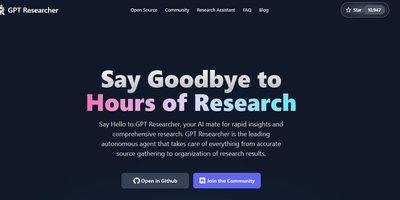
A question goes in; a cited, long-form report comes out - GPT Researcher is an open-source autonomous research agent. A planner agent decomposes the query into sub-questions, execution agents crawl 20+ web sources in parallel with JavaScript-enabled scraping, and a publisher aggregates findings into a 2,000+ word report with inline citations, exportable to PDF, Word, and Markdown. The Deep Research mode extends this recursively: each result yields follow-up questions that are explored to configurable breadth and depth in a tree pattern, while accumulated learnings, citations, and visited URLs are shared across branches. It also researches local documents (PDF, CSV, Word) alongside the web. LLM and search providers are pluggable, including OpenAI, Anthropic, Google, DeepSeek, and Ollama for models, and Tavily, Google, Bing, DuckDuckGo, and SearXNG for retrieval. It ships as a Python package, a FastAPI server with web frontend, a Docker image, and an MCP server for use inside Claude or Cursor. MIT-licensed.
Clawboo
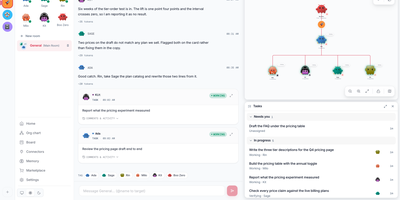
Describe the outcome once, in plain language, and a small crew of AI agents divides the work between them and reports back in the same chat. You type the request in the team chat; Boo Zero, the team lead, splits it into jobs on a shared board and hands each card to the teammate best placed to do it. Teammates run on Claude Code, Codex, Hermes, OpenClaw, or Clawboo's built-in runtime, and one team can mix them freely, so the researcher, the writer, and the coder can each work on their strongest tool. You follow every card live on the board and in the chat, watch the team graph to see who is doing what, and add a reviewer agent when a second pair of eyes matters. Finished work returns to Boo Zero, which pulls the pieces together and answers you in the chat. Ready-made teams from the marketplace cover marketing squads, dev teams, and research crews, and you can bring an API key from Anthropic, OpenAI, OpenRouter and more, a free local model through Ollama, or your ChatGPT subscription through the Codex CLI. Spend is tracked per team with budget warnings before costs surprise you. Running on a dedicated VPS on RepoCloud with guaranteed CPU, RAM, and SSD, full root SSH access, and a browser serial console. MIT licensed.
Chroma
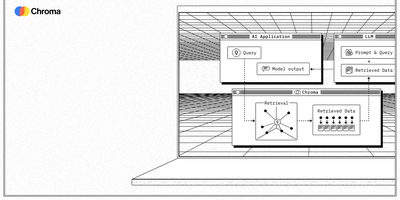
With over 29,000 GitHub stars and deep integrations into LangChain, LlamaIndex, and CrewAI, Chroma has become the default vector database for developers building retrieval-augmented generation pipelines and AI agent memory systems. Its core API consists of just four functions — create, add, query, and delete — making it the fastest path from zero to semantic search, while the underlying Rust engine handles tokenization, embedding, HNSW indexing, and similarity scoring automatically. Chroma supports dense vector search via HNSW with configurable distance metrics including L2, cosine similarity, and inner product, sparse vector search using SPLADE, full-text BM25 keyword search, and regex matching, all combinable in hybrid queries through a single unified interface. Metadata filtering at query time uses MongoDB-style operators including $eq, $ne, $gt, $lt, $in, and logical combinators $and and $or, enabling precise result scoping without post-processing. The multimodal pipeline powered by OpenCLIP embeds text and images into a shared vector space, allowing cross-modal retrieval where text queries return relevant images and vice versa. Deployment options range from embedded mode via PersistentClient for notebooks and prototypes, to client-server mode with Docker for production, to Chroma Cloud for serverless scalability. Official Python and JavaScript SDKs provide identical APIs, and embedding function integrations support OpenAI, Cohere, Hugging Face, Google, Ollama, and custom models. Running on a dedicated VPS on RepoCloud with guaranteed CPU, RAM, and SSD, full root SSH access, and a browser serial console. Apache 2.0 licensed.
Agentic Resource Registry
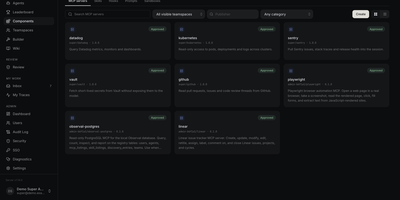
Every team building with coding agents has the same drawer problem: the best Skill, MCP server, or agent file lives in one person's repo, undocumented, while three colleagues rebuild it from scratch. Agentic Resource Registry is the internal catalog that ends the duplication, a self-hosted registry where your organization publishes Skills, MCP servers, hooks, prompts, agent files, and sandboxes in one searchable place. Browse by teamspace, publisher, category, or harness and see at a glance what each resource supports and how often it has been pulled. Authors build agent files in a four-step builder with a live summary and draft readiness checks, then submit them into a review queue where admins inspect the full prompt and version diffs before approving. Forking an approved release creates your own draft with pinned components, and reviewers can compare it against upstream line by line. The companion CLI installs any approved resource into Claude Code, Cursor, Codex, Kiro, Copilot, OpenCode, Pi, and more, generating the correct config for each harness automatically. Approved resources are also discoverable over the open ARD standard, so a running agent can hand part of its task to another approved agent or a remote A2A service. Running on a dedicated VPS on RepoCloud with guaranteed CPU, RAM, and SSD, full root SSH access, and a browser serial console. Apache-2.0 licensed.
LangWatch
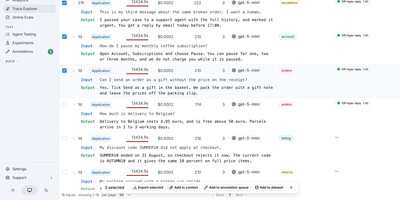
Every call your AI agents make becomes a searchable trace in LangWatch, and the same platform tests and scores those agents before a new prompt or model reaches users. The Trace Explorer filters by origin, user, model, cost, and evaluator, reads each run as a waterfall, flame graph, topology, or sequence diagram, and takes traces from the Python, TypeScript, and Go SDKs or any OpenTelemetry source. Agent Testing sends simulated users, in text or beta voice calls, through your agent while a judge passes or fails every criterion with its reasoning, adds multi-turn red teaming, and compares two agents side by side. The Experiments workbench scores prompts and agents on datasets with LLM judges, exact match, and RAG checks, then compares runs on cost, latency, and pass rate, while online evaluations monitor live traffic and guardrails block unsafe replies. Prompts keep version history and staging or production tags, Workflows wire prompts, Python code, and HTTP calls on a visual canvas, and annotation queues route traces to human reviewers. Alerts fire when a graph crosses a threshold, automations post to Slack, email, or webhooks, and scheduled reports go out by email or Slack. Claude Code, Codex, Copilot, Gemini CLI, and opencode report session cost, pull request cost, and terminal replays, and an MCP server exposes trace search and prompt management to coding assistants. Running on a dedicated VPS on RepoCloud with guaranteed CPU, RAM, and SSD, full root SSH access, and a browser serial console. Apache-2.0 licensed.
Memory OS
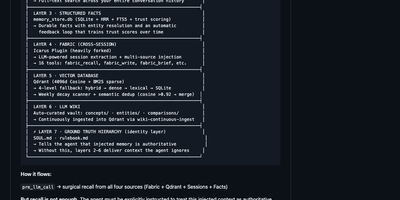
Memory OS gives Hermes Agent a permanent memory, so a new session opens with your projects, decisions, and working style already in context instead of introductions. Seven layers divide the job: workspace files carry your standing instructions into every turn, and a full-text index makes every past conversation searchable in place. Durable facts about your stack, your projects, and your patterns live in a structured store that resolves entities and scores how much each fact can be trusted, promoting what proves itself and demoting what does not. Cross-session recall pulls relevant moments from older threads, while a vector store with hybrid dense and keyword search finds the right memory even when the wording has changed. A self-curating wiki turns raw material into concept, entity, and comparison pages that are re-ingested automatically, and a Ground Truth hierarchy tells the agent to treat injected memories as authoritative instead of re-checking them. Scheduled jobs keep the system honest: hourly ingestion, weekly curation and decay scans, dead-letter reporting, and health heartbeats. It all runs beside the agent on your own machine with whichever provider you already use, from OpenRouter and Anthropic to a local Ollama. Running on a dedicated VPS on RepoCloud with guaranteed CPU, RAM, and SSD, full root SSH access, and a browser serial console. MIT licensed.
Paperclip
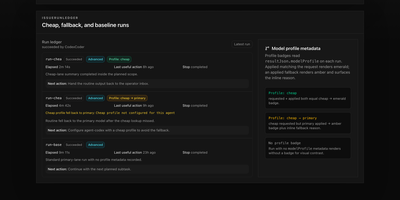
With over 77,000 GitHub stars accumulated in under five months since its March 2026 launch, Paperclip has become the default control plane for teams running multiple AI agents in production. Rather than juggling dozens of terminal tabs with Claude Code sessions, Codex instances, and Gemini CLI workers, Paperclip organizes all agents into a company structure with org charts, reporting lines, role-based permissions, and per-agent monthly budgets that trigger hard-stops when exceeded. The platform supports any runtime through its adapter system — Process adapters manage local CLI agents like Claude Code, Codex, Cursor, Pi, and OpenCode as child processes, while HTTP adapters trigger remote agents via webhooks to OpenClaw, serverless platforms, or custom endpoints. Heartbeat-based execution wakes agents on configurable schedules, injecting goal context, budget state, and workspace paths directly into the invocation payload. The Work and Task System provides atomic checkout with execution locks, first-class blocker dependencies, and structured work products to eliminate duplicate effort. Governance features include approval workflows, decision tracking, emergency stops, and full audit trails tracing every mutation to an actor. Deployment runs as a single Node.js process with embedded PostgreSQL locally or scales to external Postgres for production, installable in one command via npx paperclipai onboard. Running on a dedicated VPS on RepoCloud with guaranteed CPU, RAM, and SSD, full root SSH access, and a browser serial console. MIT licensed.
JobNavigator
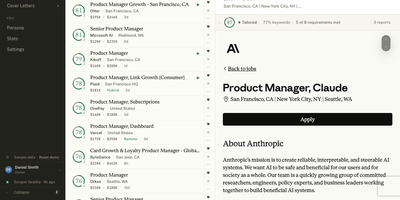
JobNavigator runs your whole job hunt as an automated pipeline, scraping career pages and job boards, scoring every posting against your résumés, and tracking each application to its outcome. Discovery fans out across company career pages through twelve ATS handlers, aggregators like LinkedIn, Indeed, and ZipRecruiter, and a Chrome extension that saves any posting you stumble on. Each new job is scored against your base résumés, lightly for a quick number or in full, with keyword coverage and requirement mapping that show exactly where you match and where you do not. Strong matches get a tailored résumé from eight PDF templates and a cover letter written from your persona, ready for your review before anything is sent. The extension then auto-fills application forms and drafts answers to free-text questions from your stored Q&A bank. Every application moves through stages and interviews in one tracker, while Gmail polling spots replies and updates the status for you, and Telegram delivers new-job alerts and a daily digest. A household can share one install with up to five accounts, each keeping its own jobs, résumés, and PIN, while scraping runs once for everyone. Running on a dedicated VPS on RepoCloud with guaranteed CPU, RAM, and SSD, full root SSH access, and a browser serial console. MIT licensed.
Lobe Chat
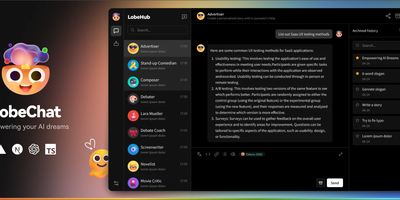
A private ChatGPT built with Next.js: Lobe Chat is the open-source AI chat interface teams self-host instead. Its main advantage is provider breadth: one interface connects to 40+ model providers, including OpenAI, Anthropic Claude, Google Gemini, Mistral, Groq, AWS Bedrock, Azure, and local models served through Ollama, so you can switch models per conversation and compare outputs. It handles multi-modal work: image recognition, image generation, text-to-speech, and speech-to-text. A plugin system based on function calling and the Model Context Protocol (MCP) adds external tools like web search and code execution. Run it in standalone mode as a single container with settings in browser storage, or in database mode with PostgreSQL and S3-compatible storage for persistent history, multi-user auth, and RAG knowledge bases built from uploaded documents with pgvector retrieval. Because tools arrive through function calling and MCP rather than a proprietary plugin format, custom internal tools can be exposed to the assistant with a standard server over STDIO or HTTP. Hundreds of pre-configured assistant roles import from the community marketplace. For teams the cost model matters: provider API keys billed per token typically undercut a ChatGPT Plus seat per person, and self-hosting keeps API keys, uploaded files, embeddings, and conversation history entirely on your own server.