Mynah
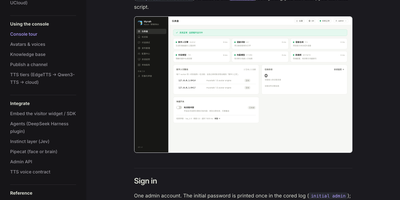
A visitor clicks your link and a face is already there, listening, answering within a fraction of a second, and stopping the moment they interrupt, because Mynah runs live digital humans in the browser instead of playing back rendered video. Underneath, cored takes WebRTC offers, runs the conversation through your chosen language model, speech recognition, and text to speech, and drives a lip synced avatar engine such as MuseTalk, FlashHead, or Wav2Lip, with a semantic end of turn model deciding when a person has finished speaking. The admin console is where you shape the experience: bake a new avatar from a talking video with explicit consent, clone or audition voices, swap avatars per channel without cold starts, and tune green screen keying and gestures live in the playground. Knowledge bases take your documents through ingestion and embedding so answers ground in your material, with retrieval tests before anything ships. Publishing freezes a model, voice, and knowledge snapshot into a channel: a shareable link with token, domain, or CIDR access control, its own branding, and a concurrency cap drawn from an engine pool that computes how many workers your VRAM can hold. Session monitoring shows who is connected and lets you kick a session, health checks watch every dependency, and light and dark themes with Chinese and English interfaces cover both console and visitor pages. Running on a dedicated VPS on RepoCloud with guaranteed CPU, RAM, and SSD, full root SSH access, and a browser serial console. Apache-2.0 licensed.
Formbricks
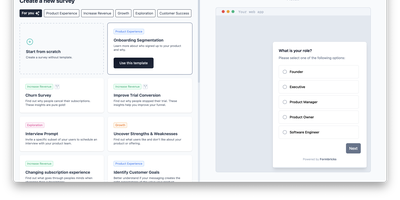
In-app, website, link, and email surveys feed one open-source experience management platform: Formbricks. Its distinguishing strength is targeted in-app research: a JavaScript SDK triggers surveys on user events and attributes, with segmentation rules like "power users who have not seen a survey in 10 days," so questions reach the right cohort at the right moment instead of a mass email blast. The no-code editor offers 20+ question types including NPS, CSAT, CES, matrix, ranking, and file upload, with skip logic, conditional branching, best-practice templates, and full brand theming. Responses feed built-in analytics with summaries and CSV/JSON export, and integrations push data to Slack, Notion, Google Sheets, Airtable, Zapier, and n8n, with webhooks and an open API on every tier. Because self-hosted surveys load from your own domain rather than a blacklisted third-party script host, ad blockers do not suppress them - in-app surveys reach users that Hotjar-style tools silently miss, which measurably raises response rates. Self-hosting also removes the third-party sub-processor from your privacy policy entirely: survey responses often contain PII, and keeping them on your own server matters for GDPR-sensitive and regulated industries. The Community Edition has no response caps or tier-gated features, so core functionality and your data stay accessible regardless of any subscription. Next.js on PostgreSQL, AGPLv3.