OpenMetadata
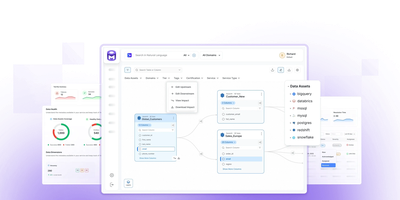
OpenMetadata builds a unified knowledge graph connecting schemas, tables, columns, dashboards, pipelines, ML models, and data products into one searchable catalog accessible at port 8585. The ingestion framework ships 130+ connectors covering Snowflake, BigQuery, Redshift, Databricks, PostgreSQL, MySQL, Kafka, Airflow, dbt, Tableau, Looker, Power BI, Metabase, and Superset, automatically extracting metadata on configurable schedules. Column-level lineage traces data flow across transformations, joins, and aggregations, while built-in data quality testing executes profiling and validation rules as data contracts with automated alerting on failures. Governance features include role-based access control, PII auto-detection, glossary term propagation, and domain-based ownership assignment. The native MCP server and AI SDK expose semantic search, lineage queries, and governance metadata as tools any LLM agent can call, enabling AI systems to discover and reason about enterprise data with full trust context. The architecture requires only PostgreSQL or MySQL plus Elasticsearch, no Kafka, no graph database, and deploys via a single Docker Compose file. Created by the founders of Apache Hadoop, Apache Atlas, and Uber's Databook, the platform has earned over 14,700 GitHub stars and adoption by 3,000+ organizations. Apache 2.0 licensed.
DataHub
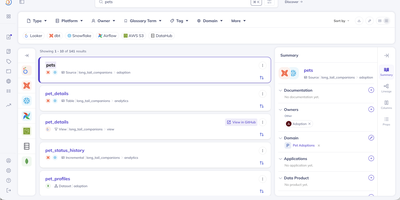
DataHub maps your entire data ecosystem into a searchable, governed catalog where every table, pipeline, dashboard, and metric is discoverable and traceable from source to consumer. Originally built at LinkedIn to manage metadata at hyperscale and proven to handle 10 million+ assets and billions of relationships in production, the platform is now trusted by 3,000+ organizations including Netflix, Visa, Slack, and Pinterest. The Spring Java backend (GMS) exposes both GraphQL and OpenAPI REST endpoints, while the React frontend delivers an intuitive interface for searching, browsing, and governing data assets. The Python-based ingestion framework provides 80+ production-grade connectors extracting deep metadata from Snowflake, BigQuery, Redshift, Databricks, dbt, Airflow, Spark, Kafka, Looker, Tableau, Power BI, Superset, PostgreSQL, MySQL, Hive, Glue, S3, Iceberg, and Unity Catalog through pull-based scheduled crawls and push-based emission via Python and Java SDKs. Automatic table-level and column-level lineage detection uses SQL parsing with 97-99% accuracy, tracing data flows from ingestion pipelines through warehouses to BI dashboards. Real-time metadata streaming via Kafka keeps the catalog continuously synchronized as schemas evolve and pipelines execute. The governance layer provides business glossary management, tag propagation along lineage graphs, domain-based organization, and fine-grained access control policies. DataHub Actions triggers automated responses to metadata changes, enabling notifications, quality checks, and downstream workflows. Elasticsearch powers full-text search with faceted filtering across entities. Running on a dedicated VPS on RepoCloud with guaranteed CPU, RAM, and SSD, full root SSH access, and a browser serial console. Apache 2.0 licensed.
GeoLens
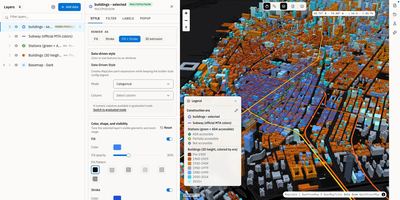
Transforming scattered spatial files into an interactive data catalog, GeoLens empowers engineering and GIS teams to organize geospatial assets, execute semantic searches, and build interactive 3D maps on self-hosted infrastructure. Users can ingest shapefiles, GeoJSON boundaries, database tables, and Cloud-Optimized GeoTIFF rasters into a centralized inventory with automatic source freshness auditing. Natural language queries evaluate dataset relevance across spatial boundaries and thematic tags, allowing analysts to uncover hydrology networks or zoning footprints without knowing exact layer names. The browser-based composition canvas lets cartographers extrude three-dimensional building footprints, overlay elevation terrain contours, color features by attribute values, and reorder layer hierarchies with drag-and-drop ease. Finished map projects publish immediately as secure shareable web links or responsive embeds for external dashboards. Desktop GIS operators can connect directly from QGIS or ArcGIS through native OGC API Features and STAC endpoints to query live vector tiles and run spatial filters. Teams can export filtered geometries into GeoPackage, FlatGeobuf, GeoParquet, or PMTiles archives to support downstream analysis workflows. Running on a dedicated VPS on RepoCloud with guaranteed CPU, RAM, and SSD, full root SSH access, and a browser serial console. Apache 2.0 licensed.
CKAN
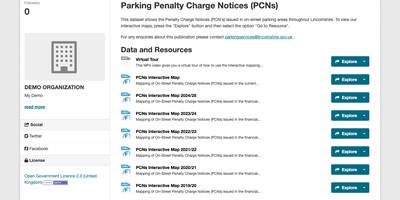
CKAN lets governments, research institutions, and companies publish data as a searchable catalog, where every dataset carries its description, license, tags, and downloadable files. Organizations own their datasets, and members, editors, and admins get different rights, so a dataset can stay private until someone with publishing rights releases it. Visitors narrow results with faceted filters on tags, formats, and organizations, or write fielded queries with wildcards and fuzzy matching. Resource pages preview spreadsheets in a grid and, when the data fits, as maps and charts, and they also display images, PDFs, and HTML. The DataStore keeps tabular resources as queryable tables, serving filtered rows with range conditions and nested AND/OR logic. Everything the web interface does is also available through the Action API. Groups gather related datasets, and custom metadata fields extend each record. Per-dataset activity streams document how data changes, and follow buttons feed a personal news feed. Files can be stored on local disk or, with extensions, in S3, Google Cloud Storage, or Azure Blob Storage. Extensions add geospatial search, harvesting for federated portals, multilingual metadata, and more chart types, and themes restyle the portal to match your brand. Running on a dedicated VPS on RepoCloud with guaranteed CPU, RAM, and SSD, full root SSH access, and a browser serial console. AGPL-3.0 licensed.