Payload CMS
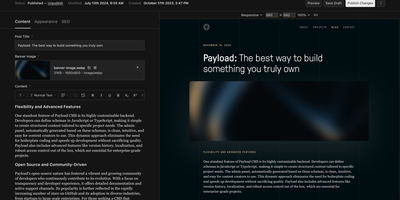
Backed by 44,000 GitHub stars and now part of Figma, Payload is the first headless CMS that installs natively into your Next.js application's /app directory rather than running as a separate service. The code-first architecture uses TypeScript config files to define collections, globals, and field schemas — from which Payload auto-generates database tables with migrations, a fully customizable React admin panel, REST and GraphQL endpoints, and type-safe Node.js local APIs you can call directly in React Server Components. The Lexical-based rich text editor supports block-based layout building, inline media embeds, and nested field structures, while the built-in localization engine handles unlimited locales with field-level translations. Authentication ships out of the box with HTTP-only cookie sessions, CSRF protection, role-based access control definable at the document, field, and operation level, and support for OAuth providers. Version history tracks every document change with full draft and publish workflows, and Live Preview renders content edits in real-time using server components. The job queue system manages background tasks and multi-step workflows deployable via Vercel Cron or standalone workers. Database flexibility spans PostgreSQL, MongoDB, and SQLite through swappable adapters, and the plugin ecosystem includes official modules for SEO, form builders, redirects, nested documents, and search alongside hundreds of community extensions. Running on a dedicated VPS on RepoCloud with guaranteed CPU, RAM, and SSD, full root SSH access, and a browser serial console. MIT licensed.
T3 Code
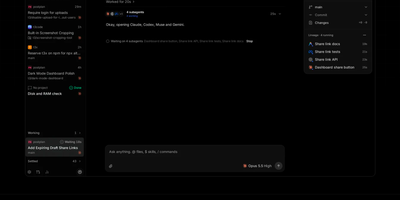
T3 Code puts every coding agent you already pay for behind one control surface, so Claude Code, Codex, Cursor, Grok Build, OpenCode, and Antigravity all run on your server while you direct them from your phone, browser, or desktop. Start a thread, choose the provider and model that fit the job, and watch the agent work in a shared conversation instead of a terminal you have to babysit. Permission modes decide when an agent must stop and ask, and its approvals, questions, and plan reviews arrive in the same thread wherever you happen to be connected from. When the work lands, review it file by file in the built-in diff view, then commit, push, and open pull requests through the Git and GitHub integrations without leaving the app. A real terminal sits beside the chat, and projects, settings, and scheduled tasks stay attached to the machine where the code actually runs. Install it as a background service and reach it from anywhere through T3 Connect, a Tailscale or LAN pairing, or the hosted web client, with a pairing code guarding local access. Outside agents can also drive threads over MCP, launching, messaging, and waiting on work across machines you have linked together. Running on a dedicated VPS on RepoCloud with guaranteed CPU, RAM, and SSD, full root SSH access, and a browser serial console. MIT licensed.
Auto Company
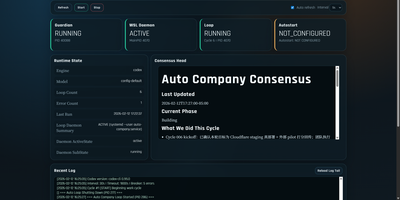
With over 2,700 GitHub stars, Auto Company is the first open-source framework that runs a fully autonomous AI company 24/7 — 14 specialized agents modeled after Jeff Bezos (CEO strategy), Werner Vogels (CTO architecture), Charlie Munger (critical analysis), DHH (full-stack engineering), Kelsey Hightower (DevOps), Seth Godin (marketing), and eight more domain experts collaborate through dynamic squad formation to ideate products, write code, deploy infrastructure, and execute marketing campaigns without human intervention. The five-layer architecture separates execution, orchestration, cognition, workflow routing, and observability, while the consensus memory pattern uses a single markdown file as a relay baton between cycles — no vector databases, no Redis, no embeddings required. A bash loop invokes Claude Code or OpenAI Codex CLI every 30 seconds, each cycle selecting 2-5 agents from the 14-person pool based on task context. Over 30 reusable skills handle specialized tasks from frontend design to competitive analysis and deployment automation. Circuit breakers trigger cooldown after consecutive errors, rate-limit detection auto-sleeps on API throttling, and sandbox rollback protects against destructive changes. The Python-powered web dashboard displays real-time cycle status, cost tracking per cycle averaging under $2, and agent activity visualization, with CLI control via make start, stop, monitor, pause, and resume. Supports macOS via launchd, Windows via WSL with systemd, and native Linux deployment. The npx create-auto-co command scaffolds a new AI company in seconds. Running on a dedicated VPS on RepoCloud with guaranteed CPU, RAM, and SSD, full root SSH access, and a browser serial console. MIT licensed.
Hoppscotch
Backed by nearly 80,000 GitHub stars and recognized as one of the most popular developer tools in the open-source ecosystem, Hoppscotch delivers a complete API development platform that runs instantly in any browser with zero installation. The platform supports six protocols out of the box including REST with full HTTP method coverage, GraphQL with schema introspection and multi-column documentation, WebSocket for full-duplex communication, Socket.IO, MQTT for IoT messaging, and Server-Sent Events for real-time streaming. Request collections organize your API calls into logical groups with support for sub-folders, environment variables with scope inheritance, pre-request scripts and post-request test scripts written in JavaScript, and automatic code snippet generation in over twenty languages and frameworks. Teams can collaborate in real-time with shared workspaces, role-based access controls, and cloud synchronization across devices. Migration from Postman, Insomnia, or OpenAPI specifications happens with a single click import. The self-hosted edition deploys via Docker Compose with PostgreSQL for data persistence, supporting SSO authentication through SAML and OAuth providers, SMTP configuration with OAuth2, and admin dashboard for user management. The platform also ships as a native desktop application for macOS, Windows, and Linux with offline support, plus a CLI tool for running collections in CI/CD pipelines. A built-in proxy mode bypasses CORS restrictions during development, and an interceptor enables request debugging and response modification. Running on a dedicated VPS on RepoCloud with guaranteed CPU, RAM, and SSD, full root SSH access, and a browser serial console. MIT licensed.
Coder
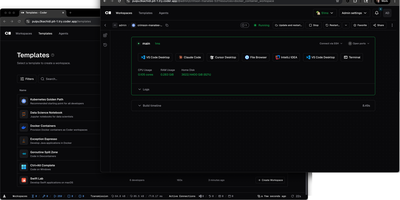
With over 14,000 GitHub stars and enterprise adoption by security-conscious organizations, Coder transforms how development teams provision, manage, and secure their coding environments. Every workspace is defined as a Terraform template, meaning infrastructure engineers can standardize development environments across EC2 instances, Kubernetes pods, Docker containers, or any combination, while developers get self-service provisioning that launches in seconds rather than days of manual setup. The WireGuard-based networking layer establishes encrypted tunnels between developer machines and remote workspaces, providing low-latency access without exposing ports or configuring VPN concentrators. Automatic idle detection shuts down unused workspaces after configurable periods, directly reducing cloud compute costs for organizations running hundreds of developer environments. The Coder Agents feature introduces native AI coding capabilities where the agent loop executes entirely within the control plane on self-hosted infrastructure, keeping LLM API credentials out of individual workspaces and eliminating credential exfiltration risks. Centralized model governance allows platform teams to approve specific AI providers and models, set per-user spend limits, and maintain complete audit logs of all prompts, tool calls, and agent activity. IDE integration supports VS Code through a dedicated extension, JetBrains IDEs via Gateway and Toolbox plugins, and browser-based code-server for web access. The template registry provides pre-built configurations for common development stacks. DevContainer support builds environments from standard devcontainer.json specifications. Deploy on a dedicated VPS on RepoCloud with guaranteed CPU, RAM, and SSD, full root SSH access, and a browser serial console. AGPL-3.0 licensed.
Wagtail
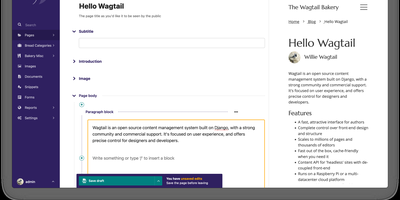
Backed by over 20,000 GitHub stars, 800 contributors, and organizations like Google, NASA, and the NHS, Wagtail is the Django-powered content management system that gives editors creative freedom through StreamField while keeping developers in full control of data structure and front-end rendering. StreamField lets editors compose pages from a custom library of content blocks — rich text, images, embedded videos, tables, code snippets, and developer-defined custom types — without compromising the underlying data model or breaking responsive layouts. The built-in JSON API supports headless deployments with versioned endpoints for pages, images, and documents, enabling decoupled front-ends in Next.js, Nuxt.js, or any framework that consumes REST. Editorial workflows provide configurable approval chains where content moves through draft, review, and publish states with commenting, task assignment, and email notifications built into the admin interface. Integrated search connects to Elasticsearch for full-text indexing with faceted filtering, or falls back to PostgreSQL and SQLite backends with fuzzy matching support added in v7.4. Multi-site management serves multiple domains from a single Wagtail installation with independent page trees, while the internationalization framework handles content translation with locale-aware URL routing. Image management includes focal point detection, responsive renditions, and automatic format conversion. The platform supports Django 5.2 and 6.0 with Python 3.10 through 3.14 and PostgreSQL, MySQL, MariaDB, or SQLite databases. Running on a dedicated VPS on RepoCloud with guaranteed CPU, RAM, and SSD, full root SSH access, and a browser serial console. BSD-3-Clause licensed.
Stormkit
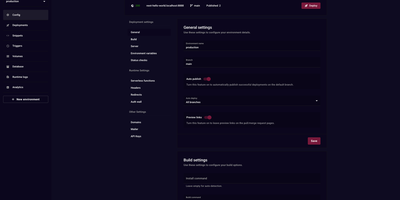
Stormkit delivers a self-hostable PaaS that eliminates vendor lock-in while providing Vercel-class deployment workflows. The Go backend handles build orchestration, hosting, and background job processing while the React frontend provides a complete management dashboard for applications, environments, and team collaboration. Git integration with GitHub, GitLab, and Bitbucket enables push-to-deploy workflows where every commit triggers automated builds with preview links posted directly to pull requests. Serverless functions use filesystem-based routing — each TypeScript or Node.js file in the API directory becomes an endpoint automatically, deploying to AWS Lambda with configurable timeouts. PostgreSQL database schemas ship with automatic migrations, isolated credentials per environment, and secure environment variable injection preventing credential leakage between staging and production. Custom domains provision TLS certificates automatically through Let's Encrypt with support for custom certificates and headers. The environment system creates isolated deployment contexts for production, staging, and development with independent variables, domain bindings, and auto-publish rules per branch. Privacy-respecting server-side analytics track visitors, referrers, and top paths without client cookies or third-party scripts. Role-based access control manages team permissions across applications. Docker Compose deployment provisions the full stack including the API server, hosting service, build runner, and worker server. Running on a dedicated VPS on RepoCloud with guaranteed CPU, RAM, and SSD, full root SSH access, and a browser serial console. AGPL-3.0 licensed.
code-server
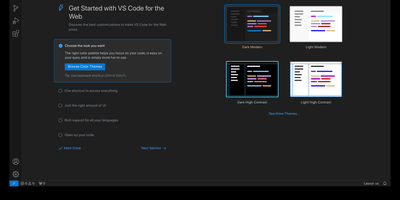
With over 78,000 GitHub stars, 270 contributors, and seven years of continuous development tracking upstream VS Code releases within days, code-server has become the definitive way to run a full Visual Studio Code IDE on any remote machine and access it from any browser on any device. The project applies a curated set of patches to Microsoft's VS Code codebase that add password authentication, sub-path hosting behind reverse proxies, self-contained web views that never call out to Microsoft servers, a built-in proxy for accessing ports on the remote machine directly through the VS Code ports panel, and on-disk settings persistence instead of browser storage. The extension ecosystem works with the Open VSX marketplace by default, giving access to thousands of extensions for Python, JavaScript, Go, Rust, Java, and every other language, along with themes, linters, formatters, and debuggers. The integrated terminal provides direct shell access to the server, Git integration handles version control without leaving the editor, and the debugger supports breakpoints, variable inspection, and step-through execution for Node.js, Python, Go, and other runtimes. DevContainer support enables reproducible development environments defined in JSON configuration files. Installation options include a one-line install script, manual package installation, Docker via the official codercom/code-server image, and DevContainer features. Minimum requirements are a Linux machine with 1GB RAM, 2 vCPUs, and WebSocket support. Running on a dedicated VPS on RepoCloud with guaranteed CPU, RAM, and SSD, full root SSH access, and a browser serial console. MIT licensed.
LiveCodes
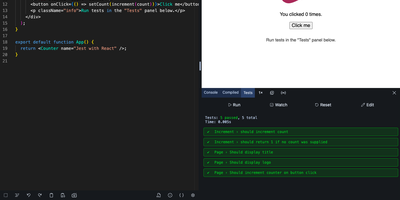
Try an idea in React, Svelte, Python, or SQL without installing anything: LiveCodes is a browser-based playground where code compiles, runs, and previews the moment you type it. Starter templates open ready-made projects for most of the 90+ supported technologies. The desktop editor brings completion, multi-cursor editing, Emmet, and Vim or Emacs bindings, while a lighter touch-friendly editor takes over on phones and tablets. Packages from npm, deno.land/x, jsr, and GitHub import straight into your code, and a console, compiled-code viewer, and test runner show what happens behind the preview. Bring projects in from GitHub gists, GitLab snippets, JS Bin, or zip files, then share them as links or QR codes, export them as HTML, JSON, or zip archives, or send them to CodePen and JSFiddle. Deploy a project to a public URL on GitHub Pages, sync your work across devices, or broadcast your editor and result live to a classroom. An embed builder and SDKs for JavaScript, React, Vue, Svelte, Solid, Preact, and web components place playgrounds inside documentation pages, and prefilled code makes every example editable. Projects stay private by default. Local assets, snippets, themes, and dark or light modes tailor the workspace to each person. Running on a dedicated VPS on RepoCloud with guaranteed CPU, RAM, and SSD, full root SSH access, and a browser serial console. MIT licensed.
HabitSync
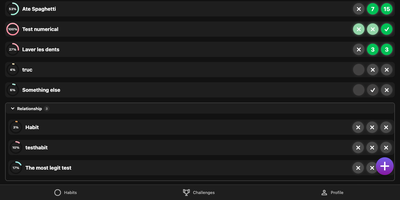
HabitSync treats habit tracking as a team sport, because willpower alone rarely survives February. Set each habit up the way life actually works: daily, weekly, monthly, on chosen weekdays, or at a custom interval, with a target value to reach or a ceiling to stay under for the habits you are trying to quit. Logging takes one tap, or a long press when today's effort deserves a custom number or a stopwatch. Share a habit with a partner, a sibling, or the whole household and everyone's progress sits side by side, which turns "did you go to the gym" into a question the dashboard answers. Monthly challenges raise the stakes with community voting, leaderboards, and medals for the top performers, while gentle automation watches your back: scheduled reminders when a habit goes unlogged, an alert when your completion slips under a threshold, and a quiet nudge when a friend overtakes you. Years of Loop Habit Tracker history import instead of being abandoned, and the installable web app keeps the streak one tap away on any device. Running on a dedicated VPS on RepoCloud with guaranteed CPU, RAM, and SSD, full root SSH access, and a browser serial console. BSD-3-Clause licensed.
Tinykit
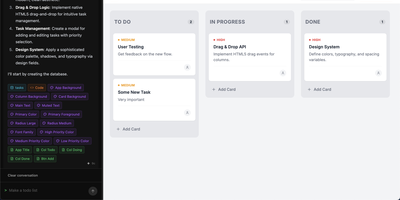
Describe the small app you keep wishing existed, and Tinykit builds it, gives it a database, and puts it live on your server. Tell it the tool you need and the agent writes the code, creates the data collections behind it, and wires the two together, then steps aside. The result is not a screenshot of an app; it is the app, served from your own server with its data syncing in real time and its files stored beside it. Open the built-in code editor to adjust the single file behind each app, or avoid code entirely: content fields let you edit text like a miniature CMS, and the design system panel restyles colors, fonts, and shadows visually. Every change takes a snapshot, so bold prompts carry an undo button and nothing is one bad idea away from lost. Hosts running errands for a household, an internal team, or a portfolio of side projects can keep adding apps, each reachable on its own domain, with token costs for every prompt shown in real money so the building budget is never a mystery. Running on a dedicated VPS on RepoCloud with guaranteed CPU, RAM, and SSD, full root SSH access, and a browser serial console. MIT licensed.
LLemonStack
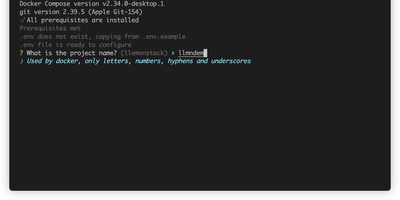
One CLI command deploys a complete AI development environment: n8n, Flowise, Supabase, Ollama, Qdrant, LiteLLM, Langfuse, Open WebUI, LightRAG, Browser-Use, Firecrawl, Crawl4AI, and more, all pre-wired with networking, credentials, and database connections. LLemonStack eliminates the hours of Docker Compose configuration that typically precede any local AI agent project. The llmn CLI initializes isolated project environments with auto-generated secure credentials, starts services in dependency order (databases first, then middleware, then apps), and displays a dashboard showing every service URL and access token. n8n brings 400+ workflow integrations, Flowise provides visual agent building, Ollama runs local LLMs like Llama and Mistral, Qdrant stores vectors at high performance, Open WebUI offers ChatGPT-style model interaction, and LiteLLM proxies requests to any provider with cost tracking. Langfuse automatically logs traces for every LiteLLM query, providing full observability. Each project maintains isolated Postgres schemas preventing data collision across parallel stacks. Firecrawl and Crawl4AI extract web content into LLM-ready formats for RAG pipelines feeding LightRAG or Qdrant. Dozzle streams live container logs for debugging. Import/export tooling migrates workflows between projects with automatic credential reconfiguration. Running on a dedicated VPS on RepoCloud with guaranteed CPU, RAM, and SSD, full root SSH access, and a browser serial console. AGPL-3.0 licensed.

Ubuntu VPS
A minimal Ubuntu 24.04 LTS virtual private server — no pre-installed applications, no opinionated configuration, just the operating system and root access. Start from a clean slate and install exactly what you need: web servers, databases, development toolchains, CI runners, monitoring stacks, VPN endpoints, game servers, or anything else that runs on Linux. The server ships with apt package management, systemd service supervision, and standard networking configured out of the box, giving you access to over 36,000 packages in the Universe repository alone. Connect via SSH with the key you select during deployment; a dedicated IPv4 address is included with every server at no extra charge. A browser-based serial console in the RepoCloud dashboard provides emergency access without an SSH client. Snapshots let you capture the server state before risky changes and roll back with one click. Resize CPU and RAM on demand without reinstalling. Canonical's standard security maintenance covers this LTS release through May 2029 — five years of patches for the Main repository. Ubuntu Pro extends that to ten years with additional Universe coverage, kernel livepatching, and compliance tooling, available free for up to five machines.