Listmonk
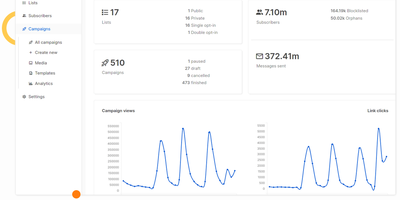
Seven million emails from a single binary peaking at 57 MB of RAM: listmonk is a high-performance newsletter and mailing list manager in Go with PostgreSQL as its only dependency - no Redis, no worker processes, no message broker. The project's own production benchmark sent 7+ million emails with the binary peaking around 57 MB of RAM, and throughput exceeds 100K emails per hour on modest hardware. Campaigns run through a multi-threaded, multi-SMTP queue with round-robin delivery, per-server concurrency, retries, and sliding-window rate limiting across providers like Amazon SES, SendGrid, Mailgun, or your own Postfix relay. Subscribers carry custom JSON attributes and are segmented with raw SQL queries, so any audience Postgres can express, listmonk can target. Templates use Go template syntax with 100+ functions for dynamic per-subscriber content, and the Vue dashboard reports opens, clicks, bounces, and unsubscribes with automated bounce processing. A REST API handles transactional email and programmatic control, a built-in media library hosts campaign assets, and CSV or API import migrates lists from hosted platforms. The economics are the headline: where Mailchimp pricing scales with list size, listmonk plus Amazon SES sends the same volume for hosting cost plus roughly $0.10 per thousand emails - commonly a 95% reduction - and your email list, a core business asset, stays on your own infrastructure. AGPLv3-licensed; bring your own SMTP provider for delivery.
Odysseus
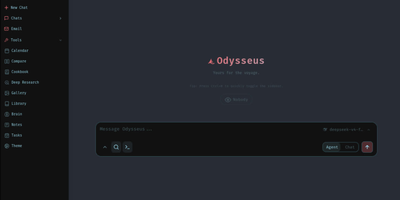
Agents with tool use, deep research, a document editor, an IMAP/SMTP email client with AI triage, notes, tasks, and a CalDAV-synced calendar - Odysseus bundles all of it into one open-source, self-hosted AI workspace. It runs local models through Ollama, vLLM, or llama.cpp and cloud APIs like OpenAI and OpenRouter, with a hardware-aware Cookbook that scans your machine and recommends quantized models that fit. Persistent memory uses ChromaDB with hybrid vector-plus-keyword retrieval, web search runs through a bundled SearXNG instance, and agents can use MCP servers, files, and shell access with safety controls, plus custom skills and scheduled agent tasks. A blind Compare mode runs side-by-side model duels with identities hidden and accumulates Elo-style ratings from your votes, so model selection is based on your actual workloads rather than leaderboard claims. Deep research mode - adapted from the Tongyi DeepResearch approach - reads sources through SearXNG and produces cited reports, while the email client tags, summarizes, sets reminders, and drafts replies locally rather than through a third-party mail AI. The writing-first document editor adds AI edits, Markdown and HTML support, and version history. The stack is Python 3.11 with FastAPI, SQLite for state, and a vanilla JS frontend, licensed AGPL-3.0 with zero telemetry. Because agents can read email and execute commands, keep authentication enabled and never expose it as a public unauthenticated service.
Notifuse
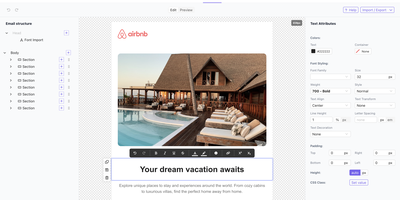
Marketing campaigns and transactional mail from one open-source platform: Notifuse is a modern, self-hosted alternative to Mailchimp, Brevo, and Klaviyo without per-email or per-contact pricing. Built with Go and React on PostgreSQL, it separates concerns cleanly: a drag-and-drop visual builder composes responsive templates from MJML components with Liquid variables like {{ contact.first_name }} and per-template version history; campaigns add A/B testing across subject lines, content, and send times; and a REST transactional API serves application-triggered mail. Delivery routes through your choice of provider - Amazon SES, Mailgun, Postmark, SendGrid, SparkPost, Mailjet, or plain SMTP - with multi-provider failover. Contacts carry custom fields and a full activity timeline (messages, profile changes, webhook events), and real-time segmentation builds dynamic rules over properties, activity, and subscriptions. Event-driven automations create behavioral sequences, a notification center gives recipients self-service preference management, and an S3-compatible file manager handles images with CDN delivery. Multi-tenant workspaces with isolated databases and custom domains suit agencies. Open and click tracking report engagement in real time.
Bulwark Webmail
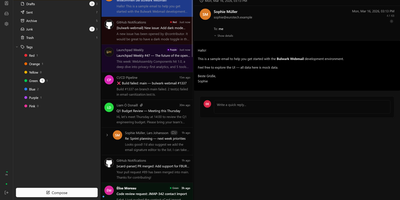
Transforming your Stalwart Mail Server into an all-in-one private communication hub, Bulwark Webmail delivers fast web-based email, collaborative calendars, shared contacts, and cloud files in a single unified interface. Users can manage multiple email accounts from an integrated inbox with conversational message threading, nested organizational tags, scheduled delivery, and instant full-text search across thousands of archived messages. The rich text composer provides markdown shortcuts, inline image embedding, reusable canned response templates, and automated draft synchronization. Team members can coordinate schedules across day, week, month, and agenda calendar views with drag-to-reschedule adjustments, interactive iMIP meeting invitations, and external CalDAV calendar subscriptions. The integrated address book organizes individual contacts into custom groups with full vCard import and export support, while the files module lets users browse server storage, preview incoming attachments, and upload documents directly through the browser. Built-in security safeguards enforce multi-factor authentication, cryptographic S/MIME signatures, client-side encryption at rest, and automated HTML luminance remapping to keep dark emails legible. Running on a dedicated VPS on RepoCloud with guaranteed CPU, RAM, and SSD, full root SSH access, and a browser serial console. AGPL v3 licensed.
Mailcow
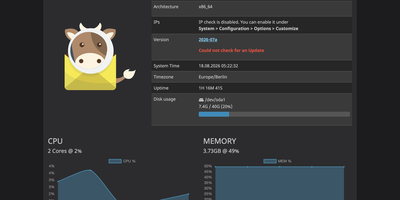
With over 13,000 GitHub stars and active monthly releases, Mailcow delivers a production-ready mail server infrastructure through Docker Compose orchestration of twelve integrated containers. The stack pairs Postfix as the MTA handling SMTP traffic with Dovecot for IMAP and POP3 retrieval featuring the Flatcurve full-text search engine, while Rspamd provides machine-learning-powered spam filtering with Bayesian classification, DKIM signing, and ARC support. ClamAV scans attachments for malware including Office document macro analysis via Olefy, and SOGo serves as a responsive webmail client with CalDAV, CardDAV, and Microsoft ActiveSync synchronization. The admin panel manages multiple domains, per-user spam score thresholds, quarantine review, black and whitelists, temporary spam aliases, mailbox quotas, and TLS enforcement policies for both inbound and outbound messages. Security features include two-factor authentication via TOTP, WebAuthn, and Yubikey OTP, a Fail2ban-like Netfilter integration for brute-force protection, and automatic SPF, DKIM, and DMARC configuration. The ACME container handles Let's Encrypt certificate generation with DNS-01 challenge support, while Postfix TLS-Pol provides MTA-STS and DANE/TLSA resolution for encrypted transport. Built-in imapsync enables periodic migration from remote mailboxes, and the REST API allows programmatic management of all server resources. MariaDB stores user data, Redis caches configuration and sessions, and Unbound provides local DNSSEC-validating DNS resolution. Running on a dedicated VPS on RepoCloud with guaranteed CPU, RAM, and SSD, full root SSH access, and a browser serial console. GPL-3.0 licensed.
BillionMail
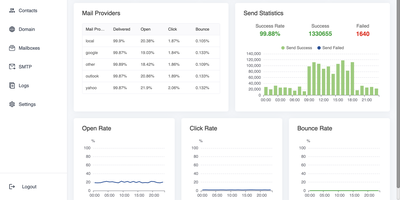
With over 15,000 GitHub stars accumulated since its February 2025 launch, BillionMail delivers the rare combination of a production mail transfer agent and a full email marketing suite in a single self-hosted package — eliminating the monthly per-subscriber fees charged by Mailchimp, SendGrid, and similar platforms. The Go-based architecture bundles Postfix for SMTP transmission, Dovecot for IMAP and POP3 mailbox access, Rspamd for intelligent spam filtering and greylisting, and RoundCube for browser-based webmail, all orchestrated through Docker Compose with PostgreSQL for persistent storage and Redis for queue management and caching. The marketing engine supports unlimited subscriber lists with tag-based segmentation, scheduled campaign sends, A/B subject line testing, and both HTML and drag-and-drop visual template editors for crafting responsive emails without coding. Real-time analytics dashboards track sent volume, deliverability rate, open rate, click-through rate, and bounce reasons, while the platform provides step-by-step DNS record configuration wizards for SPF, DKIM, and DMARC to maximize inbox placement. A transactional email API exposes REST endpoints for single and batch sending, enabling integration with CRM systems, e-commerce platforms, and custom applications. Auto-provisioned free SSL certificates, Fail2ban brute-force protection, and privacy-first architecture with zero third-party tracking ensure secure operation. The platform installs in under eight minutes via a single shell script and supports SMTP on port 25, SMTPS on 465, submission on 587, IMAP on 143/993, and POP3 on 110/995. Running on a dedicated VPS on RepoCloud with guaranteed CPU, RAM, and SSD, full root SSH access, and a browser serial console. AGPLv3 licensed.
Stalwart Mail
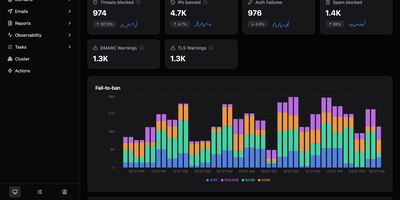
Stalwart replaces the traditional Postfix + Dovecot + SpamAssassin + calendar-server stack with one Rust binary that speaks every standard mail and collaboration protocol natively. JMAP, IMAP4rev2, POP3, SMTP, CalDAV, CardDAV, and WebDAV all run inside the same process — no glue scripts, no sidecar daemons, no version conflicts between components. The pluggable storage architecture lets operators choose RocksDB for single-node deployments, FoundationDB for distributed clusters, PostgreSQL, MySQL/MariaDB, or SQLite for the data store, S3/MinIO/Azure Blob for message blobs, and Elasticsearch or Meilisearch for full-text search, with Redis or the internal engine backing rate limiters and session state. Security features include S/MIME and OpenPGP encryption at rest, automated DKIM key generation with DNS publication, DANE and MTA-STS transport security, automatic ACME TLS provisioning, granular ACLs, rate limiting, and IP banning. The browser-based admin console manages accounts, domains, groups, mailing lists, SMTP queues, DMARC/TLS-RPT/ARF reports, and every configuration object without touching a config file, while the self-service portal at /account gives end users password reset and encryption key management. Multi-tenant support with per-tenant quotas enables hosting-platform deployments, and coordinator-less clustering via Zenoh or NATS scales horizontally by adding nodes. Deploy via Docker or the standalone binary. Running on a dedicated VPS on RepoCloud with guaranteed CPU, RAM, and SSD, full root SSH access, and a browser serial console. AGPL v3 licensed.
Mail-in-a-Box
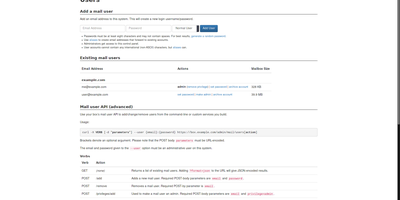
Mail-in-a-Box turns a single Ubuntu server into a fully functional email system with one setup command, installing and configuring Postfix for SMTP, Dovecot for IMAP, Roundcube for webmail, and Z-Push for Exchange ActiveSync push notifications in an automated sequence that would take days to replicate manually. The DNS server auto-configures the full suite of email authentication records: SPF, DKIM, DMARC, DNSSEC with DANE TLSA, MTA-STS, and SSHFP. Getting all of these right is what separates email that lands in inboxes from email that lands in spam, and most manual installations never achieve the complete set. Nextcloud integration adds CardDAV contact sync and CalDAV calendar sharing across devices. Let's Encrypt certificates provision and renew automatically for every hosted domain. The web control panel manages users, aliases, custom DNS records, and automated backups, protected by TOTP two-factor authentication. Daily health checks verify that services run correctly, ports remain open, TLS certificates stay valid, and DNS records resolve properly, alerting you before delivery problems develop. Multiple domains and users operate from one installation with internationalized domain name support. Built-in HTTPS static site hosting uses the TLS infrastructure already in place. Runs on a dedicated RepoCloud VPS with guaranteed resources, root SSH, and browser serial console for complete email sovereignty. CC0 public domain licensed.
Inbox Zero
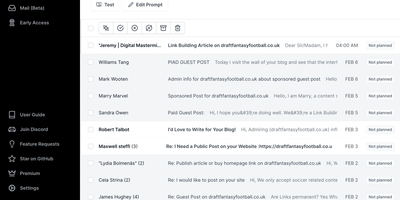
Your Gmail, Google Workspace, or Outlook inbox, worked by an AI assistant: Inbox Zero sits on top of the account you already have. Its core idea is rules written in plain English - tell the assistant "label invoices and file the PDF to Drive" or "archive cold outreach unless they mention my company" - and it executes against every incoming message. Emails that need a response arrive with a pre-drafted reply written in your tone, learned from your email history and calendar context. Reply Zero tracks what you owe responses to and what you're waiting on; the Bulk Unsubscriber surfaces newsletters you never read (with read-rate analytics) for one-click unsubscribe-and-archive; the Cold Email Blocker auto-archives unsolicited pitches based on your own definition of "cold." Smart Filing routes attachments - receipts, contracts, PDFs - into the right Google Drive or OneDrive folder, and Slack/Telegram integration lets you read, draft, and triage without opening a mail client. Email analytics show top senders and volume trends. It is not a new email client: everything happens in your real mailbox using native filters. Self-hosting means your mail content and the LLM calls that process it run on infrastructure you control.
Keila
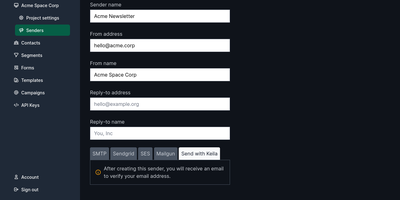
Among open-source Mailchimp alternatives, Keila has the most modern UI - built in Germany on Elixir and Phoenix (the PETAL stack), with GDPR-conscious defaults including an optional no-tracking mode, and 100% open source with no proprietary premium tier. Campaign authoring is flexible three ways: a visual block editor with multi-column layouts, Markdown with or without WYSIWYG for hybrid HTML-plus-plain- text sends, and raw MJML for hand-coded designs. The personalization system is unusually clean - every contact carries custom data as a single JSON object (populated from sign-up form fields or pushed from your CMS/CRM), and Shopify's Liquid template language renders it into fully dynamic emails. Targeting uses a visual segment editor backed by a powerful segment language for complex logic over tags, language preferences, and any custom field. Sign-up forms with custom fields grow your lists; open and click tracking measures campaigns; scheduled sending handles timing. Delivery pipes through your own SMTP or first-class integrations with AWS SES (including automated bounce handling), SendGrid, Mailgun, and Postmark. A full REST API manages contacts, campaigns, and segments, with Erlang/OTP reliability underneath. Comfortable at 100K+ subscribers. AGPL-licensed, EU-hosted project, actively developed.
Mautic
A campaign engine wrapped around a contact database: Mautic, the largest open-source marketing automation platform, replaces HubSpot or Marketo without per-contact pricing. Contacts arrive through forms, landing pages, imports, or the REST API and flow into segments: dynamic filters that update automatically from behavior, custom profile fields, or point scores. Segments decide who qualifies; campaigns decide what happens. The drag-and-drop Campaign Builder composes multi-step workflows from actions, positive/negative decision trees, and conditions (field values, tags, device type, segment membership, point thresholds), with static or relative delays, a Jump-to-Step action for moving contacts between branches, and handoffs that push contacts into CRMs or entirely different campaigns. Messaging covers email, SMS, and web/app push out of the box, with A/B testing and a drag-and-drop email builder; dynamic website content swaps page sections per known contact. Lead scoring assigns points for clicks and visits with decay for inactivity, while stages track funnel position. Native integrations cover Salesforce, HubSpot, Zoho, and Dynamics, plus a full REST API for custom sync. It runs on PHP and MySQL with cron jobs processing campaigns and segment rebuilds - self-hosting keeps your entire contact database and behavioral history under your control.
Macro
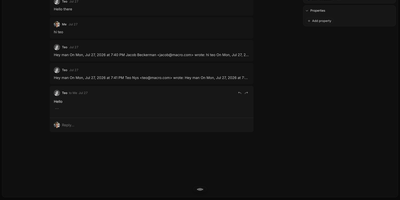
Macro merges email, team chat, collaborative documents, task management, CRM, and video calls into one keyboard-driven application where AI agents operate across the entire workspace with shared team memory, replacing the Slack plus Notion plus Linear plus Superhuman plus HubSpot stack with a single deployment. The email module provides a multi-account unified inbox with keyboard shortcuts, shared team inboxes, and Gmail integration. Team messaging offers channels and direct messages designed for technical discussions with threaded conversations. The task system draws from Linear with board and list views tightly integrated with channels, email threads, and AI agents. Real-time collaborative documents use CRDT synchronization via Loro for conflict-free editing with Markdown-native formatting and @mention linking. A 2D canvas board embeds @links to tasks, files, and emails for visual project planning. AI agents access unified team-level memory spanning all workspace modules, taking autonomous actions across email, chat, tasks, and documents through MCP-compatible tool interfaces. Video calls include recording, transcription, and automatic logging to team memory. The CRM module tracks customers and contacts with custom properties, email synchronization, and data enrichment. Eighty-plus Rust microservices on the Axum framework handle backend operations while a SolidJS static SPA delivers the frontend with instant search and real-time collaboration. Docker Compose deployment provisions the complete service stack with PostgreSQL, Redis, OpenSearch, and FusionAuth authentication. Running on a dedicated VPS on RepoCloud with guaranteed CPU, RAM, and SSD, full root SSH access, and a browser serial console. AGPL-3.0 licensed.
Plunk
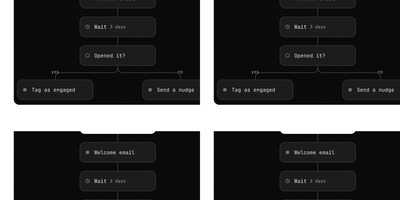
Plunk consolidates transactional emails, marketing campaigns, and drip automation into one platform riding AWS SES at roughly one-tenth of a cent per message, with zero per-contact charges regardless of list size. The Turborepo monorepo architecture separates the Express.js API server (handling REST requests with Prisma ORM against PostgreSQL) from a dedicated BullMQ worker process that consumes email, campaign, and workflow jobs independently for fault isolation and horizontal scaling. Transactional emails support HTML bodies, template variable substitution via React Email components, attachments, and custom headers with dedicated SMTP relay on ports 465 and 587 for integration with existing frameworks. The campaign system sends newsletters and product updates to full contact lists or dynamically segmented audiences based on contact properties and behavioral events, with scheduling, A/B testing, and performance tracking for opens, clicks, and bounces. The workflow automation builder creates event-triggered sequences with delays, conditional branches, and webhook steps for lifecycle campaigns like onboarding drip sequences and re-engagement flows. Contact management stores unlimited contacts with custom data fields, CSV import, full activity history, and dynamic segmentation. Custom domain verification with DKIM and SPF ensures deliverability, while inbound email processing handles incoming messages with custom routing rules. Docker Compose deployment runs five containers including PostgreSQL, Redis, MinIO for S3-compatible storage, and ntfy for notifications. Running on a dedicated VPS on RepoCloud with guaranteed CPU, RAM, and SSD, full root SSH access, and a browser serial console. AGPL-3.0 licensed.
SnappyMail
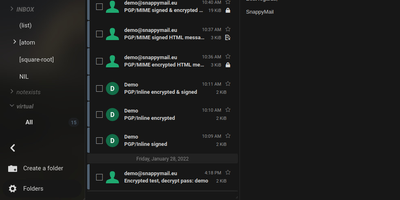
SnappyMail is a fast, privacy-respecting webmail client that connects to any existing IMAP and SMTP server, booting in under a second with a JavaScript payload of just 138 KB under Brotli compression (down from RainLoop's 8 MB fork origin). No database is required: all configuration and user data persists as flat files in a single volume, making Docker deployment trivially simple with the roughly 30 MB image consuming approximately 50 MB of RAM. Built-in PGP encryption supports three backends: OpenPGP.js v5 with ECDSA and EDDSA key generation, GnuPG integration, and Mailvelope browser extension compatibility, eliminating the need for separate encryption plugins. The integrated Sieve script editor enables users to create mail filtering rules, vacation auto-responders, and forwarding conditions directly within the web interface when connected to ManageSieve-capable servers on port 4190. Multi-domain administration allows a single instance to serve users across multiple IMAP servers with per-domain authentication routing. The admin panel manages extensions, security settings, branding customization, and domain configuration. GDPR-friendly by design, it removes all social media integrations, Gravatar lookups, and external tracking present in RainLoop. Dark mode strips background and font colors from email messages. The modified Squire HTML editor replaces CKEditor for composing rich-text messages. Scores 99% on Lighthouse performance. Running on a dedicated VPS on RepoCloud with guaranteed CPU, RAM, and SSD, full root SSH access, and a browser serial console. AGPL-3.0 licensed.
Mailu
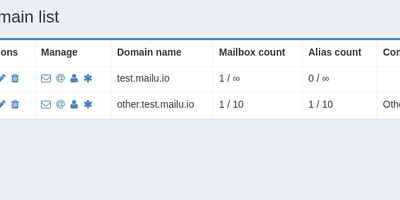
With over 7,100 GitHub stars and 200 contributors since 2016, Mailu has become one of the most popular self-hosted email solutions, delivering a complete production-ready mail server stack as pre-configured Docker containers that eliminate weeks of manual setup. The platform bundles Postfix for SMTP and Submission with auto-configuration profiles for Thunderbird, Outlook, and mobile clients, Dovecot for IMAP and POP3 with full-text search across email attachments, Rspamd for intelligent spam filtering with auto-learn Bayesian classification, greylisting, SPF and DMARC validation, and ClamAV for antivirus scanning of attachments with configurable malicious file blocking. The web administration interface provides global admin controls, per-domain delegation, user quota management, domain aliases, custom routing rules, and announcement capabilities. Users access self-service features including aliases, auto-reply, auto-forward, fetched accounts from external mailboxes via fetchmail, and Sieve filter management through ManageSieve. Security features include enforced TLS on all connections, automatic Let's Encrypt certificate provisioning, outgoing DKIM signing, DANE and MTA-STS support for transport security, and Snuffleupagus PHP hardening for the web interface. The setup wizard at setup.mailu.io generates complete Docker Compose configurations tailored to specific deployment requirements. All components are free and open-source software with zero proprietary dependencies and no tracking. Running on a dedicated VPS on RepoCloud with guaranteed CPU, RAM, and SSD, full root SSH access, and a browser serial console. MIT licensed.
AliasVault
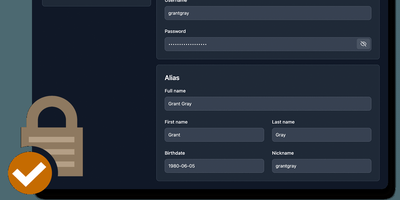
Sign up for a new service and you face a familiar choice: hand over your real email and get spam-listed forever, or generate a throwaway alias that dies when you close the tab. AliasVault eliminates that trade-off by combining a password manager with a built-in email server, so every website gets a unique identity (random email, generated name, strong password) and incoming emails land directly in your encrypted vault rather than your primary inbox. Creating a new alias takes one click: the system generates a random address on your configured domain, a fake identity with name and birthdate, and a cryptographically strong password, all stored in a zero-knowledge encrypted vault that even the server administrator cannot read. Browser extensions for Chrome, Firefox, Edge, Safari, and Brave detect login forms and autofill credentials or prompt you to create a new alias on the spot. Native iOS and Android apps with biometric unlock provide mobile access to your vault and integrate with the operating system's autofill framework. The built-in TOTP authenticator generates time-based one-time codes without needing a separate app. Import existing credentials from other password managers through standard export formats, and export your vault data at any time for full portability. Self-hosting via Docker with your own email domain gives you complete control over where alias mail is received and stored, with no third-party dependencies. Running on a dedicated VPS on RepoCloud with guaranteed CPU, RAM, and SSD, full root SSH access, and a browser serial console. AGPL-3.0 licensed.
Roundcube
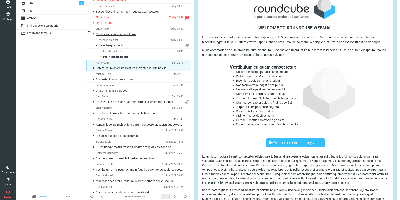
Two decades of continuous development made Roundcube the standard-bearer of open-source webmail - a PHP IMAP client that gives any mail server a polished, application-like interface in the browser. It connects to whatever IMAP/SMTP stack you run - Dovecot, Postfix, a hosted mailbox - and delivers the full desktop-client experience: drag-and-drop message management, threaded conversation views, full MIME and HTML mail handling, find-as-you-type address book with groups and LDAP connectors, multiple sender identities, full-text search, and spell checking in dozens of languages. The default Elastic skin is genuinely responsive, working as well on a phone as a desktop, and the entire UI is skinnable. The plugin API is where deployments get shaped: managesieve exposes server-side filter management in the UI, enigma brings PGP encryption and signing via GnuPG, markasjunk trains spam filters, zipdownload batches attachments, password lets users change credentials, and attachment_reminder catches the classic forgotten-attachment email - among hundreds of community plugins. Built-in caching keeps large mailboxes fast, IMAP ACLs and shared folders support team setups, and XSS protection is engineered into the rendering pipeline. It scales from a single personal mailbox to unlimited users, backed by MySQL, MariaDB, PostgreSQL, or SQLite. GPL-licensed with regular security releases.
Stalwart
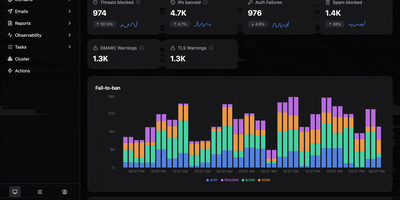
With 14,000 GitHub stars and 81 releases since March 2023, Stalwart is the most protocol-complete open-source mail server available — delivering JMAP, IMAP4rev2, IMAP4rev1, POP3, SMTP, CalDAV, CardDAV, and WebDAV from a single Rust binary that compiles to a memory-safe, zero-garbage-collection executable with predictable latency under load. The SMTP server implements DMARC, DKIMv2, DKIMv1, SPF, and ARC for complete message authentication with automatic DKIM key rotation, while transport security enforces DANE, MTA-STS, and SMTP TLS reporting to prevent downgrade attacks. Built-in spam filtering with statistical classifiers, DNS blocklists, and collaborative reputation databases eliminates the need for external Rspamd or SpamAssassin deployments. Encryption at rest protects stored messages with S/MIME or OpenPGP, and automatic TLS certificate provisioning via ACME supports TLS-ALPN-01, DNS-01, and HTTP-01 challenges without manual certificate management. The ManageSieve server enables server-side email filtering rules, while full-text search indexes message bodies and attachments for instant retrieval. Pluggable storage backends support RocksDB for embedded deployments, PostgreSQL, MySQL, and S3-compatible object storage for distributed architectures. LDAP and SQL-based authentication integrate with existing directory services, and the web administration panel manages domains, accounts, quotas, and DKIM keys. Security audited with memory safety guaranteed by Rust's ownership model. Running on a dedicated VPS on RepoCloud with guaranteed CPU, RAM, and SSD, full root SSH access, and a browser serial console. AGPL-3.0 licensed.