Canvix
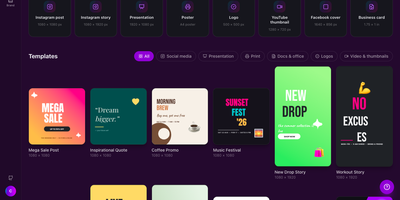
Canvix is a self-hosted design studio that lets anyone create social posts, presentations, posters, logos, and thumbnails in the browser with a drag-and-drop editor, 110 ready-made templates, and exports with no watermarks. You start from a template sized for the platform you are publishing to, then drag in shapes, lines, stickers, and your own images, moving, resizing, and rotating everything directly on the canvas. Text gets proper typography controls, with bundled fonts, styles, spacing, alignment, and curved text that arcs across the design. Layers can be reordered and locked while smart guides snap elements into alignment, and a full undo history plus autosave means a closed tab never costs you the work. Finished designs export as PNG, JPG, SVG, PDF, or video at up to three times resolution, ready to publish anywhere. Free accounts keep each person's designs private to them, while share links open a design for anyone to view or continue editing. Version snapshots let you roll a design back when an experiment goes wrong. The AI tools, magic edit, magic write, background removal, and translation, run against your own API keys, so nothing is metered. An optional MCP endpoint even lets AI assistants create and edit designs for you. Running on a dedicated VPS on RepoCloud with guaranteed CPU, RAM, and SSD, full root SSH access, and a browser serial console. MIT licensed.
LinkBreeze
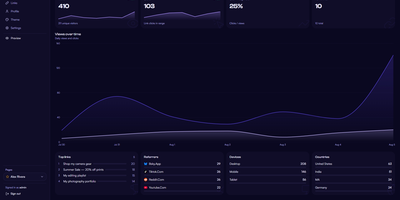
LinkBreeze is a self-hosted link-in-bio platform that lets you publish unlimited, fully themed link pages from your own server instead of renting one by the month. A guided setup wizard covers the admin credentials, profile, and theme, then a floating phone-frame preview refreshes as you edit while autosave stores your changes. Each page gets its own slug, theme, SEO tags, QR code, and analytics, so one install can serve a personal profile, a band, and a shop. Eleven built-in themes cover Aurora, Glassmorphism, Neon Cyberpunk, and Terminal Mono, backed by a token customizer for fonts, backgrounds, card styles, and raw CSS. Links pull in favicons automatically, accept thumbnails, and can be scheduled to appear and vanish on set dates, while embed widgets drop in YouTube, Spotify, SoundCloud, Vimeo, and Bandcamp players. A migration wizard imports profiles from Linktree, Bento, Hopp.bio, LittleLink, or an HTML or JSON export. Visitors can subscribe with an email address that you export to CSV, save your page as a vCard contact, or scan a QR code that downloads as SVG or PNG. Cookieless analytics track views, clicks, referrers, devices, and countries with hashed visitor IPs, and Plausible, Umami, Matomo, or Google Analytics can be added with one paste. The admin panel supports TOTP two-factor authentication, a UTM builder, JSON backup and restore, and seven interface languages. Running on a dedicated VPS on RepoCloud with guaranteed CPU, RAM, and SSD, full root SSH access, and a browser serial console. MIT licensed.

BullFlow
Generic AI writing sounds like nobody in particular; BullFlow writes from your own company knowledge instead. It first builds a private knowledge base from your documents, images, audio, and video plus structured records for your company, brand, products, customers, and cases. Ingestion runs entirely on local open models: OCR reads scans, semantic splitting and chunking prepare text, and hybrid vector plus full-text search retrieves passages with their sources and relevance scores shown under every answer. A creation agent then works in one conversation: it searches the knowledge base, drafts articles with images embedded in the text, generates image sets or short videos, and exports finished pieces as PDF or Word. Output adapts to where it is going, long-form articles for article platforms, multi-image posts with matching copy for image feeds. A separate distribution gateway sends one finished piece to many accounts across Chinese and international social platforms, checks account health on a schedule, and returns publish results and metrics by webhook. Around all of that sits a commercial shell: multiple tenants with isolated data, roles from super admin to finance, credit billing measured per token, image, and second, subscriptions, invoices, referral commissions, and a conversion funnel in the operations backend. Scheduled rules can generate and publish on a timetable with nobody watching, and notifications report each completion or failure. Running on a dedicated VPS on RepoCloud with guaranteed CPU, RAM, and SSD, full root SSH access, and a browser serial console. MIT licensed.

Lunarr
Lunarr turns the movie and TV folders you already store into a private streaming service with posters, progress tracking, and play-anywhere convenience. Point it at local disks or at libraries living on SFTP and WebDAV servers, and it scans, identifies, and decorates everything with TMDb artwork, cast pages, similar titles, and because-you-watched recommendations. Press play and the file either streams directly or is transcoded on the fly into seekable HLS, generating only the segments around the moment you are watching instead of converting whole films up front. Continue watching follows you between sessions, sidecar subtitles are picked up automatically, and known intros and credits can be skipped. Send the picture to the big screen with Chromecast or AirPlay, pair new devices without typing passwords, and hand a guest a share link instead of your account. Underneath, an admin console manages users, roles, and which libraries each person may see, watches background jobs, and holds API keys and registration settings. Rescans run on schedules you set from minutes to a month, local folders can be watched live for new arrivals, and metadata refreshes itself on a timer. Running on a dedicated VPS on RepoCloud with guaranteed CPU, RAM, and SSD, full root SSH access, and a browser serial console. Apache-2.0 licensed.
MediaMTX
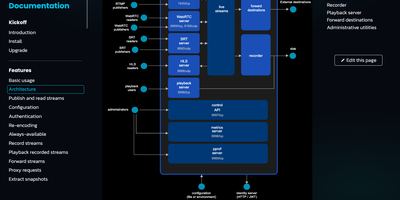
MediaMTX sits between cameras and viewers as a self-hosted live media server, taking in video and audio streams over one protocol and handing them back out over another, so one IP camera feed can end up playing in a browser, a phone app, and a recording archive simultaneously. Publish with FFmpeg, GStreamer, OBS Studio, a browser, or a Raspberry Pi camera over RTSP, RTMP, SRT, WebRTC, Media-over-QUIC, HLS, MPEG-TS, or RTP, and read it back on any other protocol without a transcoding pipeline. Run dozens of camera feeds side by side, each on its own path, and keep every path available even while its publisher is offline. Record everything to disk in fMP4 or MPEG-TS as it streams, then play recordings back later through the same server instead of shipping files around. Authenticate publishers and viewers with built-in users, an external HTTP check, or JWT, and use the control API plus Prometheus metrics to wire the server into the rest of your monitoring stack. Forward streams to other servers, proxy cameras behind NAT, and fire hook commands whenever a client connects, publishes, or disconnects, so a doorbell camera can trigger a snapshot or an alert as it starts streaming. Reload the configuration while clients stay connected, and tune everything from the same mediamtx.yml file or environment variables, with no database or runtime dependencies to babysit. Running on a dedicated VPS on RepoCloud with guaranteed CPU, RAM, and SSD, full root SSH access, and a browser serial console. MIT licensed.
Immich
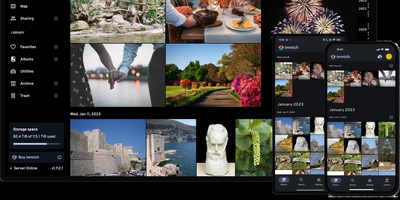
With over 110,000 GitHub stars and one of the fastest-growing open-source communities in the self-hosted space, Immich delivers a Google Photos-grade experience entirely on your own hardware. The platform handles automatic background backup from Android and iOS devices, deduplication, and support for RAW formats, LivePhotos, and MotionPhotos. Its machine learning pipeline runs facial recognition and clustering locally on your server, enabling you to group photos by person without sending a single image to the cloud. CLIP-based semantic search lets you find images by describing their content in natural language, while metadata-driven search covers EXIF data, dates, and locations. The web interface built with SvelteKit provides a responsive timeline view, albums, shared albums with configurable permissions, public sharing links with optional passwords and expiry dates, partner sharing for family libraries, and a global map plotting photos by GPS coordinates. Administrative features include multi-user support with per-user storage quotas, OAuth integration, API key management, and a user-defined storage structure for organizing files on disk. The architecture uses PostgreSQL for metadata, Redis with BullMQ for background job queues handling thumbnail generation, video transcoding, and smart search indexing, and exposes over 400 REST API endpoints documented via OpenAPI with auto-generated SDKs for web, mobile, and CLI clients. Running on a dedicated VPS on RepoCloud with guaranteed CPU, RAM, and SSD, full root SSH access, and a browser serial console. AGPL-3.0 licensed.
Komga
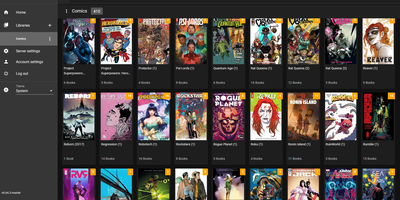
What Jellyfin is for video, Komga is for comics, manga, BDs, magazines, and eBooks: point it at folders of CBZ, CBR, CBT, PDF, and EPUB files and it becomes a proper library with cover art, embedded metadata import, and per-user reading progress. The responsive web reader handles multiple reading modes - left-to-right for western comics, right-to-left for manga, webtoon scrolling - while collections and read lists organize crossovers and story arcs, with ComicRack .cbl read list import for existing curation. Its openness is the real differentiator: OPDS v1.2 and v2.0 feeds serve virtually every reader app (Panels, Moon+ Reader, Mihon/Tachiyomi, KyBook), with OpenSearch and page-streaming extensions so mobile apps fetch pages on demand instead of whole archives. E-ink support is built in, not bolted on - Kobo devices sync directly against Komga instead of Kobo's servers, with two-way read progress, on-the-fly KEPUB conversion via Kepubify, and optional proxying so official Kobo purchases still work; KOReader sync covers everything else. Multi-user management brings per-library access control, age restrictions, and label restrictions for family setups. Housekeeping tools detect duplicate files and duplicate pages, and a REST API feeds a healthy ecosystem of community scripts. Runs from a single Docker container with embedded SQLite.
LiveKit
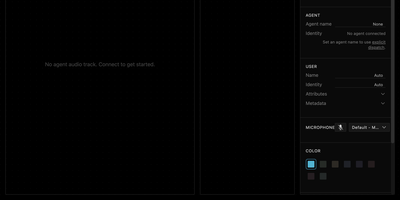
With over 20,000 GitHub stars and adoption by companies building everything from telehealth platforms to AI voice agents, LiveKit is the most widely deployed open-source real-time communication server available. The Go-based Selective Forwarding Unit handles hundreds of concurrent participants per node with adaptive bitrate streaming, simulcast layers, SVC codec support for VP9 and AV1, and end-to-end encryption. Client SDKs span JavaScript, Swift, Kotlin, Flutter, React Native, Rust, Python, Unity, and ESP32 embedded devices, while server-side APIs cover Node.js, Go, Ruby, Java, Python, Rust, PHP, and .NET. The Agents framework enables building AI-powered voice and video applications — real-time speech-to-text, LLM-driven conversations, and computer vision pipelines — running as server-side participants in any room. Egress records sessions to S3-compatible storage or streams to RTMP endpoints, while Ingress pulls external feeds from OBS via RTMP, WHIP, or SRT into LiveKit rooms. The SIP bridge connects traditional telephony to WebRTC rooms for hybrid conferencing. JWT-based authentication, webhook notifications, room-level moderation APIs, and selective subscription give operators granular control. Deploy as a single binary for development, Docker Compose for production single-node, or Kubernetes with the official Helm chart for distributed multi-region clusters using Redis for state coordination. Running on a dedicated VPS on RepoCloud with guaranteed CPU, RAM, and SSD, full root SSH access, and a browser serial console. Apache 2.0 licensed.
Stump
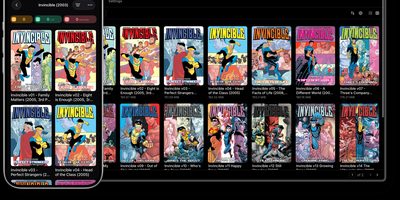
Curating digital comic archives, serialized manga, and electronic book libraries becomes effortless with Stump, a high-performance reading server that streams media collections over OPDS protocols directly to web browsers and e-reader hardware. Readers can organize extensive collections across CBZ, CBR, PDF, and EPUB formats, utilizing automated scanners that extract embedded ComicInfo XML and Calibre metadata tags. The built-in web reader renders high-resolution comic spreads, continuous vertical webtoon scrolls, and reflowable text with customizable color themes, font scaling, and reading direction toggles. Users can highlight passages, create persistent notes inside EPUB editions, and organize complex franchises into custom reading lists, oneshots, and smart filter collections. Bi-directional synchronization integrates with Kobo and KOReader hardware devices, maintaining page progression and bookmark states across handhelds and desktop sessions. Server administrators can configure multi-user access rules, enforce age restriction thresholds, and provision user-scoped API tokens for automated script pipelines and third-party companion tools. GraphQL and REST endpoints expose the entire catalog structure, allowing media collectors to integrate external metadata scrapers and trigger background library indexing tasks. Running on a dedicated VPS on RepoCloud with guaranteed CPU, RAM, and SSD, full root SSH access, and a browser serial console. MIT licensed.
Janus Gateway
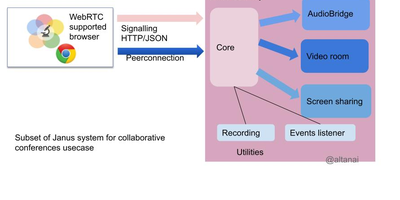
One Janus installation can host a video meeting in one session, stream a camera feed in another, and bridge a browser call into a telephone network in a third, because Janus is a general-purpose WebRTC server whose work is done by interchangeable plugins. The VideoRoom plugin publishes each participant's streams to everyone else in the room with simulcast and viewport selection, so a class or team call adapts quality per viewer instead of forcing one bitrate on all. Streaming mounts live or prerecorded sources, including RTSP cameras and RTP feeds, and hands them to any number of WebRTC viewers, while AudioBridge mixes voices into conference rooms with recording and signed-token access. SIP and NoSIP plugins register with existing VoIP infrastructure and place or receive calls, translating between WebRTC media and telephone audio so a web page can ring a desk phone. Record&Play captures publisher streams to files you can replay through the same server, TextRoom adds data-channel chat rooms, and Lua or JavaScript plugins let you script custom media logic without recompiling the core. Applications talk to Janus over HTTP or WebSocket APIs, with RabbitMQ, MQTT, and NATS transports for bus-driven deployments, and event handlers report session activity to your monitoring stack. Running on a dedicated VPS on RepoCloud with guaranteed CPU, RAM, and SSD, full root SSH access, and a browser serial console. GPL-3.0 licensed.
OpenPost
OpenPost is an open-source content creation and publishing suite that unifies multi-platform social scheduling, graphic design, and video editing into a single self-hosted control center. Creators can compose one primary announcement and tailor bespoke copy, media attachments, and thread structures across sixteen distinct networks including Bluesky, Mastodon, X, Threads, LinkedIn, YouTube, and Discord. The integrated browser canvas lets you design multi-slide carousels with custom typography, layer ordering, and automated background removal without juggling external design software. A built-in multitrack video suite allows you to trim footage, render subtitle captions, insert transitions, and slice clips directly by highlighting spoken words in generated transcripts. Social managers can organize campaigns through an interactive visual calendar, stagger deliveries across automated queues, and monitor unified comment streams to answer incoming audience inquiries directly from a single inbox. Teams can organize multiple independent client brands into partitioned workspaces with role-based permissions, automated repost policies, and programmable scheduling webhooks via native REST and Model Context Protocol endpoints. Running on a dedicated VPS on RepoCloud with guaranteed CPU, RAM, and SSD, full root SSH access, and a browser serial console. AGPL-3.0 licensed.

Thumbor
Born at Brazilian media giant Globo.com, Thumbor answers imaging CDNs like Imgix and Cloudinary with an HTTP service where every image variant is just a URL. Ask for /300x200/smart/your-image.jpg and Thumbor fetches the original, crops and resizes on demand, and caches the result - one source file, unlimited renditions, no batch pre-generation pipeline. The "smart" in the URL is the signature feature: OpenCV-based face detection finds people in the frame and crops around them (no more thumbnails with severed heads), and when no faces exist, feature detection finds visually important corners and computes a weighted center of mass as the focal point. Beyond cropping, a chainable filter pipeline handles brightness, contrast, grayscale, blur, red-eye removal, rounded corners, rotation, watermarks, and format conversion with quality control - applied in order via URL segments. All common image formats work out of the box, and every layer is pluggable: loaders (HTTP, local, S3), storages and result storages (local, S3, Ceph, and community backends), engines, optimizers, filters, and even custom detectors, with the awesome-thumbor list cataloging the ecosystem. URL signing prevents abuse of your processing capacity. Integrations exist for Django, Rails, Node, WordPress, and most frameworks. MIT-licensed, battle- tested for over a decade.
Bazarr
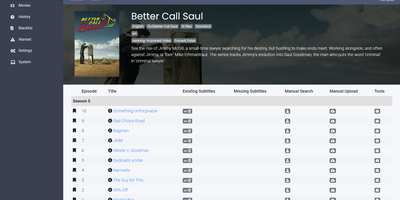
Subtitles are the one chore Sonarr and Radarr leave behind - Bazarr finishes the *arr media stack by automating them. It connects to both via their APIs and mirrors their libraries - it doesn't scan disk itself, it manages exactly what your *arr apps index. For every monitored episode and movie it checks existing internal and external subtitles against your language profiles, then hunts missing ones across dozens of providers - OpenSubtitles.com, Podnapisi, Addic7ed, Subscene, and many regional sources - covering 184 subtitle languages including forced/foreign-dialogue tracks. Matching is smarter than filename guessing: releases are compared by release group and source, some providers support exact file-hash matching, and every downloaded subtitle gets a percentage score. Set a minimum score per Sonarr/Radarr connection and Bazarr rejects weak matches; enable upgrades and it replaces previously downloaded subtitles when better ones surface. Out-of-sync files get fixed too - automatic subtitle synchronization realigns timing after download, triggered only below a configurable score threshold so good subs aren't touched. Per-show and per-movie language configuration, download history, manual on-demand search, and adaptive searching that throttles provider API calls round it out, all behind a clean Sonarr-style web UI written in Python. If your library serves multilingual viewers, this removes the last manual step.
Cinephage
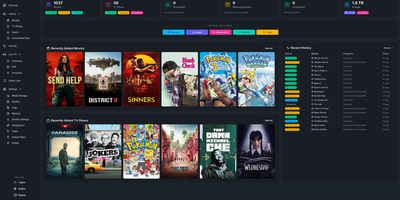
Cinephage puts your movies, series, live TV, subtitles, indexers, and download clients into one self-hosted media command center instead of a stack of separate automation services. Browse and organize libraries from a responsive interface that works on desktop and mobile, with file scanning and metadata matching keeping titles identified correctly. Search across configured indexers, compare releases with quality profiles and custom scoring rules, and send chosen downloads to your client without repeating setup for each media type. Let monitoring tasks watch for missing episodes, upgraded releases, and newly aired content, while the blocklist stops failed releases from coming back. Pull subtitles from multiple providers with language profiles, create dynamic smart lists from list sources or custom queries, and add matching titles automatically. Generate streaming links as .strm files for players such as Jellyfin, Emby, and Kodi, try live TV channels with guide data where configured, and receive library update notifications in your media server. Running on a dedicated VPS on RepoCloud with guaranteed CPU, RAM, and SSD, full root SSH access, and a browser serial console. GPL-3.0 licensed.
Mstream
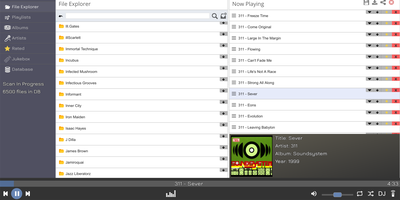
"The easiest music streaming server available" is mStream's own billing, and the claim holds up: a lightweight Node.js app that turns a folder of audio files into a private streaming service in minutes, no external database required. Its filesystem-based design is the clever part - the API mirrors your folder structure, so you can browse and play music immediately, before any library scan finishes, and your organization on disk is your organization in the app. It streams flac, mp3, wav, ogg, opus, aac, and m4a, which matters to the audiophile crowd: FLAC plays uncompressed, bit-perfect, with gapless playback for live albums and continuous mixes. The web player runs anywhere a browser does and packs personality - a Milkdrop-style visualizer (Butterchurn), playlist sharing via links, and drag-and-drop uploads straight through the file explorer. Native iOS and Android apps add the feature streaming subscriptions can't match: sync your collection to your phone for true offline playback of music you own. Multi-user support assigns separate directories and permissions per account. Resource usage is famously light - mStream is tested on multi-terabyte libraries and runs happily on a Raspberry Pi, so a small RepoCloud instance serves a lifetime's collection. GPL-licensed, with zero listening-habit telemetry.
AudioMuse-AI
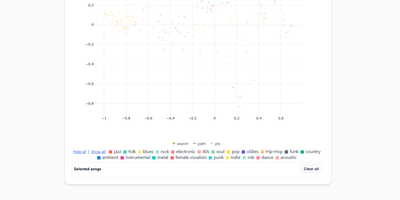
AudioMuse-AI transforms your self-hosted music collection into an intelligent sonic discovery universe that generates groove-aware playlists without relying on tag metadata or external streaming APIs. The platform scans audio files directly to extract acoustic properties, rhythmic cadence, harmonic density, and lyrical themes across seventy-two supported languages. Listeners can explore their library through a dynamic two-dimensional interactive music map, discover hidden sonic connections between distant genres, or chart smooth transitional song paths between two completely different tracks. Custom prompt-based querying lets users request niche vibes like late-night lo-fi piano, while automated clustering groups acoustically similar tracks into fresh, genre-defying collections. With Song Alchemy, curators fine-tune playlist moods by interactively adding or subtracting acoustic traits before exporting clean tracklists back to Navidrome, Jellyfin, LMS, Lyrion, Emby, or Plex. A built-in acoustic fingerprinting engine even identifies mystery tracks from twenty-second audio snippets, deduplicating songs across multi-server topologies so every file is processed only once. Running on a dedicated VPS on RepoCloud with guaranteed CPU, RAM, and SSD, full root SSH access, and a browser serial console. AGPL-3.0 licensed.

Photofield
Instead of paging through albums, Photofield lays a whole photo library out on one zoomable canvas, where thousands of thumbnails sharpen into full-resolution pictures as you zoom. Collections come straight from directories named in a configuration file. One setting turns every subfolder into its own collection. Pick a layout per collection: album grouped by date, timeline with month markers, wall, map, highlights with dates and place names, or flex. Sort oldest first, newest first, or shuffled hourly, daily, weekly, or monthly. Tiles load progressively, and an info drawer shows the date, file name, and dimensions. A right-click menu opens or copies an image, copies its link, or finds similar images. Originals are never modified, so a read-only mount is safe. Indexing runs at up to 10,000 files per second on a fast SSD with a warm cache. JPEG, PNG, AVIF, HEIC, DNG, GIF, MP4, and MOV files are recognized. Place names resolve from an embedded database, with no external lookups. The optional photofield-ai companion adds search by words like beach sunset or cat eyes, plus a Faces layout of detected faces. Alpha tagging lets you label photos. Running on a dedicated VPS on RepoCloud with guaranteed CPU, RAM, and SSD, full root SSH access, and a browser serial console. MIT licensed.
Chaptarr
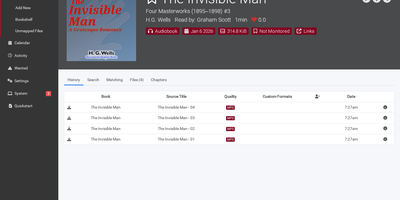
One library for the books you read and the books you listen to: Chaptarr manages audiobooks and eBooks side by side, so the same title can live on your server as a chaptered M4B and an EPUB without two separate apps fighting over it. It knows the difference between editions and narrators, which means a dramatized production, an unabridged reading, and the print text can coexist as first-class versions of one work. Multi-part releases and multi-file recordings are handled as single books, and MP3 audiobooks can be converted into one chaptered M4B with chapters preserved or inserted where they are missing. Separate root folders keep audiobooks and eBooks apart, or place eBooks alongside their audio twins; either way, matching uses file tags, folder names, and release metadata to attach files to the right book automatically. Series are organized for you, metadata profiles control which languages belong in your library, and flexible renaming tokens produce filenames that read the same way a human would shelve them. Custom quality profiles per library drive automatic upgrades when a better release appears, and the standard download clients and indexer integrations from the *arr family plug straight in. Running on a dedicated VPS on RepoCloud with guaranteed CPU, RAM, and SSD, full root SSH access, and a browser serial console. GPL-3.0 licensed.