Stoat
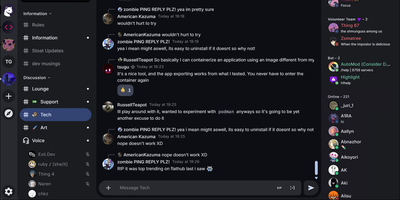
Stoat delivers a complete Discord-like community chat experience that organizations can self-host on their own infrastructure with full data ownership. The platform provides text channels organized in categories, real-time voice calls powered by LiveKit, file sharing with automatic media proxying, custom emoji support, bot framework, GIF search, server invites, and granular role-based permissions — all wrapped in a polished web UI that feels immediately familiar to Discord users. The architecture separates concerns across dedicated Rust binaries handling the REST API, WebSocket real-time events, file storage with S3-compatible backends, push notifications, and media proxying, backed by MongoDB for persistence and Redis for caching. Web, desktop, and mobile clients connect through the same API, ensuring consistent experience across platforms. Unlike federated alternatives such as Matrix, Stoat provides a single-server deployment model focused on the Discord-style community experience: server invites, channel categories, member management, and an invite-first onboarding flow that communities expect. The Docker Compose deployment stack handles all microservices with Caddy providing automatic TLS via Let's Encrypt. Running on a dedicated VPS on RepoCloud with guaranteed CPU, RAM, and SSD, full root SSH access, and a browser serial console. AGPL-3.0 licensed.
EMQX
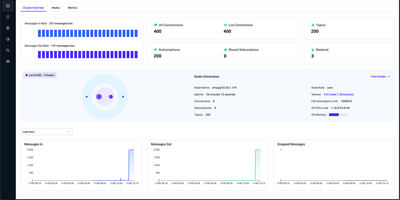
With over 16,500 GitHub stars and a track record powering connected vehicle fleets, smart city sensor networks, and industrial IoT deployments, EMQX is the MQTT messaging platform engineered to handle 100 million concurrent device connections in a single cluster while processing millions of messages per second with sub-millisecond latency. The protocol stack supports MQTT 5.0, 3.1.1, and 3.1 with full QoS 0/1/2 support, shared subscriptions, retained messages, and will messages, plus MQTT over QUIC for faster connection setup, reduced head-of-line blocking, and seamless connection migration on mobile networks. The gateway framework extends connectivity to MQTT-SN, CoAP, LwM2M, STOMP, and ExProto for bridging legacy industrial protocols. The SQL-based rule engine processes and transforms messages in real time with over 50 pre-built integrations including Kafka, PostgreSQL, MySQL, MongoDB, InfluxDB, TimescaleDB, ClickHouse, Redis, AWS Kinesis, GCP Pub/Sub, and Azure Event Hubs. The visual Flow Designer creates data processing pipelines without code. Built on Erlang/OTP with a masterless distributed architecture using Mria for state replication, the cluster separates Core nodes for data consistency and Replicant nodes for client-handling workloads. Authentication supports username/password, JWT, PSK, X.509 certificates, and LDAP with configurable ACL rules. The built-in dashboard provides real-time monitoring of connections, subscriptions, topics, message rates, and cluster health. Deployment runs via Docker, Kubernetes with the EMQX Operator, or native packages. Running on a dedicated VPS on RepoCloud with guaranteed CPU, RAM, and SSD, full root SSH access, and a browser serial console. BSL 1.1 licensed.
Octo Server
Most team chat keeps people in one app and AI agents in another; Octo Server is the backend that puts both in the same conversation. It powers the OCTO workplace, where Lobsters, the platform's OpenClaw-powered AI agents, sit in channels as first-class participants that read context, run tool calls, and report back alongside their human teammates. Every request flows through one pipeline: token and cookie authentication, organisation-aware role checks and per-channel permissions, business logic that can start or resume an agent session, then fan-out through WuKongIM for real-time delivery. Channels support threaded subspaces, shared files, and a GROUP.md document that stores the group's standing context where the whole team can edit it. The smart summary service reads busy channels and produces structured digests, so catching up means reading one brief instead of hundreds of messages. External bridges connect conversations to GitHub, WeCom, Feishu, and Loop through adapters, and webhooks push group events to your own systems. The official one-command deployment runs the server with the web client, admin console, task service, WuKongIM, MySQL, Redis, and MinIO behind nginx, scaling as one backend that every client speaks to. Running on a dedicated VPS on RepoCloud with guaranteed CPU, RAM, and SSD, full root SSH access, and a browser serial console. Apache-2.0 licensed.
Haven
Haven gives your community a private chat server with voice calls, screen sharing, and end-to-end encrypted direct messages where friends join via invite link in their browser without installing apps or creating third-party accounts. Real-time messaging supports image uploads via paste and drag-drop, emoji reactions, replies, threads, typing indicators, @mentions with autocomplete, and inline GIF search through Tenor or GIPHY. Peer-to-peer WebRTC voice chat includes per-user volume sliders, mute and deafen controls, talking indicators, and screen sharing with picture-in-picture mode. Direct messages use ECDH P-256 key exchange with AES-256-GCM symmetric encryption where private keys never leave the browser, ensuring not even the server operator can read them. Twenty-plus visual themes with stackable effects including CRT scanlines, Matrix Rain, Cyberpunk Text Scramble, Snowfall, and Campfire Embers let users personalize the experience with configurable intensity sliders. Rich Presence integration shows what members are playing or listening to via Last.fm, Steam, and Spotify. A built-in bot API supports webhooks and custom slash commands, while Discord history import preserves channels, threads, forums, reactions, pins, and avatars. The Node.js server deploys via Docker Compose or a single batch file that auto-handles dependencies, SSL certificates, and configuration. Running on a dedicated VPS on RepoCloud with guaranteed CPU, RAM, and SSD, full root SSH access, and a browser serial console. AGPL-3.0 licensed.
Revolt
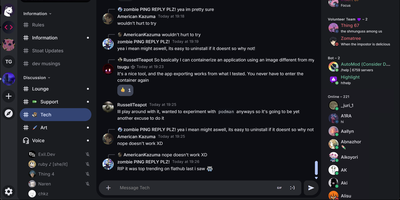
Revolt gives communities the full Discord experience without ads, behavioral tracking, or subscription fees: servers with text and voice channels, direct messages, group conversations, roles, bots, and custom emoji at zero cost per user. The Rust microservices backend splits responsibilities across Delta for REST API and authentication, Bonfire for persistent WebSocket real-time event delivery, Autumn for file upload routing to MinIO S3-compatible object storage, and January for link preview proxy and embed generation. Voice chat operates through LiveKit with WebRTC audio streaming supporting multiple concurrent participants per channel. Server administrators configure hierarchical role-based permissions at the server, channel, and per-role level, controlling who can send messages, manage channels, kick members, and access moderation tools. Text channels support Markdown formatting, custom emoji, file attachments up to 20 MB, GIF search via Tenor integration, and message reactions. The bot API enables automated moderation, entertainment, and custom workflow integration with community-maintained libraries available in JavaScript, Python, and Rust. The TypeScript and Solid.js web frontend provides a responsive interface with theme customization. Docker Compose deployment spins up the complete stack including MongoDB for message and user storage, Redis for caching, and MinIO for attachments, providing complete data sovereignty over all conversations and files. Running on a dedicated VPS on RepoCloud with guaranteed CPU, RAM, and SSD, full root SSH access, and a browser serial console. AGPL-3.0 licensed.
LastSignal
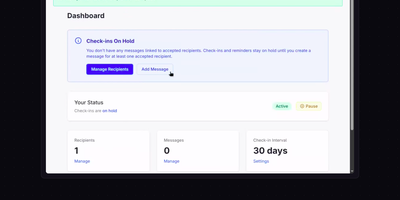
Write the messages today that the people you love would need if you suddenly could not send them, and LastSignal holds them encrypted until silence says it is time. The system emails you a check-in on a schedule you set; answer it and nothing happens, which is exactly the point. Miss one and reminders follow at fixed intervals, and the final reminder can ping a trusted contact who is able to pause the countdown, buying time when a hospital stay or a lost phone is the real story. If nobody responds, your messages are delivered by email to each recipient, who decrypts them with their own passphrase; the server never holds plaintext, so even the person running it cannot read what you wrote. You can stagger access with a per-recipient delay, so one person reads their message the day it arrives while another waits the number of days you chose. Automations can report in through a keep-alive token endpoint instead of email, for machines that prove you are around by staying alive themselves. Timings for check-ins, reminders, and the trusted-contact pause are all configurable per account. Running on a dedicated VPS on RepoCloud with guaranteed CPU, RAM, and SSD, full root SSH access, and a browser serial console. MIT licensed.
Campfire Rust
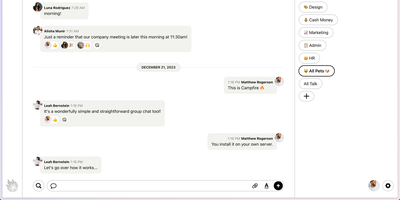
Your team chat can be one executable on your own server: Campfire Rust runs rooms, direct messages, attachments, and search as a single binary that replaces the whole Ruby, Puma, Redis, Resque, and Thruster stack. Create rooms with access controls for projects, departments, or a private board discussion, and keep direct messages beside them for quick questions. File attachments arrive with previews, mentions pull the right person into a thread, and search finds the decision someone made months ago. Web Push notifications reach browsers and phones, so a quiet room still finds its people when it matters. Chatbots connect through a simple HTTP API for sending and receiving messages and attachments, which makes Campfire a home for build alerts, deploy notices, and support pings. Existing Campfire installs upgrade in place because the Rust binary reads the same SQLite database, storage layout, and signed cookies, with no data migration and no mass sign-out. Automatic TLS with Let's Encrypt certificates, HTTP/2, and Action Cable-compatible WebSockets are built in, and the whole system works on air-gapped networks that never touch the internet. Run it as your primary chat, as a backup for the day a hosted service goes down, or as a walled garden for executives and events. Running on a dedicated VPS on RepoCloud with guaranteed CPU, RAM, and SSD, full root SSH access, and a browser serial console. MIT licensed.
Eclipse Hono
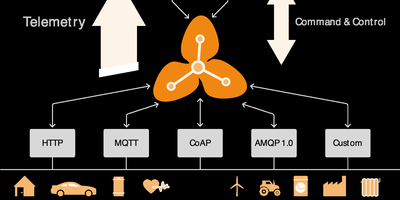
Eclipse Hono is an IoT connectivity platform that sits between device fleets and business applications, accepting connections over MQTT, HTTP, AMQP 1.0, and CoAP adapters and normalizing everything into uniform telemetry and event streams. Devices authenticate against a central registry of tenants and credentials, with X.509 client certificates, pre-shared keys, or automatic provisioning for zero-touch onboarding. Applications consume normalized data from Apache Kafka or an AMQP 1.0 messaging network, choosing per tenant which backbone carries its traffic, and send commands back down to devices through the same platform with delivery feedback. Resource limits cap how much data each tenant's devices may move, keeping one noisy fleet from crowding out the rest, while metrics and tracing follow every message hop. The 2.7 release adds preliminary MQTT 5 support with corrected connect reason codes, message tracing logs, and a hardened JDBC device registry backed by PostgreSQL for production tenant and credential management. Protocol adapters scale horizontally as stateless services, so capacity grows by adding instances behind a load balancer. Running on a dedicated VPS on RepoCloud with guaranteed CPU, RAM, and SSD, full root SSH access, and a browser serial console. EPL-2.0 licensed.