django CMS
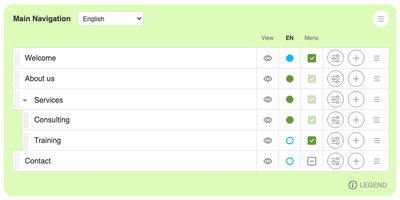
Click the pencil on a live page, change a headline or drop in an image, and publish: that is django CMS, an open-source content management system built around editing in place. A structure board lists every plugin on a page as a draggable tree, so layouts get rearranged without touching code. Plugins cover rich text with tables and links, pictures from a media library with sizing, margin, and visibility settings, and nested containers, and rules limit where each plugin may appear. With versioning enabled, every edit is a draft that can be previewed, compared visually or in source against an earlier version, discarded, or published, and publishing can be reserved for editors. Each page carries a translation per language with its own title and slug, and a language menu adds translations or copies plugins from another language. The page tree manages navigation as a hierarchy with drag-and-drop ordering, per-language status dots, and a menu toggle per page. Page permissions can let a legal team edit one branch of the tree and nothing else, and one settings file can serve several domains by hostname. Apphooks mount whole applications, such as a news section, on a page that editors place in the tree, and reusable aliases keep footers and banners in one place. Running on a dedicated VPS on RepoCloud with guaranteed CPU, RAM, and SSD, full root SSH access, and a browser serial console. BSD-3-Clause licensed.
TYPO3
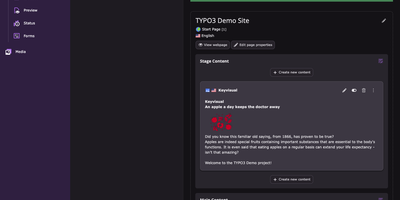
TYPO3 lets an organization run any number of multilingual websites from one installation, with editors working in a page tree and administrators deciding who may touch what. Editing happens in a context panel that slides in beside the page layout, and a guided wizard creates new pages step by step. Translations can be copied or connected to their source with change tracking, and sites can mix languages, including right-to-left scripts. Workspaces keep edits away from the live site until they are previewed and approved, while access lists, page permissions, and mounts control which parts of the tree each backend user may change. Marketing teams get a QR code module and a short URL module with hit counters and expiry dates, and redirects are created automatically whenever a page slug changes. The Form Framework builds forms with multiple file uploads in one field, CKEditor 5 text editing, and email notifications customized in the backend. A dashboard shows widgets such as recent documents and backend logins, and a Bookmark Manager groups shortcuts into large page trees. The Camino starter theme gives integrators a ready-made frontend with several color schemes, and developers shape sites further with Fluid templates and TypoScript, plus extensions from extensions.typo3.org. Running on a dedicated VPS on RepoCloud with guaranteed CPU, RAM, and SSD, full root SSH access, and a browser serial console. GPL-2.0 licensed.