Butterbase
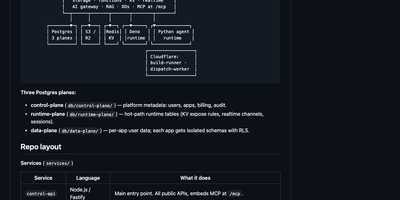
Butterbase gives AI applications a complete backend they can run themselves, from a dedicated PostgreSQL database for every app to an MCP server that lets agents operate that backend directly. Define schemas declaratively, apply migrations, protect rows with Row-Level Security policies, and call the generated REST endpoints without building a separate data API. Add email and OAuth sign-in with Google, GitHub, Apple, X, and other providers, then tune JWT behavior, post-login hooks, service keys, and API keys for each application. Store files in S3 or R2 compatible object storage with presigned URLs and access controls, and keep regional key-value data with TTLs and an audit trail. Run TypeScript functions on Deno, coordinate chat rooms or rate limiters as durable per-key objects, and stream table changes to live interfaces over WebSocket subscriptions. Route chat and embedding calls through one AI gateway, ingest documents into RAG collections, and build checkpointed agent workflows that can pause for human approval before continuing. Host static frontends and edge handlers, expose webhooks for application events, and manage schemas, storage, functions, realtime channels, and integrations through more than forty MCP tools. Running on a dedicated VPS on RepoCloud with guaranteed CPU, RAM, and SSD, full root SSH access, and a browser serial console. Apache-2.0 licensed.
AnyCable
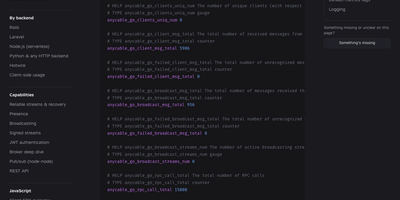
AnyCable moves your WebSocket connections out of your application process and into a dedicated realtime server, so live chat, presence, and notifications keep flowing while your app code focuses on business logic. Rails teams feel it first: the Action Cable channels, subscriptions, and broadcasts already in production keep working unchanged once the endpoint points at AnyCable, which handles authentication, subscriptions, and connection churn by calling back into your application over RPC only when channel code needs to run. Anything that can send an HTTP request can publish to connected clients, and teams outside Rails use standalone mode from Node, Python, Go, or PHP services, including Laravel applications looking for a Reverb or Pusher replacement. Broadcast traffic arrives through Redis Pub/Sub, durable Redis Streams, or the HTTP API, so background jobs and other services push messages without holding a single socket open. Operators watch connected clients, broadcast volume, and RPC failures through Prometheus metrics, and can disconnect remote clients or inspect active streams without a restart. Signed-in users stay safe because every connection request passes through your existing authentication before the server accepts it. Running on a dedicated VPS on RepoCloud with guaranteed CPU, RAM, and SSD, full root SSH access, and a browser serial console. MIT licensed.
PocketBase
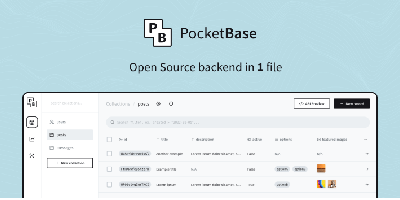
An entire backend in a single Go executable: PocketBase embeds SQLite with realtime subscriptions, authentication and user management, file storage, and an admin dashboard, all behind a REST-ish API. SQLite runs in WAL mode, which outperforms client-server databases for the read-heavy workloads typical of small and mid-sized apps. Authentication supports email/password, one-time passwords, and 15+ OAuth2 providers including Google, Apple, and GitHub, with stateless tokens. Clients subscribe to record changes over server-sent events, and official JavaScript and Dart SDKs cover web, mobile, and Flutter frontends. Collections, rules, and API access permissions are managed visually in the admin UI. When you need custom logic, extend it with JavaScript hooks running in the embedded JS VM of the prebuilt binary, or import PocketBase as a Go library and compile custom business logic into your own single-file backend. File storage attaches uploads to records with thumbnail generation for images and optional S3-compatible external storage. All state lives in one pb_data directory, so backup is a directory copy and upgrade is replacing a binary - one of the lowest-maintenance backends you can run. The contrast with Firebase is the point: where usage-based pricing scales with reads, writes, and bandwidth, PocketBase runs the entire backend at flat hosting cost, and the data is a plain SQLite file you can copy anywhere. MIT-licensed.
Mercure
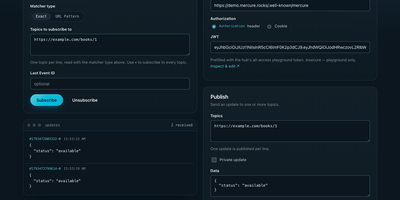
Mercure is a realtime hub that pushes updates from your backend straight to browsers over Server-Sent Events, so live dashboards, chat rooms, and activity feeds refresh the moment data changes. Subscribers connect through the browser's built-in EventSource API and choose topics with exact matchers for single resources or URL Pattern matchers for whole families such as /books/:id. Publishers send one form-encoded POST to the hub endpoint, and Mercure fans each update out to every matching connection instantly. JWT access tokens grant publish and subscribe rights topic by topic, so private updates reach only entitled clients while public topics can stay open to anonymous subscribers. If a connection drops, the client reconnects with its last event ID and Mercure replays the updates it missed from stored history. Subscription events announce every arrival and departure, so your application gets live presence and a current list of who is connected. A built-in debug UI shows messages flowing through the hub alongside active subscriptions, turning realtime bugs into something you can watch happen. Optional end-to-end encryption protects sensitive payloads, and any backend able to send an HTTP POST can publish, whatever language it runs. Running on a dedicated VPS on RepoCloud with guaranteed CPU, RAM, and SSD, full root SSH access, and a browser serial console. AGPL-3.0 licensed.