Roundcube
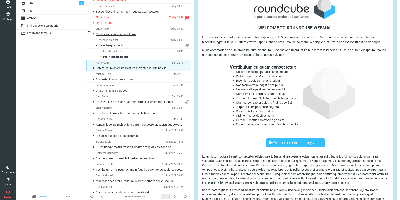
Two decades of continuous development made Roundcube the standard-bearer of open-source webmail - a PHP IMAP client that gives any mail server a polished, application-like interface in the browser. It connects to whatever IMAP/SMTP stack you run - Dovecot, Postfix, a hosted mailbox - and delivers the full desktop-client experience: drag-and-drop message management, threaded conversation views, full MIME and HTML mail handling, find-as-you-type address book with groups and LDAP connectors, multiple sender identities, full-text search, and spell checking in dozens of languages. The default Elastic skin is genuinely responsive, working as well on a phone as a desktop, and the entire UI is skinnable. The plugin API is where deployments get shaped: managesieve exposes server-side filter management in the UI, enigma brings PGP encryption and signing via GnuPG, markasjunk trains spam filters, zipdownload batches attachments, password lets users change credentials, and attachment_reminder catches the classic forgotten-attachment email - among hundreds of community plugins. Built-in caching keeps large mailboxes fast, IMAP ACLs and shared folders support team setups, and XSS protection is engineered into the rendering pipeline. It scales from a single personal mailbox to unlimited users, backed by MySQL, MariaDB, PostgreSQL, or SQLite. GPL-licensed with regular security releases.
Solidtime
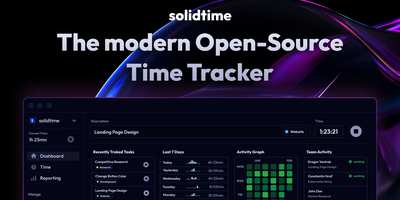
Solidtime is a time tracker for freelancers and agencies, offering a modern SaaS-quality interface that rivals commercial tools like Toggl and Clockify. The time tracking interface provides a running timer, calendar view, and weekly timesheet for flexible entry across desktop, mobile, and the dedicated macOS, Windows, and Linux desktop applications. Project management organizes work by client with hierarchical billable rates configurable at organization, member, project, and project-member levels, ensuring accurate billing across complex team structures. The invoicing module generates polished PDF invoices and structured EU e-invoices with configurable VAT rates, percentage and fixed discounts, EU reverse-charge handling, reusable company templates, and automatic line item generation from billable time entries. Reporting provides filterable summaries by user, project, client, and date range with exportable data for billing audits and team retrospectives. Multi-organization support manages separate workspaces from a single account with role-based permissions controlling access across organizations. Data import from Toggl, Clockify, and generic Timeentry CSV files enables migration from existing tools without losing historical records. The RESTful API with bearer token authentication enables automation and integration with external services. Docker deployment with PostgreSQL runs behind Nginx or Traefik reverse proxy. Running on a dedicated VPS on RepoCloud with guaranteed CPU, RAM, and SSD, full root SSH access, and a browser serial console. AGPL-3.0 licensed.
Navidrome
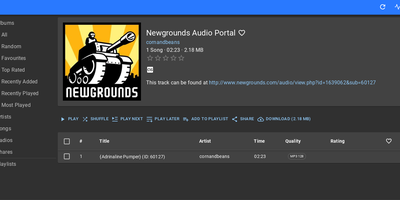
Spotify economics without the subscription or catalog gaps: Navidrome, the reference self-hosted music server, streams your own FLAC, MP3, and ALAC collection from a single Go binary with a React/Material UI web player. Its Subsonic/OpenSubsonic API compatibility is the superpower: 50+ existing clients work out of the box, from Symfonium and DSub on Android to Feishin and Sonixd on desktop, plus Android Auto, CarPlay, and Android TV apps. Transcoding is server-managed and FFmpeg-backed - FLAC direct-plays at home and downsamples to MP3, AAC, or Opus over mobile bandwidth, with the OpenSubsonic transcoding extension letting clients declare capabilities and receive per-track direct-play or transcode decisions automatically. Multi-user support gives every account its own play counts, favorites, ratings, and playlists, and multi-library support scopes different collections to different users. The feature list covers serious listening: Last.fm and ListenBrainz scrobbling, artist bios and images, embedded and external lyrics, audiobook bookmarks, saved play queues that resume on another device, internet radio, jukebox mode, and M3U playlist auto-import kept in sync with your folder. Resource usage is famously low - it runs happily on a Raspberry Pi and scales to six-figure track counts.
Temporal
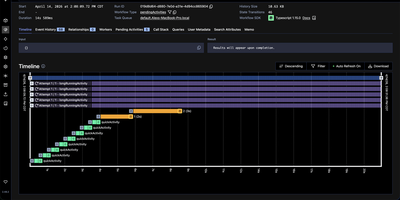
Powering mission-critical infrastructure at OpenAI, Cursor, Replit, Lovable, Retool, and Snap with over 22,000 GitHub stars, Temporal is the durable execution platform that originated from Uber's Cadence project — built by the creators of AWS SQS, AWS SWF, and Azure Durable Functions with nine years of production-proven reliability. The workflow-as-code model lets developers write business logic in Go, Java, Python, TypeScript, .NET, PHP, or Ruby using native SDKs, while the Temporal Server automatically persists state at every step, replays from failures, retries activities with configurable backoff policies, and manages task queues without developers writing reconciliation logic. Workflows support signals for external event injection, timers for scheduled delays, child workflows for decomposition, and queries for real-time state inspection — all backed by deterministic replay over an event-sourced history that guarantees exactly-once semantics. The Web UI provides visual workflow execution inspection with event timelines, pending activity monitoring, namespace management, and worker health dashboards. Persistence supports PostgreSQL, MySQL, or Apache Cassandra for horizontal scalability, with Elasticsearch or OpenSearch for advanced workflow visibility queries. Multi-cluster replication enables global failover across data centers. The self-hosted stack deploys via Docker Compose with the auto-setup image, PostgreSQL, Web UI, and admin tools — operational within 30 minutes. Running on a dedicated VPS on RepoCloud with guaranteed CPU, RAM, and SSD, full root SSH access, and a browser serial console. MIT licensed.
Kavita
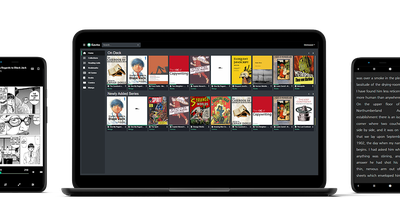
Manga, comics, ebooks, and light novels get a streaming-service-style home in Kavita - a fast, cross-platform reading server for the DRM-free collection you share with family and friends. It natively serves CBZ, CBR, CB7, ZIP/RAR/7z archives, raw images, EPUB, and PDF, with hand-crafted web readers per format: webtoon scrolling, single and dual-page spreads with advanced caching for the comic reader, and a book reader with adjustable fonts, spacing, margins, color themes, and column modes. Reading progress tracks per user, so everyone resumes exactly where they stopped on any device. Metadata parses from filenames, ComicInfo.xml, and EPUB fields, feeding index-backed search, smart filters, collections, reading lists with CBL import, and Want to Read queues. Role-based user management covers age restrictions, per-library access, and OIDC authentication. An OPDS feed connects third-party clients - Panels on iOS, Librera on Android, KOReader on e-ink devices - and a comprehensive REST API supports custom integrations. EPUB annotation and highlight support, custom theming, and full localization round it out. Built with .NET and Angular, it handles 50,000+ file libraries without strain; optional Kavita+ adds AniList scrobbling, recommendations, and external metadata.
LinkWarden
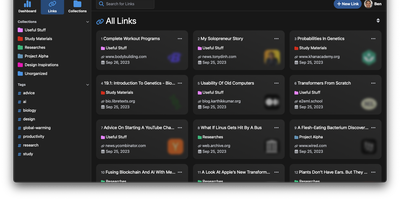
Links rot - the hard truth Linkwarden is built around, as a collaborative bookmark manager that preserves what it saves. Every page you save is fully preserved - a screenshot, a PDF, a self-contained single-file HTML archive (generated by the Monolith Rust binary), and a clean reader view - so the content survives even after the original site disappears. Think of it as a private Wayback Machine you own, with an optional one-click snapshot to archive.org on top. The reading experience matches the archival rigor: a distraction- free reader view supports text highlighting and annotation, and full-text search across everything you have saved is powered by Meilisearch. Optional AI tagging analyzes page content and auto-assigns tags - generate new ones, pick from your existing set, or constrain to predefined tags - with providers ranging from local Ollama models (fully private) to OpenAI, Anthropic, and OpenRouter. Organization is collections, sub-collections, and multiple tags per link; teams collaborate on shared collections with per-member permissions, and public collections share curated link sets (with preserved copies) to anyone. The stack is Next.js/React on TypeScript with PostgreSQL via Prisma, NextAuth supporting credentials, OAuth2, and SAML SSO, and a Playwright-driven headless Chromium worker doing the capture. Native iOS and Android apps and browser extensions feed it from anywhere.
Languagetool
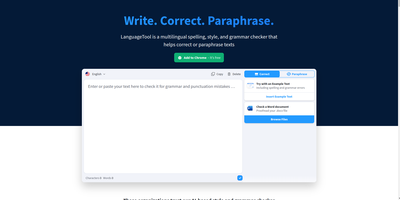
Grammar, punctuation, and style errors a dictionary lookup can't see: LanguageTool is open-source proofreading powered by a Java rule engine covering English, German, Spanish, French, Portuguese, Dutch, and 25+ other languages. Self-hosting the HTTP server is how you get Grammarly-class checking without sending every sentence you write to a third party - a real concern when the text being proofread is confidential email, legal drafts, or unreleased documentation. Your instance exposes the standard /v2/check API, so the official ecosystem plugs straight in: browser extensions for Chrome and Firefox accept a custom server URL, and integrations exist for VS Code, LibreOffice, Obsidian, Vim, Emacs, and many editors. Notably, self-hosting restores free browser-extension checking that the hosted service moved behind a premium subscription - your server, no character limits, no paywall. Detection quality is tunable: optional n-gram datasets (multi-gigabyte language models for en, de, es, fr, nl) teach the engine word-order and confusion-pair errors like there/their and brakes/breaks, and a fastText model improves automatic language identification. Everything runs offline once models are downloaded. The core is LGPL, the API is documented with Swagger, and rules are community- maintained and constantly expanding.
Cognee
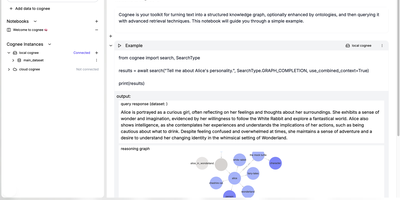
Cognee gives AI agents persistent long-term memory that survives across sessions, replacing the traditional stack of separate graph, vector, and session databases with a unified engine running on a single PostgreSQL instance. The memory-native API exposes four verbs (remember, recall, forget, and improve) enabling agents to persist context, retrieve cited answers, prune outdated knowledge, and self-improve from feedback. Under the hood, Cognee combines pgvector embeddings with a PostgreSQL-native graph store and cognitive-science-grounded ontology generation, delivering hybrid retrieval that fuses semantic similarity, structural graph traversal, and lexical search in a single query. Integrations span Claude Code, Cursor, LangGraph, OpenAI Agents, and any MCP-compatible client through a dedicated MCP server on port 8001, while the Python and TypeScript SDKs provide direct programmatic access. The platform supports swappable backends including Neo4j, FalkorDB, Qdrant, ChromaDB, Weaviate, Milvus, and LanceDB for teams with existing infrastructure. Built-in OpenTelemetry tracing, an experimental dashboard with knowledge graph visualization, multi-tenant user isolation, and audit trails ensure production readiness. Deploy via Docker Compose with optional profiles for PostgreSQL, Neo4j, Redis, and the web frontend. Reached v1.0 in April 2026 with 30,000+ stars. Running on a dedicated VPS on RepoCloud with guaranteed CPU, RAM, and SSD, full root SSH access, and a browser serial console. Apache 2.0 licensed.

OpenSquilla
Claiming 60-80% token cost reduction compared to flat single-model deployments and backed by 6,500+ GitHub stars, OpenSquilla delivers an intelligent AI agent runtime where a local ML classifier evaluates every turn on message length, code blocks, keyword patterns, and semantic embeddings before routing it to the optimal model tier from C0 through C3. The pluggable provider layer connects natively to TokenRhythm, OpenRouter, OpenAI, Anthropic, Ollama, DeepSeek, Gemini, DashScope, Moonshot, Mistral, Groq, Zhipu, SiliconFlow, vLLM, LM Studio, and additional compatible backends with primary-plus-fallback selection. The four-tier cognitive memory architecture spans working, episodic, semantic, and raw layers with vector-semantic and BM25 retrieval powered by on-device ONNX embeddings that never leave your infrastructure. Security isolation operates at the syscall level via Bubblewrap on Linux and Seatbelt on macOS, complemented by policy-based execution controls and prompt injection protections. The unified TurnRunner executes identically across the Vue-based control console Web UI, terminal CLI, and chat channel integrations including Slack and Discord, ensuring consistent tool dispatch, retry logic, and decision logging regardless of entry point. Built-in skills cover deep research, multi-search-engine queries, document generation for DOCX, PPTX, XLSX, and PDF formats, GitHub integration, cron scheduling, and bounded subagent delegation. Per-agent workspaces with durable session storage provide transcript replay, context state management, and per-call cost tracking with automatic quota enforcement. Running on a dedicated VPS on RepoCloud with guaranteed CPU, RAM, and SSD, full root SSH access, and a browser serial console. Apache-2.0 licensed.
Cal.diy
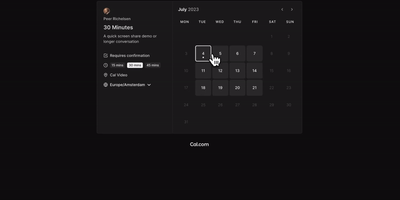
With over 47,000 GitHub stars, Cal.diy is the fully open-source community fork of Cal.com that strips away every proprietary license gate and enterprise paywall to deliver a pure MIT-licensed scheduling platform you completely own. The booking engine supports individual event types including recurring events, seated events with capacity limits, and paid bookings through Stripe and PayPal, all backed by customizable availability schedules with date overrides, buffer times, minimum notice periods, and travel schedule support. Calendar synchronization is bidirectional across nine providers — Google Calendar, Outlook and Office 365, Apple Calendar, CalDAV, Lark, Feishu, Zoho, Exchange, and ICS feeds — so every booking automatically appears on your existing calendar while blocking conflicting slots. Video conferencing links generate automatically for Zoom, Google Meet, Microsoft Teams, Webex, Jitsi, Daily.co, Whereby, and Huddle01, eliminating manual link management. The automation layer connects through webhooks, Zapier, n8n, Make, and Pipedream to CRM platforms like HubSpot, Salesforce, and Close, messaging services including Discord, Telegram, and WhatsApp, and analytics tools such as Google Analytics 4, PostHog, and Fathom. The entire application is built on the T3 stack — Next.js for server-rendered pages, tRPC for end-to-end type-safe APIs, Prisma for PostgreSQL database access, and Tailwind CSS for the responsive interface. Unlike Cal.com's open-core model, Cal.diy requires no license key and includes no gated features. Running on a dedicated VPS on RepoCloud with guaranteed CPU, RAM, and SSD, full root SSH access, and a browser serial console. MIT licensed.
Lemmy
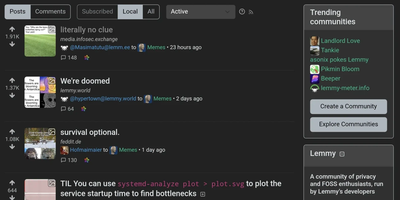
Powering over 496 instances with more than 35,000 monthly active users and 26,500 communities, Lemmy has established itself as the leading open-source, federated link aggregation platform in the Fediverse. Built entirely in Rust for memory-safe, high-performance server operation, Lemmy enables anyone to run their own Reddit-style community that automatically connects with every other Lemmy instance — and compatible ActivityPub platforms like Mastodon, PieFed, and Kbin — through standardized federation protocols. Users create and subscribe to topic-based communities, submit posts containing text, links, or images, engage through threaded comment discussions, and shape content visibility through upvote/downvote mechanisms. Instance administrators retain full control over moderation policy, federation allowlists and blocklists, site appearance, and user registration settings, while community moderators can sticky posts, lock threads, ban users, and maintain public moderation logs for transparency. The platform supports private messaging between users, email notifications, RSS and Atom feed generation for every community, comprehensive internationalization with dozens of language packs, custom emoji support, and both light and dark themes through a clean mobile-responsive interface. Deployment is straightforward with official Docker Compose configurations and Ansible playbooks, backed by a PostgreSQL database with pict-rs for image hosting. Lemmy's Rust backend consistently benchmarks among the most efficient Fediverse server implementations, enabling small VPS instances to serve thousands of users. Running on a dedicated VPS on RepoCloud with guaranteed CPU, RAM, and SSD, full root SSH access, and a browser serial console. AGPL-3.0 licensed.
iDURAR
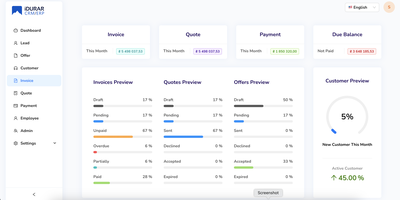
Quote to cash in one web application - create quotes, convert them to invoices, record payments, track customers: iDURAR is an open-source ERP and CRM platform for small and medium-sized businesses. Built on the MERN stack (MongoDB, Express, React, Node.js) with Ant Design components and Redux state management, it presents a clean SaaS-style interface that needs little onboarding. Core modules cover invoice management with PDF generation and email delivery, payment recording against invoices, quote and proforma handling, customer records, and accounting views over the resulting data. Multi-currency support and localization make it usable for internationally operating teams. Because the whole stack is JavaScript with an API-first backend, extending it - custom fields, new modules, integrations - is approachable for any Node/React developer rather than requiring a specialist ERP skill set. Deployment is straightforward via Docker with a MongoDB instance. Licensed under AGPL-3.0 with free commercial use; a hosted enterprise version exists but the self-hosted edition is fully functional.
Trilium Notes
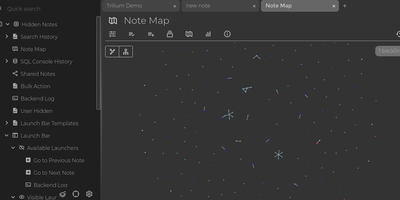
For people whose notes number in the tens of thousands, Trilium Notes is the hierarchical note-taking application built specifically for large personal knowledge bases - actively maintained as TriliumNext. Notes arrange into arbitrarily deep trees where every note is both content and container, and cloning lets a single note live in multiple places at once - bash notes belong under both Linux and Scripting, and Trilium refuses to make you choose. A WYSIWYG editor handles rich text, tables, math, and syntax-highlighted code blocks with Markdown-style shortcuts, while dedicated note types cover Excalidraw sketches, mind maps, geo maps with GPX tracks, relation maps that visualize connections between notes, and tables with typed columns. The attribute system is the power layer: labels attach queryable metadata (#year=1999, #author), relations create named links between notes, and both inherit down the tree - feeding full-text search, saved queries, and scripting. Scripting is Trilium's deepest differentiator: JavaScript code notes run on events like note changes or hourly schedules, build custom widgets, and add server-side logic, turning the knowledge base into a programmable platform. Protected notes encrypt sensitive content, note hoisting focuses on subtrees, and the self-hosted server syncs desktop clients across devices.
Hatchet
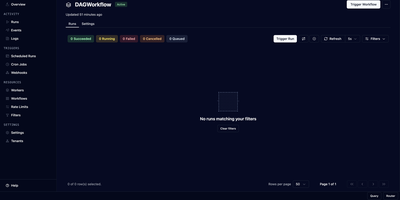
Processing over one billion tasks per month on Hatchet Cloud and holding 7,600+ GitHub stars, Hatchet is the open-source orchestration engine that replaces fragile legacy queues with durable, fault-tolerant task execution built entirely on PostgreSQL — no Redis, RabbitMQ, or Kafka required. Born from the creators' experience scaling Uber's Cadence-inspired patterns, the v1 engine achieves 10,000 tasks per second sustained throughput with 20ms average queue latency through dynamic buffer flushing and batch insert optimization. Define tasks, durable workflows, and DAG pipelines as code using native SDKs for Python, TypeScript, Go, and Ruby — every function gets automatic retries with configurable backoff, concurrency control with group round robin or cancellation policies, priority queuing, and dynamic rate limiting for third-party API protection. Durable execution persists the complete history of every task and state transition, enabling replay from failure, debugging via full event timelines, and complex pause/resume conditions using durable sleep and event waits. The real-time web dashboard provides workflow run visualization with DAG timeline rendering, worker health monitoring with slot utilization, queue depth metrics, task throughput charts, and error rate tracking — all filterable by status, workflow, or time window. OpenTelemetry integration and Prometheus metrics export enable advanced observability. Multi-tenant by default with users, roles, and namespace isolation. Self-host via Docker Compose with PostgreSQL and optional RabbitMQ, or use the single-container Hatchet Lite image for development. Running on a dedicated VPS on RepoCloud with guaranteed CPU, RAM, and SSD, full root SSH access, and a browser serial console. MIT licensed.
Logto
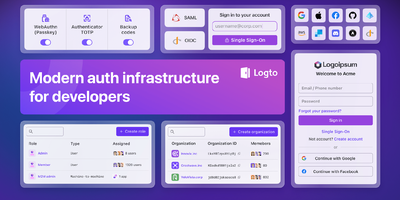
With over 14,000 GitHub stars, 1 million managed identities on Logto Cloud, and continuous releases through version 1.42.0 in July 2026, Logto has emerged as the most credible open-source alternative to Auth0, Clerk, and AWS Cognito by packaging OIDC, OAuth 2.1, enterprise SSO, multi-tenancy, and RBAC into a single MPL-2.0 codebase that self-hosts for free with no per-MAU pricing surprises. Every Logto tenant operates as a fully compliant OpenID Provider supporting PKCE-only public clients, DPoP token binding, and RFC 9068 JWT access tokens. Pre-built sign-in flows handle email, phone, social login via Google, Facebook, Azure AD, and dozens of connectors, passkey authentication, and multi-factor verification through TOTP and WebAuthn. Organizations enable first-class multi-tenancy where users belong to multiple tenants with per-organization RBAC scopes on API resources. Enterprise SSO connects to Okta, Entra ID, and any SAML or OIDC identity provider. SDKs for over 30 frameworks including React, Next.js, Angular, Vue, Flutter, Go, and Python integrate authentication into SPAs, web apps, mobile apps, APIs, machine-to-machine, and CLI tools. The admin console provides user management, audit logs, webhook event subscriptions, and custom domain configuration. Personal Access Tokens and token exchange support AI agent architectures and MCP server authentication. Running on a dedicated VPS on RepoCloud with guaranteed CPU, RAM, and SSD, full root SSH access, and a browser serial console. MPL-2.0 licensed.
Stalwart
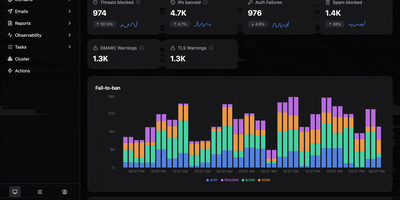
With 14,000 GitHub stars and 81 releases since March 2023, Stalwart is the most protocol-complete open-source mail server available — delivering JMAP, IMAP4rev2, IMAP4rev1, POP3, SMTP, CalDAV, CardDAV, and WebDAV from a single Rust binary that compiles to a memory-safe, zero-garbage-collection executable with predictable latency under load. The SMTP server implements DMARC, DKIMv2, DKIMv1, SPF, and ARC for complete message authentication with automatic DKIM key rotation, while transport security enforces DANE, MTA-STS, and SMTP TLS reporting to prevent downgrade attacks. Built-in spam filtering with statistical classifiers, DNS blocklists, and collaborative reputation databases eliminates the need for external Rspamd or SpamAssassin deployments. Encryption at rest protects stored messages with S/MIME or OpenPGP, and automatic TLS certificate provisioning via ACME supports TLS-ALPN-01, DNS-01, and HTTP-01 challenges without manual certificate management. The ManageSieve server enables server-side email filtering rules, while full-text search indexes message bodies and attachments for instant retrieval. Pluggable storage backends support RocksDB for embedded deployments, PostgreSQL, MySQL, and S3-compatible object storage for distributed architectures. LDAP and SQL-based authentication integrate with existing directory services, and the web administration panel manages domains, accounts, quotas, and DKIM keys. Security audited with memory safety guaranteed by Rust's ownership model. Running on a dedicated VPS on RepoCloud with guaranteed CPU, RAM, and SSD, full root SSH access, and a browser serial console. AGPL-3.0 licensed.
Maintenant
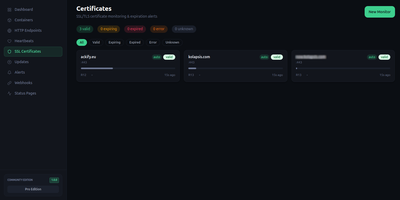
Maintenant replaces three to five separate monitoring tools with a single Go binary that consolidates container discovery, endpoint monitoring, SSL tracking, resource metrics, and public status pages without requiring any external database. The embedded Vue 3 frontend serves on port 8080 immediately after deployment, auto-discovering Docker containers and Kubernetes pods through direct socket and API access without configuration. HTTP and TCP endpoint monitoring validates availability with configurable intervals, while TLS certificate tracking alerts before expiration across all monitored domains. Resource metrics collect CPU, RAM, network throughput, and disk usage per container with real-time Server-Sent Events streaming to the dashboard. Heartbeat and cron monitoring accepts pings from external scheduled jobs, triggering alerts on missed check-ins via webhook callbacks and Discord notifications. The built-in alert engine supports escalation rules and notification batching. Public status pages expose component health to end users without authentication, customizable per monitored service. Network security insights analyze exposed ports, container privilege levels, and host configuration to produce a posture score. Update intelligence scans OCI registries to detect available container image updates with digest comparison. The REST API with SSE broker enables automation, and the integrated MCP server provides tooling for AI assistant integration. SQLite in WAL mode stores all data with zero operational overhead. Running on a dedicated VPS on RepoCloud with guaranteed CPU, RAM, and SSD, full root SSH access, and a browser serial console. AGPL-3.0 licensed.
Bookstack
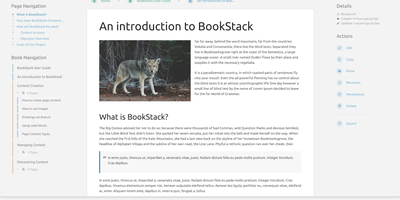
Most wikis die of flat page-and-tag sprawl; BookStack's defining decision is enforced structure - an MIT-licensed PHP/Laravel platform (over MySQL) where content lives in a hierarchy of shelves, books, chapters, and pages, the way a physical library works. A shelf maps to a department, a book to "Engineering Runbooks," a chapter to "Database Procedures," a page to the actual document. That opinionation removes the "where does this go?" friction and keeps knowledge bases tidy as they grow. Editing works both ways: a clean WYSIWYG editor for most users, a Markdown editor with live preview for those who prefer it - switchable per page. Full-text search spans all books or scopes to one, with direct links to individual paragraphs, and include tags let you embed one page's content inside another so shared blocks update everywhere at once. Every edit creates a diffable, revertible revision. Page templates standardize recurring formats, tags add cross-cutting categorization, and built-in diagrams.net integration draws architecture diagrams in place. Authentication covers email/password plus OIDC, SAML2, LDAP, and social login; a full role and permission system locks content down per shelf, book, or page. Pages and books export to PDF, HTML, plain text, and Markdown, a REST API automates content, and the whole thing runs happily on the cheapest VPS you can find.