FreeSBC
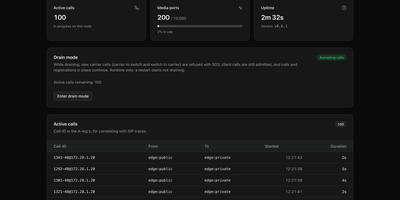
FreeSBC sits at the edge of your phone system so your FreeSWITCH or Asterisk never has to face the public internet. It is the only element with a public address: phones register through it over SIP on UDP, TCP, or TLS, browsers call through WebSocket with WebRTC terminated at the edge (ICE-Lite, DTLS-SRTP, and RTCP-mux, relayed onward as plain RTP), and carriers reach your switch through it as an outbound proxy, with the switch's private addresses hidden from every SDP body, Contact, and Request-URI it constructs. The switch stays on a private LAN as the registrar and call brain, holding credentials and carrier accounts, while FreeSBC anchors all media on its own ports with hardened first-packet latching and a silence watchdog, and never transcodes. Against the background radiation of SIP scanning, it applies per-IP rate limits with separate limits for carrier sources, scanner fingerprinting with in-memory bans, and admission control for public INVITEs and REGISTER enumeration, and every denial is a silent drop. A multi-switch pool hashes users across switches, and one fixed private socket keeps the trusted side simple. The embedded WebUI, REST API, and Prometheus metrics sit behind a bcrypt-checked admin login, showing live calls and media ports. One static binary, one YAML file, no database, no Redis, and no separate media process to babysit. Running on a dedicated VPS on RepoCloud with guaranteed CPU, RAM, and SSD, full root SSH access, and a browser serial console. Apache-2.0 licensed.
MikoPBX
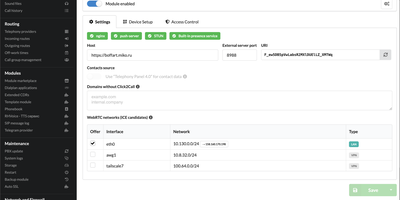
MikoPBX gives a small business a complete phone system on a server it controls, with extensions, call queues, IVR menus, and call recording instead of per-seat hosted PBX fees. Follow a call through it: incoming rules per provider match exact numbers or patterns, fall through by priority when nobody answers, and end at a default route. Each employee gets an extension with SIP credentials, forwarding for no-answer, busy, and unavailable states, and an optional recording switch. Queues offer seven distribution strategies, including Ring All, Least Recent, Fewest Calls, and Memory Hunt, and can announce each caller's position and estimated wait. IVR menus play a recorded greeting, route keypad choices to departments or extensions, and fall back to a default number after a set number of retries. Call history filters by caller, destination, or DID, flags missed calls in red, and plays or downloads recordings as WebM, MP3, WAV, or OGG. Voicemail, call transfer, call pickup, and a holiday and night-time switcher serve daily needs, while free and paid marketplace modules, among them a softphone, auto dialer, and LDAP/AD sync, handle the rest. A firewall, Fail2Ban, passkey sign-in, and CrowdSec integration protect the system, and a REST API with more than 250 endpoints lets other tools manage it. The interface speaks 26 languages. Running on a dedicated VPS on RepoCloud with guaranteed CPU, RAM, and SSD, full root SSH access, and a browser serial console. GPL-3.0 licensed.
Lampline
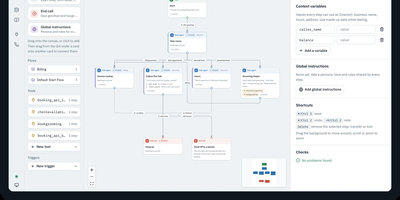
Once a voice agent is imported or built, Lampline connects it to a phone line, sends an AI caller to grade real calls, and keeps it all on your own server. Start by importing a Dialogflow CX or CX Agent Studio export along with a report of anything to check, or build fresh in a drag-and-drop builder that mixes LLM steps with scripted pages for exact lines and form fields. Next, pick one of 20 model providers, including Claude, OpenAI, Gemini, Bedrock, Groq, and DeepSeek, or run Ollama with local speech and no API keys. Test by chat or microphone while each step lights up, and let agents call HTTP and MCP tools and save records in collections of their own. Then connect callers through Twilio, Telnyx, or any SIP trunk, PBX, or session border controller via jambonz, with transfers to a person that carry the call's details as SIP headers. Finally, evals phone the agent over a real line, where an AI Test Caller brings background noise, accents, and interruptions, grades each transcript check by check, and reports typical and p95 response times as callers hear them. Each agent stays a folder of YAML and Markdown that you can review in git and lint or test with the vk CLI. Running on a dedicated VPS on RepoCloud with guaranteed CPU, RAM, and SSD, full root SSH access, and a browser serial console. Apache-2.0 licensed.
Dograh
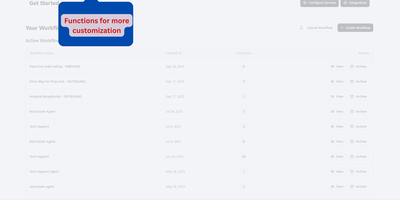
Build a voice AI agent that answers calls, qualifies leads, books appointments, and transfers to a human when needed, all from a drag-and-drop workflow builder in your browser. Dograh ships as a Docker Compose stack (API, web UI, Postgres, Redis, MinIO) that you self-host on any Linux server with automatic HTTPS provisioning via Let's Encrypt. The visual workflow builder lets you design multi-turn conversation flows by connecting nodes for greetings, intent classification, tool calls, and handoffs; describe your use case in plain English and the platform generates the LLM prompt and node graph for you. Connect your own speech-to-text, LLM, and text-to-speech providers (OpenAI, Anthropic, Gemini, ElevenLabs, Deepgram, local Whisper, Kokoro, or any OpenAI-compatible endpoint) or use the built-in Speech-to-Speech mode with Gemini Flash Live and GPT-Realtime-2 for sub-200ms latency. Telephony plugs in through Twilio, Vonage, Vobiz, or Cloudonix for inbound and outbound calling, with live agent transfer when the conversation needs a human. Webhook tool calls connect to Salesforce, HubSpot, Google Calendar, Cal.com, or any REST API without writing orchestration code. The ClonedVoice feature mixes real human voice recordings for high-frequency phrases with neural TTS fallback for dynamic content, cutting costs while improving caller trust. A built-in MCP server lets AI coding agents like Claude Code or Cursor design, test, and edit workflows through natural language. Deploy on a dedicated VPS on RepoCloud with guaranteed CPU, RAM, and SSD, full root SSH access, and a browser serial console. BSD 2-Clause licensed.