zrok
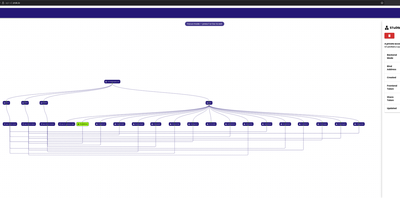
zrok puts services that live behind NAT and firewalls onto the public internet with a shareable URL, without opening a single inbound port. The machine being shared dials out to an OpenZiti overlay network, so a web app on your desk, a Raspberry Pi at home, or a staging box inside a corporate network becomes reachable through your instance while its firewall stays closed. One command shares an HTTP service publicly; add a name from one of your namespaces and the URL stays stable even when you move the backend to a different machine, and an ephemeral name can be promoted to a reserved one when a quick demo turns into a keeper. Private shares skip the public internet entirely and reach only the users you grant, including raw TCP and UDP services, while web and drive backend modes publish static sites or whole folders, with OAuth, password auth, and an interstitial warning page available on public shares. The long-running agent keeps every share and access under one process, restarts the named ones after a reboot, and offers a localhost console for point-and-click sharing; the account-wide web console maps your environments, shares, and accesses as a navigable graph or a sortable table with live activity. Operators get invite-based accounts, InfluxDB-backed usage metrics, and configurable limits that warn or cut off accounts that exceed their quotas. Running on a dedicated VPS on RepoCloud with guaranteed CPU, RAM, and SSD, full root SSH access, and a browser serial console. Apache-2.0 licensed.
NetsGo
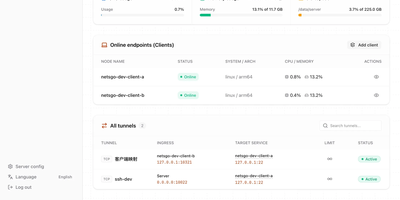
Created to eliminate the configuration fragmentation plaguing multi-device Homelab setups and small-team infrastructures, NetsGo merges what typically requires three separate tools — a tunnel daemon, a management panel, and a monitoring stack — into a single Go binary that starts with one command and listens on one port. The server exposes HTTP, TCP, and UDP tunnels, a built-in Web console for node management, a REST API for automation, and real-time traffic statistics with per-client bandwidth limiting, all sharing default port 9527 so firewalls and reverse proxies need only a single rule. Version 0.1.11 introduced Client-to-Client P2P tunnels via WebRTC DataChannel with three selectable transport strategies — Server relay, Prefer P2P with automatic fallback, and P2P only — reducing latency for direct connections while maintaining the centralized control plane. The management console displays every connected client's online status, authentication tokens, tunnel configuration, active transport mode, P2P candidate gathering progress, and cumulative byte-level traffic counters updated every second. Unlike frp or rathole which delegate management to external plugins or configuration files, NetsGo provides built-in client key generation, tunnel target migration between nodes, SOCKS5 proxying, IP-whitelist console access, and one-command server upgrades. Running on a dedicated VPS on RepoCloud with guaranteed CPU, RAM, and SSD, full root SSH access, and a browser serial console. Apache 2.0 licensed.
Wiredoor
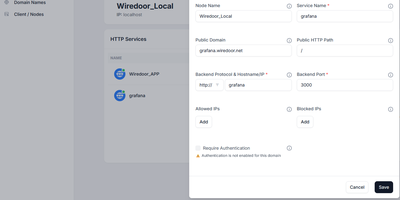
A self-hosted front door for apps that live on home labs, office LANs, and private clusters, Wiredoor publishes them to the internet without opening a single inbound port on the private side. The Wiredoor CLI on each remote machine dials out to the server over an encrypted WireGuard tunnel. Web apps and APIs are routed by domain and path, WebSocket traffic included, while TCP and UDP services such as SSH or Redis get a public port of their own. Public domains receive Let's Encrypt certificates, internal names fall back to self-signed ones, and Cloudflare or GoDaddy credentials let the server create DNS records itself. Any web route can demand OAuth2 sign-in with an email allow list and a few open paths, and every protocol accepts IP allow lists. Gateway nodes stretch one tunnel across a Docker network, Kubernetes cluster, or private subnet, so a single link serves many backends. Services can be switched off or given an expiry such as 30 minutes, 2 hours, or 1 day. The dashboard shows which nodes are connected and whether their services are enabled, while the CLI creates, enables, and disables services from a terminal. Optional Prometheus and Grafana views chart traffic and tunnel peers, and CrowdSec can block abusive addresses. Running on a dedicated VPS on RepoCloud with guaranteed CPU, RAM, and SSD, full root SSH access, and a browser serial console. Apache-2.0 licensed.
Rustunnel
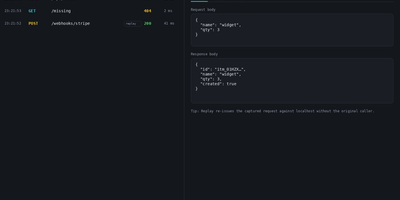
Rustunnel turns a service running on your laptop or private network into a public HTTPS, TCP, or UDP endpoint without opening inbound ports on the machine where it lives. Point the client at a local port and share the public address for webhook testing, a quick demo, an AI agent tool, SSH access, a game server, or an IoT device that cannot accept inbound connections. Give tunnels custom subdomains on your own wildcard domain, terminate HTTPS with automatic Let's Encrypt certificates, and keep client traffic encrypted from edge to local service. Put several backends behind one subdomain or TCP port and let TCP or HTTP health probes remove sick members before visitors hit them. When two peers can reach each other directly, start a P2P tunnel with NAT hole punching and QUIC, with relay fallback when the direct path fails. Watch sessions, tunnel health, traffic, and request logs from the live dashboard, inspect headers and bodies in the local request inspector, and replay a captured call while debugging a webhook. Manage tunnels, tokens, groups, captured requests, and history through the REST API, scrape Prometheus metrics, review audit logs, or let an MCP-compatible coding assistant create and close tunnels in plain language. Running on a dedicated VPS on RepoCloud with guaranteed CPU, RAM, and SSD, full root SSH access, and a browser serial console. AGPL-3.0 licensed.