Nebula
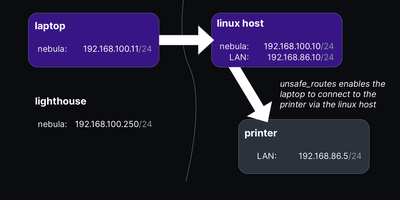
Give every laptop, server, and cloud VM you own one private address that works from anywhere, and that is exactly the overlay network Nebula builds. Each machine runs a single small binary, presents a certificate signed by your own certificate authority, and joins a peer-to-peer layer-3 mesh where tunnels form on demand between hosts that need to talk. Lighthouse nodes, the piece you park on a VPS, keep track of where every peer can be reached and introduce hosts to each other, so machines find each other without any central VPN concentrator carrying their traffic. UDP hole punching and keepalive packets open direct tunnels through home routers and office NAT, and when two hard NATs refuse to cooperate, a relay host forwards the encrypted traffic until a better path appears. Every host enforces its own firewall, default deny on all overlay traffic, with rules keyed to certificate groups, so laptops in the user-endpoint group can reach a server's web port while other groups cannot. Ordinary hosts need no inbound ports at all, and the same binary runs on Linux, macOS, Windows, phones, and FreeBSD, making the mesh feel identical at home, in a datacenter, or across three clouds. Unsafe routes can even pull an existing office subnet into the overlay, giving legacy hardware that will never run Nebula an address on the private network. Running on a dedicated VPS on RepoCloud with guaranteed CPU, RAM, and SSD, full root SSH access, and a browser serial console. MIT licensed.
Mistgate
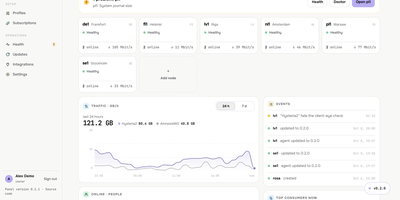
Running a VPN for family, friends, or a small team usually means babysitting servers one SSH session at a time, and Mistgate replaces that with one panel that keeps the whole fleet configured. Add a server from the browser by typing its address and root password: the panel pins the host key, checks the host, opens the ports, and installs the signed node agent for you. Each person gets one subscription link that their app turns into the server list, or a personal AmneziaVPN key per device, so a lost phone can be revoked without touching anyone else. Groups decide which protocol profiles a person receives, while per-user traffic quotas, expiry dates, device limits, and per-device speed limits keep sharing fair. Hysteria2 brings QUIC-based speed with port hopping, obfuscation, and certificate options; VLESS REALITY and AmneziaWG 2.0 and 3.1 cover networks where one protocol gets blocked, and Cloudflare WARP can serve as the exit for all three. Every five minutes the panel connects to each server the way a real client app would, a doctor on every node runs host checks with safe fixes, and alerts reach you on Telegram before your users notice. The public address shows strangers a decoy site while the admin hides behind a secret path, and encrypted backups go to your Cloudflare R2 bucket on a schedule. Running on a dedicated VPS on RepoCloud with guaranteed CPU, RAM, and SSD, full root SSH access, and a browser serial console. AGPL-3.0 licensed.
Tailscale
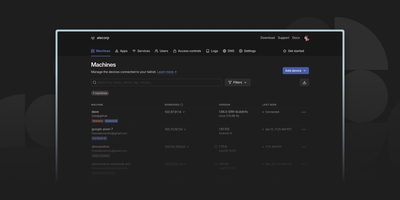
With over 34,000 GitHub stars and backing from a well-funded engineering team, Tailscale has fundamentally simplified how developers and system administrators think about secure networking. The client daemon establishes WireGuard tunnels directly between devices using sophisticated NAT traversal techniques, achieving direct peer-to-peer connections in the vast majority of network configurations without requiring port forwarding, firewall rules, or VPN concentrators. When direct connections prove impossible due to restrictive network environments, DERP relay servers provide encrypted fallback paths. MagicDNS assigns human-readable hostnames to every device on the network, eliminating the need to remember IP addresses across a tailnet. Subnet routing allows nodes to advertise access to entire local networks, enabling remote access to office resources, home labs, or cloud VPCs through a single gateway node. Exit node functionality routes all internet traffic through a designated device for privacy protection or geographic flexibility. Access control lists define granular policies for which devices and users can communicate with which services, enforced cryptographically at the network layer. The authentication layer integrates with identity providers including Google, Microsoft, GitHub, Apple, and OIDC-compliant systems for single sign-on access. Taildrop enables direct encrypted file transfers between devices without cloud intermediaries. The tailscale CLI provides complete network management from the terminal including status monitoring, route advertisement, and node configuration. Running Tailscale on a dedicated VPS on RepoCloud with guaranteed CPU, RAM, and SSD, full root SSH access, and a browser serial console provides a permanent, always-on node in your mesh network. BSD-3-Clause licensed with an active open-source community.
DefGuard
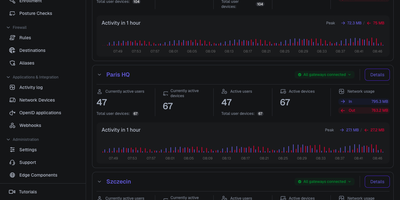
Behind one admin panel, DefGuard runs a WireGuard VPN, an identity provider, and multi-factor authentication, so every person and device proves who they are before reaching your private network. Administrators define VPN locations, assign which users and groups may enter each one, and enforce firewall rules that allow or deny traffic per location, with changes applied to gateways in real time. People enroll remotely through a guided self-service flow, register their own laptops and phones, and connect with desktop and mobile clients that show live connection statistics. Sign-in goes well beyond passwords, because the built-in OpenID Connect provider gives internal tools single sign-on, while TOTP codes, WebAuthn and FIDO2 keys, email tokens, and mobile biometrics gate each connection. Directory teams sync accounts from LDAP and Active Directory, or federate sign-in through Google, Microsoft, and custom OpenID providers, instead of maintaining a separate user list. Every authentication, enrollment, and policy change lands in a searchable activity log, and webhooks plus a REST API let surrounding systems react to access events automatically. Gateways keep enforcing access from a local cache when the control plane is unreachable, and several gateways can front the same location for failover. Running on a dedicated VPS on RepoCloud with guaranteed CPU, RAM, and SSD, full root SSH access, and a browser serial console. AGPL-3.0 licensed.
3X-UI
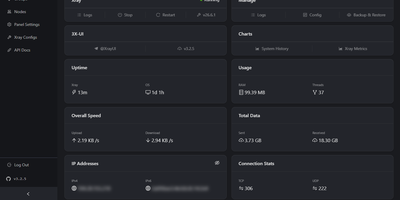
3X-UI is the most popular open-source Xray management panel, providing a full-featured web interface for deploying and monitoring proxy and VPN protocols on Linux servers. The Go backend manages Xray-core instances supporting VLESS, VMess, Trojan, Shadowsocks, WireGuard, Hysteria2, HTTP, SOCKS, Dokodemo-door, and TUN inbounds across TCP, mKCP, WebSocket, gRPC, HTTPUpgrade, and XHTTP transports secured with TLS, XTLS Vision, and REALITY. The Clients page tracks each user with individual traffic quotas, expiration dates, concurrent connection limits, and live online status indicators, while one-click share links, QR codes, and a built-in subscription server distribute configurations in multiple output formats. The multi-node architecture manages and scales deployments across multiple servers from a single panel instance. The Panel Settings page configures listen address, port, URI path, session duration, trusted proxy CIDRs, authentication, and Telegram bot integration for remote monitoring and management alerts. Outbound routing supports WARP, NordVPN, custom rules, load balancers, and proxy chaining. Xray Configs provides template-level control over the core configuration, while the API Docs page exposes a complete RESTful API with in-panel Swagger documentation. Data persists in SQLite by default or PostgreSQL for larger deployments, with database export and import from the panel. Fail2ban integration enforces per-client IP limits. On RepoCloud, deploy 3X-UI on a dedicated VPS with Docker, root SSH access, and complete control over your proxy infrastructure, all under the GPL-3.0 license.
ZTNET
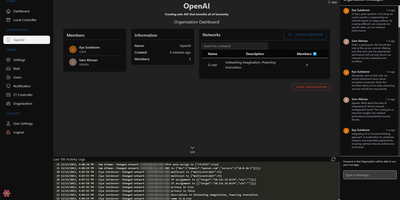
ZTNET provides a polished web dashboard for running your own ZeroTier network controller, covering network creation, member authorization, IP assignment, flow rule editing, and real-time node monitoring entirely from the browser. The organization system supports multi-tenant deployments where teams manage separate network pools with role-based permissions and customizable email notification templates for events like member joins, departures, IP changes, and authorization updates. Each network view displays connected members with their ZeroTier addresses, assigned IPs, last-seen timestamps, physical endpoints, and protocol versions in a clean tabular layout. The admin panel provides platform-wide user management, SMTP configuration for transactional emails, and system-level settings. Built on the T3 stack with Next.js, Prisma ORM, tRPC, TypeScript, and Tailwind CSS with DaisyUI components, the application supports both PostgreSQL and SQLite for persistence and communicates directly with the ZeroTier controller daemon through its native API. Dark and light themes adapt to user preference, and responsive layouts make network management practical from any device. Docker Compose bundles the web application alongside the ZeroTier controller service. Over 100,000 Docker pulls confirm steady community adoption. GPL-3.0 licensed.
Wag
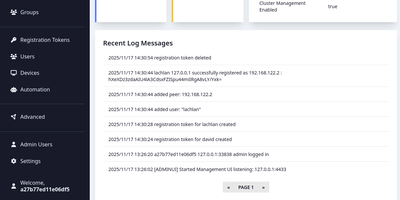
Wag is an authentication gateway for WireGuard that lets each device reach only the routes it should, and asks for a second factor before the sensitive ones open. Admins write access policies for everyone, groups, or single users, marking subnets, hosts, ports, and protocols as MFA-required, always allowed, or denied, and the most specific prefix wins, so one allowed address can sit inside a protected range. Devices join with a registration token, and the public endpoint answers with a finished WireGuard profile. Users then confirm a TOTP code, a WebAuthn security key, an OIDC single sign-on login that maps identity provider groups into Wag groups, or a PAM prompt, and repeated failures lock the account. Session lifetime and idle timeouts decide when they must prove themselves again. The browser portal lists users, devices, rules, registration tokens, and webhooks with real-time notifications, while a command line locks devices, resets MFA, and manages administrators. Webhooks turn JSON from an HR or identity system into new tokens or removed users and devices, and clients can fetch the list of guarded routes from a small API. Remote staff, contractors limited to one host, and homelabs are typical uses. When a server fails, the VPN remains reachable through clustering with witness nodes or an external etcd, and certificates arrive through ACME with HTTP-01 or Cloudflare DNS-01. Running on a dedicated VPS on RepoCloud with guaranteed CPU, RAM, and SSD, full root SSH access, and a browser serial console. BSD-3-Clause licensed.
Meshlan
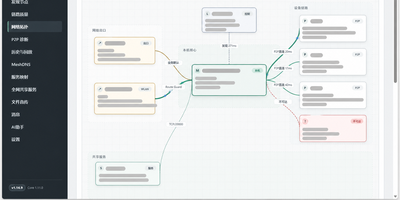
Meshlan turns your own Linux server into the control plane for a private virtual LAN that connects remote Windows devices as if they sat on the same router. Devices pair through your server, receive their certificates, and then talk directly to each other over encrypted tunnels whenever NAT allows, using dual-stack hole punching, UPnP, and STUN diagnostics to find a path. When a direct connection is impossible, traffic falls back to relays, and multiple relay nodes are chosen automatically by latency, jitter, packet loss, and health. You can publish a service that only listens on localhost, a local API, a web panel, a database, a game server, to the mesh on a custom port, with direct access or manual approval by its creator. Names stay stable while addresses change: devices answer to names like alice.mesh and services to api.alice.mesh, and an HTTPS gateway serves mesh websites without port numbers. Files move directly between devices over the encrypted link while the server only distributes metadata. The console shows the live topology with P2P and relay paths, latency, and service health, and local history keeps traffic and events for replay with a time slider. Optional AI automation keeps model keys on the server, encrypts context end to end, and asks for your confirmation before changing anything. Signed updates verify and roll back automatically when a health check fails. Running on a dedicated VPS on RepoCloud with guaranteed CPU, RAM, and SSD, full root SSH access, and a browser serial console. MIT licensed.