SRS
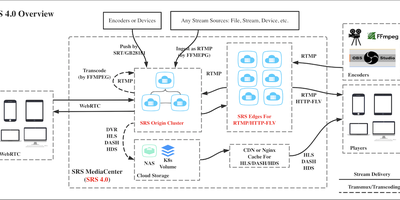
Viewers arrive on browsers, phones, and desktop players, and SRS meets each of them with the right protocol from a single published stream. A broadcaster pushing RTMP can reach browser viewers through WebRTC with sub-second latency, phone apps through HLS, and desktop players through HTTP-FLV, all from the same live source without running parallel encoders. WHIP endpoints accept WebRTC ingest from browser studios and tools like OBS, while WHEP serves WebRTC playback, so an entire publish-to-viewer path can stay on modern web protocols. Operators shape each channel with virtual hosts, authenticate publishers and players through HTTP hooks that consult your own backend, and record live streams to disk as DVR archives for replay. Forwarding republishes a stream to YouTube, Facebook, or another SRS instance, and origin clustering lets edge servers pull from a central origin so one ingest feeds viewers in several regions. The built-in HTTP API reports streams, clients, and server health for monitoring, and GB28181 support ingests surveillance camera networks alongside creator broadcasts. Configuration lives in a single reloadable file, so changing a vhost or enabling HLS rarely means restarting the listeners your audience is attached to. Running on a dedicated VPS on RepoCloud with guaranteed CPU, RAM, and SSD, full root SSH access, and a browser serial console. MIT licensed.
Deploy