Chief-Onboarding
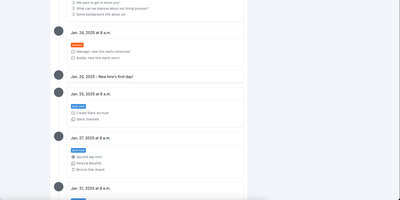
New hires fail from information overload and IT bottlenecks, not lack of goodwill - the observation behind ChiefOnboarding, a free, open-source employee onboarding platform (Django, Celery, PostgreSQL, Redis). Its answer is sequences - drag-and-drop timelines that drip-feed to-do items, resources, courses, forms, and badges to each new hire, triggered by dates or by completing a previous item, so nobody faces everything at once. Onboarding starts before day one: preboarding pages welcome hires early, and colleagues can leave personal messages that appear there. The account provisioning module creates the new hire's Slack, Google, Asana, and other accounts automatically on the scheduled day via a library of integrations plus custom webhooks - the IT ticket queue never gets involved. Everything works through two equivalent interfaces: a full web dashboard and a Slack bot, either usable standalone. Slack can even auto-create new hire accounts when someone joins the workspace and assign default sequences with zero manual action. Colleague tasks with comments and collaboration, a searchable people directory, scheduled introductions, and per-hire timezone awareness (no 3 a.m. notifications) round it out. No trackers, no phoning home - third-party credentials sit in encrypted fields on your server.
Horilla HRMS
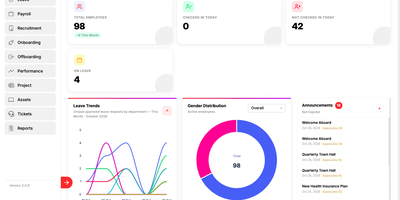
Horilla HRMS gives a growing company one home for the whole employee journey, from the first job posting to the final payslip, instead of five disconnected HR tools. Recruiters publish openings, collect resumes, and drag candidates through a Kanban hiring pipeline with interview scheduling and email built in; the moment someone is hired, structured onboarding checklists take over. Every employee record lives in one directory with documents, job history, and reporting lines, and staff help themselves through a self-service portal for leave requests, attendance views, and payslip downloads. Attendance arrives from biometric devices, mobile check-ins, or geo-fenced punches, and leave balances update themselves as approvals flow through managers. Payroll then reads that same attendance and leave data, applies your salary structures, overtime rules, loans, and statutory deductions, and generates itemized payslips in a single run. Managers set goals, run review cycles, and collect continuous feedback in the performance module, while the asset register tracks every laptop and phone issued to the team. An internal helpdesk queues employee requests with priorities and assignees, offboarding workflows make sure exits are as orderly as arrivals, and LDAP integration ties accounts to your existing directory. Running on a dedicated VPS on RepoCloud with guaranteed CPU, RAM, and SSD, full root SSH access, and a browser serial console. LGPL-2.1 licensed.
Ever Gauzy
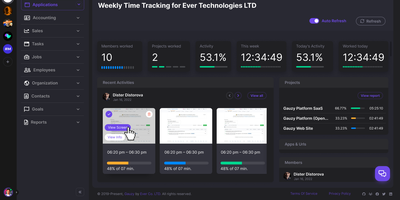
Ever Gauzy consolidates ERP invoicing, CRM sales pipelines, HRM employee records, applicant tracking, and project management into one full-stack TypeScript platform, eliminating the need to stitch together five separate SaaS subscriptions. Over 4,300 GitHub stars and 3,800+ releases back a CQRS architecture that separates command and query responsibilities across modules for invoices, expenses, payments, inventory, contacts, leads, deals, employee onboarding, candidate interviews, hiring workflows, sprints, goals, and KPI tracking. Time tracking captures hours via web timer, Electron desktop timer with activity monitoring and automatic screenshot capture, or browser extension, with timesheet submission and approval workflows supporting billable hour classification across Hubstaff and Upwork integrations. The multi-tenant architecture provides automatic tenant scoping with role-based permissions, while dual ORM support through TypeORM and MikroORM with Knex query builder ensures database flexibility across PostgreSQL, MySQL, and MariaDB. REST APIs documented with OpenAPI and Swagger expose every module for headless operation, complemented by an MCP server offering 323 tools for AI assistant integration. The Angular 19 dashboard provides dark, light, corporate, and material themes with i18n across 10 languages via Crowdin. Supports Docker, Kubernetes, Terraform, and Pulumi deployment with Redis caching and OpenSearch full-text indexing. Running on a dedicated VPS on RepoCloud with guaranteed CPU, RAM, and SSD, full root SSH access, and a browser serial console. AGPL-3.0 licensed.
Urlaubsverwaltung
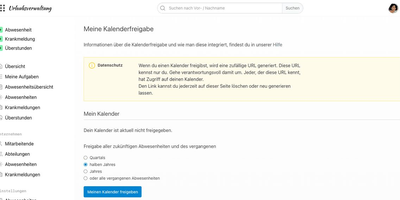
One calendar answers who is away next week: Urlaubsverwaltung is a self-hosted leave and absence manager where employees request vacation, managers approve it, and sick notes and overtime balances live beside the requests. A request moves through waiting, provisionally approved, finally approved, rejected, or cancelled states, so employees and approvers always see where a decision stands. Department heads decide for their own teams, a second stage authority can add the final approval, the boss sees every request company wide, and office staff manage people, settings, and sick notes for others. Administrators configure which absence types exist, from annual and special leave to parental leave, sabbatical, training, and working from home, each with its own color and rules. Sick notes are recorded as full day, morning, or afternoon, including child sick notes, and a note can later be converted into vacation when plans change. Overtime gets the same care: staff log hours and minutes for any period, choose to add or reduce their balance, and attach a comment for the record. Personal, department, and company calendars collect every absence, secret iCal links feed external calendar apps, and optional Google Calendar synchronization pushes new and changed entries. Email notifications for submissions, upcoming absences, substitute duties, and overtime entries can be switched on per person, and a token protected REST API exposes persons, absences, sick notes, and workdays. Running on a dedicated VPS on RepoCloud with guaranteed CPU, RAM, and SSD, full root SSH access, and a browser serial console. Apache-2.0 licensed.
Frappe HR
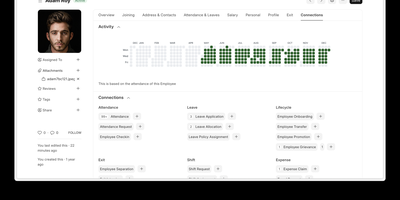
Stitching together separate SaaS subscriptions for applicant tracking, time-off requests, expense approvals, and monthly payroll creates fragmented employee records and costly per-seat bills; Frappe HR consolidates over 13 human resource modules into one self-hosted platform. People operations teams manage the complete employee lifecycle from job openings, interview assessments, and offer letters through structured onboarding, internal transfers, promotions, and exit interviews. Shift planners organize rotational rosters and capture geolocation-verified attendance check-ins, while employees request leave against regional holiday calendars and multi-tier policies. Finance and payroll managers build custom salary structures, configure regional income tax slabs, process regular or off-cycle payslips, and reconcile employee expense claims and cash advances directly with ERPNext accounting ledgers. Goal tracking and appraisal cycles align individual key result areas (KRAs) with self-evaluations and manager feedback scores. A progressive web app interface lets staff submit leave requests, log attendance, and file expense receipts from their phones. Running on a dedicated VPS on RepoCloud with guaranteed CPU, RAM, and SSD, full root SSH access, and a browser serial console. GPL-3.0 licensed.
OrangeHRM
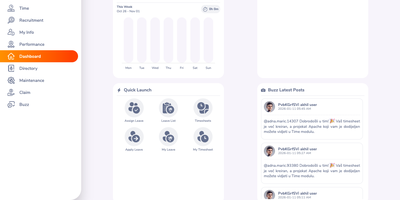
Leave balances, timesheets, and employee files tend to scatter across spreadsheets as a company grows; OrangeHRM pulls them into one human resources system that runs entirely on your own server. Human resources staff keep a complete record for every employee, from contact details and job history to documents, dependents, and custom fields the organization defines. Employees request vacation, sick days, or any leave type you configure, and supervisors approve or reject each request against live entitlement balances instead of counting days by hand. Timesheets and punch-in, punch-out attendance records show who worked on which project and for how long, turning payroll preparation into a review step instead of an investigation. When a position opens, vacancies are published, applications collected, and candidates moved through screening, interviews, and offers with every comment kept on the candidate record. Performance reviews run on scheduled cycles with goals and appraisals recorded per employee, so annual reviews stop depending on whoever kept the best notes. Administrators shape the system around the company itself: organization structure, job titles, pay grades, locations, user roles, and the logo and colors employees see at login. Built-in reports answer everyday questions, like whose contracts end this quarter or which department used the most leave, and the directory gives everyone a searchable view of who does what. Running on a dedicated VPS on RepoCloud with guaranteed CPU, RAM, and SSD, full root SSH access, and a browser serial console. GPL-3.0 licensed.
MintHCM
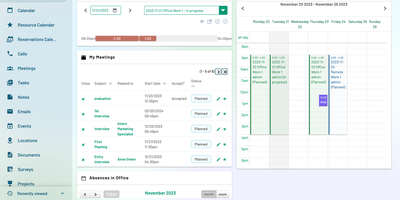
The first AI-enabled open-source Human Capital Management system built for the agentic era — not a legacy HRMS with AI features bolted on, but a platform architected from the ground up with native MCP, A2A, and WebMCP protocols enabling any LLM client to query employee records, create calendar entries, and orchestrate multi-step HR workflows. Built on the battle-tested SuiteCRM/SugarCRM CE foundation and extended with 17 dedicated HR modules — recruitment pipeline with candidate scoring, onboarding checklists, competency matrices, employment history tracking, leave management with accrual policies, time and attendance, resource booking, travel and expense reporting, workplace management, performance evaluations, job description builder, employer branding campaigns, offboarding workflows, and a configurable analytics engine — all controlled through granular role-based permissions. The integrated LangGraph-powered AI agent operates with human-in-the-loop confirmation before mutating data, while the MCP server layer exposes structured HR operations to Claude Desktop, GitHub Copilot, and any MCP-compatible client. Native REST API enables integration with SAP, Workday, and custom applications. Mobile apps for iOS and Android provide field access to employee data and approvals. Runs on Apache2 with PHP 8.2, MySQL 8.0 or MariaDB, and ElasticSearch 7.10+ for full-text search and list indexing. Running on a dedicated VPS on RepoCloud with guaranteed CPU, RAM, and SSD, full root SSH access, and a browser serial console. AGPL v3 licensed.