Headplane
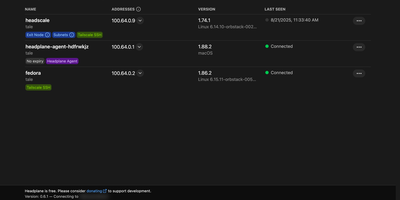
Instead of wrestling with raw command-line flags and YAML configuration files for every device on your self-hosted Headscale mesh VPN, Headplane gives you a Tailscale-style web administration console to manage machines, users, DNS records, and access policies from any browser. From the machines overview, network administrators can inspect connected nodes, view Tailnet IPv4 and IPv6 addresses, rename devices, reassign ownership across users, toggle key expiration, and approve advertised subnet routes or exit nodes in a couple of clicks. Built-in Access Control List (ACL) management lets you edit security policies, define user groups, assign node tags, and configure auto-approvers without manually SSHing into your control server. When someone needs immediate shell access to a remote Linux host on the mesh, the integrated WebSSH console opens an interactive terminal session right inside the browser tab over Tailscale SSH. You can also manage MagicDNS settings, configure split DNS nameservers, and add custom DNS records that automatically reload your Headscale instance. Multi-user administration supports OpenID Connect (OIDC) single sign-on with identity providers like Okta, Authentik, Authelia, and Google Workspace, alongside granular role assignments and pre-authentication key generation for unattended server enrollment. Running on a dedicated VPS on RepoCloud with guaranteed CPU, RAM, and SSD, full root SSH access, and a browser serial console. MIT licensed.
Meshlan
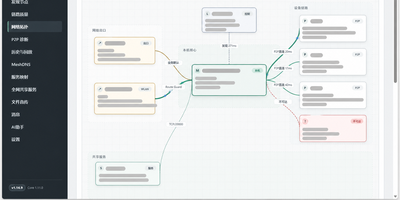
Meshlan turns your own Linux server into the control plane for a private virtual LAN that connects remote Windows devices as if they sat on the same router. Devices pair through your server, receive their certificates, and then talk directly to each other over encrypted tunnels whenever NAT allows, using dual-stack hole punching, UPnP, and STUN diagnostics to find a path. When a direct connection is impossible, traffic falls back to relays, and multiple relay nodes are chosen automatically by latency, jitter, packet loss, and health. You can publish a service that only listens on localhost, a local API, a web panel, a database, a game server, to the mesh on a custom port, with direct access or manual approval by its creator. Names stay stable while addresses change: devices answer to names like alice.mesh and services to api.alice.mesh, and an HTTPS gateway serves mesh websites without port numbers. Files move directly between devices over the encrypted link while the server only distributes metadata. The console shows the live topology with P2P and relay paths, latency, and service health, and local history keeps traffic and events for replay with a time slider. Optional AI automation keeps model keys on the server, encrypts context end to end, and asks for your confirmation before changing anything. Signed updates verify and roll back automatically when a health check fails. Running on a dedicated VPS on RepoCloud with guaranteed CPU, RAM, and SSD, full root SSH access, and a browser serial console. MIT licensed.