Snipe-IT
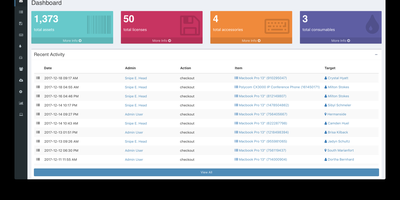
Trusted by thousands of organizations worldwide with over 14,700 GitHub stars, Snipe-IT has been the gold standard in open-source IT asset management since 2013. Built on Laravel 12 with PHP 8.2+, it provides a comprehensive web-based platform for tracking every physical and digital asset in your organization — from laptops and servers to software licenses, accessories, consumables, and components. The check-in/check-out system assigns assets to users with full audit trails, digital signature acceptance, and automated email notifications for checkouts, approaching deadlines, expiring warranties, and low inventory. License management handles multi-seat software with seat-by-seat tracking, compliance monitoring, and expiration alerts. Custom fields let you capture organization-specific metadata, while the advanced search engine supports logical operators including and/or conditions, exact matching with is:value, fuzzy exclusions with not:value, and null checks. SCIM 2.0 integration synchronizes users, groups, locations, companies, and managers from identity providers like Azure Entra ID and Okta. Enterprise authentication supports LDAP, Active Directory, Google Secure LDAP, and SAML 2.0 single sign-on. The reporting dashboard generates custom asset reports with saved templates, depreciation schedules, and audit logs. QR code labels enable instant mobile asset lookup via barcode scanners. The full-featured JSON REST API powers custom integrations, with community-built SDKs, MCP servers, and third-party mobile apps including SnipeMate and Snipe-Scan. Deploy via Docker Compose with MariaDB 11 in minutes. Running on a dedicated VPS on RepoCloud with guaranteed CPU, RAM, and SSD, full root SSH access, and a browser serial console. AGPL-3.0 licensed.
Request Tracker
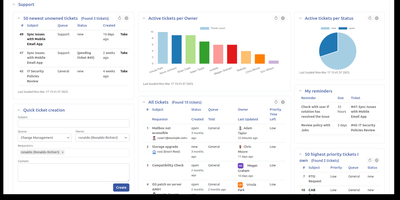
Email-driven ticketing for IT, support, and operations teams: Request Tracker turns every message sent to support@, helpdesk@, or security@ into a tracked ticket with an owner, a priority, a due date, and a complete audit trail. Staff reply to customers and comment privately to colleagues from the web interface or straight from their inbox, while requestors follow their own tickets in a self-service portal. Lifecycles built in a visual editor define custom statuses, transitions, and rights per queue, and scrips fire notifications or automated actions whenever a ticket changes. Service level agreements honor business hours, escalations trigger as deadlines approach, and scheduled tickets recreate recurring chores such as monthly patch windows. A transaction query builder, saved searches, charts, and drag-and-drop dashboards turn ticket history into reports that export to CSV or arrive by email on a schedule. Asset catalogs track laptops, licenses, and servers beside the tickets that mention them, and an Articles knowledge base feeds canned answers into replies. Time worked is logged per ticket with a My Week timesheet, approvals route sensitive requests to the right people, and PGP or S/MIME protects email in both directions. A REST2 API, a command-line client, and more than 400 extensions connect RT to the rest of your tooling. Running on a dedicated VPS on RepoCloud with guaranteed CPU, RAM, and SSD, full root SSH access, and a browser serial console. GPL-2.0 licensed.
Infrahub
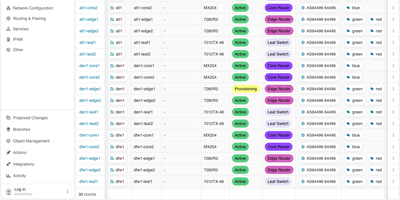
For network and infrastructure teams, Infrahub is one validated source of truth for devices, IP space, circuits, and services, with Git-style branches for every change. You write the schema in YAML, and Infrahub builds the web interface and API endpoints from it, covering sites, devices, interfaces, VLANs, BGP sessions, or any concept your business needs. Built-in IPAM tracks IPv4 and IPv6 prefix trees, utilization, addresses, namespaces, and resource pools. Work on a branch, compare a per-object diff of added, removed, and updated records, resolve conflicts, and merge through a proposed change that bundles data, files, artifacts, schema, and check results. Python checks enforce your own design rules, such as two WAN circuits per site, before anything merges. Immutable history and an activity log answer who changed what, and when. Transformations in Jinja2 or Python render device configurations and other documents as stored artifacts, while Generators create objects from a site design. Git repositories supply schemas, queries, and templates. GraphQL, REST, a Python SDK, an Ansible collection, and a Nornir plugin feed existing automation, Infrahub Sync imports from NetBox or Nautobot, and an optional MCP server lets Claude and Cursor read the data. Running on a dedicated VPS on RepoCloud with guaranteed CPU, RAM, and SSD, full root SSH access, and a browser serial console. Apache-2.0 licensed.
OTOBO
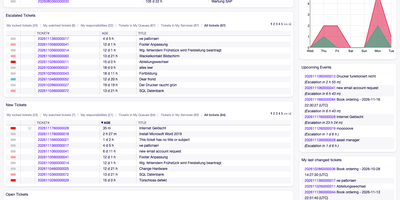
Email, phone, and portal requests become tickets with owners, queues, and deadlines in OTOBO, the open-source service management platform for IT, HR, and facility teams. Agents start on a dashboard of reminder, escalated, and new tickets, with a seven-day created-versus-closed chart and a list of upcoming escalations. Opening a ticket shows its service, service level agreement, owner, customer details, and a full article history where agents reply, forward, split, pin, or add notes. Queues, roles, and access control lists decide who sees what, while PostMaster filters sort incoming mail by sender, subject, or keywords. Dynamic fields attach custom data to tickets and can point at customers, services, and FAQ articles. Process management models multi-step workflows such as approvals with approve and reject buttons. Power search finds tickets and configuration items as you type, and a Similar Tickets widget surfaces related cases. Customers open and follow their requests in a white-label self-service portal. Optional add-on packages bring a CMDB whose configuration items link to tickets, an FAQ knowledge base, and customer satisfaction surveys. Team calendars handle recurring appointments, built-in statistics and reports measure service performance, and sign-on works through OpenID Connect, LDAP, or Active Directory. REST and SOAP web services connect OTOBO to other systems. Running on a dedicated VPS on RepoCloud with guaranteed CPU, RAM, and SSD, full root SSH access, and a browser serial console. GPL-3.0 licensed.
CISO Assistant
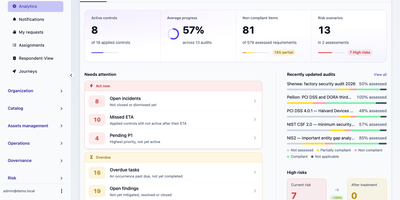
Compliance audits, risk registers, vendor reviews, and evidence usually sit in separate spreadsheets; CISO Assistant keeps them in one connected, self-hosted GRC platform. Run audits against more than 200 frameworks, including ISO 27001, NIST CSF, SOC 2, PCI DSS, NIS2, DORA, GDPR, and HIPAA, scoring each requirement and attaching evidence and applied controls. A mapping from the library projects a finished audit onto another framework, so the same questions are not answered twice. Risk assessments rate scenarios on configurable matrices, record current and residual levels, link the controls that treat them, and open matrix and action-plan views, plus EBIOS RM studies and quantitative analysis. Applied controls, policies, and recurring tasks carry owners and due dates, evidence attaches to them, and a month-by-month control plan shows what is outstanding. Third-party risk covers vendors, solutions, contracts, criticality tiers, and questionnaires that vendor representatives answer themselves. Assets, business impact analyses, incidents, and a GDPR register with DPIA screening share the same workspace. Analytics tabs list what needs attention, and a workflow builder can email scheduled digests or react to events. An MCP server with 139 tools lets Claude, ChatGPT, or LM Studio read and change records, and an optional chat assistant answers questions with a local or hosted model. SAML or OIDC single sign-on, MFA, a REST API, and a CLI cover access and automation. Running on a dedicated VPS on RepoCloud with guaranteed CPU, RAM, and SSD, full root SSH access, and a browser serial console. AGPL-3.0 licensed.
Znuny
Znuny turns every customer request into a ticket with an owner, a priority, a deadline, and a complete history, no matter whether it arrived by email, phone, web portal, API, or a monitoring alert. Agents work from a dashboard that lists open and new tickets, escalations, running processes, a seven-day created-versus-closed chart, upcoming events, and logged-in colleagues. Queues route tickets to the right team, and automation handles classification, escalation, notifications, and state changes, from simple email filters up to multi-step business processes. Service level agreements are tracked against every ticket, with alerts before deadlines pass and overdue items highlighted. Customers help themselves through a self-service portal and a searchable FAQ knowledge base, while agents opening a ticket immediately see who the customer is, which company they belong to, the services they are entitled to, and their full support history. Configuration items in the CMDB link assets and services to the tickets they affect, statistics and reports turn ticket data into decisions, and calendar appointments can create tickets on schedule. Administrators shape the system with over 2,000 configuration options, dynamic fields, and granular permissions. Running on a dedicated VPS on RepoCloud with guaranteed CPU, RAM, and SSD, full root SSH access, and a browser serial console. GPL-3.0 licensed.
AnsibleForms
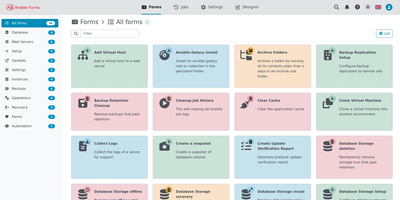
AnsibleForms turns Ansible playbooks into self-service web forms that colleagues can run safely, with the right variables, without filing a ticket or touching a terminal. A colleague picks the form, fills in fields that validate as they type, and the job launches with exactly the variables the playbook expects. Dropdowns can cascade from a database query, a REST call, or a small expression, so the environment list is never typed from memory and the wrong region is never an option. Forms feed playbooks running in runtime containers or templates on the AWX, Semaphore, Rundeck, or Jenkins servers you already have, and workflows chain them with conditions, success and failure paths, and an approval step when a person should look first. Runs can be scheduled, stored, aborted, and relaunched, with live output while they work and a full history afterward. Designers edit forms in the browser and keep everything in Git, sign-in stretches from local accounts to LDAP and OIDC, and credentials travel encrypted or straight from Vault. Running on a dedicated VPS on RepoCloud with guaranteed CPU, RAM, and SSD, full root SSH access, and a browser serial console. GPL-3.0 licensed.
DFIR-IRIS
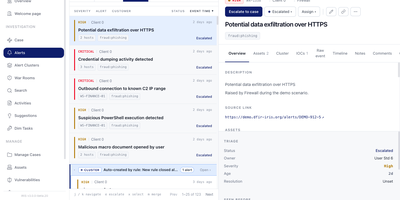
Incident response teams get one shared workspace for alerts, cases, evidence, and timelines in DFIR-IRIS, a free, self-hosted platform built for collaborative investigations. Alerts from SIEM and EDR tools arrive through an API, where analysts triage them, assign owners, and merge or escalate them into cases. Cases record a customer, classification, and SOC ticket ID, and case templates pre-fill the summary, tags, tasks, and note folders so every incident starts from your playbook. Assets, IOCs with TLP levels, tasks, notes, and uploaded evidence sit side by side in the case. The timeline orders events chronologically and files them under categories such as Initial Access, Lateral Movement, and Exfiltration. The case graph maps how assets, IOCs, and events connect. Modules enrich indicators with VirusTotal or MISP and push events to Slack, Microsoft Teams, Discord, or automation tools such as Shuffle. A datastore keeps case files organized, with IOC files wrapped in password-protected archives. Investigation and activity reports export to DOCX, Markdown, or HTML from templates your administrators manage. Customers, groups, and per-user rules decide who can see, read, or edit each case, and custom attributes extend any case object with the fields your team needs. Running on a dedicated VPS on RepoCloud with guaranteed CPU, RAM, and SSD, full root SSH access, and a browser serial console. LGPL-3.0 licensed.
GLPI
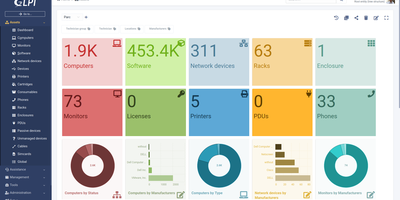
GLPI combines helpdesk ticketing, hardware inventory, license compliance, CMDB, and project management in a single PHP application with over 6,200 GitHub stars and 500,000+ Docker pulls, offering a unified ITSM platform that replaces ServiceNow, Freshservice, and ManageEngine without per-agent pricing. The ITIL-aligned service desk handles incidents, problems, changes, and service requests with configurable SLA management, approval workflows, satisfaction surveys, and business rules that automate ticket routing, escalation, and categorization. Native dynamic inventory through the GLPI Agent discovers Windows, Linux, and macOS endpoints with deep hardware profiling, while network discovery scans switches, printers, and infrastructure devices automatically. Software and license management tracks per-user and per-core license allocations with compliance reporting, expiration alerts, and financial cost tracking across the asset lifecycle from purchase through depreciation to disposal. Data center infrastructure management provides rack visualization with U-level positioning, PDU tracking, and connection mapping. The integrated forms editor builds custom request portals for end-users, while the self-service portal lets users submit tickets, browse the service catalog, and reserve assets. Webhooks trigger external HTTP calls on events, and the High-Level REST API v2 exposes every resource for automation. A plugin marketplace offers 90+ extensions for monitoring integration, advanced reporting, and authentication. Deploy via Docker with the glpi/glpi image alongside MySQL. Running on a dedicated VPS on RepoCloud with guaranteed CPU, RAM, and SSD, full root SSH access, and a browser serial console. GPLv3 licensed.
iTop
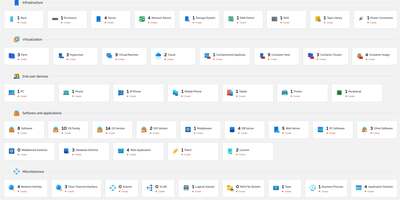
Keep every ticket tied to the servers, applications, and contracts it affects with iTop, an IT service management platform that joins a configuration management database (CMDB) to a helpdesk. Agents work user requests, incidents, problems, known errors, and changes through ITIL-style life cycles, and SLA targets for time to own and time to resolve move a ticket to an escalated status when a deadline passes. The CMDB models infrastructure, virtualization, end-user devices, software, and business applications, and its impact analysis graph shows what a failing server would take down. A service catalog of services and subcategories, backed by customer and provider contracts, feeds a user portal where employees and customers submit requests from a mosaic, tree, or list, follow progress, add comments and attachments, and reopen resolved tickets. Administrators bulk-load inventory from CSV, run consistency audits to catch data-quality problems, synchronize records from external sources, and connect other tools through REST web services. Sign-in works with local accounts, LDAP, or CAS, with optional two-factor authentication through authenticator apps, email codes, or recovery codes, and the console offers dark, high-contrast, and color-blind-friendly themes. Running on a dedicated VPS on RepoCloud with guaranteed CPU, RAM, and SSD, full root SSH access, and a browser serial console. AGPL-3.0 licensed.
FreeITSM
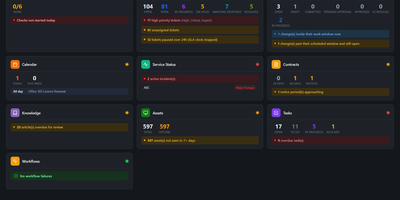
Run an entire IT service desk without paying per seat: FreeITSM turns email, chat, and portal requests into tickets and keeps assets, knowledge, changes, and projects in the same place. The inbox looks like Outlook, with folders by department or team, SLAs, canned replies, internal notes, time entries, and bulk actions. Messages arrive from Microsoft 365, Gmail, IMAP, WhatsApp, Telegram, Slack, Microsoft Teams, Mattermost, and an embeddable web chat widget. A Watchtower dashboard shows what needs attention across every module at a glance. Asset records collect hardware, software, storage, contracts, and lease dates, and a CMDB maps servers, databases, applications, and services. Change management tracks approvals and scheduled work windows, and a shared calendar covers on-call rotas and maintenance. Tasks run on a Kanban board with list, calendar, and timeline views, and projects add health rings and plans. Staff publish knowledge articles in folders with tags, and end users get a portal with a request catalogue. Optional AI features, using your own keys or a local model server, clean up replies and answer questions from the knowledge base. Running on a dedicated VPS on RepoCloud with guaranteed CPU, RAM, and SSD, full root SSH access, and a browser serial console. MIT licensed.
ManageIQ
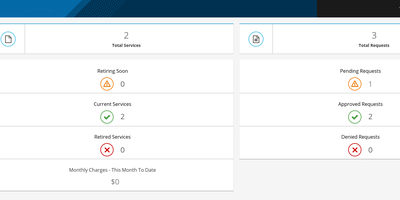
ManageIQ gives operators one console for every cloud and hypervisor the organization runs, connecting to VMware, OpenStack, AWS, Azure, Google Cloud, Kubernetes, OpenShift, and Nutanix to continuously discover inventory, map relationships, and listen for changes without installing agents. Discovered estates become manageable: operators publish bundles of resources into a self-service catalog that end users order like apps, then govern the full life cycle through policy, compliance, delegated operations, and retirement. SmartState analysis scans the contents of VMs, hosts, and containers agentlessly, even foreign or uncooperative ones, feeding security and compliance policies that flag drift automatically. Utilization metrics reveal idle systems and right-sizing opportunities, with capacity planning and what-if scenarios before hardware purchases. Chargeback and showback assign rates to tenants, group VMs by tag or container images by label, and generate reports in multiple currencies. Embedded Ansible automation executes playbooks for provisioning and remediation, and the Spassky release adds Nutanix and Terraform Enterprise providers on a Rails 7.2 core. Running on a dedicated VPS on RepoCloud with guaranteed CPU, RAM, and SSD, full root SSH access, and a browser serial console. Apache-2.0 licensed.
Ralph
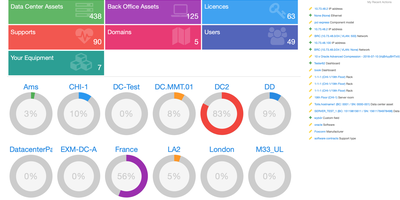
Ralph tracks thousands of assets across data centers and back offices through a unified CMDB, DCIM, and asset management platform, providing the same capabilities as ServiceNow, Device42, and Sunbird dcTrack without per-asset licensing fees. Used by Allegro in production and backed by over 2,500 GitHub stars, it is built on Python 3 with Django and Django REST Framework. Interactive data center floor plans support drag-and-drop rack placement, front and rear rack views showing U-level asset positioning, power consumption tracking per PDU, and ethernet and fiber connection mapping. The back office module manages laptops, desktops, printers, mobile phones, and accessories with user assignment tracking, warehouse inventory, stock-taking audits, and automated loan workflows. IP address management handles network environments with DHCP and DNS integration alongside network topology visualization. Software license tracking monitors per-user and per-core allocations with usage calculations, compliance reporting, and expiration alerts, while vendor support contracts track SLA agreements and warranty renewal dates. The transitions system automates asset lifecycle processes through configurable workflows that trigger HTTP webhooks, custom Python scripts, email notifications, and Puppet and Ansible configuration management integration. Custom fields extend the data model with text, numbers, dates, choices, and URLs per asset type, accessible via the REST API. Multi-tenant architecture organizes assets by regions, data centers, service environments, and business units. Deploy via Docker with the allegro/ralph image alongside MySQL and Redis. Running on a dedicated VPS on RepoCloud with guaranteed CPU, RAM, and SSD, full root SSH access, and a browser serial console. Apache 2.0 licensed.