Doccano
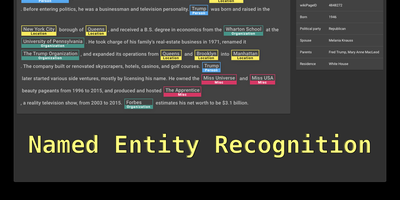
Doccano is a text annotation platforms for building machine learning training datasets. The web-based interface supports text classification for sentiment analysis and document categorization, sequence labeling for named entity recognition with overlapping entity support and relation extraction between labeled spans, and sequence-to-sequence annotation for text summarization and machine translation pairs. Collaborative annotation enables multiple annotators to work on the same project simultaneously with per-user progress tracking, annotation guidelines, example assignment to specific members, and filtering by assignee. Auto-labeling integrates with external machine learning model APIs through configurable request and response mapping templates, allowing pre-annotation that annotators can review and correct. Data import accepts plain text, JSONL, CoNLL, and Excel formats, while export produces JSONL and CoNLL datasets compatible with spaCy, Hugging Face Transformers, PaddleNLP, and other training frameworks through the doccano-transformer library. The Django backend with Django REST Framework exposes a complete RESTful API for programmatic project creation, dataset management, and annotation retrieval via the official doccano-client Python library. Celery handles background tasks including dataset import and export processing with Flower providing task monitoring. One-click deployment supports AWS CloudFormation and Heroku alongside Docker Compose for self-hosted environments. Running on a dedicated VPS on RepoCloud with guaranteed CPU, RAM, and SSD, full root SSH access, and a browser serial console. MIT licensed.
Casdoor
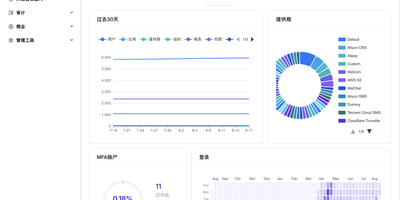
With 13,800+ GitHub stars and active releases through 2026, Casdoor is the open-source identity platform that ships OAuth 2.0, OIDC, SAML 2.0, CAS, LDAP, SCIM 2.0, WebAuthn passkeys, TOTP multi-factor authentication, and Face ID biometric login in a single Go binary with a React web console — covering every authentication protocol your organization will ever need. Social login connects 50+ identity providers including Google, GitHub, Microsoft Azure AD, Facebook, WeChat, DingTalk, Apple, Twitter, and LinkedIn without custom code. The AI-first architecture includes a Model Context Protocol gateway for AI agent authentication and Agent-to-Agent protocol support for securing LLM-powered workflows. Built-in Casbin integration delivers authorization primitives beyond basic RBAC: attribute-based access control, relationship-based access control, and custom policy models through a unified engine. The organization-scoped multi-tenancy model isolates users, applications, and identity providers per tenant with customizable login pages, branding, and SMTP configuration. SCIM 2.0 endpoints automate user provisioning from HR systems and Active Directory. Official SDKs for Go, Java, Node.js, Python, and PHP accelerate application integration. The RESTful API exposes every resource for programmatic management. Comprehensive audit logs record authentication events and administrative actions. Deploy via Docker Compose with MySQL or PostgreSQL, the all-in-one SQLite Docker image for quick trials, or the official Kubernetes Helm chart for production clusters. Running on a dedicated VPS on RepoCloud with guaranteed CPU, RAM, and SSD, full root SSH access, and a browser serial console. Apache 2.0 licensed.
GLPI
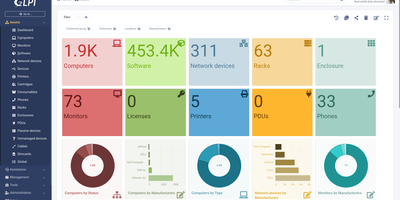
GLPI combines helpdesk ticketing, hardware inventory, license compliance, CMDB, and project management in a single PHP application with over 6,200 GitHub stars and 500,000+ Docker pulls, offering a unified ITSM platform that replaces ServiceNow, Freshservice, and ManageEngine without per-agent pricing. The ITIL-aligned service desk handles incidents, problems, changes, and service requests with configurable SLA management, approval workflows, satisfaction surveys, and business rules that automate ticket routing, escalation, and categorization. Native dynamic inventory through the GLPI Agent discovers Windows, Linux, and macOS endpoints with deep hardware profiling, while network discovery scans switches, printers, and infrastructure devices automatically. Software and license management tracks per-user and per-core license allocations with compliance reporting, expiration alerts, and financial cost tracking across the asset lifecycle from purchase through depreciation to disposal. Data center infrastructure management provides rack visualization with U-level positioning, PDU tracking, and connection mapping. The integrated forms editor builds custom request portals for end-users, while the self-service portal lets users submit tickets, browse the service catalog, and reserve assets. Webhooks trigger external HTTP calls on events, and the High-Level REST API v2 exposes every resource for automation. A plugin marketplace offers 90+ extensions for monitoring integration, advanced reporting, and authentication. Deploy via Docker with the glpi/glpi image alongside MySQL. Running on a dedicated VPS on RepoCloud with guaranteed CPU, RAM, and SSD, full root SSH access, and a browser serial console. GPLv3 licensed.
Mailcow
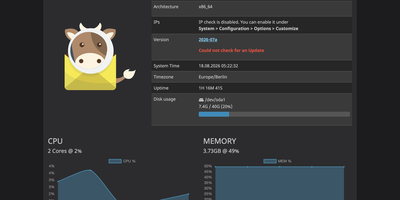
With over 13,000 GitHub stars and active monthly releases, Mailcow delivers a production-ready mail server infrastructure through Docker Compose orchestration of twelve integrated containers. The stack pairs Postfix as the MTA handling SMTP traffic with Dovecot for IMAP and POP3 retrieval featuring the Flatcurve full-text search engine, while Rspamd provides machine-learning-powered spam filtering with Bayesian classification, DKIM signing, and ARC support. ClamAV scans attachments for malware including Office document macro analysis via Olefy, and SOGo serves as a responsive webmail client with CalDAV, CardDAV, and Microsoft ActiveSync synchronization. The admin panel manages multiple domains, per-user spam score thresholds, quarantine review, black and whitelists, temporary spam aliases, mailbox quotas, and TLS enforcement policies for both inbound and outbound messages. Security features include two-factor authentication via TOTP, WebAuthn, and Yubikey OTP, a Fail2ban-like Netfilter integration for brute-force protection, and automatic SPF, DKIM, and DMARC configuration. The ACME container handles Let's Encrypt certificate generation with DNS-01 challenge support, while Postfix TLS-Pol provides MTA-STS and DANE/TLSA resolution for encrypted transport. Built-in imapsync enables periodic migration from remote mailboxes, and the REST API allows programmatic management of all server resources. MariaDB stores user data, Redis caches configuration and sessions, and Unbound provides local DNSSEC-validating DNS resolution. Running on a dedicated VPS on RepoCloud with guaranteed CPU, RAM, and SSD, full root SSH access, and a browser serial console. GPL-3.0 licensed.
Tabby
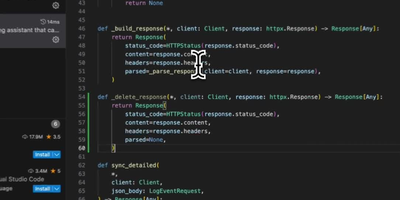
With over 33,000 GitHub stars and a codebase written in 92.9% Rust for maximum performance and memory safety, Tabby is the most widely adopted self-hosted alternative to GitHub Copilot — delivering real-time code completions entirely on your own infrastructure with zero code leaving your network. Deploy a single Docker container on any NVIDIA CUDA, Apple Silicon Metal, AMD ROCm, or CPU-only server and connect VS Code, JetBrains IDEs (IntelliJ, PyCharm, WebStorm, GoLand), Vim, Neovim, and Emacs through native extensions. The completion engine supports a curated registry of models including StarCoder2 (1B to 15B parameters), DeepSeek-Coder, CodeLlama, CodeGemma, Qwen2.5-Coder, and Mistral Code — swappable at runtime through the admin dashboard without redeployment. Repository indexing parses your Git repositories and feeds project-specific types, function signatures, and patterns into completion context via RAG, producing suggestions that understand your codebase rather than generic boilerplate. The Answer Engine provides instant responses to code queries within the IDE, while inline chat enables contextual code editing and explanation without switching windows. The admin dashboard manages per-developer API tokens, usage analytics, and model configuration. Enterprise features include SSO via LDAP, OAuth, and SAML, role-based access control, and audit logging for compliance environments. A single RTX 4090 workstation serves a team of 10-15 developers with sub-500ms completion latency. Running on a dedicated VPS on RepoCloud with guaranteed CPU, RAM, and SSD, full root SSH access, and a browser serial console. Apache 2.0 licensed.
Roundcube
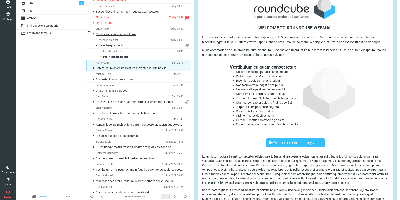
Two decades of continuous development made Roundcube the standard-bearer of open-source webmail - a PHP IMAP client that gives any mail server a polished, application-like interface in the browser. It connects to whatever IMAP/SMTP stack you run - Dovecot, Postfix, a hosted mailbox - and delivers the full desktop-client experience: drag-and-drop message management, threaded conversation views, full MIME and HTML mail handling, find-as-you-type address book with groups and LDAP connectors, multiple sender identities, full-text search, and spell checking in dozens of languages. The default Elastic skin is genuinely responsive, working as well on a phone as a desktop, and the entire UI is skinnable. The plugin API is where deployments get shaped: managesieve exposes server-side filter management in the UI, enigma brings PGP encryption and signing via GnuPG, markasjunk trains spam filters, zipdownload batches attachments, password lets users change credentials, and attachment_reminder catches the classic forgotten-attachment email - among hundreds of community plugins. Built-in caching keeps large mailboxes fast, IMAP ACLs and shared folders support team setups, and XSS protection is engineered into the rendering pipeline. It scales from a single personal mailbox to unlimited users, backed by MySQL, MariaDB, PostgreSQL, or SQLite. GPL-licensed with regular security releases.
Bitwarden
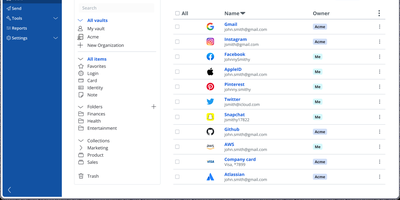
Backed by nearly 20,000 GitHub stars and ranked number one in G2's Enterprise User Satisfaction for eleven consecutive quarters, Bitwarden is the open-source password manager trusted by millions worldwide. The zero-knowledge encryption architecture ensures all vault data — passwords, passkeys, credit cards, identities, secure notes, and file attachments — is encrypted exclusively on client devices using AES-256 with PBKDF2-SHA256 or Argon2id key derivation and RSA-2048 for organization key exchange. Cross-platform clients span a web vault, browser extensions for Chrome, Firefox, Safari, Edge, Opera, Vivaldi, and Brave, native desktop apps for Windows, macOS, and Linux, mobile apps for iOS and Android, and a CLI for scripting. Bitwarden Send enables time-limited, password-protected sharing of text and files, while the built-in TOTP authenticator generates two-factor codes alongside stored credentials. Enterprise deployments integrate with identity providers through SAML 2.0 and OpenID Connect SSO, automate provisioning via SCIM or Directory Connector supporting LDAP, Active Directory, Azure AD, Okta, and OneLogin, and enforce security policies with custom roles and granular permissions. Emergency access allows designated contacts to request vault view or takeover through configurable waiting periods with cryptographic key exchange. The Secrets Manager stores API keys, tokens, and infrastructure credentials with native GitHub Actions, GitLab CI/CD, Ansible, and Terraform integrations. Running on a dedicated VPS on RepoCloud with guaranteed CPU, RAM, and SSD, full root SSH access, and a browser serial console. AGPL-3.0 licensed.
VictoriaMetrics
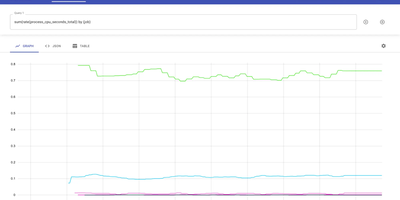
Trusted by thousands of organizations processing billions of time series data points and backed by 17,000+ GitHub stars, VictoriaMetrics delivers a monitoring and time series database that outperforms Prometheus by 16x on query speed while consuming 2.5x less disk space through its optimized compression and storage engine. The architecture supports both single-node deployments handling 10M+ active time series and a horizontally scalable cluster version with vminsert, vmstorage, and vmselect components providing multi-tenancy, replication, and independent namespace isolation. Data ingestion accepts both push protocols including InfluxDB line protocol, Graphite plaintext, OpenTSDB HTTP, CSV, and OpenTelemetry OTLP alongside pull-based Prometheus scraping and remote write, enabling drop-in replacement of existing monitoring stacks without reconfiguring exporters. MetricsQL extends standard PromQL with additional functions, subqueries, and implicit time range alignment while maintaining full backward compatibility with existing Prometheus alerts and Grafana dashboards. The vmalert component processes recording and alerting rules with Alertmanager integration, while vmbackup and vmrestore enable point-in-time snapshots to S3, GCS, and Azure Blob Storage. Stream aggregation operates as a StatsD alternative for pre-aggregating high-cardinality metrics before storage. NFS-compatible storage backends including Amazon EFS and Google Filestore allow shared persistent volumes across cluster nodes. Running on a dedicated VPS on RepoCloud with guaranteed CPU, RAM, and SSD, full root SSH access, and a browser serial console. Apache-2.0 licensed.
SD WebUI Forge
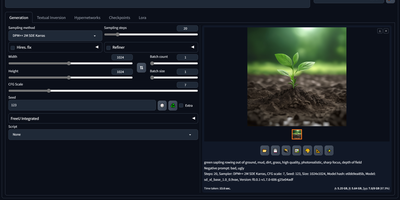
With 12,800 GitHub stars and backing from the same developer who created ControlNet, Stable Diffusion WebUI Forge replaces Automatic1111's inference backend with a dynamic GPU memory management system that runs SDXL 30-75% faster while consuming significantly less VRAM — enabling 1024x1024 generation on 6GB cards where A1111 requires 8GB or more. The Gradio 4 interface provides txt2img, img2img, inpainting, and outpainting workflows with a Forge Canvas supporting pressure-sensitive input from Wacom tablets and Microsoft Surface devices. Native Flux.1 model support loads Flux Dev and Schnell checkpoints using BitsandBytes NF4 and FP8 quantization for deployment on consumer GPUs without model splitting. Built-in ControlNet integration includes all preprocessors — Canny, Depth, Normal, OpenPose, MLSD, Scribble, Segmentation, Tile, and IP-Adapter — without requiring separate extension installation. The extension ecosystem maintains full compatibility with popular Automatic1111 extensions including Adetailer for face enhancement, After Detailer, Regional Prompter, and Dynamic Prompts. LoRA loading supports standard, LyCORIS, and DoRA formats with automatic weight detection. The API provides RESTful endpoints for txt2img, img2img, extra single/batch processing, and progress monitoring enabling headless batch generation. Deploy via one-click installer package, Python virtual environment, or Docker with NVIDIA GPU passthrough. Running on a dedicated VPS on RepoCloud with guaranteed CPU, RAM, and SSD, full root SSH access, and a browser serial console. AGPL-3.0 licensed.
Navidrome
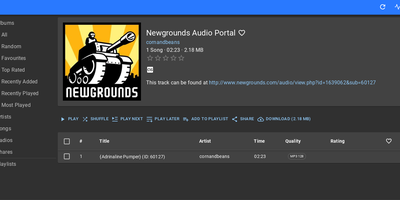
Spotify economics without the subscription or catalog gaps: Navidrome, the reference self-hosted music server, streams your own FLAC, MP3, and ALAC collection from a single Go binary with a React/Material UI web player. Its Subsonic/OpenSubsonic API compatibility is the superpower: 50+ existing clients work out of the box, from Symfonium and DSub on Android to Feishin and Sonixd on desktop, plus Android Auto, CarPlay, and Android TV apps. Transcoding is server-managed and FFmpeg-backed - FLAC direct-plays at home and downsamples to MP3, AAC, or Opus over mobile bandwidth, with the OpenSubsonic transcoding extension letting clients declare capabilities and receive per-track direct-play or transcode decisions automatically. Multi-user support gives every account its own play counts, favorites, ratings, and playlists, and multi-library support scopes different collections to different users. The feature list covers serious listening: Last.fm and ListenBrainz scrobbling, artist bios and images, embedded and external lyrics, audiobook bookmarks, saved play queues that resume on another device, internet radio, jukebox mode, and M3U playlist auto-import kept in sync with your folder. Resource usage is famously low - it runs happily on a Raspberry Pi and scales to six-figure track counts.
LibreTranslate
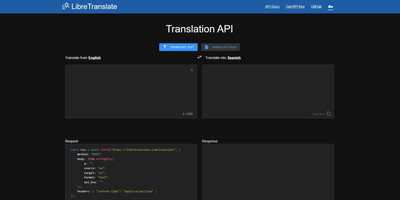
Machine translation with no Google, no Azure, no per-character billing, and no text leaving your infrastructure: LibreTranslate is a free, open-source translation API that runs entirely on your own server. The engine underneath is Argos Translate, which runs OpenNMT neural models with SentencePiece tokenization and Stanza sentence-boundary detection, all offline. Models install as portable .argosmodel packages covering dozens of languages - English, Spanish, French, German, Chinese, Japanese, Russian, Arabic, Hindi, Portuguese, and many more - and Argos handles automatic pivoting: with es-to-en and en-to-fr installed, it chains them to translate es-to-fr without a direct model. The API is a straightforward HTTP POST to /translate with source and target language codes, returning JSON - simple enough that the ecosystem has clients in every major language and integrations across tools like Weblate and Mastodon. Beyond plain text it translates HTML while preserving markup and handles whole file uploads (documents in, translated documents out), plus automatic language detection when the source is unknown. A clean bundled web UI serves interactive translation for end users, and optional API keys with rate limits control access. AGPL-licensed and trainable with custom models, it is the standard answer when translation must be private, unmetered, and self-contained - GDPR-sensitive text never touches a third party.
BillionMail
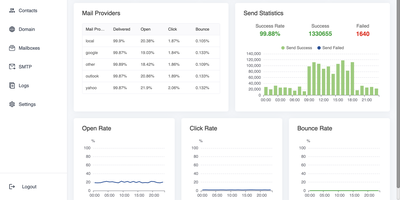
With over 15,000 GitHub stars accumulated since its February 2025 launch, BillionMail delivers the rare combination of a production mail transfer agent and a full email marketing suite in a single self-hosted package — eliminating the monthly per-subscriber fees charged by Mailchimp, SendGrid, and similar platforms. The Go-based architecture bundles Postfix for SMTP transmission, Dovecot for IMAP and POP3 mailbox access, Rspamd for intelligent spam filtering and greylisting, and RoundCube for browser-based webmail, all orchestrated through Docker Compose with PostgreSQL for persistent storage and Redis for queue management and caching. The marketing engine supports unlimited subscriber lists with tag-based segmentation, scheduled campaign sends, A/B subject line testing, and both HTML and drag-and-drop visual template editors for crafting responsive emails without coding. Real-time analytics dashboards track sent volume, deliverability rate, open rate, click-through rate, and bounce reasons, while the platform provides step-by-step DNS record configuration wizards for SPF, DKIM, and DMARC to maximize inbox placement. A transactional email API exposes REST endpoints for single and batch sending, enabling integration with CRM systems, e-commerce platforms, and custom applications. Auto-provisioned free SSL certificates, Fail2ban brute-force protection, and privacy-first architecture with zero third-party tracking ensure secure operation. The platform installs in under eight minutes via a single shell script and supports SMTP on port 25, SMTPS on 465, submission on 587, IMAP on 143/993, and POP3 on 110/995. Running on a dedicated VPS on RepoCloud with guaranteed CPU, RAM, and SSD, full root SSH access, and a browser serial console. AGPLv3 licensed.
OctoPrint
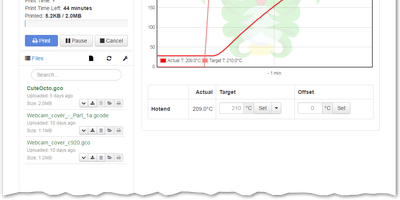
Over a million active instances make OctoPrint the standard web interface for consumer 3D printers - Gina Häußge's Python application, the center of the printing world since 2012. It talks to your printer over USB serial and turns every browser into a control panel: upload, organize, and start G-code prints; watch hotend and bed temperature graphs in real time; drive the print head manually; adjust feed rate, flow, and fan speed mid-print; and hit an emergency stop if things go wrong. The G-code visualizer renders the current layer in sync with the job, and a connected webcam adds a live feed plus automatic timelapse recording of every build. What keeps OctoPrint ahead is its plugin ecosystem - 300+ community plugins installable from the built-in manager. Highlights include Obico's AI spaghetti detection that pauses failed prints automatically, OctoEverywhere for tunnel-based remote access, Bed Level Visualizer's 3D mesh of your bed surface, PrintTimeGenius for accurate time estimates, Exclude Region to abandon one failed object mid-print while others continue, and Firmware Updater to flash Marlin or Klipper without SD-card shuffling. Event hooks fire notifications when prints finish or fail, and a full REST API supports slicer integration and custom automation. AGPL-licensed.
HumHub
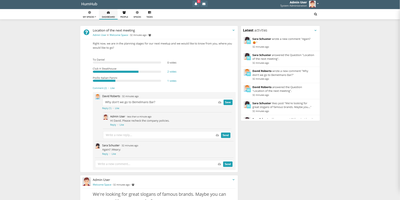
Workplace and Yammer's pattern on your own server, with GDPR compliance by construction rather than contract: HumHub is an open-source enterprise social network from Germany. Built in PHP on Yii2, it organizes everything around four concepts. Users get rich profiles with follows and interactions. Spaces are the structural unit - rooms for departments, projects, events, or clubs, with per-Space permissions, notification settings, and email summaries, and operators can auto-map users into the right Spaces. Content covers posts, wiki pages, photos and video, events, and tasks, with multi-level comments, versioning, archiving, moderation reporting, and filterable full-text search across everything. Modules make it a platform: roughly 80 install-and-activate extensions including Calendar, Wiki, Polls, Tasks, Gallery, News, direct-message Mail, OnlyOffice document editing, Advanced LDAP, SAML and JWT SSO, a RESTful API, mass user import, Translation Manager, and a Theme Builder with custom pages - every one optional and toggleable at runtime. That module economy is why HumHub serves such varied deployments: corporate intranets, city governments, universities, political parties, and nonprofits all configure the same core differently. Requirements are a plain LAMP stack - PHP 8.1+ and MySQL/MariaDB - making it one of the easiest community platforms to operate long-term.
QuestDB
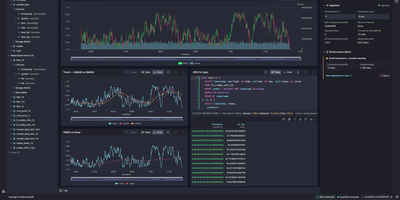
Powering trading floors at firms processing millions of market data events per second and trusted by organizations including Airbus, Yahoo, and Copenhagen Atomics, QuestDB has earned over 17,000 GitHub stars as the time-series database that refuses to make you choose between ingestion speed and query latency. The column-oriented, time-partitioned storage engine processes millions of rows per second on ingest through write-ahead logging with instant durability, while SIMD-accelerated parallel execution returns analytical queries over billions of rows in milliseconds. Time-series SQL extensions add ASOF JOIN for point-in-time lookups across tables with misaligned timestamps, SAMPLE BY for downsampling at arbitrary time intervals, LATEST ON for last-value queries, and WINDOW JOIN for sliding window aggregations — all through standard SQL syntax accessible via the PostgreSQL wire protocol, REST API, or the QuestDB Wire Protocol (QWP) that streams Apache Arrow at 220 million rows per second. Multi-tier storage automatically moves data from the WAL through native columnar format to Parquet files on S3-compatible object storage, keeping hot data fast and cold data portable without manual tiering. The built-in web console provides an interactive SQL editor with syntax highlighting, autocomplete, and charting for quick data exploration. Views, materialized views, and n-dimensional arrays support real-time analytics, while native Parquet export enables direct integration with Python, DuckDB, and AI/ML frameworks. Running on a dedicated VPS on RepoCloud with guaranteed CPU, RAM, and SSD, full root SSH access, and a browser serial console. Apache 2.0 licensed.

Krayin CRM
Krayin CRM gives sales teams a visual Kanban pipeline where leads flow through configurable stages — new, contacted, qualified, proposal, won, lost — with deal values tracked per stage, drag-and-drop transitions, and AI-powered document import that extracts contact details from uploaded PDFs, DOCs, and images without manual data entry. Built on Laravel 12 with a Vue.js frontend and MySQL database, the platform delivers complete customer lifecycle management through a two-stage contact model separating unqualified Leads from qualified Persons linked to Organizations, with a unified timeline displaying associated activities, notes, emails, and deals. The activity module schedules calls, meetings, and tasks on a drag-and-drop calendar with reminders and team assignment. A built-in product catalog supports line-item quoting with pricing and quantities. Email integration connects via SMTP, IMAP, and SendGrid parsing, linked to leads and contacts automatically. Workflow automation triggers actions on conditions and pushes events to external systems via webhooks. The dashboard visualizes pipeline performance, top customers, top products, and email engagement with pie charts and trend widgets. Custom attributes add text, number, date, boolean, and dropdown fields to any entity. Role-based ACLs manage team permissions per module. Extensions add multi-tenant SaaS, WhatsApp lead generation, and VoIP calling. Deploy via Docker Compose. Running on a dedicated VPS on RepoCloud with guaranteed CPU, RAM, and SSD, full root SSH access, and a browser serial console. MIT licensed.
Neko
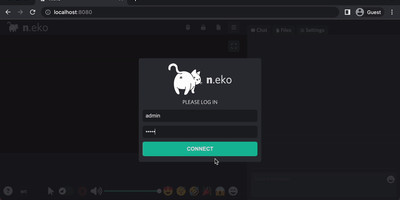
With over 21,000 GitHub stars and six years of steady development through version 3.1.0, Neko transforms any Docker container into a fully interactive browser or desktop environment streamed to web browsers via WebRTC with sub-300-millisecond glass-to-glass latency. The Go backend captures X server display frames using the Pion WebRTC library while the Vue.js frontend renders the remote session with native audio synchronization, delivering a significantly smoother experience than Apache Guacamole or noVNC which rely on image-over-WebSocket approaches. Multiple users simultaneously view and collaboratively control the same session with real-time input synchronization and host-managed control passing between participants. Pre-built Docker images cover Firefox, Chromium, Google Chrome, Tor Browser, Brave, Vivaldi, and Microsoft Edge alongside full desktop environments including XFCE and KDE for running any Linux application. Neko Rooms provides multi-tenant deployment with a REST API for programmatic room provisioning, while Neko Apps extends the platform with additional containerized applications beyond browsers. Sessions persist on the server independently of client connections — close your laptop, reconnect from your phone, and resume exactly where you left off. Optional VPN and Tor integration routes traffic through encrypted tunnels for privacy-sensitive browsing. RTMP broadcasting streams sessions to external platforms. The embeddable client supports iframe integration for custom portals and applications. Running on a dedicated VPS on RepoCloud with guaranteed CPU, RAM, and SSD, full root SSH access, and a browser serial console. Apache-2.0 licensed.
Draw a UI
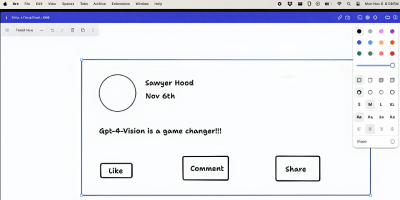
Sketch a wireframe, get working code: Draw a UI turns hand-drawn layouts into web interfaces. It pairs the open-source tldraw canvas with an OpenAI vision model: you sketch a layout - boxes, labels, buttons, arrows, whatever communicates the idea - select the drawing, and click Make Real. The app snapshots your selection as a PNG, sends it to the vision API with instructions to return a single HTML file styled with Tailwind CSS, and renders the result in an iframe directly on the canvas next to your sketch. The loop is iterative: annotate the generated prototype or redraw parts of it, select both the sketch and the previous result, and generate again - the model receives the earlier HTML as context and produces an updated version. Built by Figma engineer Sawyer Hood as one of the first viral GPT-4 Vision demos and the basis for tldraw's "Make Real", it is a Next.js app that runs against your own OpenAI API key. Self-hosting matters here: the upstream demo ships without authentication, so a private deployment keeps your API key from being drained by strangers. MIT-licensed.