LiveCodes
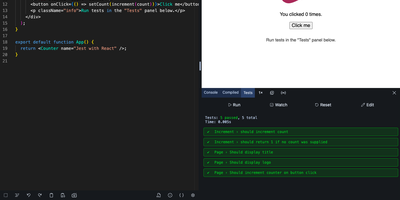
Try an idea in React, Svelte, Python, or SQL without installing anything: LiveCodes is a browser-based playground where code compiles, runs, and previews the moment you type it. Starter templates open ready-made projects for most of the 90+ supported technologies. The desktop editor brings completion, multi-cursor editing, Emmet, and Vim or Emacs bindings, while a lighter touch-friendly editor takes over on phones and tablets. Packages from npm, deno.land/x, jsr, and GitHub import straight into your code, and a console, compiled-code viewer, and test runner show what happens behind the preview. Bring projects in from GitHub gists, GitLab snippets, JS Bin, or zip files, then share them as links or QR codes, export them as HTML, JSON, or zip archives, or send them to CodePen and JSFiddle. Deploy a project to a public URL on GitHub Pages, sync your work across devices, or broadcast your editor and result live to a classroom. An embed builder and SDKs for JavaScript, React, Vue, Svelte, Solid, Preact, and web components place playgrounds inside documentation pages, and prefilled code makes every example editable. Projects stay private by default. Local assets, snippets, themes, and dark or light modes tailor the workspace to each person. Running on a dedicated VPS on RepoCloud with guaranteed CPU, RAM, and SSD, full root SSH access, and a browser serial console. MIT licensed.
Arkon
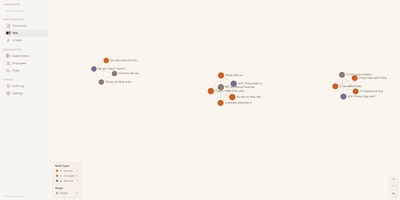
With 1,200+ GitHub stars since its April 2026 launch, Arkon provides an enterprise-grade knowledge management layer that turns scattered organizational documentation into AI-accessible structured context. The platform runs as a centralized MCP server, compiling your SOPs, policies, technical docs, and institutional knowledge into a versioned wiki with draft-approval workflows, then serving that wiki to Claude Desktop, Claude.ai, Cursor, and any MCP-compatible client through a single permission-scoped endpoint. OAuth 2.1 with PKCE authentication eliminates manual token management — employees authenticate through a browser login while the system discovers endpoints automatically via RFC 8414. The RBAC v2 system supports custom roles with granular permissions, department-scoped AI Skills, workspace isolation, and comprehensive audit logging so every query and access event is traceable. RAG retrieval powered by pgvector embeddings enables AI clients to search across all organizational documents with source attribution, while the AI Skills system lets teams define reusable instruction sets scoped to specific departments or roles. The architecture runs seven Docker containers coordinated by Compose: PostgreSQL with pgvector for embeddings and metadata, Redis for caching, MinIO for document storage, a FastAPI backend, two ARQ async workers for embedding generation and document processing, and a Next.js frontend portal accessible on port 3119. API keys are encrypted at rest with Fernet, and no telemetry leaves the deployment. Running on a dedicated VPS on RepoCloud with guaranteed CPU, RAM, and SSD, full root SSH access, and a browser serial console. PolyForm Internal Use licensed.
Fireshare
FireShare turns a folder of game captures on your server into a browsable library where every clip gets its own permanent link, ready to paste into Discord the moment something worth bragging about happens. Point it at the directories you already record to and it scans what is there: the file people watch is always your untouched original, in MP4, WebM, or MOV, never a recompressed stand-in. Privacy is set per file, public for the feed, link-only for friends, or behind a password, and whole folders can be shared as a single link. It also sorts the chaos for you, detecting the game in each capture and shelving hundreds of timestamped filenames under proper cover art you can search and browse. Trim the dead air off a clip before posting it, add a title, description, tags, and a custom thumbnail, and watch the view count climb. For screens that struggle with huge originals, optional transcoding adds adaptive lower qualities on CPU or an NVIDIA GPU, and HDR captures get tone-mapped to SDR instead of looking washed out. Friends can upload through the browser or by token from scripts, new public clips can announce themselves to Discord or an RSS reader, and accounts come with permissions, profiles, and two-factor sign-in. Running on a dedicated VPS on RepoCloud with guaranteed CPU, RAM, and SSD, full root SSH access, and a browser serial console. GPL-3.0 licensed.
Norish
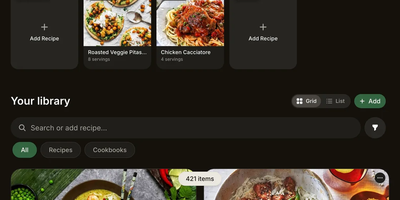
Planning weekly dinners across a busy household becomes effortless with Norish, a real-time recipe manager, meal planner, and smart grocery list platform that captures dishes from any link, video, or cookbook photo. Families and roommates can paste a food blog URL, drop in a YouTube Short, Instagram Reel, or TikTok link, or snap up to ten photos of handwritten recipe cards to generate a clean, structured dish with automatic tags, cuisines, and allergen alerts. When you drag meals onto the shared household calendar or sync your schedule over CalDAV, every ingredient flows into a live grocery list that remembers which supermarket aisle or store each item belongs to and automatically excludes staples already sitting in your pantry inventory. Splitting up in the supermarket aisles works seamlessly because checked-off items disappear on your partner's phone screen the instant you tap them, even across fifteen supported interface languages. In the kitchen, step-by-step cooking mode keeps your screen awake, embeds countdown timers directly inside preparation steps, links fractional ingredient quantities to the exact step where they are used, and scales servings or swaps between metric and US measurements with a single tap. Automatic macro calculations powered by USDA FoodData Central and CIQUAL databases break down calories, protein, carbohydrates, and fat per serving. Running on a dedicated VPS on RepoCloud with guaranteed CPU, RAM, and SSD, full root SSH access, and a browser serial console. AGPL-3.0 licensed.
Gitea Mirror
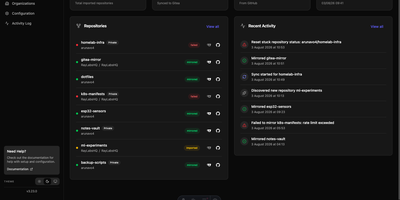
Gitea Mirror is an automated Git repository synchronization platform that mirrors your personal, starred, and organizational GitHub repositories directly to a self-hosted Gitea or Forgejo server. Through the web dashboard, you can connect standard GitHub accounts or GitHub Enterprise environments, discover newly created repositories automatically, and schedule recurring background sync intervals so your self-hosted forge always holds an up-to-date backup. Beyond raw Git commits and branches, the application transfers full repository metadata including issues, pull requests, labels, milestones, releases with attached assets, and project wikis. Teams managing large binary assets such as machine learning weights, media files, or game textures can enable Git LFS mirroring to replicate large objects alongside source code. Organization administrators can map entire GitHub organizations to custom destination namespaces, apply configurable fork handling strategies, preserve source visibility settings, and mark specific repositories to ignore. Built-in force-push protection detects destructive upstream history rewrites and offers backup-on-demand or block-and-approve workflows, while automatic cleanup rules prune deleted upstream repositories and expired activity logs. Access to the management console is secured with local accounts, reverse-proxy header authentication, or external SAML 2.0 and OpenID Connect identity providers. Running on a dedicated VPS on RepoCloud with guaranteed CPU, RAM, and SSD, full root SSH access, and a browser serial console. AGPL-3.0 licensed.
DCM
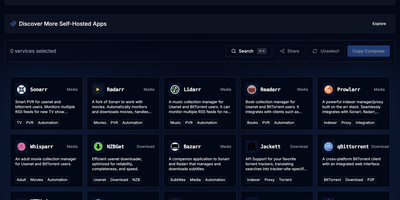
DCM is a visual builder that eliminates docker-compose copy-paste anxiety for home server enthusiasts. The TypeScript and Next.js web interface on port 7576 presents a curated catalog of popular self-hosted applications organized into categories: media management with Jellyfin, Plex, Sonarr, Radarr, and Prowlarr; dashboards like Homarr and Heimdall; databases including PostgreSQL, MariaDB, MongoDB, and Redis; monitoring stacks with Grafana and Prometheus; download clients like qBittorrent and NZBGet; security tools including Vaultwarden; storage solutions like Nextcloud; and home automation via Home Assistant. Select any combination of containers and DCM generates both compose.yaml and .env files with correct volume mounts, environment variables, PUID/PGID ownership, network modes, and port mappings — ready to paste into your terminal. Automatic port conflict detection identifies clashing services and reassigns ports before you ever hit a deployment error. The Template Gallery ships predefined multi-container stacks for common setups: media servers, development environments, database clusters, and monitoring solutions — some incorporating ten or more services in a single template. Built as a static Next.js export served from a 62 MB multi-arch Docker image supporting amd64, arm64, and arm/v7, DCM runs on everything from rack servers to Raspberry Pis. Share generated configurations via URL or download them locally. Running on a dedicated VPS on RepoCloud with guaranteed CPU, RAM, and SSD, full root SSH access, and a browser serial console. AGPL-3.0 licensed.
Email OAuth 2.0 Proxy
Your scanner still emails PDFs, your backup scripts still send nightly reports, and none of them will ever learn OAuth 2.0: Email OAuth 2.0 Proxy learns it on their behalf. It listens on local IMAP, POP, and SMTP ports on your server, and when a client logs in the old-fashioned way with a username and password, the proxy swaps that exchange for a modern SASL XOAUTH2 token before the connection ever reaches the provider. The client never knows anything changed, so ancient mail apps, embedded devices, monitoring tools, and hand-rolled scripts keep sending and fetching mail through Outlook, Office 365, Gmail, Google Workspace, Fastmail, Yahoo, AOL, and any other provider that demands OAuth 2.0. The hop from your client to the proxy stays simple, while the proxy opens a fully encrypted TLS connection upstream, including STARTTLS negotiation for SMTP relays that require it. One proxy instance serves many accounts at once, with each mailbox mapped to its own local port and its tokens cached under a password you control. Optional plugins can even rewrite traffic in flight: strip Microsoft Defender Safe Links back to their real URLs, stop duplicate sent messages, or swallow test mail into a black hole. Setup is a single configuration file covering server ports, per-account scopes, and token endpoints, and the proxy then runs quietly as a headless service. Running on a dedicated VPS on RepoCloud with guaranteed CPU, RAM, and SSD, full root SSH access, and a browser serial console. Apache-2.0 licensed.
Chatterbox TTS
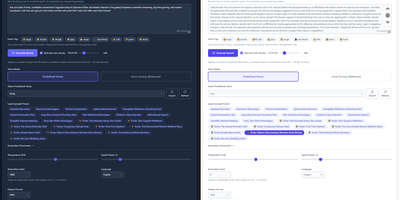
With 26,000 GitHub stars and consistent victories over ElevenLabs in blind evaluations, Chatterbox delivers state-of-the-art text-to-speech with zero-shot voice cloning requiring only 5 seconds of reference audio. The model family spans three architectures: Chatterbox Multilingual V3 (500M parameters, 23+ languages including Arabic, Chinese, Japanese, Korean, Hindi, French, German, Spanish, and Portuguese), Chatterbox-Turbo (350M parameters optimized for voice agents with a single-step distilled decoder achieving ~200ms time-to-first-speech), and Chatterbox-Nano (110M parameters running 3x faster than realtime on 8 CPU cores for edge deployment). Unique among open-source TTS systems, Chatterbox introduces emotion exaggeration control — adjusting intensity from monotone to dramatically expressive via a single parameter — and native paralinguistic tagging where tokens like [laugh], [cough], [chuckle], and [gasp] inject natural vocal reactions inline without post-processing. The alignment-informed inference pipeline eliminates hallucinations and repetition artifacts common in autoregressive TTS. Built-in PerTh neural watermarking embeds imperceptible forensic identifiers in generated audio for provenance tracking. Trained on 500,000 hours of cleaned speech data across all supported languages. Voice conversion scripts enable transforming existing audio into any cloned voice. Deploy via pip install with PyTorch, serve through Gradio interfaces or custom FastAPI endpoints, and expose via HTTP streaming or WebSocket for sub-200ms conversational applications. Running on a dedicated VPS on RepoCloud with guaranteed CPU, RAM, and SSD, full root SSH access, and a browser serial console. MIT licensed.
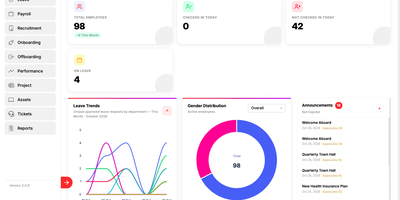
Horilla HRMS
Horilla HRMS gives a growing company one home for the whole employee journey, from the first job posting to the final payslip, instead of five disconnected HR tools. Recruiters publish openings, collect resumes, and drag candidates through a Kanban hiring pipeline with interview scheduling and email built in; the moment someone is hired, structured onboarding checklists take over. Every employee record lives in one directory with documents, job history, and reporting lines, and staff help themselves through a self-service portal for leave requests, attendance views, and payslip downloads. Attendance arrives from biometric devices, mobile check-ins, or geo-fenced punches, and leave balances update themselves as approvals flow through managers. Payroll then reads that same attendance and leave data, applies your salary structures, overtime rules, loans, and statutory deductions, and generates itemized payslips in a single run. Managers set goals, run review cycles, and collect continuous feedback in the performance module, while the asset register tracks every laptop and phone issued to the team. An internal helpdesk queues employee requests with priorities and assignees, offboarding workflows make sure exits are as orderly as arrivals, and LDAP integration ties accounts to your existing directory. Running on a dedicated VPS on RepoCloud with guaranteed CPU, RAM, and SSD, full root SSH access, and a browser serial console. LGPL-2.1 licensed.
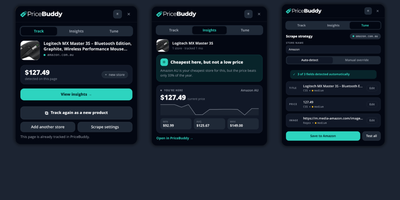
PriceBuddy
Waiting for the right moment to buy usually means refreshing product pages for weeks, so PriceBuddy does the refreshing for you and speaks up when the price is right. Paste a product URL and it fetches the details and price, then rechecks on a global schedule or a per-product interval from every 5 minutes to every 24 hours. Stores are scraped with CSS selectors, regular expressions, or JSONPath, a headless browser covers JavaScript-heavy shops, and an optional AI provider (OpenAI, Anthropic, Gemini, or local Ollama) can recover missing prices or repair broken selectors. Attach several URLs to one product to compare retailers or marketplace listings, with in-stock, pre-order, and discontinued states shown beside each source. Unit pricing reveals the real cost per tablet or bag when multi-packs distort shelf prices, while history charts show minimum, maximum, and average over time. Alerts fire on a target price, a drop threshold, or a back-in-stock event and arrive by in-app notice, email, Pushover, Gotify, Apprise, Telegram, Discord webhook, or ntfy. Tags sort products into draggable dashboard groups, with optional smart sections for what to buy now, recent drops, and failed checks. Each user keeps separate products and settings, a REST API with scoped tokens serves your scripts, and a Chrome and Edge extension tracks items from the page you are viewing. Running on a dedicated VPS on RepoCloud with guaranteed CPU, RAM, and SSD, full root SSH access, and a browser serial console. GPL-3.0 licensed.
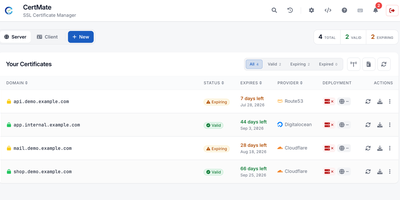
CertMate
Certificate lifetimes are collapsing toward 47 days, which turns TLS from a yearly chore into a weekly one, and CertMate is the control plane that makes that schedule boring. It issues and renews certificates from Let's Encrypt, ZeroSSL, Google Trust Services, Actalis, DigiCert, SSL.com, Sectigo, or your own private CA, validating by DNS-01 through 29 DNS providers, HTTP-01, or a CSR whose private key never leaves the device. Renewals run automatically, earlier when a certificate's life is short or the CA moves the date through ARI, and deploy hooks push each renewed certificate where it is actually served, then probe the live endpoint to prove the new certificate answers. Discovery watches hosts and certificate transparency logs for certificates you did not issue, folding them into one inventory of what is served where and when it expires. Certificates rest on local disk or in Azure Key Vault, AWS Secrets Manager, HashiCorp Vault, Infisical, or S3 storage, with encrypted backups copied off-site. Its built-in CA issues client certificates for mTLS with OCSP and CRL, and can serve ACME itself, so certbot, lego, acme.sh, and cert-manager get internal certificates under EAB rules you define. Every action lands in a tamper-evident, hash-chained audit trail you can export and verify independently. Running on a dedicated VPS on RepoCloud with guaranteed CPU, RAM, and SSD, full root SSH access, and a browser serial console. MIT licensed.

Split Pro
Split Pro settles the question that ruins group dinners, who owes whom, with a private expense ledger that runs on your own server instead of an ad-supported app. Create a group for the apartment, the trip, or the team lunch rotation, then log each shared cost with its category, currency, date, and a photo of the receipt. Every expense splits your way: equally, by percentage, by shares, by exact amounts, or with manual adjustments when someone covered the tip. Rent, utilities, and subscriptions can repeat on a schedule so recurring bills enter the ledger on their own. The balances view shows exactly who is ahead and who owes, and debt simplification collapses a web of small obligations into the fewest possible payments. Negative expenses record refunds and corrections without breaking the math, and the activity feed keeps a visible history of every edit and deletion. Coming from Splitwise, you can import your friends and groups to pick up where you left off, and bank transactions from supported providers convert straight into expenses. On phones it installs as a progressive web app with push notifications whenever a new expense lands. Logins use email magic links, Google, or your own OIDC provider, and signups can be closed so the instance stays limited to your circle. Running on a dedicated VPS on RepoCloud with guaranteed CPU, RAM, and SSD, full root SSH access, and a browser serial console. MIT licensed.
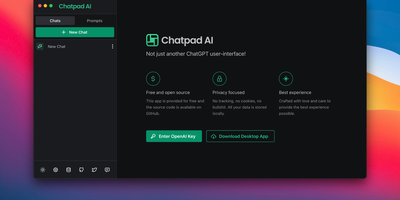
Chatpad
Why should your chat history live on someone else's servers? Chatpad AI - a React/TypeScript front end for the OpenAI API, built on the Mantine component library - is designed around that question. Enter your own OpenAI API key and start chatting with GPT models; every conversation, prompt, and setting is stored locally in your browser via DexieJS over IndexedDB, with no tracking, no cookies, and no backend database at all. That architecture is the point - the Docker image is just Nginx serving static files, making it one of the lightest AI deployments in the catalog, and pay-per-token API pricing typically undercuts a ChatGPT Plus subscription for moderate use. The interface earns its "premium quality" tagline with the details: a persona selector that switches communication styles per conversation, a saved-prompts library for messages you reuse constantly, organized chat history, and full data export/import so conversations move between browsers or into backups as files you control. A JSON config file customizes defaults - models, API endpoints, UI options - without rebuilding the image. AGPL-licensed, with desktop builds available upstream. For teams that want ChatGPT's utility with a self-hosted, zero-telemetry footprint, Chatpad is the minimal, sane answer.
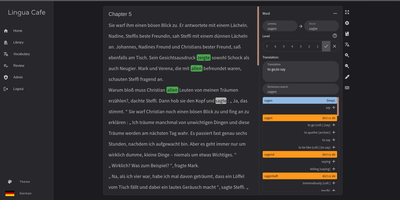
LinguaCafe
LinguaCafe turns your own reading material, novels, news sites, ebooks, and video subtitles, into a private language tutor that lives entirely on your server. Import a text and every word starts out highlighted as new; as you read and mark words known, the highlighting thins out until whole pages sit clean. When an unknown word stops you, the built-in vocabulary search shows its dictionary form, so inflected verbs surface as their infinitive and nouns carry their gender, while optional DeepL translation covers anything the dictionaries miss. Marking a word adds it to your vocabulary, and multi-word selections become phrases that stay highlighted everywhere they appear again. Chapters track how many new, highlighted, and known words they contain, which makes judging a text's difficulty a glance instead of a guess. The review system cycles highlighted words through Leitner-style spaced repetition, and anything you collect can be exported or pushed straight into Anki through AnkiConnect for study on your phone. Japanese learners get kanji and radical breakdowns beside the reading pane. Everything stays local: your books, your words, and your progress never leave the machine. Running on a dedicated VPS on RepoCloud with guaranteed CPU, RAM, and SSD, full root SSH access, and a browser serial console. GPL-3.0 licensed.
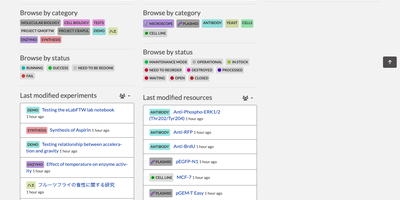
eLabFTW
For research teams that need to show what was recorded and when, eLabFTW® is an electronic lab notebook that keeps experiments, lab inventory, and equipment bookings in one shared, searchable system. Each experiment holds rich-text notes, tables, images, checkable steps, custom metadata fields, tags, statuses, and attached files. Templates turn a protocol you repeat into a one-click starting point. A separate resource database catalogs antibodies, plasmids, cell lines, chemicals, and instruments, and typing # in an experiment links straight to any of them. Compounds import from PubChem by CID or CAS number, arriving with formulas, identifiers, and hazard data. The inventory tree maps buildings and their sub-locations, records where each container is stored, and tracks quantity and unit. Book a microscope by dragging a slot on the scheduler, and permissions decide who may reserve what. Entries can be signed with Ed25519 keys and timestamped through RFC 3161 authorities such as DFN, Digicert, and GlobalSign, or anchored on the Bloxberg blockchain; a timestamp archive can never be edited or deleted. Export to PDF, ZIP, CSV, JSON, or .eln archives, and import .eln or CSV files when moving from spreadsheets or another notebook. Users sign in locally or through SAML2 or LDAP, and an API with per-user keys lets instruments and scripts read and write entries. Running on a dedicated VPS on RepoCloud with guaranteed CPU, RAM, and SSD, full root SSH access, and a browser serial console. AGPL-3.0 licensed.
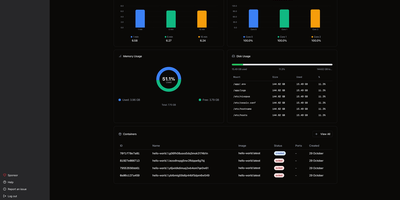
Nixopus
Tell an AI agent to deploy your app and watch it actually happen. Nixopus connects to your GitHub repo, analyzes the codebase to detect your framework, generates the right Docker configuration, resolves dependency conflicts, and ships the whole thing to your server with HTTPS enabled. When something breaks, the agent reads the logs, creates a pull request with a fix, and redeploys without waking you up. The chat interface lets you deploy, add custom domains, check logs, roll back, and troubleshoot in plain English from the web dashboard or directly from your VS Code or Cursor editor. Extensions bring one-click installs for 100+ self-hostable apps like Appwrite, Excalidraw, and Ollama, each showing you exactly what it runs on your server before installation. Connect multiple servers and monitor CPU, memory, disk, and running containers across your entire fleet from a single dashboard with draggable widget layouts. The built-in terminal opens SSH sessions right in the browser with split-pane support, so you can watch logs in one pane while running commands in another. Framework detection covers Next.js, Django, Rails, Go, FastAPI, and anything else that fits a container image. Every deployment gets automatic TLS via Caddy with Let's Encrypt certificates provisioned and renewed silently. Previous container images are retained so rollbacks skip the rebuild step entirely. Deploy on a dedicated VPS on RepoCloud with guaranteed CPU, RAM, and SSD, full root SSH access, and a browser serial console. AGPL-3.0 licensed.
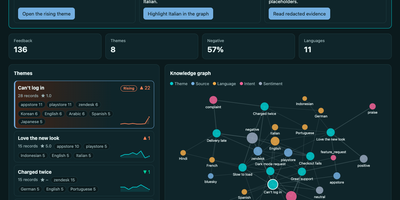
Obsei
Before any AI model reads a single customer message, Obsei has already stripped out the names, email addresses, card numbers, and ID numbers hiding inside it. Obsei pulls in what customers are saying from App Store and Google Play reviews, Zendesk, Freshdesk, and Intercom tickets, GitHub issues, surveys, YouTube comments, Bluesky, RSS feeds, SQL databases, and even Gong call transcripts. Every record is pseudonymised on the way in and stored in an encrypted database that never phones home. Then the labelling starts: sentiment, intent, language, and your own custom questions, each answered with a confidence score by a zero-shot classifier running locally on your machine, or by an LLM you choose through your own keys. Answers the model is unsure about are escalated to a stronger model or queued for a human instead of being silently wrong. Related complaints roll up into stable themes with week-by-week trends, and anything mentioned by fewer than five people stays hidden, so individuals cannot be picked out of a chart. When a theme spikes, alerts and digests land in Slack, and individual findings can be routed straight into Jira, Linear, or GitHub issues. Your analysts browse it all in the built-in Studio, and your AI agents can ask questions over MCP and get cited, redacted evidence back, with any action they propose waiting for your approval. Running on a dedicated VPS on RepoCloud with guaranteed CPU, RAM, and SSD, full root SSH access, and a browser serial console. Apache-2.0 licensed.
Keeper
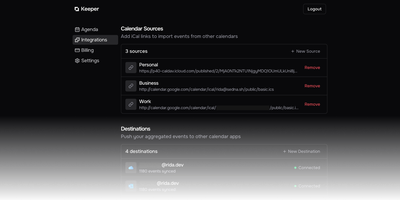
Work, personal, business, and school calendars at different providers double-book because no one system sees your real availability - Keeper solves that multi-calendar collision problem. Its pull-compare-push sync engine aggregates events from Google Calendar, Outlook/Office 365, iCloud, FastMail, any CalDAV server, or read-only iCal/ICS feeds, and pushes blocking events to one or many destination calendars so time slots align everywhere. The design is deliberately content-agnostic - it syncs timeslots, not titles or descriptions, so a personal appointment shows as busy time on your work calendar without leaking details. Sync logic is clean: events Keeper creates carry a traceable UID suffix, deletions propagate, and orphaned entries are purged automatically. A token-authenticated aggregated iCal feed combines selected calendars into one subscribable URL for Apple Calendar or Thunderbird. An optional MCP server gives AI agents read-only calendar access over OAuth 2.1 - list calendars and query events by date range, with no write capability. Built with Next.js and Bun under AGPL-3.0, the standalone Docker image bundles web, API, cron, worker, Redis, and PostgreSQL in one container, and self-hosting unlocks every Pro feature - unlimited calendars and one-minute sync intervals - for free.