PayMe
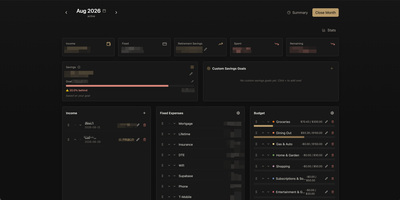
PayMe is a privacy-first personal finance dashboard that runs entirely on your own hardware with zero third-party service dependencies. The Rust backend compiled to a single binary serves a React 19 frontend built with Vite, TypeScript, and Tailwind CSS 4, storing all financial data in a local SQLite database that auto-migrates on startup. Monthly dashboards track income entries, fixed expenses like mortgage and utilities, and budget categories with real-time progress bars showing spending against configurable limits. The savings module includes goal tracking with percentage-based progress indicators, custom savings goals for targeted objectives, retirement savings projections with breakdown analysis, and projected savings calculations. Variance analysis compares actual spending against budgets across categories. Drag-and-drop reordering powered by dnd-kit lets you arrange income sources, expenses, and budget items to match your workflow. The interactive charts rendered by Recharts visualize spending trends, income patterns, and savings trajectories. Month-by-month navigation tracks financial history over time, while the Summary and Stats views aggregate data across periods. JWT-based authentication secures access, and the full OpenAPI Swagger documentation at the /swagger-ui endpoint exposes every API route for automation and integration. Docker Compose deployment creates a minimal image with the compiled Rust binary and static frontend assets, running on port 3001 behind nginx, Caddy, or Traefik reverse proxy with HTTPS. On RepoCloud, deploy PayMe on a dedicated VPS with persistent SQLite storage, root SSH access, and complete privacy over your household financial data, all under the MIT license.
BlogFactory
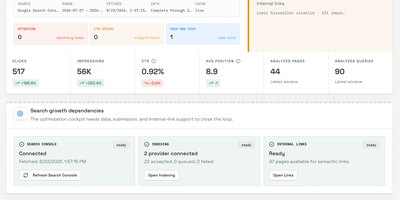
BlogFactory is the first open-source agent control plane purpose-built for multi-site content operations, shipping 16 distinct capabilities across four operational pillars — Operate, Grow, Control, and Deliver — in its v0.1.0 release. The platform keeps source evidence, AI-generated drafts, revisions, SEO metadata, human review, preflight checks, and CMS delivery destinations in one workspace while enforcing a server-side authority ceiling that prevents agents from ever publishing live content, accessing credentials, or performing administrative actions. AI agents connect through a Streamable HTTP MCP endpoint with OAuth authentication and site-scoped tool discovery, compatible with Codex, ChatGPT, and any MCP-capable client. Content creation supports single articles from keywords, titles, URLs, PDFs, text, or YouTube sources, batch campaigns, and programmatic content via reusable templates with structured data rows. The Search Growth module connects Google Search Console complete-day data to ranked optimization opportunities, 30-day growth plans, content classification by signal type (growing, low-CTR, almost-ranking, page-two, zero-click), indexing checks, and semantic internal-link suggestions. Brand Voice separates global voice rules, writer profiles, knowledge context, and brand guidelines from article mechanics. Approved drafts are delivered as CMS drafts to WordPress, Ghost, Wix, or Framer through idempotent, optimistic-locking-protected handoffs with explicit destination selection and preflight validation. The stack runs on React/Vite, a Hono/TypeScript API, PostgreSQL, and MinIO via Docker Compose, with providers including OpenRouter, OpenAI, and Google services under a bring-your-own-AI model. Running on a dedicated VPS on RepoCloud with guaranteed CPU, RAM, and SSD, full root SSH access, and a browser serial console. AGPL-3.0 licensed.
Dock-Dploy
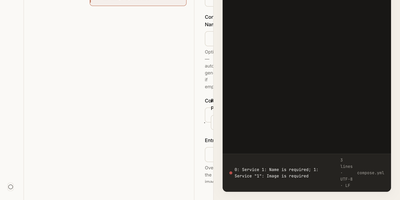
Visual drag-and-drop assembly replaces manual text editing in Dock-Dploy, a Docker Compose builder and configuration management suite that turns complex multi-service container topologies into validated YAML manifests. DevOps engineers and self-hosters can visually assemble application stacks by selecting container base images, defining healthcheck probes, mapping bridge networks, and assigning persistent volume mounts through a reactive web interface. An integrated marketplace catalog allows teams to search, preview, and import battle-tested templates for services like PostgreSQL, Redis, and Nginx with one click. Real-time Zod schema validation inspects every service parameter as you type, flagging port collisions, missing environment variables, and malformed volume syntax before deployment. A split-screen CodeMirror editor provides continuous synchronization between graphic form fields and generated YAML definitions with automatic code sanitization and clipboard exports. Beyond Compose stacks, operators can design blueprint templates, generate reverse proxy routing profiles, and assemble recurring cron schedules for automated backup and maintenance routines. Running on a dedicated VPS on RepoCloud with guaranteed CPU, RAM, and SSD, full root SSH access, and a browser serial console. AGPL-3.0 licensed.