Artalk
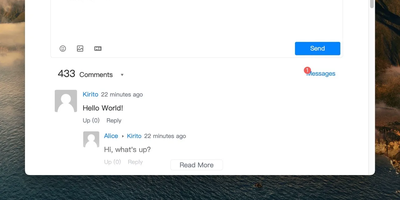
Artalk embeds a full commenting system into any webpage with three lines of JavaScript, packing multi-site management, social login, spam filtering, and Markdown rendering into a client that weighs roughly 40KB. One server instance manages comments for unlimited websites with complete data isolation between sites, eliminating the need for separate deployments per project. The framework-agnostic Vanilla JS client renders a complete comment interface with Markdown support, LaTeX mathematical formula rendering, image uploads, emoji packs compatible with OwO format, and automatic dark mode detection. An integrated admin dashboard accessible through the comment box provides comment moderation queues, IP banning, comment pinning, page-level statistics, and content management without direct database access. Social login authenticates commenters through GitHub, Google, Twitter, Discord, and additional OAuth providers, while captcha protection spans four backends: image captcha, Cloudflare Turnstile, Google reCAPTCHA, and hCaptcha. Spam filtering layers include Akismet integration, keyword block lists, and cloud moderation services that catch unwanted content before publication. Email notifications support SMTP, Aliyun DM, and Sendmail transports with customizable templates, and multi-channel push notifications extend to Telegram, Bark, and other messaging platforms. The OpenAPI-documented HTTP API enables programmatic comment management. Database flexibility covers SQLite, MySQL, PostgreSQL, and SQL Server. A plugin marketplace offers community extensions for custom behavior. Continuously maintained for over 8 years. Running on a dedicated VPS on RepoCloud with guaranteed CPU, RAM, and SSD, full root SSH access, and a browser serial console. MIT licensed.
Bytedesk
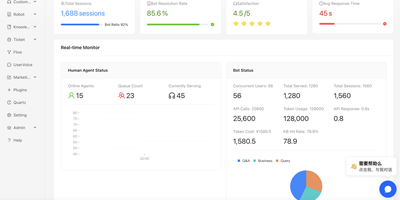
Support teams handling website live chat, email queues, and social messaging channels gain a unified, AI-assisted helpdesk in Bytedesk. Incoming conversations from web widgets, mobile SDKs, WhatsApp, WeChat, and email flow into a single agent workbench equipped with skill-group routing, VIP priority rules, and automatic human handoff. Customer-facing AI agents connect to Ollama, DeepSeek, OpenAI, Qwen, and Zhipu models to answer recurring inquiries using retrieval-augmented generation (RAG) over internal knowledge bases and FAQ libraries, complete with function calling and Model Context Protocol (MCP) tool execution. Complex escalations convert into SLA-tracked tickets with custom approval workflows, or transition directly into browser-based WebRTC video calls, screen sharing sessions, and FreeSwitch voice call center queues. Supervisors track real-time queue depth, bot resolution rates, token usage, automated AI quality scores, and customer satisfaction surveys from the analytics dashboard. Native client SDKs for Web, iOS, Android, Flutter, UniApp, WordPress, and WooCommerce make embedding customizable chat widgets straightforward across any storefront. Running on a dedicated VPS on RepoCloud with guaranteed CPU, RAM, and SSD, full root SSH access, and a browser serial console. AGPL-3.0 licensed.
GoModel
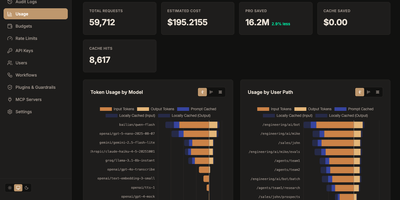
Instead of scattering provider credentials and vendor-specific SDK logic across dozens of microservices, engineering teams route every LLM call through GoModel, an open-source AI gateway that unifies 34 model providers behind OpenAI-compatible and Anthropic-compatible endpoints. Pointing existing OpenAI or Anthropic SDKs at the gateway unlocks chat completions, the Responses API, Anthropic Messages, embeddings, batch jobs, and realtime audio across OpenAI, Anthropic, Gemini, Bedrock, Azure, Groq, DeepSeek, Ollama, and vLLM. Platform operators publish virtual model aliases that distribute traffic via weighted round-robin or lowest-cost routing while rotating multiple API keys per provider and failing over through circuit breakers during upstream outages. Sticky session routing keeps multi-turn agent conversations on the same target to preserve warm prompt caches, while exact-match and vector semantic caching via Qdrant, pgvector, Pinecone, or Weaviate cut duplicate token costs. Versioned workflows and pre-dispatch guardrails enforce prompt injection rules, rate limits, and hard USD spend budgets across hierarchical tenant user paths before requests are dispatched. The built-in admin dashboard offers live audit logs, per-tenant cost analytics, LiteLLM key migration, an interactive request playground, Model Context Protocol tool aggregation, and OpenTelemetry and Prometheus metrics. Running on a dedicated VPS on RepoCloud with guaranteed CPU, RAM, and SSD, full root SSH access, and a browser serial console. MIT licensed.
Atomic
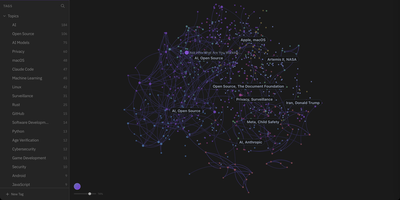
Atomic transforms collections of personal Markdown notes into an AI-augmented knowledge graph by breaking documents down into semantically linked conceptual units. Users capture thoughts, research excerpts, and web clippings as modular notes that the system automatically chunks, embeds, and categorizes with hierarchical tags. An interactive force-directed canvas maps out the entire knowledge base, positioning related ideas closer together based on embedding cosine similarity rather than manual folder hierarchies. Built-in vector search queries across text embeddings directly within SQLite, retrieving precise contextual snippets in response to natural language prompts. The automated wiki engine synthesizes disparate notes into comprehensive reference articles equipped with verifiable inline citations back to original source materials. Integrated conversational agents leverage retrieved knowledge context to answer research questions, surface contradictions across past entries, and draft structured daily briefings. External AI tools can read, search, and update stored knowledge through an embedded Model Context Protocol server endpoint. Running on a dedicated VPS on RepoCloud with guaranteed CPU, RAM, and SSD, full root SSH access, and a browser serial console. MIT licensed.

InnoShop
InnoShop runs your entire online store on your own server, from a multilingual storefront and checkout to orders, shipments, and returns, and it even lets an AI assistant operate the shop alongside you. Set up products with SKUs, attributes, brands, and categories, then sell through a responsive storefront that speaks your customers' languages and prices in their currencies. Orders flow into the admin panel with status updates, shipment tracking, and return handling, while customers pay through PayPal, Stripe, bank transfer, or payment and shipping plugins you install. A built-in media library keeps product photos and files organized and reusable across the whole catalog. Visit analytics show who is browsing the store, with bot detection and geographic aggregation separating real shoppers from crawler noise. The unusual part is the AI door: a built-in MCP server exposes more than 45 store operations as tools, so an assistant can list products, check inventory, update an order status, or pull a sales report in plain conversation. That door is disabled by default, opens only with an admin token, stays read-only until you explicitly enable write tools, and never exceeds the permissions of the account behind the token. Plugins extend the store without forking it, and themes reshape the storefront without touching the catalog underneath. Running on a dedicated VPS on RepoCloud with guaranteed CPU, RAM, and SSD, full root SSH access, and a browser serial console. OSL-3.0 licensed.
Endurain
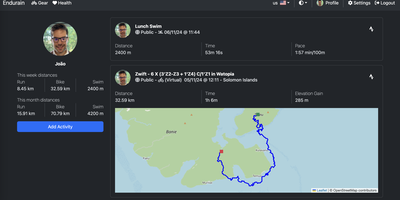
A personal Strava on your own server: Endurain is a self-hosted fitness platform that keeps your complete workout history, GPS routes, and health data out of a vendor's cloud. It ingests the standard device formats (.gpx, .tcx, and preferred .fit with full sensor data) via manual or bulk upload, and syncs directly with Strava and Garmin Connect so migrating years of history is straightforward - Garmin sync covers activities, gear, and body composition. The dashboard shows activity feeds with weekly and monthly statistics, routes on maps, and distance, speed, and training-volume trends over time, with definable goals that update automatically. Gear tracking is notably deep: log wetsuits, bicycles, shoes, racquets, skis, and snowboards, assign default gear per activity type, and track individual components like bike chains against replacement mileage. Multi-user support with admin and user roles, follower features, per-activity privacy settings, and configurable sign-up (email verification, admin approval) make it usable for clubs and coaches as well as individuals. Auth is serious for a fitness app: MFA TOTP, OIDC/SAML SSO, and email-based password resets via Apprise. The stack is Vue.js over a Python FastAPI backend with PostgreSQL, plus weight, steps, and sleep logging, imperial/metric units, multi-language support, and third-party app integration.
LLemonStack
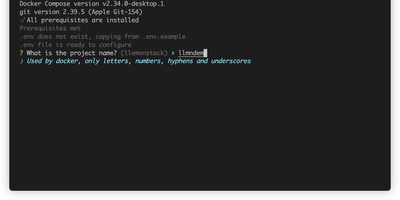
One CLI command deploys a complete AI development environment: n8n, Flowise, Supabase, Ollama, Qdrant, LiteLLM, Langfuse, Open WebUI, LightRAG, Browser-Use, Firecrawl, Crawl4AI, and more, all pre-wired with networking, credentials, and database connections. LLemonStack eliminates the hours of Docker Compose configuration that typically precede any local AI agent project. The llmn CLI initializes isolated project environments with auto-generated secure credentials, starts services in dependency order (databases first, then middleware, then apps), and displays a dashboard showing every service URL and access token. n8n brings 400+ workflow integrations, Flowise provides visual agent building, Ollama runs local LLMs like Llama and Mistral, Qdrant stores vectors at high performance, Open WebUI offers ChatGPT-style model interaction, and LiteLLM proxies requests to any provider with cost tracking. Langfuse automatically logs traces for every LiteLLM query, providing full observability. Each project maintains isolated Postgres schemas preventing data collision across parallel stacks. Firecrawl and Crawl4AI extract web content into LLM-ready formats for RAG pipelines feeding LightRAG or Qdrant. Dozzle streams live container logs for debugging. Import/export tooling migrates workflows between projects with automatic credential reconfiguration. Running on a dedicated VPS on RepoCloud with guaranteed CPU, RAM, and SSD, full root SSH access, and a browser serial console. AGPL-3.0 licensed.
Komari
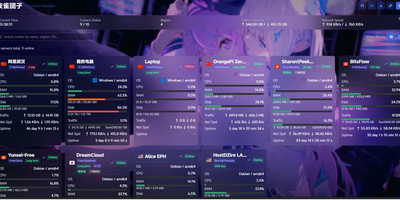
Komari turns a scattered fleet of VPS boxes into one clean status wall that shows which servers are alive, struggling, or about to expire. Every node reports CPU, GPU, memory, swap, disk, load, network speed, traffic totals, and uptime to a real-time dashboard, with history views from ten minutes to thirty days or any custom range. Flip between a card grid and a table, search by name, region, or operating system, and tag each machine with its price, billing cycle, and days until renewal. Latency tasks send ICMP, TCP, or HTTP probes and plot the results in per-node charts. Offline alerts wait out a per-node grace period before firing, expiry reminders warn before a plan lapses, and Webhook and custom JavaScript channels deliver them. A multi-tab browser terminal that reattaches after disconnects, remote command execution, and a remote file manager with an editor let you fix problems without leaving the panel. Agents install with a script, a binary, Docker, or an auto-discovery key for batch rollouts, and administrators can switch an agent's version remotely. Plugins run on an embedded JavaScript runtime and can add scheduled jobs, HTTP hooks, static pages, and notification channels. Administrators can add two-factor authentication, OAuth sign-in, API keys for a JSON-RPC 2.0 endpoint, themes from a theme market, and backups. Running on a dedicated VPS on RepoCloud with guaranteed CPU, RAM, and SSD, full root SSH access, and a browser serial console. MIT licensed.
Kima
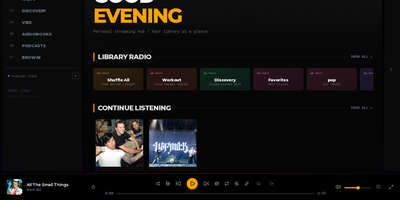
Streaming personal music collections with neural discovery and intelligent playlist curation is what Kima accomplishes as a modern self-hosted audio server that replaces Spotify and Apple Music. Listeners organize their FLAC, MP3, and AAC audio files into responsive grid layouts that scale up to eight columns on ultra-wide displays while automatically fetching album covers, artist biographies, and synchronized line-by-line lyrics. The built-in Vibe System utilizes CLAP neural network audio embeddings to map an entire music collection across two-dimensional clusters and three-dimensional interactive galaxy views, enabling users to explore acoustic relationships or queue smooth sonic paths between distant tracks. Music fans can import playlists directly from Spotify, Deezer, and YouTube using deterministic ISRC matching, while automated Made For You mixes generate era-specific playlists, workout stations, and discovery queues based on individual listening habits. Integrated podcast search pulls subscriptions from iTunes with automatic episode tracking across devices, while native Audiobookshelf connectors synchronize spoken-word chapter positions and playback progress directly into the unified web player. OpenSubsonic API endpoints allow mobile users to stream libraries through native clients like Symfonium and DSub using scoped authentication tokens, while administrators manage multi-user accounts with time-based two-factor authentication. Running on a dedicated VPS on RepoCloud with guaranteed CPU, RAM, and SSD, full root SSH access, and a browser serial console. GPL-3.0 licensed.
DumbAssets
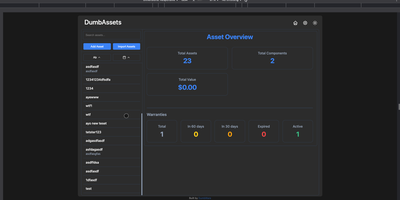
DumbAssets delivers a deliberately simple physical asset tracker that does exactly one thing well — keeping tabs on everything you own, from server racks down to individual HDDs, with hierarchical component nesting that mirrors real-world organization. The Node.js backend stores all data in JSON files within a single /data directory, making backups trivial with one folder copy while the PWA-enabled frontend provides responsive access from any device with light and dark theme persistence. Assets track model numbers, serial numbers, purchase dates, warranty expiration dates, and custom descriptions while sub-components nest infinitely — attach a Dell R730 to your server rack, then attach individual drives, CPUs, and NICs to that server with separate warranty and maintenance schedules for each. The Apprise notification engine fires configurable alerts for warranty expirations and maintenance events with direct links back to the specific asset in the web interface. Photo uploads attach visual records to any asset, receipt storage keeps purchase documentation alongside the item it covers, and a flexible tagging system enables cross-cutting organization beyond the hierarchy. PIN authentication with brute-force protection secures the interface, while search covers names, models, serials, and descriptions with sorting by warranty status, tags, components, or alphabetical order. Deploy with a single Docker command mapping port 3000 and one data volume. Running on a dedicated VPS on RepoCloud with guaranteed CPU, RAM, and SSD, full root SSH access, and a browser serial console. GPL v3 licensed.
DockFlare
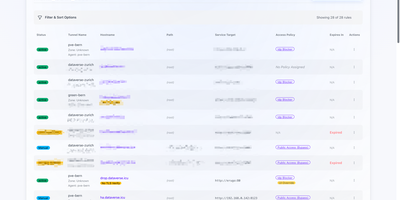
Combining Docker container labels with a live web control plane, DockFlare automates Cloudflare Tunnel ingress routing, multi-zone DNS records, and Zero Trust Access policies across self-hosted infrastructure. DevOps engineers and homelab operators can attach simple container labels to expose HTTP, HTTPS, TCP, SSH, and RDP services publicly in seconds without clicking through external cloud dashboards. For non-containerized workloads such as bare-metal hypervisors or network appliances, administrators can define manual ingress rules, path-based routes, custom TLS SNI headers, and origin certificate bypass flags directly in the web interface. Security teams use reusable Access Groups and wildcard zone policies to enforce Google, GitHub, Azure AD, or custom OIDC authentication across every subdomain from a single policy definition. Distributed deployments connect lightweight remote agents back to the primary controller using Zero Trust service tokens so multi-host clusters share one unified routing view. When containers stop or restart, configurable grace-period timers prevent accidental route churn before cleaning up stale DNS entries, while encrypted state backups protect your entire ingress configuration. Running on a dedicated VPS on RepoCloud with guaranteed CPU, RAM, and SSD, full root SSH access, and a browser serial console. GPL-3.0 licensed.
Budget Board
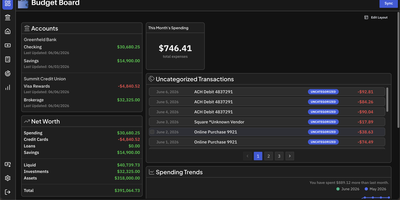
Budget Board is an open-source personal finance dashboard built to replace Mint by unifying checking accounts, credit cards, property assets, monthly category budgets, and long-term savings goals under your own roof. Households can connect their financial institutions through SimpleFIN for North American banks or LunchFlow for international accounts so balances and daily transactions sync automatically on a configurable schedule. If you prefer offline statement management, the bulk CSV importer parses custom date and amount formats while mapping rows directly to your accounts. Once transactions arrive, you can train the built-in machine learning auto-categorizer on your historical spending with a customizable confidence threshold, or define deterministic rules that match merchant descriptions, dates, and amounts. Monthly budget cards track hierarchical parent and child categories against spending limits, and the goals workspace calculates progress toward paying down debt or building an emergency fund. Interactive trends charts let you filter cash flow, net worth, and category breakdowns across custom date ranges and accounts. Multi-user households can secure their financial records with local two-factor authentication or external OpenID Connect single sign-on, alongside localized date and currency formatting in English, German, French, and Simplified Chinese. Running on a dedicated VPS on RepoCloud with guaranteed CPU, RAM, and SSD, full root SSH access, and a browser serial console. AGPL-3.0 licensed.
Sharry
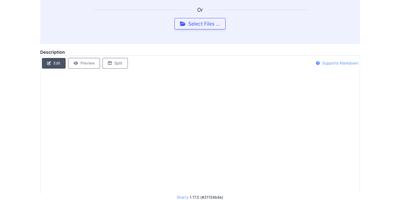
Sharry moves files in both directions: you hand someone a download link, and they hand files back to you, without either side juggling accounts on a commercial transfer service. Upload a file and you get a public URL that is hard to guess but open to anyone who has it; add a password as a second secret, set how long the share lives, and cap how many times it may be downloaded. Expired shares clean themselves up on a schedule. Uploads run over the tus protocol, so a dropped connection in the middle of a two-gigabyte video is an inconvenience, not a restart: send the same file again and it resumes from the last received chunk. Downloads support caching and range requests, which means recipients can stream a video in the browser and scrub its timeline instead of waiting for the whole file. The reverse direction is what makes Sharry unusual: every registered user can maintain alias pages behind their own unguessable URLs, where clients, students, or family members upload files straight to that user, with an email notification when something arrives. Everything is scriptable through a documented REST API, and files can live in the database, on the filesystem, or in S3-compatible storage. Running on a dedicated VPS on RepoCloud with guaranteed CPU, RAM, and SSD, full root SSH access, and a browser serial console. GPL-3.0 licensed.
OnGrid
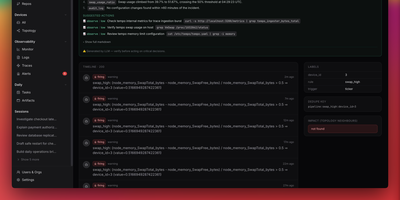
When an alert fires, OnGrid investigates it for you: an AI operations agent that correlates metrics, logs, traces, and topology, then names the root cause in plain language. A coordinator agent hands each question to specialist SRE, network, or database sub-agents, and the incident investigator walks the service graph for blast radius, queries Prometheus, Loki, and Tempo, and pins the cause to a line of source code before posting its report back to chat. Lightweight edge agents on every host dial out over a single tunnel, so no inbound ports are opened, and operators can reach any machine through an audited browser shell. The agent works through more than 26 read-only inspection tools in a sandbox, while anything that changes production waits behind an approval gate. Ask questions or receive reports in Slack, Telegram, Larksuite, DingTalk, or WeCom, and run it on Anthropic, OpenAI, GLM, DeepSeek, Gemini, Kimi, or any OpenAI-compatible endpoint. A workflow builder turns triggers, agents, tools, and notifications into repeatable automations, and a knowledge vault indexes runbooks, incident history, and repositories for search. Enroll Kubernetes clusters to inspect workloads and manage upgrades, or discover network neighbors, verify them over SNMP, and map them into the topology. Role-based access separates admins, users, and viewers. Running on a dedicated VPS on RepoCloud with guaranteed CPU, RAM, and SSD, full root SSH access, and a browser serial console. AGPL-3.0 licensed.
Portabase
Portabase takes a zero-trust approach to database backups: lightweight Rust/Tokio agents deploy next to each database, encrypt dumps with AES-GCM before data ever leaves the host, and poll the Next.js control plane outbound every five seconds requiring zero inbound firewall rules. This architecture contains blast radius if the dashboard is compromised while supporting ten engines with stable backup and restore: PostgreSQL 12 through 18, MySQL 5.7 through 9, MariaDB 10 and 11, MongoDB 4 through 8, SQLite 3.x, Redis 2.8+, Valkey 7.2+, Firebird 3.0 through 5.0, Microsoft SQL Server 2017 through 2022 including Azure SQL, and Docker volumes on Engine 20.10+. Encrypted backups store on configurable backends including local filesystems, any S3-compatible provider (AWS, MinIO, RustFS), Google Cloud Storage, and Azure Blob Storage. Cron-based scheduling with Grandfather-Father-Son retention policies automates backup lifecycle management, while on-demand restore targets any compatible server for cross-environment recovery. The CLI installs agents with a single command and auto-updates when new versions ship. A RESTful API with MCP server integration enables automation from CI/CD pipelines and AI agent workflows. Developed by a non-profit under Apache-2.0. 1,270+ stars and 174 releases since October 2024. Running on a dedicated VPS on RepoCloud with guaranteed CPU, RAM, and SSD, full root SSH access, and a browser serial console.
Pyrra
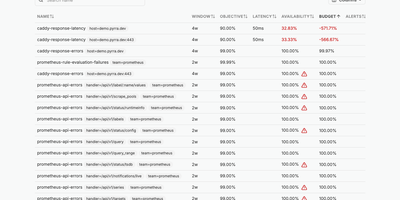
Define a service level objective in a few lines of YAML and Pyrra writes the Prometheus recording rules and multi-window burn rate alerts for it, then tracks the remaining error budget in a web interface. An objective can be an error ratio or a latency target, declared as a Kubernetes custom resource or as a plain file read from disk when running under Docker or as binaries. Grouping labels fan one definition out into an objective per route or handler. The objectives page lists each SLO with its window, target, availability, and remaining budget, sorted so the worst offenders sit on top; columns can be sorted or hidden, and a search box or a click on any label filters the list. Opening an objective highlights availability and error budget, plots the budget over time, and charts requests, errors, and duration with a time range picker and absolute or relative scales. Below the charts, a table shows the four generated alerts with their severities. Generated alerts carry a link back to the objective's page, and severities can be overridden in the spec. Queries go to Prometheus, Thanos, or Mimir, with basic auth, bearer tokens, or tenant IDs, and ready-made Grafana dashboards chart the same objectives. Running on a dedicated VPS on RepoCloud with guaranteed CPU, RAM, and SSD, full root SSH access, and a browser serial console. Apache-2.0 licensed.
Websurfx
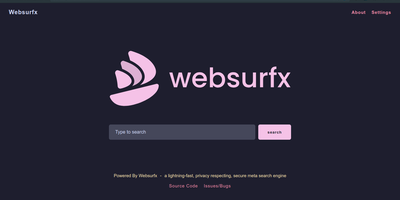
Websurfx aggregates results from multiple search engines into one private, ad-free interface that never tracks your queries. Written in Rust, the backend provides memory safety against buffer overflows and data races at the language level while handling concurrent requests across upstream providers like DuckDuckGo and Searx. A built-in re-ranking algorithm scores and merges results by relevance, producing a unified page that draws from many sources while appearing as one coherent search. Safe-search filtering operates across four levels from unrestricted to complete content blocking, with regex-based filter lists for parental controls in schools and organizations. Upstream requests route through configurable proxy chains or Tor, preventing search providers from correlating your queries with a specific IP address. Four Docker image variants target different caching strategies: hybrid Redis plus in-memory for maximum throughput, Redis-only, in-memory-only, or zero-persistence for environments where cached queries must never touch disk. The Lua configuration file controls engine selection, request timeouts, rate limiting thresholds, and production-mode delays that throttle upstream traffic to prevent abuse. Quick-result widgets handle calculations, currency conversions, and unit transformations inline without external redirects. Image search capabilities serve visual discovery for designers and researchers who need media results without surveillance. Runs on a RepoCloud VPS with dedicated resources and full root access. AGPL-3.0 licensed.

Halcyon Video
Friday night, 1994: you are standing in the Action aisle deciding what the weekend looks like, except the shelves are stocked with your own library and the store lives in your browser. Halcyon Video rebuilds that ritual in 3D around your Jellyfin, Plex, or Emby server, turning libraries into aisles and genres into signed sections you can walk. Pick a case off the shelf and it comes up in your hand at true rental proportions; flip it over for the synopsis, cast, runtime, ratings, and a technical table read from the actual file. Seasons arrive as box sets, popular titles sit deeper on the shelf, and the clerk behind the counter searches by title, director, or genre and recommends from your catalog and watch history. Carry an armful to the checkout and she bags them in plastic that folds around the cases, receipt and all. A RomM connection opens a games department with platform-correct cartons and clamshells, while Jellyseerr requests appear as discovery cases you can order in-store. Drive it from the couch with a TV remote, gamepad, keyboard, or phone, or let attract mode tour the floor past the ceiling CRTs. Running on a dedicated VPS on RepoCloud with guaranteed CPU, RAM, and SSD, full root SSH access, and a browser serial console. GPL-3.0 licensed.