Cozy Cloud
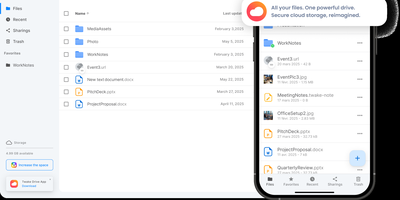
With over 1,200 GitHub stars, 12,000+ commits, and more than a decade of active development distributed under the AGPL-3.0 license, Cozy Cloud operates as a comprehensive personal data hub that goes far beyond file storage by connecting your documents, contacts, calendars, banking transactions, energy bills, and productivity tools into a single self-hosted platform where no third party profiles you. The cozy-stack Go binary handles file storage, CouchDB document management, job scheduling, app serving, and the REST API in a single process consuming approximately 150MB of RAM idle. Sandboxed konnectors import data from 50+ external services — banks, utility providers, telecom operators, cloud drives — running as isolated jobs via nsjail to prevent untrusted code from accessing other user data. The built-in app store serves web applications in subdomain-isolated environments with Content Security Policy headers, each app communicating exclusively through the documented REST API. Real-time synchronization via PouchDB replication and WebSocket keeps files, contacts, and documents consistent across desktop clients, mobile apps for iOS and Android with automatic photo backup, and the web interface. Security features include automatic Let's Encrypt TLS certificates, Argon2id password hashing, optional TOTP two-factor authentication, and GDPR-compliant data export via the CLI. Each user receives their own isolated instance with independent storage, database, and application configuration. Running on a dedicated VPS on RepoCloud with guaranteed CPU, RAM, and SSD, full root SSH access, and a browser serial console. AGPL-3.0 licensed.
Traggo
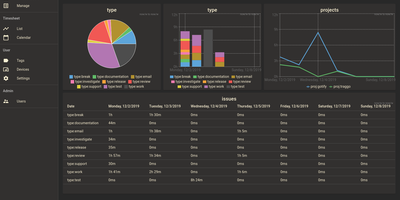
With over 1,600 GitHub stars and a design philosophy that fundamentally rethinks how time tracking should work, Traggo abandons the traditional project-task hierarchy that forces your work into rigid categories and instead lets you tag time spans with arbitrary key-value pairs — project:website, type:coding, client:acme, billable:yes — enabling cross-dimensional analysis that conventional trackers cannot replicate. The Go backend compiles into a single binary that runs alongside a SQLite database and embedded web UI in under 10MB total, consuming approximately 50MB of RAM at runtime and starting in seconds on even the smallest VPS. Tags are the fundamental data model: create any tag key with any set of values, then apply multiple tags to each time span simultaneously to track by project, client, task type, energy level, or any other dimension your workflow demands. Customizable dashboards render pie charts, bar charts, and line graphs from tag-aggregated data, letting you visualize time distribution across any combination of dimensions over configurable date ranges. The calendar view displays time spans as colored blocks across days and weeks, while the list view provides chronological entry browsing with inline editing. Multiple themes including light and dark modes adapt the interface to personal preference, and simple user management with role-based access supports small team deployments. Docker deployment runs a single container exposing port 3030 with multi-architecture support for amd64, arm64, and arm v7. Running on a dedicated VPS on RepoCloud with guaranteed CPU, RAM, and SSD, full root SSH access, and a browser serial console. GPL-3.0 licensed.
MeshCentral
With over 7,000 GitHub stars and continuous development since 2017 by former Intel engineer Ylian Saint-Hilaire, MeshCentral has become the go-to self-hosted alternative to ConnectWise Control and Splashtop for managing devices remotely without per-seat licensing fees. The Node.js server installs via a single npm command and manages Windows, macOS, Linux, and FreeBSD endpoints through lightweight agents that maintain persistent WebSocket connections for real-time remote desktop, terminal access, and file transfer directly in the browser. Intel AMT integration provides out-of-band hardware management including power control and BIOS access even when the operating system is unresponsive. Device groups organize endpoints by location, customer, or function with granular role-based access control for multi-technician environments. Session recording captures remote desktop interactions for compliance auditing, while Wake-on-LAN powers on machines remotely across subnets. The server supports MongoDB for production deployments handling thousands of agents or the embedded NeDB for smaller setups under 200 devices, with a single 8GB VPS comfortably managing 1,500 concurrent agents. Security features include mandatory TLS with automatic Let's Encrypt certificate provisioning, multi-factor authentication via TOTP and FIDO2, SAML-based single sign-on, IP filtering, and HashiCorp Vault integration for secrets management. The web console provides real-time device monitoring with hardware and software inventory, network topology visualization, and customizable branding. TacticalRMM uses MeshCentral as its remote access layer. Running on a dedicated VPS on RepoCloud with guaranteed CPU, RAM, and SSD, full root SSH access, and a browser serial console. Apache-2.0 licensed.
Frappe Helpdesk
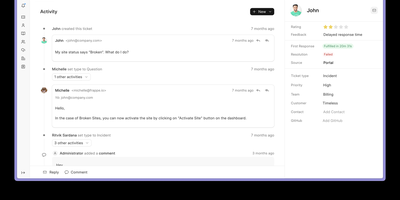
With over 3,200 GitHub stars, 900 forks, and backing from the team behind ERPNext, Frappe Helpdesk delivers a modern, streamlined alternative to Zendesk and Freshdesk with unlimited agents, no per-seat pricing, and full source code access under the AGPL-3.0 license. Built on the Frappe Framework with a Python backend and Vue 3 frontend using Frappe UI, the application collects customer inquiries from email, web forms, and the customer portal into a centralized ticketing queue with complete conversation history and threaded replies. Customizable SLA rules define response and resolution timelines by ticket type or team, triggering automatic alerts and escalations when deadlines approach or are missed. Assignment rules route incoming tickets to the appropriate agents based on priority, issue type, or workload balancing, while manual reassignment and transfer between teams remains available at any time. The customer self-service portal lets users submit tickets, track status, and search a knowledge base of published help articles that reduce repetitive support requests. Agents access saved reply templates for consistent, rapid responses to common queries. Custom fields, configurable workflows, and saved views adapt the interface to match each organization's support process. Real-time updates via WebSocket push ticket changes instantly to all connected agents. The PWA-compatible interface provides mobile access without a native app. Frappe Framework compatibility spans versions 15 and 16. Running on a dedicated VPS on RepoCloud with guaranteed CPU, RAM, and SSD, full root SSH access, and a browser serial console. AGPL-3.0 licensed.
osTicket
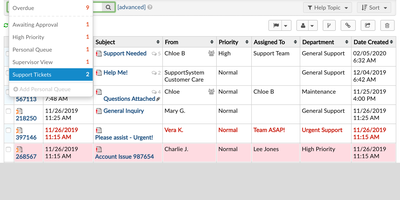
With nearly 3,900 GitHub stars, over 1,800 forks, and continuous development since 2013 culminating in the v1.18.4 release in June 2026, osTicket remains one of the most deployed open-source help desk systems worldwide, trusted by organizations from small businesses to universities and government agencies. The PHP backend on Apache or IIS with MySQL stores every ticket, response, and attachment while the web interface provides separate agent and customer portal views with role-based access control across departments, teams, and individual agents. Customers submit tickets through web forms, email piping, or phone-entry by agents, and configurable ticket filters automatically route incoming requests to the correct department, assign agents or teams, set priority levels, apply SLA plans, and trigger canned responses based on matching criteria including custom field values. Agent collision avoidance locks tickets during response composition to prevent duplicate replies, while SLA plans with business hour schedules track due dates and escalate overdue tickets automatically. Custom forms and fields let organizations capture structured data specific to each help topic — from IT asset tags to billing account numbers — with configurable required and internal-only visibility. The advanced search system with saved queries and CSV export enables reporting across all ticket metadata and custom fields. The customer portal provides ticket tracking, profile management, and knowledge base access. OAuth2 plugin support enables modern email authentication with Microsoft 365 and Google. Running on a dedicated VPS on RepoCloud with guaranteed CPU, RAM, and SSD, full root SSH access, and a browser serial console. GPL-2.0 licensed.
WhoDB
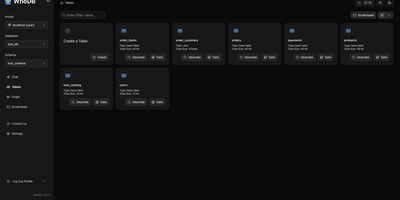
With nearly 5,000 GitHub stars earned in under two years, WhoDB has rapidly emerged as the lightweight alternative to heavyweight database clients like DBeaver and DataGrip by delivering a sub-50MB binary that starts in under a second and connects to 18+ database systems from a single interface. The Go backend serves the React and TypeScript frontend with table virtualization for efficient rendering of large result sets, lazy loading, and query result streaming that keeps the interface responsive even when browsing tables with millions of rows. The Community Edition connects to PostgreSQL, CockroachDB, YugabyteDB, MySQL, MariaDB, TiDB, SQLite, DuckDB, MongoDB, FerretDB, Redis, Valkey, Dragonfly, Elasticsearch, OpenSearch, ClickHouse, QuestDB, and Memcached through a unified credential selector that switches between databases with minimal configuration. Interactive schema diagrams render entity-relationship graphs showing table structures, foreign keys, and column types for visual database exploration. The Jupyter-style query scratchpad provides SQL autocomplete, syntax highlighting, and multi-statement execution with paginated results. AI integration optionally connects to Ollama, OpenAI, Anthropic, LM Studio, or any OpenAI-compatible provider for natural language database queries — ask questions in plain English and receive generated SQL. Data management includes inline row editing, CSV export, and filtered data views. Docker deployment runs a single container exposing port 8080. Running on a dedicated VPS on RepoCloud with guaranteed CPU, RAM, and SSD, full root SSH access, and a browser serial console. Apache-2.0 licensed.
LibrePhotos
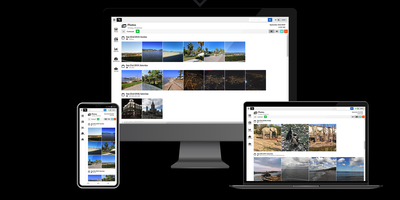
With over 8,000 GitHub stars and continuous development since 2020, LibrePhotos delivers the core intelligence of Google Photos — face recognition, object detection, semantic search, and automatic album generation — entirely on your own hardware without sending a single photo to a third-party server. The Django 5 backend processes uploaded media through a machine learning pipeline that runs face detection via the face_recognition library, clusters identified faces using scikit-learn and HDBSCAN, generates image captions through BLIP and Moondream 2, and classifies scenes using Places365 or Google's SigLIP 2 vision-language model with zero-shot classification against 900+ real-world tags. Semantic search lets you find photos by natural language queries like "sunset at the beach" without manual tagging, while metadata search filters by person, camera, lens, file type, and filesystem path. The React 18 frontend built with Vite presents a timeline view, fullscreen lightbox with slideshow mode, photo detail sidebar showing location and people, and a folder navigation view with breadcrumb paths. RAW files from any camera are converted via ImageMagick, videos processed through FFmpeg, and Live Photos paired with their RAW+JPEG counterparts as unified entries. Public album sharing via link provides fine-grained privacy controls, and duplicate detection uses perceptual hashing to identify near-identical images. Deployment runs as a single unified Docker container or via Docker Compose with Kubernetes manifests also available. Running on a dedicated VPS on RepoCloud with guaranteed CPU, RAM, and SSD, full root SSH access, and a browser serial console. MIT licensed.
Letta
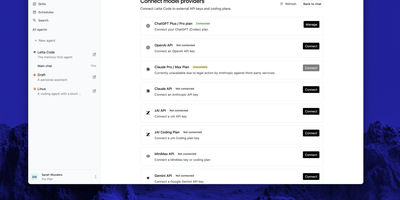
With over 24,000 GitHub stars and origins in the MemGPT research paper on virtual context management, Letta has evolved into the leading open-source platform for building AI agents that maintain persistent memory, identity, and continuity across sessions rather than operating as stateless prompt-response loops. The core architecture uses memory blocks — structured, labeled text chunks that reside permanently in the agent's context window — allowing agents to programmatically rewrite their own memory, learn new skills, and improve through a sleeptime dreaming process that runs reflection and memory organization during idle periods. The self-hosted App Server deploys via Docker and exposes a WebSocket API on port 4500, letting the TypeScript Agent SDK connect from any application using local, remote, or cloud backends. Agents support git-versioned memory through MemFS where every memory change is tracked and auditable, multi-agent communication via subagents, scheduled tasks, and integration with messaging platforms including Slack, Discord, Telegram, WhatsApp, and Signal. The platform is fully model-agnostic, routing to OpenAI, Anthropic, xAI, or self-hosted open-weight models through Ollama depending on cost, performance, and data residency requirements. The Agent File format serializes complete agent state — memory, skills, prompts, and conversation history — into portable snapshots. Desktop applications for macOS, Windows, and Linux provide native interfaces alongside the terminal CLI and web chat at chat.letta.com. Running on a dedicated VPS on RepoCloud with guaranteed CPU, RAM, and SSD, full root SSH access, and a browser serial console. Apache-2.0 licensed.
Kubero
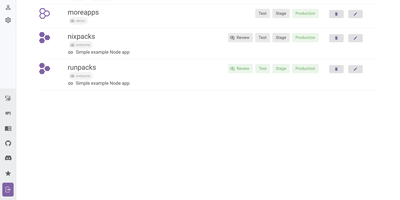
With over 4,300 GitHub stars and a v3 release adding built-in user management, team views, and multi-language support, Kubero has established itself as the most feature-complete open-source Heroku alternative running natively on Kubernetes. The platform operates as a Kubernetes operator with two containers — kubero-ui and the operator — storing all state in etcd without an external database. Developers push code via Git integration with GitHub, GitLab, Bitea, or Gitea, and Kubero automatically builds using Buildpacks, Nixpacks, Runpacks, or Dockerfiles, then deploys to the configured domain with SSL via cert-manager. CI/CD pipelines support up to four staging environments — review, test, staging, and production — with per-stage environment variable isolation and ephemeral review apps that spin up on pull request open and tear down on close. The template catalog includes over 170 pre-configured applications like WordPress, Grafana, and PostgreSQL deployable in one click, while managed add-ons provide highly available PostgreSQL, Redis, MySQL, Kafka, CouchDB, Elasticsearch, and MongoDB alongside your applications. Security features include Trivy vulnerability scanning, GitHub and OAuth2 single sign-on, basic auth, and a role-based permission system with API tokens. The NestJS backend with Vue.js and Vuetify frontend provides application metrics, real-time logs, a built-in web console for container access, scheduled cronjob management, and deployment notifications via Discord, Slack, or webhooks. Running on a dedicated VPS on RepoCloud with guaranteed CPU, RAM, and SSD, full root SSH access, and a browser serial console. GPL-3.0 licensed.
Blinko
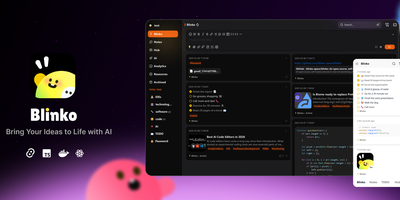
Capture fleeting thoughts as interactive flash cards and transform unorganized notes into an AI-searchable personal brain with Blinko. Users can jot down rapid notes, format rich markdown documents with code snippets and task lists, and attach multimedia files through a responsive web interface. An integrated retrieval-augmented generation engine indexes every note into vector embeddings, allowing users to query their entire personal archive using conversational natural language. You can connect local Ollama models or remote providers such as OpenAI, DeepSeek, Anthropic, and Grok to summarize lengthy entries and suggest hierarchical classification tags automatically. The interactive daily review interface presents random cards to help review, organize, or archive older insights before they are forgotten. Built-in tools include an integrated global music player for focused writing sessions, custom RSS feed ingestion, and password-protected note sharing with configurable expiration dates. Running on a dedicated VPS on RepoCloud with guaranteed CPU, RAM, and SSD, full root SSH access, and a browser serial console. GPL-3.0 licensed.

Pocket ID
Backed by over 8,700 GitHub stars and OpenID Connect certification, Pocket ID delivers what enterprise identity platforms like Keycloak provide but without the configuration complexity — a passkey-only OIDC provider purpose-built for homelabs and small deployments. The core design decision is radical simplicity: no passwords exist in the system, only WebAuthn-based passkeys using hardware security keys, TouchID, FaceID, or device PINs, making phishing attacks structurally impossible rather than merely discouraged. The Go backend built on the Gin framework serves a compiled SvelteKit frontend as static assets, running as a single Docker container with SQLite as the default database and optional PostgreSQL for larger deployments. User management supports manual creation, signup links, and open registration, with group-based access control that restricts which OIDC clients each group can access and attaches custom claims for downstream role mapping. LDAP synchronization pulls users and groups from OpenLDAP or Active Directory, while SCIM support enables automated provisioning from compatible identity sources. Federated client credentials handle machine-to-machine authentication for service-to-service communication patterns. The audit system logs every authentication event with GeoIP enrichment, sends email notifications for sign-ins from unknown devices, and provides one-time login codes for accessing accounts from devices without passkey support. TLS with HTTP/2 is built in, PKCE adds code exchange protection, and OpenTelemetry provides tracing and metrics integration. Running on a dedicated VPS on RepoCloud with guaranteed CPU, RAM, and SSD, full root SSH access, and a browser serial console. BSD 2-Clause licensed.
Dawarich
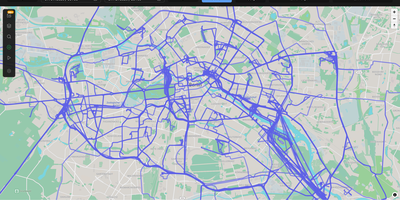
With over 9,000 GitHub stars earned since Google killed its browser-based Timeline, Dawarich fills the gap with a fully self-hosted location history platform that keeps your movement data under your control. Built on Ruby on Rails 8.0 with PostgreSQL and the PostGIS spatial extension for geometry-based queries, Dawarich imports your entire Google Takeout location archive in minutes and begins rendering interactive maps immediately. The visualization engine supports five map layers — heatmaps, points, lines, Fog of War exploration tracking, and a 3D globe view — each powered by Leaflet and spatial SQL rather than browser-side computation. Native iOS and Android apps handle background GPS tracking with offline support, automatically uploading location points when connectivity returns, while third-party integrations support OwnTracks, GPSLogger, Overland, Home Assistant, Traccar, and PhoneTrack. The trip system lets you create route visualizations between any two dates, attach notes, replay travel paths with a timeline scrubber, and share trips publicly with phrase-protected links and per-section visibility controls. Immich and PhotoPrism integrations automatically overlay geotagged photos on your maps and trips, while AirTrail integration renders flight history as arcs. Statistics dashboards break down countries visited, cities explored, total distance traveled, and active days by year and month, with visit detection suggesting places you have frequented. Running on a dedicated VPS on RepoCloud with guaranteed CPU, RAM, and SSD, full root SSH access, and a browser serial console. AGPL-3.0 licensed.
Screego
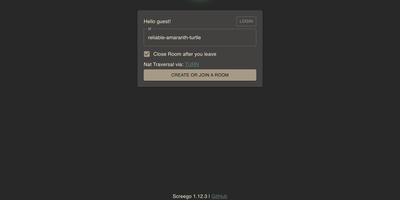
With over 10,000 GitHub stars and a reputation forged in the frustration of laggy corporate screen sharing, Screego delivers what Microsoft Teams and Zoom screen share consistently fail to provide: instant, high-resolution screen streaming that lets remote colleagues actually read your code. Built on WebRTC peer-to-peer connections, Screego transmits screen data directly between browsers without routing through centralized servers, achieving sub-second latency and native-resolution quality that makes pair programming and code reviews genuinely productive. The server component, written in Go with a TypeScript frontend, deploys as a single binary or Docker container with minimal configuration — set your external URL, generate a secret key, and you're live. An integrated TURN server handles NAT traversal automatically, eliminating the need for separate STUN/TURN infrastructure, with configurable UDP port ranges and support for external TURN servers when scaling beyond a single instance. Authentication supports three modes — requiring login for all actions, only for TURN connections, or none — with user management via simple credential files. Rooms are created instantly and support multiple simultaneous viewers, with system and tab audio sharing available for demonstrations that need sound. The architecture supports reverse proxy deployment behind Nginx, Caddy, or Apache with automatic TLS termination, and recent releases added riscv64 architecture support alongside existing amd64 and arm64 builds. Running on a dedicated VPS on RepoCloud with guaranteed CPU, RAM, and SSD, full root SSH access, and a browser serial console. GPL-3.0 licensed.
Pixelfed
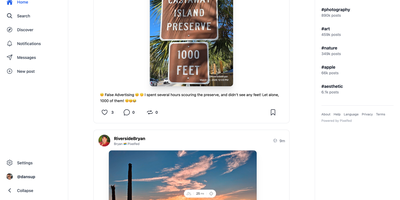
With nearly 7,000 GitHub stars and instances spanning hundreds of federated servers, Pixelfed has become the leading open-source alternative to Instagram — delivering ad-free, algorithm-free photo sharing across the Fediverse. Built on Laravel with a Vue.js frontend, Pixelfed provides a polished, mobile-responsive interface where users upload photos and videos, apply built-in filters, create multi-image posts with alt text, share ephemeral stories, organize content into curated collections, and exchange direct messages — all without tracking, algorithmic manipulation, or targeted advertising. Federation through the ActivityPub protocol means Mastodon, Pleroma, and other Fediverse users can follow Pixelfed accounts, view photo posts in their timelines, and interact through likes, boosts, and replies, while Pixelfed users can discover content through both local and federated timelines. Instance administrators control registration policies, content moderation rules, federation blocklists and allowlists, storage backends including local or S3-compatible options, and server-wide settings. The Mastodon-compatible API enables third-party mobile app support alongside the built-in Progressive Web App experience. Advanced features include blurhash image placeholders for smooth loading, federated groups for community building through FEP-400e and FEP-1b12 extensions, HTTP Signatures with Authorized Fetch for secure federation, and comprehensive data export for full portability. Deployment requires PHP 8.1+, MySQL or PostgreSQL, Redis, and a reverse proxy, with Docker Compose configurations available for streamlined setup. Running on a dedicated VPS on RepoCloud with guaranteed CPU, RAM, and SSD, full root SSH access, and a browser serial console. AGPL-3.0 licensed.
Lemmy
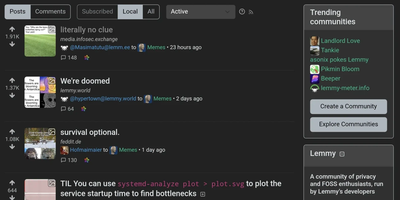
Powering over 496 instances with more than 35,000 monthly active users and 26,500 communities, Lemmy has established itself as the leading open-source, federated link aggregation platform in the Fediverse. Built entirely in Rust for memory-safe, high-performance server operation, Lemmy enables anyone to run their own Reddit-style community that automatically connects with every other Lemmy instance — and compatible ActivityPub platforms like Mastodon, PieFed, and Kbin — through standardized federation protocols. Users create and subscribe to topic-based communities, submit posts containing text, links, or images, engage through threaded comment discussions, and shape content visibility through upvote/downvote mechanisms. Instance administrators retain full control over moderation policy, federation allowlists and blocklists, site appearance, and user registration settings, while community moderators can sticky posts, lock threads, ban users, and maintain public moderation logs for transparency. The platform supports private messaging between users, email notifications, RSS and Atom feed generation for every community, comprehensive internationalization with dozens of language packs, custom emoji support, and both light and dark themes through a clean mobile-responsive interface. Deployment is straightforward with official Docker Compose configurations and Ansible playbooks, backed by a PostgreSQL database with pict-rs for image hosting. Lemmy's Rust backend consistently benchmarks among the most efficient Fediverse server implementations, enabling small VPS instances to serve thousands of users. Running on a dedicated VPS on RepoCloud with guaranteed CPU, RAM, and SSD, full root SSH access, and a browser serial console. AGPL-3.0 licensed.
Apache Kafka
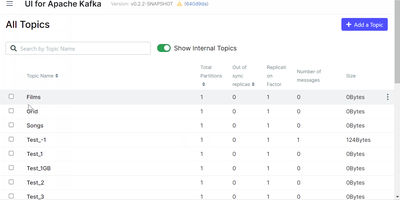
Used by over 80% of Fortune 100 companies including LinkedIn, Netflix, Uber, and Goldman Sachs, Apache Kafka processes trillions of messages per day as the world's most widely deployed distributed event streaming platform. Since version 4.0 released in March 2025, Kafka operates exclusively with KRaft consensus, replacing Apache ZooKeeper entirely with an internal Raft-based metadata quorum managed by controller nodes, reducing operational complexity and eliminating external coordination dependencies. Topics are organized as append-only partitioned commit logs with configurable replication factors across brokers, delivering network-limited throughput with end-to-end latencies as low as 2 milliseconds. Kafka Streams provides a client library for building stateful stream processing applications with exactly-once semantics, windowed aggregations, joins across streams and tables, and interactive queries against local state stores. Kafka Connect integrates with hundreds of systems including PostgreSQL, MySQL, Elasticsearch, Amazon S3, MongoDB, HDFS, and JMS through a standardized connector framework with distributed worker mode and automatic offset management. Share Groups introduced in version 4.2 deliver queue-style consumption semantics alongside traditional consumer groups, enabling Kafka to serve both pub-sub and point-to-point messaging patterns natively. The Schema Registry enforces Avro, Protobuf, and JSON Schema compatibility rules across producers and consumers, preventing schema evolution from breaking downstream applications. Tiered Storage offloads older log segments to object storage like S3 while maintaining transparent consumer access, dramatically reducing local broker storage costs for long-retention topics. Running on a dedicated VPS on RepoCloud with guaranteed CPU, RAM, and SSD, full root SSH access, and a browser serial console. Apache 2.0 licensed.
HashiCorp Consul
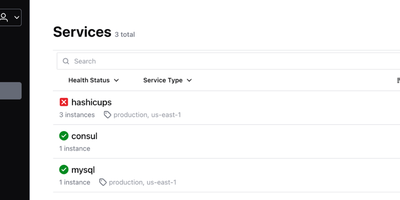
With nearly 30,000 GitHub stars and deployment across organizations including Criteo, Pandora, and Barclays, HashiCorp Consul is the industry-standard platform for service discovery, service mesh, and distributed configuration across dynamic multi-cloud and multi-datacenter infrastructure. Services register themselves and become discoverable via a built-in DNS interface on port 8600 or an HTTP API on port 8500, with health checks ensuring only healthy instances receive traffic through automatic catalog deregistration and service-level circuit breaking. The service mesh capabilities use Envoy sidecar proxies with Transparent Proxy mode to establish automatic mTLS encryption for all service-to-service communication, while identity-based intentions define fine-grained authorization rules controlling which services can communicate. The integrated API Gateway manages north-south traffic into the mesh with configurable routing rules, TLS termination, and header-based matching policies. Consul's distributed key-value store provides hierarchical configuration storage accessible via CLI, HTTP API, and the built-in web UI, with blocking queries enabling watch-based configuration updates without polling. Multi-datacenter federation connects Consul clusters across regions through WAN gossip and RPC forwarding, enabling cross-datacenter service discovery and failover with configurable prepared queries. The Raft consensus protocol provides strong consistency for the service catalog and KV store, with anti-entropy mechanisms ensuring agent state converges with the server catalog. Consul integrates natively with Kubernetes via Helm charts with automatic sidecar injection, Nomad for workload orchestration, Vault for secrets management, and Terraform for infrastructure provisioning. Running on a dedicated VPS on RepoCloud with guaranteed CPU, RAM, and SSD, full root SSH access, and a browser serial console. BUSL 1.1 licensed.
HashiCorp Vault
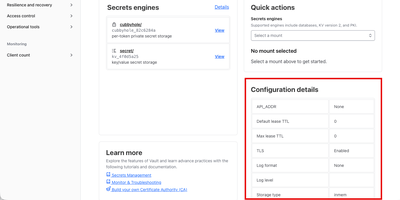
With over 36,000 GitHub stars and adoption by organizations including Adobe, Shopify, and Roblox, HashiCorp Vault is the industry-standard platform for secrets management, encryption services, and privileged access control across hybrid and multi-cloud infrastructure. The key/value secrets engine stores arbitrary secrets with full versioning, soft-delete, and metadata tracking, while dynamic secrets engines generate on-demand, short-lived credentials for AWS, Azure, GCP, databases including PostgreSQL, MySQL, MongoDB, and MSSQL, and SSH access with automatic revocation after configurable lease periods. The PKI secrets engine dynamically issues X.509 certificates on demand with automatic rotation and ACME protocol support, eliminating manual certificate management workflows entirely. Encryption as a service through the transit secrets engine lets applications encrypt, decrypt, sign, verify, and generate HMACs without managing cryptographic keys directly, supporting AES-GCM-256, ChaCha20-Poly1305, RSA-2048/4096, ECDSA-P256/P384, and ED25519 algorithms. Authentication integrates with LDAP, OIDC/OAuth2, SAML, AppRole for machine-to-machine access, Kubernetes service accounts, AWS IAM, Azure Active Directory, and GitHub tokens. Fine-grained ACL policies use path-based rules with glob patterns and sentinel policies for programmatic enforcement. The integrated Raft storage backend provides high-availability clustering without external dependencies, while alternative backends include Consul, S3, DynamoDB, PostgreSQL, and MySQL. The built-in web UI provides a visual interface for browsing secrets, managing policies, configuring auth methods, and monitoring cluster health. Running on a dedicated VPS on RepoCloud with guaranteed CPU, RAM, and SSD, full root SSH access, and a browser serial console. BSL 1.1 licensed.