Moltis
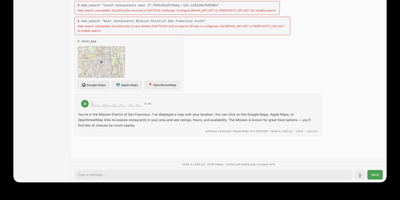
Moltis gives individuals and teams a completely private personal AI agent server that bridges conversational assistants to everyday messaging platforms while executing real-world computing tasks inside secure execution environments. Users can interact with autonomous agents across Telegram, Discord, WhatsApp, Slack, Matrix, and browser interfaces to draft correspondence, automate research, and schedule recurring cron tasks. The system coordinates multi-agent delegation by spinning up specialized sub-agents with dedicated roles for code generation, pull request reviews, quality assurance testing, and technical documentation. Built-in sandboxing isolates tool operations within container boundaries or WebAssembly modules, ensuring shell commands, web scraping routines, and script executions cannot alter underlying operating system files without explicit permission. Native Model Context Protocol integration allows operators to attach external data endpoints, database connectors, and custom command-line utilities without rewriting core routing logic. Persistent memory preserves conversational context and document embeddings across multiple sessions, allowing assistants to recall prior discussions, user preferences, and project guidelines indefinitely. Administrators can configure granular tool approvals, manage WebAuthn passkey authentication, and review real-time WebSocket communication logs through an embedded control panel. Running on a dedicated VPS on RepoCloud with guaranteed CPU, RAM, and SSD, full root SSH access, and a browser serial console. MIT licensed.
Artifact Keeper
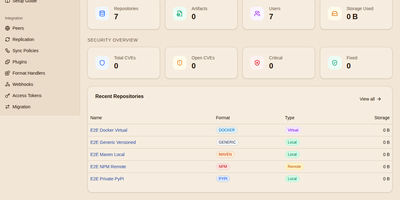
Artifact Keeper serves as a self-hosted universal software artifact repository that consolidates container images, application libraries, and infrastructure bundles under a unified management control plane. Software development teams can publish and resolve dependencies using their existing build tools, including Docker, Helm, npm, PyPI, Maven, Cargo, NuGet, and Terraform without installing proprietary client plugins. Remote repositories act as transparent pull-through caching proxies for public upstreams like Docker Hub and PyPI, accelerating internal CI/CD build speeds while insulating production pipelines from external registry outages. Virtual repositories combine multiple local, remote, and third-party endpoints into single URLs, resolving packages across prioritized internal teams and public registries automatically. Automated security scanners evaluate incoming packages for Common Vulnerabilities and Exposures using Trivy and Grype engines, assigning letter grades and enforcing quarantine policies to block vulnerable binaries before production release. Administrators can sign package metadata with cryptographic GPG keys, configure peer mesh replication across geographic regions, and manage team permissions using OpenID Connect, SAML, and granular access tokens. Running on a dedicated VPS on RepoCloud with guaranteed CPU, RAM, and SSD, full root SSH access, and a browser serial console. MIT licensed.
Trade Journal
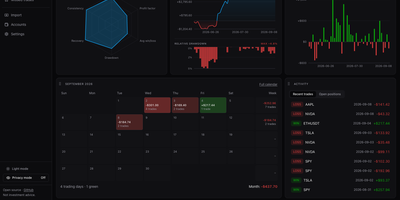
A trading journal you host yourself, Trade Journal rebuilds broker fills and statement exports into round-trip trades, a profit and loss calendar, and daily notes that show what actually works. Read-only sync covers more than twenty brokers and exchanges, including Alpaca, Binance, Coinbase, Kraken, and IBKR Flex. Statement import auto-detects TradingView, MetaTrader, NinjaTrader, Tradovate, and thinkorswim files, handles TradeZella and Tradervue CSV migrations, and maps columns for anything else. Trades can be matched first-in-first-out, last-in-first-out, or by weighted average, with partial fills, scale-ins, and futures multipliers handled. The dashboard offers gauges, cumulative and daily P&L, an Edge Score radar, and cards you can rearrange into named layouts, while Reports break results down by symbol, tag, mistake, playbook, weekday, and time of day. Each trade page charts entries and exits and can replay candles you load, with estimated MAE and MFE. Daily journal pages hold Markdown notes, templates, attachments, and voice dictation, and optional AI recaps use your own Anthropic or OpenAI key or a local Ollama model. Playbook checklists score rule adherence, a prop firm ledger tracks costs and payouts, and privacy mode masks every amount. Running on a dedicated VPS on RepoCloud with guaranteed CPU, RAM, and SSD, full root SSH access, and a browser serial console. MIT licensed.
opendesk
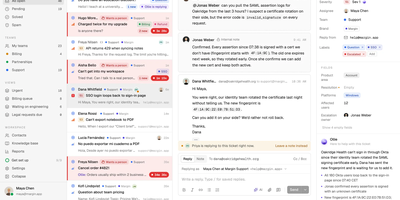
When a customer emails your support address, starts a live chat, or asks a question from your help center, opendesk lands it in one shared ticket inbox where every change appears live for the whole team. Agents work a single queue where tickets carry status, priority, assignee, team, tags, and an SLA clock, with internal notes, merging, snoozing, and bulk edits for busy days. Customers chat through a widget that offers identity verification, typing indicators, and 14 languages, and each widget can route to its own team and topics. Support leads publish collections and articles to a public help center, set SLA targets per priority, run automation rules on ticket events, and read reports on volume, response and resolution times, breaches, and CSAT. Ollie, the built-in AI, uses that help center to answer chats, draft replies, summarize threads, triage tickets, and translate both ways, through any Anthropic or OpenAI-compatible provider including local models. Admins can switch it off. Replies leave from your own address through Google, Microsoft, or any SMTP server. Developers connect Linear, GitHub, Jira, Sentry, Slack, Stripe, and any MCP server, or build on the REST API, signed webhooks, and a realtime socket. Desktop apps for macOS, Windows, and Linux and a native iPhone app keep agents reachable. Running on a dedicated VPS on RepoCloud with guaranteed CPU, RAM, and SSD, full root SSH access, and a browser serial console. Apache-2.0 licensed.
GymCoach
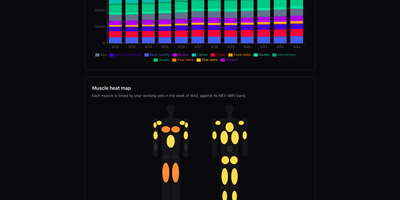
Strength training, cardio, and body metrics land in one workout log on your own server, backed by an optional AI coach that explains its advice from your real numbers. Quick entry such as 100x8@9 logs weight, reps, and effort in one line, with a rest timer, plate-loading calculator, and warm-up ramp beside the set table. A weight picker offers only loads your equipment can build, and a readiness check-in adjusts the suggested load and says why. Templates for 5/3/1 BBB, GZCLP, nSuns, PPL, and Upper/Lower run as written and edit like any custom program. Progress pages chart estimated 1RM, weekly volume per muscle group against MEV and MRV bands, a muscle heat map, bodyweight goals, and a training calendar. Garmin FIT, TCX, and GPX imports need no cloud account and add heart-rate charts and aerobic decoupling to each run or ride. The coach writes a weekly debrief, chats in a streaming conversation, and drafts a full program from a one-sentence goal, using your own Anthropic or OpenRouter key. History imports from Strong or Hevy CSV files with a dry-run preview and exports to CSV or TCX, and an MCP connector lets ChatGPT or other agents analyse it. The app installs as an offline-capable PWA, speaks English, French, Russian, and German, and keeps every user's data separate. Running on a dedicated VPS on RepoCloud with guaranteed CPU, RAM, and SSD, full root SSH access, and a browser serial console. MIT licensed.
Wiki.js
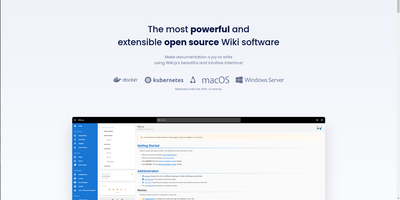
Team and product documentation on a fast Vue frontend with PostgreSQL storage: Wiki.js is a Node.js wiki engine. Its distinguishing trait is per-page editor choice: authors pick Markdown with live preview, a WYSIWYG visual builder for non-technical writers, or raw HTML, page by page. Native Git synchronization commits every page change to GitHub, GitLab, Bitbucket, Azure DevOps, or any Git remote - bi-directionally, so edits made in the repository flow back into the wiki - giving documentation version-controlled backup for free. Authentication coverage is among the broadest of any self-hosted wiki: local accounts with self-registration, social login via Google, GitHub, Discord, and Slack, and enterprise SSO through LDAP/Active Directory, SAML, CAS, Auth0, Okta, Azure AD, Keycloak, and generic OAuth2/OIDC, with optional MFA. Built-in full-text search runs on PostgreSQL with zero setup, and external engines like Algolia or Solr can substitute. Page history with visual version comparison, granular group-based permissions per path, nested navigation menus, 50+ integration modules, and full localization round it out. AGPLv3-licensed with a 28k-star community.
Node-RED
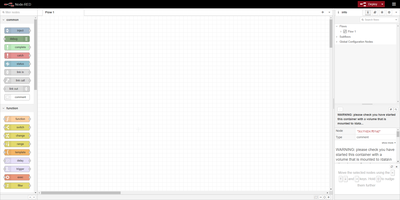
Wire nodes together in a browser, deploy in one click, and real-time data flows from sources through transformations to outputs: Node-RED is the OpenJS Foundation's flow-based programming tool for event-driven applications. Born at IBM as a proof-of-concept for manipulating MQTT topic mappings, it has become the lingua franca of IoT and automation glue - home automation, industrial control, edge data collection - with a community library of over 5,000 contributed nodes and flows covering protocols, devices, and services. Where visual wiring runs out, JavaScript function nodes written in a rich in-editor code editor take over, and every flow serializes to importable, exportable JSON that shares cleanly and version-controls sensibly. Version 5.0 (2026) delivered the largest editor overhaul in the project's history: a rethought layout with Explorer and Information panels in a split sidebar, a native dark theme with theme variants, improved accessibility, and refreshed node appearance. The runtime is lightweight Node.js, exploiting the event-driven non-blocking model so the same flows run on a Raspberry Pi at the network edge or a cloud VM. Apache-2.0 licensed with 240+ contributors, it pairs naturally with dashboard nodes for live charts and controls.
Keep
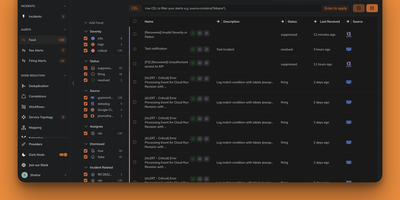
Keep is an open-source AIOps and alert management platform built with Python FastAPI and Next.js. It provides a single pane of glass for monitoring alerts from 110+ integrations, alert deduplication, correlation, enrichment, and filtering, YAML-based workflow automation similar to GitHub Actions, AI-powered correlation and summarization, and customizable dashboards for incident management. With 12,100+ GitHub stars, Y Combinator backing, and an Elastic partnership, Keep is the open-source AIOps platform that centralizes alert management across your entire monitoring stack into a single customizable dashboard. Alert deduplication identifies duplicate notifications across providers, correlation groups related alerts into incidents based on rules or AI-powered semantic analysis using pluggable LLM backends supporting OpenAI, Anthropic, and local models via Ollama, and enrichment adds context from external sources like CMDBs and databases. Workflow automation follows a GitHub Actions paradigm with declarative YAML files defining triggers, conditions, and actions that can query MySQL, update Jira tickets, send Slack messages, execute Python scripts, or call REST APIs. Authentication supports no-auth, database, Auth0, Keycloak, OAuth2 Proxy, Okta, and OneLogin. The Common Expression Language enables advanced alert querying, slicing, and rule-based grouping to reduce noise. On RepoCloud, deploy Keep on a dedicated VPS with Docker Compose, root SSH access, and complete control over your alert infrastructure, all under the MIT license.
OctoBot
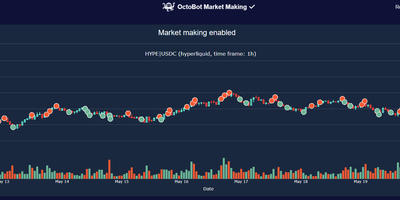
OctoBot provides a free and fully configurable cryptocurrency trading platform that runs on your own server. The bot automates investment strategies across 15+ exchanges including Binance, Coinbase, MEXC, Hyperliquid, Kucoin, OKX, and Bybit, supporting spot, futures, and perpetual markets. The AI trading system connects to any OpenAI-compatible API or local Ollama server, enabling strategies powered by ChatGPT, Llama, Mistral, or any custom model for market analysis and signal generation. TradingView integration accepts PineScript indicator signals and strategy alerts via webhooks, while built-in technical analysis covers RSI, Moving Averages, MACD, Bollinger Bands, and other standard indicators. The modular tentacle architecture allows community-developed plugins to extend strategy logic, evaluators, data sources, and exchange interfaces. The backtesting engine replays historical market data against any configured strategy, reporting profit and loss, drawdown, win rate, and trade-by-trade breakdown before committing real funds. Paper trading provides risk-free live simulation with the same execution logic as production. The web dashboard displays real-time portfolio value, open positions, trade history, and strategy performance with interactive charts. Telegram bot integration enables remote monitoring, notifications, and command execution from mobile devices. Docker deployment runs the full stack in a single container with persistent volume storage for configuration and trade data. On RepoCloud, deploy OctoBot on a dedicated VPS with root SSH access, persistent storage for your trading data and strategy configurations, and complete control over exchange API keys and AI model connections, all under the GPL-3.0 license.
Baserow
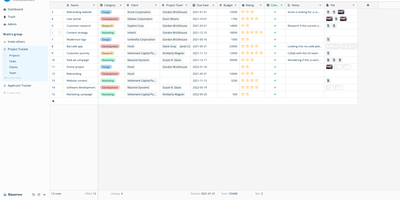
Airtable's spreadsheet-database model, self-hostable and open-source: that is Baserow. It presents data in a spreadsheet-style grid, but underneath each table is a real relational structure with typed fields, links between tables, filters, sorts, and multiple views (grid, gallery, form, kanban, calendar). Beyond the database core, it includes an application builder for composing pages and portals on your data, workflow automations, and dashboards. Everything is API-first: each table exposes a REST endpoint with token auth and webhooks, so it plugs directly into n8n, Zapier, or custom scripts. The stack is Django (Python) on the backend, Vue.js on the frontend, PostgreSQL for storage, with Redis for async tasks. Core features are MIT-licensed; premium features are a paid add-on. The self-hosted version has no row, storage, or API request limits - Airtable's per-base record caps and monthly API quotas simply don't exist here, and capacity is bounded only by your PostgreSQL database and disk. Existing Airtable bases, CSVs, and Excel files import directly with structure preserved, so migration doesn't start from a blank slate, and both the backend and frontend support plugins for custom field types and integrations without forking the core. For non-technical teammates the interface behaves like a spreadsheet; for engineers, the data model is the API.
Tududi
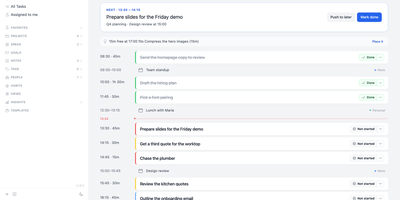
Tududi is a self-hosted planner that turns a pile of tasks into a plan for the day, keeping projects, notes, goals, and habits on a server you control. One Add box files an Inbox item, Task, Note, or Project and understands natural-language dates, recurrence, tags, projects, and people, so "every first monday #home" becomes a recurring task without opening a form. The Today page switches between planning mode, with a timeline or list beside your calendar and optional AI help to sketch the day, and doing mode, with a Next card and a hint when a free slot fits a small task. Tasks have subtasks and live in projects and areas, projects link to season or year goals, and saved views, project templates, and optional Eisenhower and Kanban boards organize the work. Habits support build or quit goals with streaks, a strength score, and a history grid, while notes offer linked pages, backlinks, and mermaid diagrams. Households and teams share projects with read-only or read-write access, assign tasks to people, and follow an Everyone board; members without email sign in through one-time links. Telegram captures tasks and can send daily summaries, CalDAV syncs with reminder apps, OIDC handles single sign-on, and an MCP server lets Claude or Cursor manage tasks. AI stays off until you enable it and add a provider; local models work too. Running on a dedicated VPS on RepoCloud with guaranteed CPU, RAM, and SSD, full root SSH access, and a browser serial console. MIT licensed.
Open Wearables
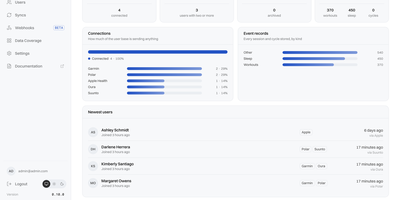
Garmin, Oura, Whoop, and Apple Health each speak a different data dialect, and Open Wearables translates all of them into one consistent REST API that you host yourself. Users authorize through a connection link or the connect widget, history backfills on the first sync, and heart rate, HRV, SpO2, sleep, workouts, and meals land in one normalized schema. When two devices record the same night, configurable data priorities decide which provider and device type wins. Native iOS, Android, Flutter, and React Native SDKs push Apple Health, Samsung Health, and Health Connect data from the phone, and full Apple Health XML exports can be imported too. Outgoing webhooks announce new data with signed payloads, test events, and delivery logs, while a live sync stream shows every pull as it happens. The developer portal adds a dashboard, user profiles with sleep, meals, scores, and women's health tabs, sync history, data coverage, API keys, team invitations, retention policies, and a seed data generator. Sleep and resilience scores ship with open algorithms you can audit and tune. An MCP server lets Claude Desktop or Cursor answer questions such as how a user slept last week. Use it for AI health coaches, fitness coaching apps, healthcare platforms, research cohorts, or a personal health archive with n8n automations on top. Running on a dedicated VPS on RepoCloud with guaranteed CPU, RAM, and SSD, full root SSH access, and a browser serial console. MIT licensed.
GoModel
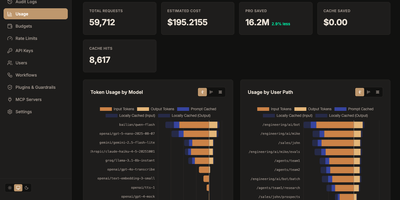
Instead of scattering provider credentials and vendor-specific SDK logic across dozens of microservices, engineering teams route every LLM call through GoModel, an open-source AI gateway that unifies 34 model providers behind OpenAI-compatible and Anthropic-compatible endpoints. Pointing existing OpenAI or Anthropic SDKs at the gateway unlocks chat completions, the Responses API, Anthropic Messages, embeddings, batch jobs, and realtime audio across OpenAI, Anthropic, Gemini, Bedrock, Azure, Groq, DeepSeek, Ollama, and vLLM. Platform operators publish virtual model aliases that distribute traffic via weighted round-robin or lowest-cost routing while rotating multiple API keys per provider and failing over through circuit breakers during upstream outages. Sticky session routing keeps multi-turn agent conversations on the same target to preserve warm prompt caches, while exact-match and vector semantic caching via Qdrant, pgvector, Pinecone, or Weaviate cut duplicate token costs. Versioned workflows and pre-dispatch guardrails enforce prompt injection rules, rate limits, and hard USD spend budgets across hierarchical tenant user paths before requests are dispatched. The built-in admin dashboard offers live audit logs, per-tenant cost analytics, LiteLLM key migration, an interactive request playground, Model Context Protocol tool aggregation, and OpenTelemetry and Prometheus metrics. Running on a dedicated VPS on RepoCloud with guaranteed CPU, RAM, and SSD, full root SSH access, and a browser serial console. MIT licensed.
Haven
Haven gives your community a private chat server with voice calls, screen sharing, and end-to-end encrypted direct messages where friends join via invite link in their browser without installing apps or creating third-party accounts. Real-time messaging supports image uploads via paste and drag-drop, emoji reactions, replies, threads, typing indicators, @mentions with autocomplete, and inline GIF search through Tenor or GIPHY. Peer-to-peer WebRTC voice chat includes per-user volume sliders, mute and deafen controls, talking indicators, and screen sharing with picture-in-picture mode. Direct messages use ECDH P-256 key exchange with AES-256-GCM symmetric encryption where private keys never leave the browser, ensuring not even the server operator can read them. Twenty-plus visual themes with stackable effects including CRT scanlines, Matrix Rain, Cyberpunk Text Scramble, Snowfall, and Campfire Embers let users personalize the experience with configurable intensity sliders. Rich Presence integration shows what members are playing or listening to via Last.fm, Steam, and Spotify. A built-in bot API supports webhooks and custom slash commands, while Discord history import preserves channels, threads, forums, reactions, pins, and avatars. The Node.js server deploys via Docker Compose or a single batch file that auto-handles dependencies, SSL certificates, and configuration. Running on a dedicated VPS on RepoCloud with guaranteed CPU, RAM, and SSD, full root SSH access, and a browser serial console. AGPL-3.0 licensed.
Levelrail
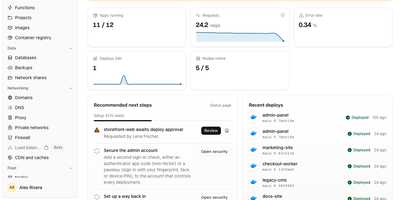
Push to git, watch the deploy go live over HTTPS, and roll back in one click, all on servers you own: Levelrail is a self-hosted platform for running apps and databases without Kubernetes. Deploys start from GitHub, GitLab, Bitbucket, or Gitea webhooks and build from a Dockerfile, Compose file, image, or framework preset such as Next.js, Go, React, or Spring Boot, with preview environments per pull request, canary and blue-green rollouts, approvals, and freezes. Embedded Caddy gives every app a domain with HTTPS: self-signed by default, Let's Encrypt with one toggle, a free sslip.io address when no domain exists, or your own uploaded certificate. Provision Postgres, MySQL, MariaDB, MongoDB, Redis, ClickHouse, and more with scheduled backups that are re-downloaded and verified, Postgres point-in-time recovery, and password rotation. Metrics with deploy markers, searchable live logs, alerts, and a public status page need no separate monitoring stack. Roughly 360 one-click templates and a Cmd+K search across apps, databases, and nodes speed up daily work. Extra servers enroll with a one-time token and a reverse-dialed agent that needs no inbound ports. Sign in with passkeys, TOTP, OAuth from 20 providers, or OIDC, then scope access with IAM policies, encrypted secrets, and a tamper-evident audit log. A CLI, HTTP API, and MCP server let scripts and coding agents deploy and roll back. Running on a dedicated VPS on RepoCloud with guaranteed CPU, RAM, and SSD, full root SSH access, and a browser serial console. Apache-2.0 licensed.
DragonflyDB
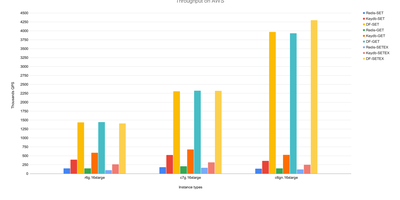
With over 30,000 GitHub stars and benchmarks showing 25x the throughput of single-threaded Redis, DragonflyDB is a modern in-memory data store that eliminates the need for complex Redis Cluster deployments by fully utilizing every CPU core on a single machine. Its shared-nothing, thread-per-core architecture written in C++ supports over 200 Redis commands and 13 Memcached commands, making it a true drop-in replacement that requires zero application code changes. A single DragonflyDB instance scales vertically from 8GB to 768GB of RAM across up to 64 cores, replacing entire Redis Cluster topologies with one process while maintaining full compatibility with Strings, Hashes, Lists, Sets, Sorted Sets, Streams, JSON, and Bloom Filters. The novel dashtable data structure and cache eviction algorithm achieve higher hit rates than LRU and LFU with zero memory overhead per entry. Forkless point-in-time snapshotting eliminates the memory spikes associated with Redis BGSAVE, while automatic backup scheduling via cron syntax supports both local disk and AWS S3 cloud storage. Primary-replica replication follows the Redis replication protocol up to version 6.2, and Prometheus-compatible metrics at the default port enable Grafana monitoring dashboards out of the box. DragonflyDB also exposes an HTTP admin interface on its main TCP port for operational monitoring. Running on a dedicated VPS on RepoCloud with guaranteed CPU, RAM, and SSD, full root SSH access, and a browser serial console. BSL 1.1 licensed.
QuestDB
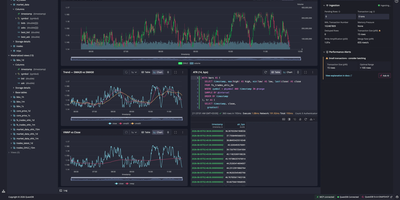
Powering trading floors at firms processing millions of market data events per second and trusted by organizations including Airbus, Yahoo, and Copenhagen Atomics, QuestDB has earned over 17,000 GitHub stars as the time-series database that refuses to make you choose between ingestion speed and query latency. The column-oriented, time-partitioned storage engine processes millions of rows per second on ingest through write-ahead logging with instant durability, while SIMD-accelerated parallel execution returns analytical queries over billions of rows in milliseconds. Time-series SQL extensions add ASOF JOIN for point-in-time lookups across tables with misaligned timestamps, SAMPLE BY for downsampling at arbitrary time intervals, LATEST ON for last-value queries, and WINDOW JOIN for sliding window aggregations — all through standard SQL syntax accessible via the PostgreSQL wire protocol, REST API, or the QuestDB Wire Protocol (QWP) that streams Apache Arrow at 220 million rows per second. Multi-tier storage automatically moves data from the WAL through native columnar format to Parquet files on S3-compatible object storage, keeping hot data fast and cold data portable without manual tiering. The built-in web console provides an interactive SQL editor with syntax highlighting, autocomplete, and charting for quick data exploration. Views, materialized views, and n-dimensional arrays support real-time analytics, while native Parquet export enables direct integration with Python, DuckDB, and AI/ML frameworks. Running on a dedicated VPS on RepoCloud with guaranteed CPU, RAM, and SSD, full root SSH access, and a browser serial console. Apache 2.0 licensed.
SD WebUI Forge
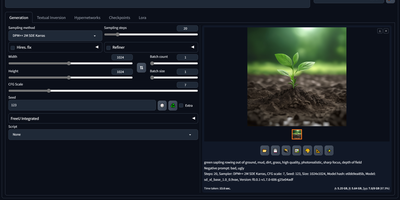
With 12,800 GitHub stars and backing from the same developer who created ControlNet, Stable Diffusion WebUI Forge replaces Automatic1111's inference backend with a dynamic GPU memory management system that runs SDXL 30-75% faster while consuming significantly less VRAM — enabling 1024x1024 generation on 6GB cards where A1111 requires 8GB or more. The Gradio 4 interface provides txt2img, img2img, inpainting, and outpainting workflows with a Forge Canvas supporting pressure-sensitive input from Wacom tablets and Microsoft Surface devices. Native Flux.1 model support loads Flux Dev and Schnell checkpoints using BitsandBytes NF4 and FP8 quantization for deployment on consumer GPUs without model splitting. Built-in ControlNet integration includes all preprocessors — Canny, Depth, Normal, OpenPose, MLSD, Scribble, Segmentation, Tile, and IP-Adapter — without requiring separate extension installation. The extension ecosystem maintains full compatibility with popular Automatic1111 extensions including Adetailer for face enhancement, After Detailer, Regional Prompter, and Dynamic Prompts. LoRA loading supports standard, LyCORIS, and DoRA formats with automatic weight detection. The API provides RESTful endpoints for txt2img, img2img, extra single/batch processing, and progress monitoring enabling headless batch generation. Deploy via one-click installer package, Python virtual environment, or Docker with NVIDIA GPU passthrough. Running on a dedicated VPS on RepoCloud with guaranteed CPU, RAM, and SSD, full root SSH access, and a browser serial console. AGPL-3.0 licensed.