KubeSphere
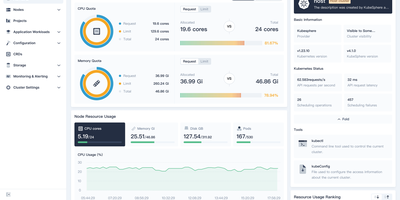
Managing Kubernetes shouldn't require every developer to become a Kubernetes expert — KubeSphere wraps cluster operations, CI/CD, service mesh, and observability into guided web workflows that operations teams configure once and developers consume without kubectl. The LuBan extensible architecture treats each capability as an independently installable extension plugging into a lightweight microkernel: enable DevOps without service mesh, add monitoring without the app store, compose exactly what your organization needs. Multi-cluster management provides a centralized control plane for provisioning and operating clusters across cloud providers, data centers, and edge locations with unified identity and resource quotas. The DevOps extension integrates Jenkins for graphical pipeline creation with S2I and B2I workflows, while Argo CD powers GitOps continuous deployment with real-time sync status. Istio-based service mesh provides traffic management, canary deployments, circuit breaking, and distributed tracing through the console without CLI knowledge. Prometheus monitoring with custom dashboards, Fluentd log collection with multi-tenant search, and alerting via Slack and email complete the observability stack. Multi-tenant workspace hierarchy enforces resource quotas and fine-grained RBAC roles across teams. A built-in Helm-based app store handles lifecycle management across clusters. KubeKey deploys production-grade clusters on bare metal or VMs with air-gapped support. Running on a dedicated VPS on RepoCloud with guaranteed CPU, RAM, and SSD, full root SSH access, and a browser serial console. Apache-2.0 licensed.
Mail-in-a-Box
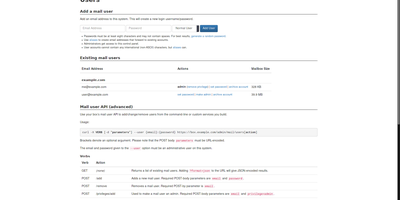
Mail-in-a-Box turns a single Ubuntu server into a fully functional email system with one setup command, installing and configuring Postfix for SMTP, Dovecot for IMAP, Roundcube for webmail, and Z-Push for Exchange ActiveSync push notifications in an automated sequence that would take days to replicate manually. The DNS server auto-configures the full suite of email authentication records: SPF, DKIM, DMARC, DNSSEC with DANE TLSA, MTA-STS, and SSHFP. Getting all of these right is what separates email that lands in inboxes from email that lands in spam, and most manual installations never achieve the complete set. Nextcloud integration adds CardDAV contact sync and CalDAV calendar sharing across devices. Let's Encrypt certificates provision and renew automatically for every hosted domain. The web control panel manages users, aliases, custom DNS records, and automated backups, protected by TOTP two-factor authentication. Daily health checks verify that services run correctly, ports remain open, TLS certificates stay valid, and DNS records resolve properly, alerting you before delivery problems develop. Multiple domains and users operate from one installation with internationalized domain name support. Built-in HTTPS static site hosting uses the TLS infrastructure already in place. Runs on a dedicated RepoCloud VPS with guaranteed resources, root SSH, and browser serial console for complete email sovereignty. CC0 public domain licensed.
Pixelfed
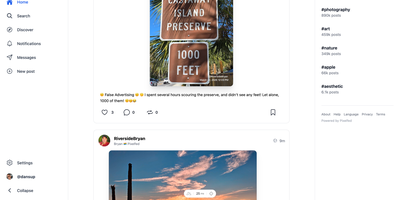
With nearly 7,000 GitHub stars and instances spanning hundreds of federated servers, Pixelfed has become the leading open-source alternative to Instagram — delivering ad-free, algorithm-free photo sharing across the Fediverse. Built on Laravel with a Vue.js frontend, Pixelfed provides a polished, mobile-responsive interface where users upload photos and videos, apply built-in filters, create multi-image posts with alt text, share ephemeral stories, organize content into curated collections, and exchange direct messages — all without tracking, algorithmic manipulation, or targeted advertising. Federation through the ActivityPub protocol means Mastodon, Pleroma, and other Fediverse users can follow Pixelfed accounts, view photo posts in their timelines, and interact through likes, boosts, and replies, while Pixelfed users can discover content through both local and federated timelines. Instance administrators control registration policies, content moderation rules, federation blocklists and allowlists, storage backends including local or S3-compatible options, and server-wide settings. The Mastodon-compatible API enables third-party mobile app support alongside the built-in Progressive Web App experience. Advanced features include blurhash image placeholders for smooth loading, federated groups for community building through FEP-400e and FEP-1b12 extensions, HTTP Signatures with Authorized Fetch for secure federation, and comprehensive data export for full portability. Deployment requires PHP 8.1+, MySQL or PostgreSQL, Redis, and a reverse proxy, with Docker Compose configurations available for streamlined setup. Running on a dedicated VPS on RepoCloud with guaranteed CPU, RAM, and SSD, full root SSH access, and a browser serial console. AGPL-3.0 licensed.
The Lounge
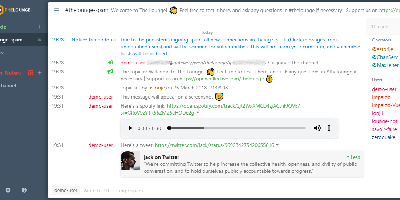
"Forget about bouncers" became a real sentence because of The Lounge: a Node.js web IRC client that holds persistent connections to your networks 24/7, logging everything while you sleep, so closing the browser tab never means missing a message or losing your place in a channel. Open it again from any device - desktop, phone, tablet - and you resume exactly where you left off, with full history synchronized. Because it combines bouncer and client in one process, the experience feels like a modern chat app rather than 1990s infrastructure: push notifications for highlights and private messages (with self-generated VAPID keys, so even Web Push needs no third-party service), automatic link previews, inline file and image uploads, and full IRCv3 protocol support. It installs as a progressive web app from any modern browser, so phones get a native-feel client without an app store. Multi-user support means one instance serves your whole team or community, each user with their own networks and history, and LDAP integration ties into existing authentication. A public mode alternatively serves as an open, registration-free web chat for events or support channels. MIT-licensed, born as a fork of Shout, and a fixture of self-hosting stacks since.
D-Tale
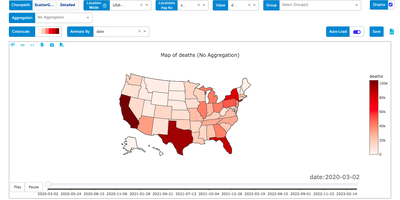
If your data lives in a pandas DataFrame, D-Tale gives it a spreadsheet-style grid, a column profiler, and a chart builder in the browser, started with one call from a notebook or script. In the grid you sort, filter, and edit cells inline, lock, hide, reorder, rename, or reformat columns from their menus, and open a Describe view with each column's distribution, summary statistics, outliers, and missing values, while highlight modes color dtypes, outliers, and numeric ranges across the whole table. Correlation matrices, a predictive power score, and duplicate reports sit beside dataframe functions that add numeric, binned, date, random, and type-converted columns, and Merge & Stack combines dataframes, including ones uploaded from Excel files. The chart builder draws line, bar, stacked, pie, wordcloud, heatmap, 3D scatter, surface, and map charts with grouping and aggregation, exports them as standalone HTML, and a network viewer graphs relationships between nodes. Whatever you build in the interface can be exported as reproducible Python code, and data can be saved as CSV or TSV. Launch it from Jupyter, Google Colab, Kaggle, a terminal, or the command line with a CSV path, protect it with optional authentication, and choose light or dark themes and English or Chinese. Running on a dedicated VPS on RepoCloud with guaranteed CPU, RAM, and SSD, full root SSH access, and a browser serial console. LGPL-2.1 licensed.
CKAN
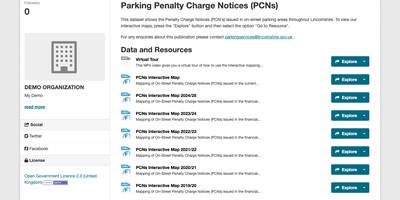
CKAN lets governments, research institutions, and companies publish data as a searchable catalog, where every dataset carries its description, license, tags, and downloadable files. Organizations own their datasets, and members, editors, and admins get different rights, so a dataset can stay private until someone with publishing rights releases it. Visitors narrow results with faceted filters on tags, formats, and organizations, or write fielded queries with wildcards and fuzzy matching. Resource pages preview spreadsheets in a grid and, when the data fits, as maps and charts, and they also display images, PDFs, and HTML. The DataStore keeps tabular resources as queryable tables, serving filtered rows with range conditions and nested AND/OR logic. Everything the web interface does is also available through the Action API. Groups gather related datasets, and custom metadata fields extend each record. Per-dataset activity streams document how data changes, and follow buttons feed a personal news feed. Files can be stored on local disk or, with extensions, in S3, Google Cloud Storage, or Azure Blob Storage. Extensions add geospatial search, harvesting for federated portals, multilingual metadata, and more chart types, and themes restyle the portal to match your brand. Running on a dedicated VPS on RepoCloud with guaranteed CPU, RAM, and SSD, full root SSH access, and a browser serial console. AGPL-3.0 licensed.
Wakapi
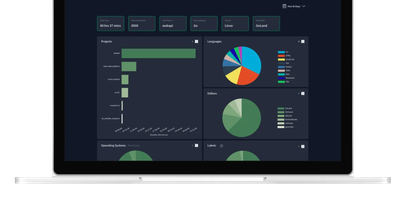
Its author, a student and WakaTime fan, didn't want to pay $9/month for data about his own keystrokes - so Wakapi was born, a self-hosted, WakaTime-compatible backend for coding statistics. The compatibility is the killer design decision: the official WakaTime plugins for VS Code, JetBrains IDEs, Vim, and dozens of other editors work unmodified - just point the plugin's API URL at your Wakapi instance with your personal key, and heartbeats flow to your server instead of a third party's. Duration inference matches WakaTime's own algorithm, with a configurable timeout (10 minutes by default). From that stream Wakapi builds statistics and plots across projects, languages, editors, hosts, and operating systems, plus the fun extras: public leaderboards (optionally login-gated, with configurable aggregation windows), badges for GitHub readmes, and weekly email reports. A REST API serves your data programmatically, Prometheus export feeds your existing Grafana, and a WakaTime relay mode can mirror heartbeats to both services during migration - with one-click import of historical WakaTime data. Written in Go, it is lightning fast and light enough for the smallest instance, storing to SQLite, PostgreSQL, or MySQL, with configurable data retention for GDPR peace of mind. Deliberately smaller than WakaTime, deliberately yours.
OHIF Viewer
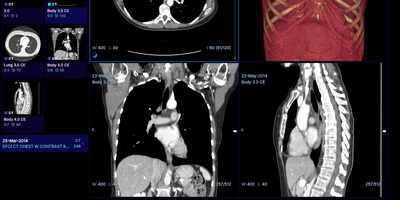
The OHIF Viewer reads CT, MR, PET, and slide microscopy studies straight from a DICOMweb archive and shows them in any browser tab, with no workstation software to install. The study list filters by patient name, MRN, study date, description, modality, and accession number. Each study launches into the workflow mode that fits its modalities. Basic Viewer mode tracks the measurements drawn on images and gathers them in a side panel for review. Layouts include MPR, four-up 3D, volume rendering, and PET/CT fusion with maximum intensity projection. Labelmap tools offer brush, eraser, threshold, and shape segmentation, and DICOM segmentation, RT Structure, and structured report objects display alongside the pixels. PDFs, video clips, ECG waveforms, 4D series, and whole slide microscopy open in the same interface. Hanging protocols arrange series the way each workflow expects. An iframe embed drops the viewer into a portal or research app. Pair it with Orthanc or DCM4CHEE for storage and Keycloak for sign-in. Oncology trial reads, imaging research, and web front ends for a PACS are the usual jobs. Running on a dedicated VPS on RepoCloud with guaranteed CPU, RAM, and SSD, full root SSH access, and a browser serial console. MIT licensed.
Password Pusher
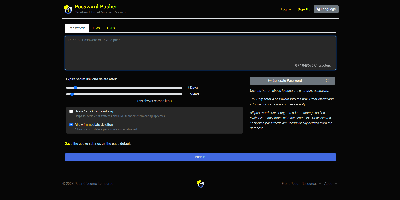
Credentials sitting forever in email threads and chat scrollback - Password Pusher solves that everyday security failure. Instead of pasting a password into Slack, you push it - a password, note, file, URL, or QR code - and share a unique one-time link that expires after a set number of views, a time limit, or both. Content is encrypted at rest with AES-GCM under a configurable master key, optionally guarded by a passphrase, and permanently deleted from the database the moment it expires; a retrieval-step option keeps URL-scanning bots from consuming views. Full audit logs record when each link was created and viewed (and by whom, with logins), and TOTP two-factor authentication can be required instance-wide. The delivery page is deliberately unbranded - no logos or confusing links for recipients - and the interface ships in 31 languages with light and dark themes. Automation runs through a JSON API (v2), an official CLI for pushing and expiring secrets from the terminal, a Chrome extension, and a catalog of third-party integrations. Apache-2.0 licensed Ruby on Rails, deployable via Docker, Kubernetes, or Helm, with SQLite or PostgreSQL storage - the sysadmin staple for sending credentials that clean up after themselves.
Yopass
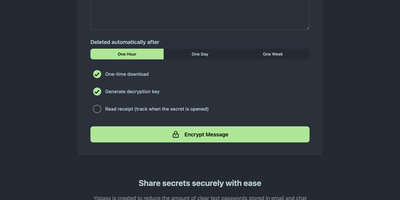
With nearly 3,000 GitHub stars and active development since 2014 through version 14.2.0, Yopass eliminates the universal bad habit of sharing passwords and API keys through Slack messages, email threads, and ticket systems by encrypting secrets entirely in the browser using OpenPGP before anything reaches the server. The Go backend stores only ciphertext — it never sees plaintext — while the React frontend handles all encryption and decryption client-side, generating one-time URLs that self-destruct after a single viewing or when the configured expiration of one hour, one day, or one week passes. File upload support streams encrypted files with configurable size limits, and optional custom password protection adds a second encryption layer beyond the URL-embedded key. The server supports Redis or Memcached as storage backends with automatic key expiration, deploying via Docker Compose in under five minutes or as Kubernetes manifests for production environments. Built-in TLS support works alongside reverse proxy configurations for Nginx, Caddy, and Traefik with automatic Let's Encrypt certificate provisioning. Prometheus metrics expose HTTP request counts, latency histograms, and secret lifecycle counters for Grafana dashboard integration and alerting. Read-only mode enables split-instance deployments separating secret creation from retrieval across different network zones. Multi-language support localizes the interface for international teams. The open-source core under Apache 2.0 provides full self-hosted functionality with no account management required. Running on a dedicated VPS on RepoCloud with guaranteed CPU, RAM, and SSD, full root SSH access, and a browser serial console. Apache-2.0 licensed.
Convoy
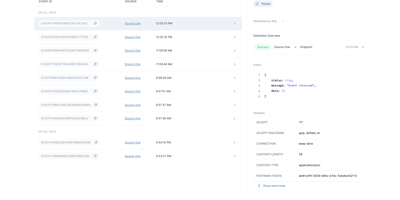
Convoy is an enterprise-grade webhooks gateway that manages both incoming and outgoing webhook traffic to guarantee reliable event delivery without exposing internal microservices to the public internet. Organizations deploy the platform at the edge to ingest events from message brokers such as Apache Kafka, RabbitMQ, and Google Cloud PubSub, or receive HTTP webhooks from third-party services directly. The gateway enforces delivery policies through configurable rate limiting per endpoint, circuit breaking during downstream outages, and automated retries using constant or exponential backoff with jitter. Developers can generate customer-facing webhook portals embedded via iframes, allowing end users to inspect delivery attempts, verify HMAC-SHA256 signatures, and manually replay failed events. Comprehensive security controls include static egress IP proxying to prevent server-side request forgery, automated rolling secret keys, and instant alerting via Slack or email when endpoints fail consecutively. Running on a dedicated VPS on RepoCloud with guaranteed CPU, RAM, and SSD, full root SSH access, and a browser serial console. Elastic License 2.0 licensed.
Networking Toolbox
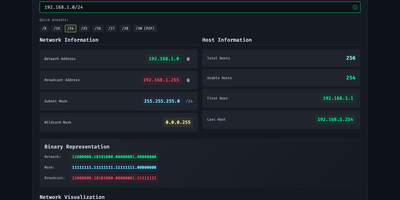
Subnet math, DNS lookups, DHCP options, and certificate checks share one browser tab in Networking Toolbox, a free toolkit for sysadmins and network engineers. Need to carve a /24 into departments? The VLSM planner fits named subnet requirements into a parent block, reports each subnet's efficiency and the leftover space, and exports the plan as CSV or JSON. Merging address lists? CIDR utilities summarize, split, compare, and deaggregate prefixes, with set operations for difference, overlap, and containment. Writing configs? Generators build DHCPv4 and DHCPv6 options, PXE profiles, Kea or ISC snippets, and SPF, DKIM, DMARC, CAA, TLSA, and SRV records, and DNSSEC helpers calculate key tags and DS records. Something broken? Diagnostics query DNS through Cloudflare, Google, Quad9, OpenDNS, or a resolver of your choice, read TLS certificate chains, grade HTTP security headers, trace redirects, check TCP ports, look up BGP routes and RDAP records, and test mail servers. Need a refresher? Reference guides explain private ranges, CGNAT, IPv6 address types, and common ports. A keyboard search palette puts any tool a few keystrokes away, and bookmarked tools stay available offline. Eighteen themes, four languages, custom branding, and accessibility switches make it feel like your own, and a keyless JSON API serves the subnet, CIDR, IP, and DNS utilities to scripts. Running on a dedicated VPS on RepoCloud with guaranteed CPU, RAM, and SSD, full root SSH access, and a browser serial console. MIT licensed.
KrakenD
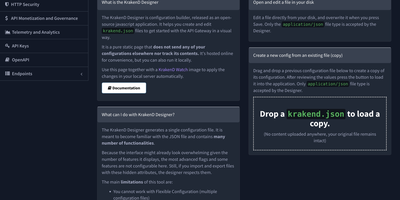
KrakenD processes over 18,000 requests per second on a single instance while consuming under 50MB of RAM at 1,000 concurrent connections, operating as a stateless API gateway that requires no database whatsoever. The Community Edition has earned over 2,600 GitHub stars by outperforming database-dependent alternatives like Kong and Tyk in independent benchmarks. Written entirely in Go, it uses declarative JSON or YAML configuration files that integrate directly into GitOps workflows for version-controlled infrastructure management. The gateway aggregates responses from multiple backend services into a single API call, transforms request and response payloads with field filtering, grouping, and mapping, and applies zero-trust security policies including JWT validation, OAuth 2.0, CORS, HSTS, clickjacking protection, and XSS prevention. Traffic management features include multi-layer rate limiting at both the router and proxy levels, circuit breakers for backend fault isolation, spike arrest policies, and concurrent call support that requests the same data from multiple backends in parallel for improved response times. Telemetry integrates with OpenTelemetry, Prometheus, Grafana dashboards, Datadog, Zipkin, and Jaeger for distributed tracing and metrics collection. The gateway extends through Go plugins, Lua scripting, Martian modifiers, and Google CEL expressions for custom request processing logic. AI workload routing supports OpenAI, Anthropic, Gemini, and other model endpoints with built-in fallback, retries, and load balancing. Deploy via Docker with the devopsfaith/krakend image as a single binary. Running on a dedicated VPS on RepoCloud with guaranteed CPU, RAM, and SSD, full root SSH access, and a browser serial console. Apache 2.0 licensed.
Corteza
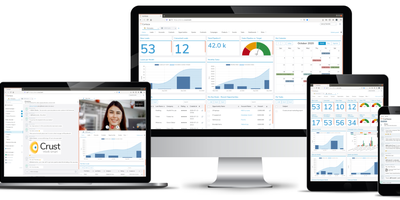
Salesforce's platform model, 100% open-source (Apache 2.0): Corteza is a Go/Vue.js low-code platform developed under a foundation, so there is no open-core bait to grow out of. The heart is Corteza Compose: namespaces contain applications, modules define record structures the way Salesforce objects do, and a drag-and-drop page builder assembles record pages, list pages, dashboards, and charts from configurable blocks. Automation comes from a visual, BPMN-style workflow engine plus JavaScript automation scripts, so cross-application business logic - approval chains, field updates, notifications - is configured rather than programmed. Granular role-based permissions reach down to individual modules, fields, and records, mirroring real organizational hierarchies. Corteza CRM ships as the flagship application built entirely on Compose: leads, accounts, opportunities, campaigns, and cases with a 360-degree customer view, covering most Salesforce standard objects - and because it is just a Compose app, adding or reshaping modules is configuration, not a fork. Everything is reachable over REST APIs, deliberately familiar tooling eases Salesforce admin migration, and a CLI can even generate synthetic records for load-testing what you build.
SOGo
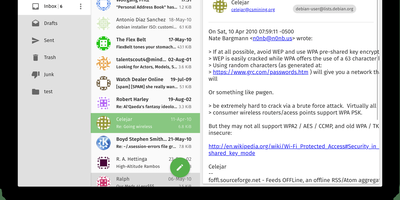
SOGo adds shared calendars, address books, and a modern webmail interface to your existing Dovecot, Postfix, or Cyrus mail setup, turning familiar infrastructure into a full Exchange competitor. Rather than replacing your IMAP and SMTP servers, SOGo layers collaboration on top of them, becoming the missing link between raw mail delivery and what users actually expect from a workplace communication platform. The ActiveSync implementation synchronizes email, contacts, calendars, and tasks natively with iPhones, Android devices, and Windows without requiring users to manually configure CalDAV endpoints. CalDAV and CardDAV compliance ensures Apple Calendar, Thunderbird (via the official SOGo Connector extension), GNOME Evolution, and Android via DAVx5 all connect without plugins or workarounds. The web interface uses AngularJS Material design with responsive layouts, offering folder management, drag-and-drop calendar scheduling, contact groups, resource booking, and delegation. Shared calendars support free-busy lookups, iMIP event invitations, and per-user ACL permissions for fine-grained access across organizational units. Built on Objective-C with the GNUstep foundation, SOGo delivers exceptional performance: hundreds of concurrent ActiveSync connections from mobile devices alongside webmail and calendar traffic with sub-second response times. With 2,095+ stars and 116 releases, the project has proven its stability in production environments supporting thousands of users. The Docker deployment runs alongside PostgreSQL and memcached.
Indico
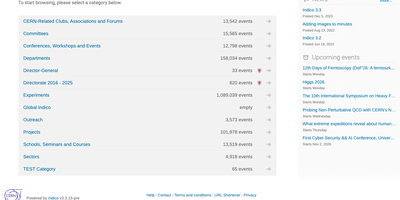
From the call for abstracts to the badge handed over at the registration desk, Indico handles every step of running a conference, plus the weekly meetings and one-off lectures that fill the calendar around it. Events live in a nested tree of categories, and access rules can be set per category, event, session, or single contribution, with custom roles inside each event. Speakers submit abstracts, track reviewers score them against questions the organizers define, judges accept or reject them, and accepted talks become contributions that sit in a drag-and-drop timetable of color-coded sessions. Registration forms are assembled field by field, carry fees, and take payment through PayPal, Stripe, or SIX Payment plugins; attendees get QR-coded tickets, and a badge editor prints name tags for the whole room. A paper reviewing workflow collects full papers. Meeting pages keep minutes and slide decks attached to the talk they belong to. The room booking module adds approvals, recurring reservations, and audiovisual equipment, and the Zoom plugin creates online sessions straight from an event page. Calendar views span a month, week, or day, filter by category, and export to iCal for subscriptions. Scripts pull event data from the HTTP export API as JSON or XML with personal API tokens. Running on a dedicated VPS on RepoCloud with guaranteed CPU, RAM, and SSD, full root SSH access, and a browser serial console. MIT licensed.
Coral
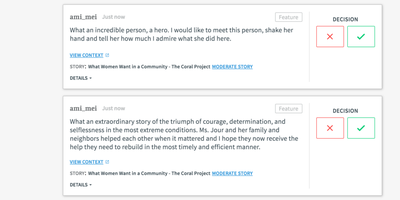
Comment sections at the Washington Post, the Wall Street Journal, and newsrooms across 30 countries run on Coral (also known as Talk) - the platform built by journalists' technologists, started under the Mozilla Foundation and now stewarded by Vox Media as an Apache-2.0 project serving 23 languages. Its founding premise is that online comments are broken and moderation is the fix. Moderators get a full queue system - reported comments, system-held pending comments, and configurable pre-moderation - backed by AI toxicity scoring that warns commenters before posting and holds high-scoring comments for review, Akismet spam detection, banned and suspect word lists, and automatic repeat-offender handling that pre-moderates users whose rejection rate crosses a threshold. Readers get features designed for healthier conversation: journalist badges in threads, muting of annoying voices, notifications, instant new-comment alerts, and timeouts rather than just bans. For publishers the economics are the point - no ads, no trackers, no hidden pixels anywhere in the code, full ownership of audience data, and GDPR compliance beyond requirements. Integration is one embedded script; SSO connects existing registration, and a GraphQL API supports customization and extension.
Atomic
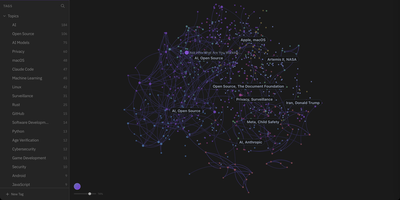
Atomic transforms collections of personal Markdown notes into an AI-augmented knowledge graph by breaking documents down into semantically linked conceptual units. Users capture thoughts, research excerpts, and web clippings as modular notes that the system automatically chunks, embeds, and categorizes with hierarchical tags. An interactive force-directed canvas maps out the entire knowledge base, positioning related ideas closer together based on embedding cosine similarity rather than manual folder hierarchies. Built-in vector search queries across text embeddings directly within SQLite, retrieving precise contextual snippets in response to natural language prompts. The automated wiki engine synthesizes disparate notes into comprehensive reference articles equipped with verifiable inline citations back to original source materials. Integrated conversational agents leverage retrieved knowledge context to answer research questions, surface contradictions across past entries, and draft structured daily briefings. External AI tools can read, search, and update stored knowledge through an embedded Model Context Protocol server endpoint. Running on a dedicated VPS on RepoCloud with guaranteed CPU, RAM, and SSD, full root SSH access, and a browser serial console. MIT licensed.