n8n
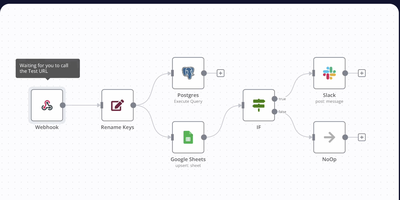
Webhooks, cron schedules, and app events trigger chains of nodes that fetch, transform, and route data: n8n is a workflow automation platform built around a visual, node-based editor. It ships with 400+ built-in integrations covering databases like Postgres, SaaS tools like Slack and HubSpot, and every major AI provider. When a pre-built node does not exist, the HTTP Request node calls any REST API, and the Code node runs JavaScript or Python inline, so you are never blocked by a missing connector. Workflows execute as directed graphs with branching, loops, error handling, and sub-workflows, and every run is logged for inspection and replay during debugging. It also includes LangChain-based nodes for building AI agents with tool calling and memory. Self-hosting on RepoCloud gives you unlimited workflow executions with no per-task pricing, and all data stays on your instance. Runs on Node.js with SQLite by default; add Postgres and Redis queue mode when you need to scale workers horizontally.
OpenClaw VPS
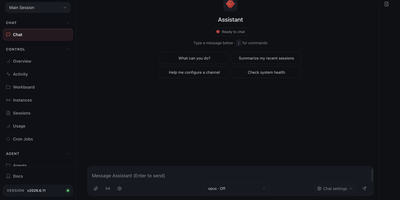
A personal AI assistant that remembers what it learns and reaches you wherever you are — OpenClaw is an open-source agent gateway built by the OpenClaw Foundation with 247,000+ GitHub stars. It connects to 200+ LLM models through providers like Anthropic, OpenRouter, and OpenAI, and meets you on 21+ messaging channels: Telegram, Slack, Discord, WhatsApp, Signal, iMessage, Matrix, and more. Persistent memory with full-text search lets the agent recall context across sessions, and a self-improving skills system means it gets more capable the longer it runs. Voice wake words and talk mode enable hands-free interaction on macOS, iOS, and Android. A live canvas provides an agent-driven visual workspace. Built-in browser automation, cron scheduling for unattended tasks, and subagent spawning for parallel workstreams round out the toolset. The gateway architecture keeps all sessions, credentials, and conversation history on your own server — nothing transits a third-party cloud unless you choose to connect one. The API key you provide for your chosen LLM provider powers the underlying calls; billing goes through your own account. Running on a dedicated VPS with guaranteed CPU, RAM, and SSD, full root SSH access, and a browser serial console. MIT licensed.
OpenBot
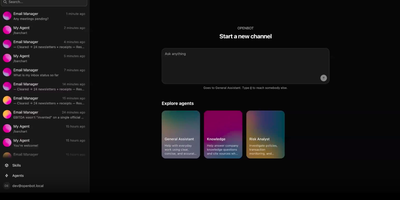
Open source GrokBot, built by the team behind the AG-UI protocol. OpenBot is the open-source enterprise agent platform that gives every AI coworker its own sandboxed computer — a real Chromium browser with its own login sessions, a private filesystem, and only the MCP tools you explicitly grant. The centralized gateway evaluates CEL policy rules against tool name, intent, bot identity, page URL, element attributes, and file paths before any action executes, writing an immutable audit row for every call and outcome. Any agent that speaks AG-UI — LangGraph, Mastra, CrewAI, Pydantic AI, Google ADK, or hand-written endpoints — registers as a Bot and receives its own channel with persistent conversation history. The take-the-wheel system lets humans assume control when an agent encounters login walls or two-factor prompts, recording control transfers as structured audit events. Knowledge documents from Google Drive and OneDrive carry source-based permissions where deny principals always win and ambiguous mappings refuse retrieval entirely. The React and Vite frontend provides live screen viewing of each agent's browser, channel-based chat, admin settings, and component galleries. The Hono API server on port 3001 handles authentication, role-based access, tenant packaging, and credential management backed by PostgreSQL with pgvector. Deploy via Docker Compose with the included supervisor that manages per-bot computer containers. Running on a dedicated VPS on RepoCloud with guaranteed CPU, RAM, and SSD, full root SSH access, and a browser serial console. MIT licensed.
EspoCRM
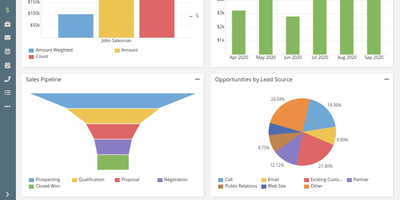
Teams tired of paying Salesforce or HubSpot per seat run EspoCRM: an AGPL-licensed PHP application with a fast single-page frontend over a REST API, covering sales, support, and marketing in one uncluttered interface. The sales core is complete - leads, contacts, accounts, opportunities with customizable pipeline stages, kanban views, calendars, meetings, and calls. Email is deeply integrated rather than bolted on: IMAP sync links messages to CRM records automatically, and mass email campaigns run with reusable templates, tracking, and Web-to-Lead forms feeding the funnel. Support teams get case management and a customer portal where clients track their own tickets and access a knowledge base. The real differentiator is the Entity Manager: create custom entities, fields, relationships, and layouts from the admin UI without code, with dynamic logic showing or hiding fields conditionally - EspoCRM is as much a business-application platform as a CRM. Formula scripting handles calculated fields and record automation in the free core; the optional Advanced Pack adds visual BPM process design and workflow rules. Role-based permissions with team and territory scoping, full-text search, reports, and a straightforward REST API for n8n or custom integrations round it out. Runs on PHP 8.3+ with MySQL, MariaDB, or PostgreSQL - unlimited users, zero per-seat fees.
Prime Agent
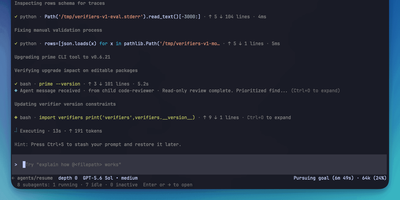
With over 14,000 GitHub stars and 41 releases since its May 2026 launch, Prime Agent delivers a fundamentally different approach to AI coding agents by treating the agent's own operating environment as programmable state that improves through use. The Recursive Language Model architecture provides the model exactly one tool — a persistent IPython kernel — where file operations, shell commands, subagent delegation via rlm() function calls, and context management all happen through code rather than rigid tool-calling schemas. Subagents launch as independent sessions with their own model, kernel, and history, communicating results through agent_message.send() without blocking the parent. The Continual Harness stores supplemental prompts, memories, skill descriptions, and reusable subagent specifications as durable state that the /refine command updates through small, evidence-backed edits with full rollback by ID. Daemon-backed sessions keep running when the terminal disconnects, with automatic context compaction summarizing older messages while preserving recent state. The TUI provides an Agent View for monitoring, switching between, and steering multiple live sessions simultaneously. Autonomous mode operates within configurable turn, token, and time budgets with user-defined quality gates. Persistent goals, heartbeats, and scheduled prompts maintain continuity across terminal sessions. Compatible with Anthropic Claude, OpenAI, Google Gemini, local models via Ollama or vLLM, and Prime Inference endpoints. Install via a single curl command on Linux or macOS. Running on a dedicated VPS on RepoCloud with guaranteed CPU, RAM, and SSD, full root SSH access, and a browser serial console. MIT licensed.
DeerFlow
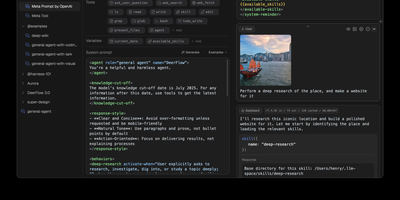
DeerFlow 2.0 is ByteDance's ground-up rewrite that transforms what began as a Deep Research framework into a batteries-included super agent harness handling tasks lasting minutes to hours autonomously. Built on LangGraph and LangChain, the runtime orchestrates a lead agent that plans, decomposes, and delegates to sub-agents executing in isolated Docker or Kubernetes sandboxes with persistent filesystem access, while an extensible skills system lets developers add capabilities as Python functions or MCP servers with OAuth token flows. The harness ships with long-term memory using persistent event loops with per-agent isolation, scheduled task execution via cron, context engineering with manual compaction, and a web UI at localhost:2026 for interactive sessions. Model support spans OpenAI GPT-4o/GPT-5, Anthropic Claude via OAuth, Google Gemini, DeepSeek, Qwen via vLLM, and OpenRouter-compatible gateways with per-model pricing configuration. IM channel integration connects Telegram, Slack, Feishu/Lark, Discord, WeChat, WeCom, DingTalk, and Buzz without requiring a public IP — all using long-polling or WebSocket transports. Production deployment uses Docker Compose with nginx reverse proxy, PostgreSQL or SQLite persistence, Redis stream bridges for multi-worker scaling, and lease-based run ownership with automatic orphan recovery. The terminal workbench TUI enables headless operation. Running on a dedicated VPS on RepoCloud with guaranteed CPU, RAM, and SSD, full root SSH access, and a browser serial console. MIT licensed.
Supabase
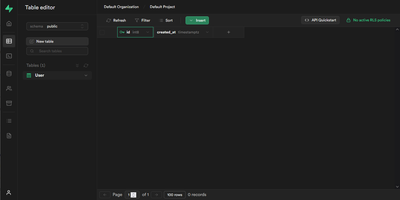
With over 107,000 GitHub stars and adoption by teams at Mozilla, 1Password, Peerlist, and thousands of startups, Supabase has become the most widely deployed open-source Firebase alternative — built entirely on PostgreSQL rather than a proprietary NoSQL store. Every project provisions a dedicated Postgres database with 40+ preinstalled extensions, auto-generating REST APIs via PostgREST, GraphQL via pg_graphql, and real-time change streams via an Elixir-based WebSocket engine that supports database change listeners, user presence tracking, and arbitrary broadcast messaging. Authentication covers email and password, phone OTP, magic links, and 20+ social providers including Google, GitHub, Apple, Azure, and SAML SSO, all enforced through Postgres Row Level Security policies that run inside the database itself. S3-compatible object storage delivers files through a CDN spanning 285+ cities with on-the-fly image transformations powered by imgproxy. Edge Functions run globally distributed TypeScript on the Deno runtime with Node.js compatibility and access to over two million NPM packages. The pgvector extension stores, indexes, and queries vector embeddings for AI-powered semantic search and retrieval-augmented generation workflows. Supabase Studio provides a browser-based dashboard with a table editor, SQL editor, schema visualizer, and log explorer. Official client SDKs ship for JavaScript, Python, Flutter, Swift, Kotlin, C#, Go, and Ruby. The self-hosted Docker Compose stack runs fourteen coordinated services including Kong API gateway, Supavisor connection pooler, and Logflare analytics. Running on a dedicated VPS on RepoCloud with guaranteed CPU, RAM, and SSD, full root SSH access, and a browser serial console. Apache 2.0 licensed.
LobeHub
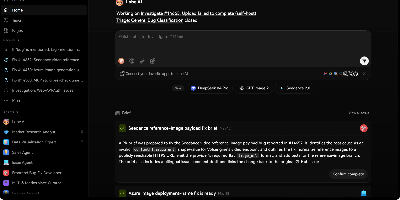
With over 82,000 GitHub stars and 700,000+ downloads, LobeHub has evolved from its origins as LobeChat into a comprehensive multi-agent AI collaboration platform where humans and autonomous agent teams co-evolve. The platform's Agent Harness architecture functions as an operating system between AI models and applications, handling prompt presets, tool orchestration, lifecycle hooks, planning, filesystem access, and sub-agent management across 25+ model providers including OpenAI, Anthropic Claude, Google Gemini, DeepSeek, Mistral, Groq, AWS Bedrock, Azure OpenAI, and local models through Ollama. Agent Groups enable sophisticated collaboration with sequential, parallel, iterative, and debate orchestration modes, allowing multiple specialized agents to tackle complex workflows simultaneously. The Agent Builder creates production-ready agents from natural language descriptions with auto-configuration, drawing from a marketplace of 505+ pre-built agents and 10,000+ MCP-compatible skills and plugins. Pages provide collaborative document editing with multi-agent co-authoring, while Schedules automate agent runs around the clock without human supervision. The knowledge base leverages PostgreSQL with pgvector for RAG-powered retrieval, and Personal Memory gives agents transparent, editable context that evolves through continual learning. The full self-hosted stack deploys via Docker Compose with PostgreSQL, Redis, RustFS for S3-compatible storage, and SearXNG for private web search, all configurable through environment variables. Running on a dedicated VPS on RepoCloud with guaranteed CPU, RAM, and SSD, full root SSH access, and a browser serial console. LobeHub Community licensed.
Postiz
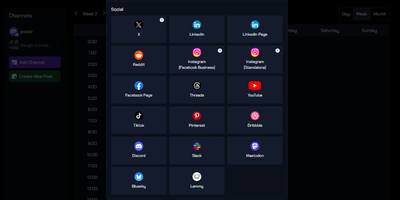
Powering over $145K monthly recurring revenue as a one-person company and holding 34,000+ GitHub stars, Postiz has emerged as the most widely adopted open-source alternative to Buffer, Hootsuite, and Hypefury — combining social media scheduling with AI-driven content creation and agentic automation in a single self-hosted platform. The Next.js 14 frontend with React 18 and Tailwind CSS delivers a visual calendar and Canva-like design editor, while the NestJS backend orchestrates publishing across 30+ social networks including X, LinkedIn, Instagram, TikTok, YouTube, Reddit, Pinterest, Threads, Dribbble, Discord, Bluesky, Mastodon, and Facebook. Temporal handles durable workflow execution for reliable scheduled posting, retry logic, and background job processing. The built-in AI assistant generates post ideas, captions, hashtags, images, and short videos from natural language prompts — all within a single chat interface. An agentic layer exposes a CLI and MCP server that allow AI agents like OpenClaw, Claude, and ChatGPT to autonomously plan, draft, and schedule posts programmatically. Team collaboration includes role-based permissions, approval workflows, multi-workspace management for agencies, and commenting on scheduled content. A full REST API with a NodeJS SDK, N8N custom nodes, and Make.com integration enables automation pipelines. Analytics track engagement, reach, and growth across all connected accounts from a unified dashboard. The self-hosted stack deploys via Docker Compose with PostgreSQL, Redis, and Temporal pre-wired — no feature limitations compared to the cloud version. Running on a dedicated VPS on RepoCloud with guaranteed CPU, RAM, and SSD, full root SSH access, and a browser serial console. AGPL-3.0 licensed.
Open Lovable
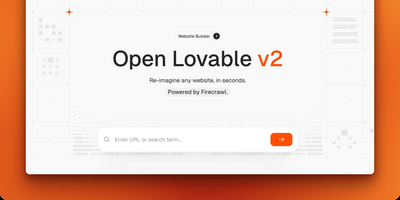
Open Lovable from the Firecrawl team delivers the first truly open-source alternative to Lovable.dev — a chat-driven AI copilot that takes any website URL and regenerates it as a complete, editable React application with TypeScript and Tailwind CSS in seconds. The pipeline combines Firecrawl's intelligent web scraping for JavaScript-rendered pages and single-page applications with your choice of AI provider — Claude, GPT-4, Google Gemini, or Groq — to analyze HTML structure, extract layouts and styling, decompose pages into proper React components, and generate production-ready code following modern best practices. Live preview runs in a secure sandbox environment using Vercel Sandbox with OIDC authentication or E2B Cloud, letting you see results immediately and iterate through natural language chat to request changes like Tailwind migration, componentization, SEO improvements, accessibility fixes, or custom form implementations. The optional Morph LLM fast-apply path accelerates small edits by applying diffs directly without full regeneration. The provider-agnostic architecture means you control costs by routing to different models — use Groq for fast iterations and Claude for complex layouts. Project structure follows Next.js conventions with organized app, components, atoms, styles, utils, and hooks directories. Deploy via pnpm with Node.js 18+ requiring only a Firecrawl API key, one AI provider key, and a sandbox provider configuration. Running on a dedicated VPS on RepoCloud with guaranteed CPU, RAM, and SSD, full root SSH access, and a browser serial console. MIT licensed.
OpnForm
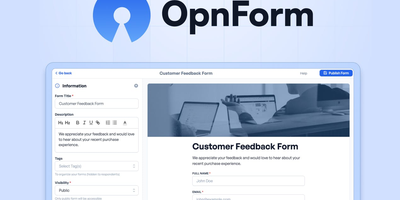
With 3,500+ GitHub stars and 100+ pre-built templates, OpnForm delivers a drag-and-drop form builder that handles everything from simple contact forms to multi-page surveys with conditional branching, calculations, and payment collection. The Laravel 11 API paired with a Nuxt 3 Vue frontend provides a responsive no-code editor supporting 20+ field types including text, date, file upload, signature capture, star ratings, phone numbers with country codes, and rich text. Conditional logic enables dynamic show/hide rules, required-field toggling, and calculated values that react to user input in real time. Submissions flow through configurable integrations — Slack notifications, Discord webhooks, Zapier connections to 5,000+ apps, Google Sheets sync, and custom webhook endpoints with full payload control. AI-powered form generation lets users describe a form in plain language and receive a ready-to-publish result. OIDC single sign-on with configurable state enforcement secures multi-user workspaces, while form-level passwords and CAPTCHA protection guard public-facing pages. Analytics dashboards track submission rates, completion times, and drop-off points. Forms embed via iframe on any website, Notion page, or custom domain with removable branding and custom CSS/JavaScript injection. The Docker Compose stack bundles the API, queue worker, scheduler, Nuxt client, PostgreSQL 16, Redis 7, and Nginx ingress proxy for a single-command deployment. Running on a dedicated VPS on RepoCloud with guaranteed CPU, RAM, and SSD, full root SSH access, and a browser serial console. AGPLv3 licensed.
Memoh
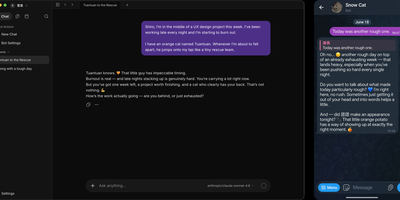
Memoh delivers an open-source multi-agent platform where every AI agent gets its own computer — not a chat window but a fully isolated container with dedicated filesystem, desktop environment, browser, network stack, and persistent long-term memory that survives across sessions, days, and platforms. The containerd-based runtime ensures each bot operates in complete isolation with snapshot and data import/export capabilities. The memory engine uses LLM-driven fact extraction with hybrid retrieval combining dense embeddings via Qdrant, sparse vectors, and BM25, plus 24-hour context loading and automatic compaction — with Mem0 and OpenViking as drop-in alternatives. Ten communication channels connect agents to users through Telegram, Discord, Lark, QQ, Matrix, WeCom, WeChat, Email, Web UI, and group chats with cross-platform identity binding. MCP tool calling enables agents to interact with external services, while browser automation drives GUI workflows for web research and data extraction. Agent hosting supports running external coding agents like Codex and Claude Code inside Memoh workspaces via ACP with per-bot configuration. Scheduled tasks run without human triggers, and agents proactively reach out when needed. The web dashboard built with Vue 3 and Tailwind CSS provides streaming chat, tool call visualization, file management, model and provider configuration, and bot lifecycle management. Deploy via Docker Compose with PostgreSQL, Qdrant, sparse service, and the Go backend server. Running on a dedicated VPS on RepoCloud with guaranteed CPU, RAM, and SSD, full root SSH access, and a browser serial console. AGPL-3.0 licensed.
Twenty
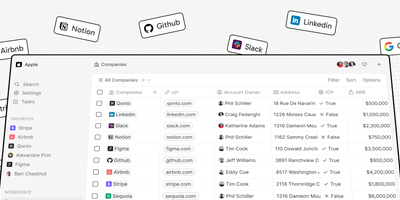
Salesforce's core workflow, open-source and on your own server: Twenty is a modern CRM built as exactly that alternative. It ships the standard CRM objects out of the box: people, companies, opportunities, notes, and tasks, displayed in table and kanban views with drag-and-drop and real-time updates. Its defining technical feature is a metadata-driven data model: you define custom objects and fields in the UI, and the backend regenerates its GraphQL schema at runtime, so a new object gets working queries, mutations, filters, and sorting within seconds, with no migrations to run - adapting the CRM to your sales process never requires code changes. A REST API is auto-generated from the same schema, GraphQL subscriptions push real-time updates, and webhooks fire on record changes for external integration. A visual workflow builder automates actions like notifications and field updates, TypeScript-based apps extend the platform with custom logic and frontend components, and email and calendar sync pulls Gmail messages and meetings onto contact timelines so communication history sits next to the record. The stack is NestJS with TypeORM, PostgreSQL, Redis, and BullMQ on the backend, React with Jotai on the frontend. Self-hosting on RepoCloud means unlimited users with no per-seat licensing - the pricing model that penalizes growing teams on commercial CRMs - and your pipeline, contacts, and deal history live in your own PostgreSQL database rather than a vendor's.
Onyx
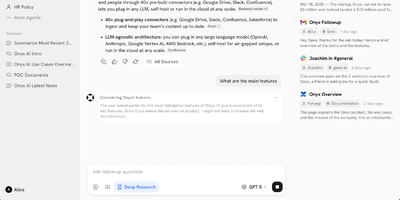
Formerly known as Danswer and now backed by over 31,000 GitHub stars with 253 releases, Onyx delivers a production-ready AI platform that turns any LLM into a context-aware enterprise assistant connected to your organization's actual knowledge. The agentic RAG pipeline combines BM-25 keyword search with prefix-aware embedding models in a hybrid index, then deploys AI agents to retrieve, verify, and synthesize answers with source citations from over 40 connected workplace tools including Google Drive, Confluence, Slack, Notion, Jira, SharePoint, GitHub, and Linear. Custom AI assistants with configurable prompts, backing knowledge sets, and document-level access control enable specialized agents for engineering, sales, support, and research workflows. The platform supports every major LLM provider — Anthropic Claude, OpenAI, Google Gemini, plus self-hosted options via Ollama, LiteLLM, and vLLM for fully air-gapped deployments. Beyond chat, Onyx provides web search with Serper, Google PSE, Brave, and SearXNG integration, an in-house web crawler, code execution, file creation, and multi-step deep research with report generation. Enterprise features include SSO via Google OAuth, OIDC, or SAML with SCIM provisioning, role-based access control, usage analytics by team and agent, query history auditing, PII removal through custom code hooks, and full whitelabeling. Deploy via Docker Compose on any infrastructure. Running on a dedicated VPS on RepoCloud with guaranteed CPU, RAM, and SSD, full root SSH access, and a browser serial console. MIT licensed (Community Edition).
Listmonk
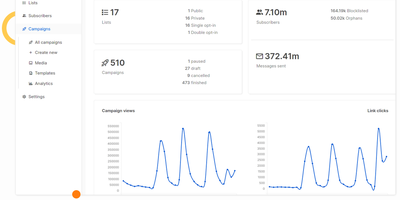
Seven million emails from a single binary peaking at 57 MB of RAM: listmonk is a high-performance newsletter and mailing list manager in Go with PostgreSQL as its only dependency - no Redis, no worker processes, no message broker. The project's own production benchmark sent 7+ million emails with the binary peaking around 57 MB of RAM, and throughput exceeds 100K emails per hour on modest hardware. Campaigns run through a multi-threaded, multi-SMTP queue with round-robin delivery, per-server concurrency, retries, and sliding-window rate limiting across providers like Amazon SES, SendGrid, Mailgun, or your own Postfix relay. Subscribers carry custom JSON attributes and are segmented with raw SQL queries, so any audience Postgres can express, listmonk can target. Templates use Go template syntax with 100+ functions for dynamic per-subscriber content, and the Vue dashboard reports opens, clicks, bounces, and unsubscribes with automated bounce processing. A REST API handles transactional email and programmatic control, a built-in media library hosts campaign assets, and CSV or API import migrates lists from hosted platforms. The economics are the headline: where Mailchimp pricing scales with list size, listmonk plus Amazon SES sends the same volume for hosting cost plus roughly $0.10 per thousand emails - commonly a 95% reduction - and your email list, a core business asset, stays on your own infrastructure. AGPLv3-licensed; bring your own SMTP provider for delivery.
Mattermost
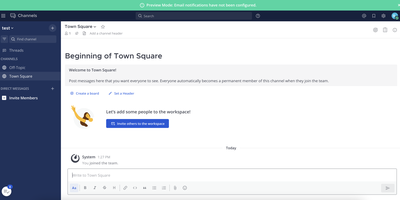
Teams that cannot send messages through someone else's cloud run Mattermost - the open-core, self-hosted alternative to Slack. It provides public and private channels, threaded discussions, unlimited search history, file sharing with previews, one-to-one audio calls, and screen sharing, with desktop clients for Windows, macOS, and Linux plus iOS and Android apps. Messages support full Markdown, which suits engineering conversations with code blocks and logs. Playbooks turn repeatable processes such as incident response and release management into checklist-driven workflows with automated triggers and retrospectives. Integration is a core strength: prebuilt connectors for GitHub, GitLab, Jira, ServiceNow, and PagerDuty, plus webhooks, slash commands, bots, a REST API, and a plugin marketplace with 700+ entries - together making it a working surface for ChatOps rather than just a chat room. Playbooks add keyword and event triggers, task assignment, status broadcasting, and post-incident retrospectives, so operational knowledge is not trapped in individuals' heads. The server is a single Go binary backed by PostgreSQL, with React clients, released monthly under MIT license and deployable fully air-gapped - which is why governments and defense organizations run it inside closed networks, and why the same control applies to any team with confidentiality requirements. The compiled Team Edition is free for unlimited users with no message history cutoff, so costs stay flat as the team grows.
AnythingLLM
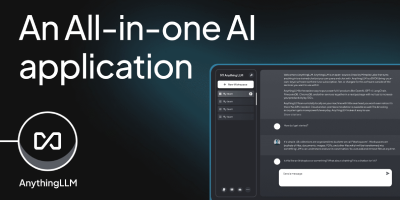
Chat with your own documents: AnythingLLM, from Mintplex Labs, wraps retrieval-augmented generation (RAG) in an open-source application anyone can run. You organize content into workspaces, each an isolated namespace with its own documents, vector embeddings, chat history, and settings, so one instance can hold several separate knowledge bases. Upload PDFs, DOCX, TXT, and other formats, or scrape web pages; the built-in collector parses and chunks them into a vector database (LanceDB by default, with Pinecone, Chroma, Qdrant, and others supported). Answers cite their source documents. It works with both cloud LLMs (OpenAI, Anthropic, Gemini) and local ones via Ollama or LM Studio, and the embedding model is separately configurable. Beyond RAG chat, it includes AI agents that can browse the web and run tools, an embeddable chat widget for your website, a developer API, and multi-user mode with admin, manager, and default roles plus per-workspace access control. Context assembly is smarter than naive RAG: pinned documents, attached files, vector search hits, and recent chat history are combined under a token budget so the model's context window is filled efficiently, and each workspace supports multiple independent conversation threads against the same knowledge base. Because the embedding model, vector store, and chat LLM are all independently swappable, you can move between providers without re-ingesting a single document. The stack is Node.js with a React frontend, MIT-licensed.
TrueForge
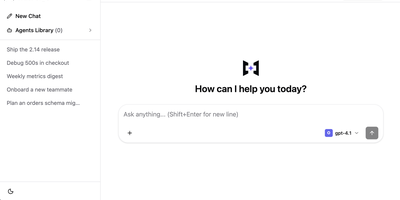
With over 2,100 GitHub stars in its first month and benchmarked at 30-75% lower cost than Claude Managed Agents on enterprise task suites, TrueForge is the open-source agent harness that provides the complete runtime layer for turning any LLM into a working production agent on your own infrastructure. The TypeScript server runs the full execution loop — streaming every step, routing tool calls through MCP servers with centralized header-auth and in-chat OAuth, delegating parallelizable work to isolated subagents, and pausing for human approval on sensitive actions. Context engineering keeps token costs low: deferred tool-schema loading delays MCP schemas until invoked, large-result offloading moves oversized outputs to files, Code Mode processes structured data through sandboxed execution, and automatic compaction summarizes older history at a configurable 50,000-token threshold while preserving the full transcript. The sandbox-as-a-tool architecture provisions isolated Daytona environments only when code execution is required, allowing one server to run many concurrent agents without idle overhead. Agents are configured from shipped YAML catalogs of models, MCP servers, git-backed SKILL.md instruction packs, and sandbox providers, then saved to an Agents Library accessible via the chat UI, TypeScript SDK, or embeddable React UI SDK. Run locally with SQLite via a single npx command, or deploy for teams with Docker Compose or Helm using Postgres and Redis with OIDC authentication. Running on a dedicated VPS on RepoCloud with guaranteed CPU, RAM, and SSD, full root SSH access, and a browser serial console. MIT licensed.