SOGo
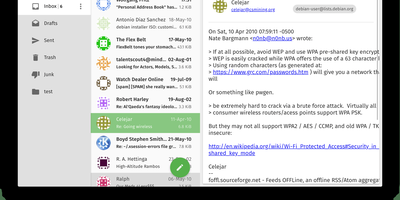
SOGo adds shared calendars, address books, and a modern webmail interface to your existing Dovecot, Postfix, or Cyrus mail setup, turning familiar infrastructure into a full Exchange competitor. Rather than replacing your IMAP and SMTP servers, SOGo layers collaboration on top of them, becoming the missing link between raw mail delivery and what users actually expect from a workplace communication platform. The ActiveSync implementation synchronizes email, contacts, calendars, and tasks natively with iPhones, Android devices, and Windows without requiring users to manually configure CalDAV endpoints. CalDAV and CardDAV compliance ensures Apple Calendar, Thunderbird (via the official SOGo Connector extension), GNOME Evolution, and Android via DAVx5 all connect without plugins or workarounds. The web interface uses AngularJS Material design with responsive layouts, offering folder management, drag-and-drop calendar scheduling, contact groups, resource booking, and delegation. Shared calendars support free-busy lookups, iMIP event invitations, and per-user ACL permissions for fine-grained access across organizational units. Built on Objective-C with the GNUstep foundation, SOGo delivers exceptional performance: hundreds of concurrent ActiveSync connections from mobile devices alongside webmail and calendar traffic with sub-second response times. With 2,095+ stars and 116 releases, the project has proven its stability in production environments supporting thousands of users. The Docker deployment runs alongside PostgreSQL and memcached.
Kodus AI
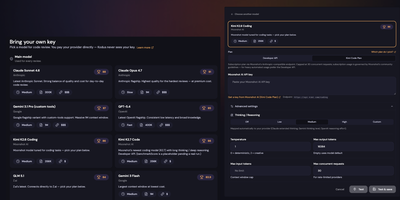
Kodus AI automates pull request code review with inline AI comments across GitHub, GitLab, Bitbucket, and Azure DevOps, supporting any LLM provider at cost with zero token markup. The multi-service TypeScript architecture deploys via Docker Compose, running an API server, background worker, webhooks service, and React dashboard backed by PostgreSQL with pgvector, MongoDB, and RabbitMQ. Integration covers both cloud platforms and their enterprise flavors (GitHub Enterprise Server, GitLab Self-Managed, Bitbucket Data Center) using standard OAuth flows and webhook signing to keep the review loop entirely inside your network. The platform is model-agnostic with Bring Your Own Key support for Claude, GPT, Gemini, Llama, and any OpenAI-compatible endpoint including locally-hosted models. Custom review rules combine your team's coding standards with requirements pulled from Jira, Linear, and Notion, automatically checking every PR against documented specifications. The CLI enables local reviews against working trees, staged diffs, branches, or specific commits, integrating into CI/CD pipelines as pre-merge gates. Source code is never stored and never used for model training, with all data encrypted in transit and at rest. 1,270+ stars and 129+ releases since March 2025. Running on a dedicated VPS on RepoCloud with guaranteed CPU, RAM, and SSD, full root SSH access, and a browser serial console. AGPL-3.0 licensed.
Bambuddy
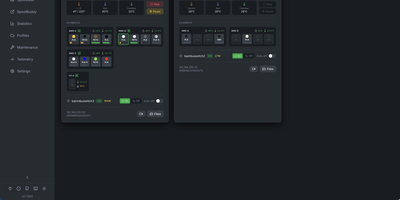
Command and automate your entire fleet of 3D printers without relying on proprietary cloud services using Bambuddy, a self-hosted management hub that delivers local network control, print scheduling, and job archiving for Bambu Lab hardware. Print shop operators can route slicing output directly from Bambu Studio or Orca Slicer through virtual printer proxies that emulate physical machines while automatically cataloging print files in a searchable 3D repository. The automated dispatch engine assigns queued gcode files to available printers based on required nozzle temperatures, build plate dimensions, and matched multi-color filament slots. Users can inspect live camera streams across multiple printing beds simultaneously, verify empty build plates before dispatching new jobs, and generate stabilized timelapse videos with custom music. Integrated smart plug connectors automatically cut power to idle machines when print cycles finish and trigger push notifications to Discord or mobile devices if thermal anomalies or mechanical pauses occur. Farm managers can schedule maintenance alerts based on cumulative motor runtime, track spool inventory levels across storage locations, and synchronize printing configurations across duplicate hardware setups. Running on a dedicated VPS on RepoCloud with guaranteed CPU, RAM, and SSD, full root SSH access, and a browser serial console. GNU AGPL v3.0 licensed.
ComfyUI
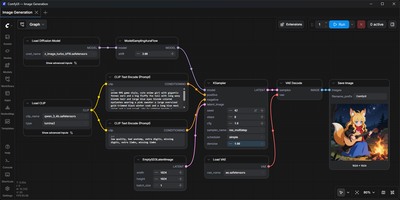
With over 126,000 GitHub stars and adoption across professional studios, research labs, and independent creators, ComfyUI has become the most widely used node-based interface for generative AI workflows — supporting image, video, audio, and 3D content creation through a single visual canvas. The graph editor natively supports Stable Diffusion 1.5, SDXL, SD3.5, Flux.1, Flux.2, HunyuanDiT, Lumina Image 2.0, HiDream, Qwen Image, and Pixart for image generation, plus Wan 2.1 and 2.2, LTX-Video, HunyuanVideo 1.5, CogVideoX, and Mochi for video, ACE-Step and Stable Audio for audio, and Hunyuan3D 2.0 for 3D models. Built-in tools handle inpainting, outpainting, ControlNet conditioning, LoRA and Hypernetwork loading, ESRGAN upscaling, area composition, model merging, and GLIGEN spatial control without writing code. The execution engine implements asynchronous queue processing with partial graph re-execution, running only changed nodes between iterations, and smart VRAM management that offloads models on GPUs with as little as 1 GB of memory. API nodes optionally connect to closed-source models through Comfy API while the core runs fully offline. Reusable subgraphs and App Mode expose complex workflows as simplified interfaces for non-technical users. The V3 custom node schema enables stateless execution with async support and process isolation. The TypeScript and Vue frontend ships as a PyPI package with stable releases every two weeks. Workflows save as JSON and embed in generated PNG, WebP, and FLAC files for reproducibility. Running on a dedicated VPS on RepoCloud with guaranteed CPU, RAM, and SSD, full root SSH access, and a browser serial console. GPL v3.0 licensed.
LightDash
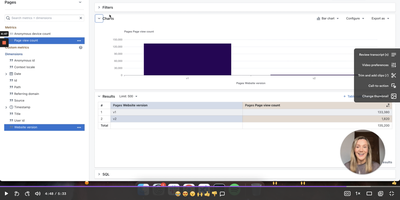
With 5,600+ GitHub stars and deep dbt integration, Lightdash is the open-source Agentic BI platform that treats analytics like software — defining metrics, dimensions, joins, permissions, and caching in a governed context layer that powers dashboards, AI agents, data apps, embedded analytics, and MCP server endpoints simultaneously. The dbt Write-Back feature lets business users create custom metrics and models in the UI, then automatically generates pull requests in GitHub or GitLab so every change flows through code review and CI validation before reaching production. Context-specific AI analysts automatically select relevant models and metrics, build queries, and present insights in plain English, while row-level security, user attributes, and customer-facing permissions ensure data governance at every layer. The platform connects to BigQuery, Snowflake, Redshift, Databricks, PostgreSQL, Trino, and ClickHouse through warehouse adapters, with the TypeScript monorepo built on React, Mantine, Vite, and TanStack Query on the frontend plus Node.js, Express, Knex, and PostgreSQL on the backend. Data teams build analytics with coding agents, preview changes from the CLI, validate in CI pipelines, and review charts and dashboards in pull requests — making the entire analytics lifecycle version-controlled and reproducible. Running on a dedicated VPS on RepoCloud with guaranteed CPU, RAM, and SSD, full root SSH access, and a browser serial console. MIT licensed.
World Monitor
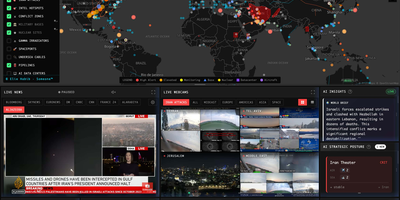
World Monitor replaces twenty or more browser tabs by fusing geopolitical, military, financial, and infrastructure signals onto a single interactive canvas built with TypeScript, Vite, globe.gl with Three.js for the 3D globe, and deck.gl with MapLibre GL for the flat map. World Monitor ingests live data from 530 upstream sources including ACLED and UCDP for conflict events, OpenSky Network for military and civilian aircraft, AISStream for vessel positions, NASA FIRMS for satellite fire detection, USGS for earthquakes, and FRED, IMF, BIS, and Finnhub for macroeconomic and market data. The Country Instability Index v8 computes real-time stress scores across 31 Tier-1 nations, while the finance radar tracks 29 stock exchanges, commodities, and cryptocurrency with a 7-signal market composite. Six specialized dashboard variants — World, Tech, Finance, Commodity, Energy, and Happy — deploy from a single codebase. AI summarization runs locally through Ollama and LM Studio integration or optionally via Groq and OpenRouter cloud providers, with Transformers.js powering browser-side inference. The platform supports 26 languages with native-language feeds and RTL layout, and provides MCP server integration for AI agent connectivity. Running on a dedicated VPS on RepoCloud with guaranteed CPU, RAM, and SSD, full root SSH access, and a browser serial console. AGPL-3.0 licensed.
PodFetch
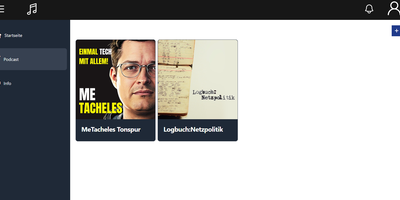
Podcast enthusiasts and homelab archivers automate digital episode preservation and stream personal audio feeds using PodFetch, an open-source self-hosted podcast manager that combines scheduled RSS downloads, Podcasting 2.0 transcript indexing, and browser playback into a modern listening platform. Listeners can subscribe to international podcast channels through direct feed URLs, Apple Podcasts directory searches, or bulk OPML subscription imports, configuring background polling timers to download new releases automatically upon publication. The integrated audio player supports variable speed playback, episode bookmarks, listening histories, and fullscreen visualization modes directly inside responsive desktop and mobile browser sessions. Advanced search capabilities leverage Podcasting 2.0 synchronized transcripts and automated speech-to-text generation via OpenAI-compatible Whisper APIs, allowing collectors to run full-text keyword searches across every spoken phrase in their audio archive. Built-in GPodder API synchronization maintains subscription lists and playback positions across popular smartphone apps like AntennaPod and native companion clients without relying on commercial cloud accounts. Server operators can assign multi-user accounts with private favorites lists, export customized RSS aggregation streams, and route storage paths between fast solid-state drives and large secondary mechanical hard disks. Running on a dedicated VPS on RepoCloud with guaranteed CPU, RAM, and SSD, full root SSH access, and a browser serial console. Apache-2.0 licensed.
RAGFlow
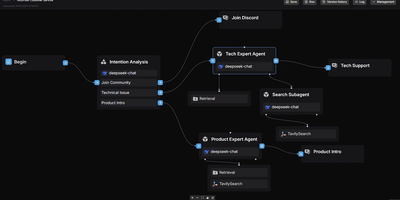
RAGFlow has established itself as one of the most widely adopted open-source RAG engines available, powering production AI systems that demand traceable, hallucination-free answers from complex enterprise data. The platform processes PDF, DOCX, Excel, and PPT files through vision-based deep document understanding with layout analysis and OCR, extracting structured knowledge from tables, charts, and images that simpler parsers miss entirely. RAGFlow's hybrid retrieval pipeline combines vector search with BM25 keyword matching and multi-stage reranking across configurable document stores including Elasticsearch, InfiniFlow's Infinity engine, OpenSearch, and OceanBase. Developers connect any combination of LLM providers — OpenAI, DeepSeek, Anthropic Claude, Google Gemini, and locally-hosted models via Ollama — through a unified configuration layer. The visual agent workflow system enables multi-step reasoning chains with persistent memory, tool calling, and pre-built templates for common enterprise scenarios. RAGFlow synchronizes data from Confluence, S3, Notion, and Google Drive, and delivers answers through chat integrations with Feishu, Discord, Telegram, and Line. The Python SDK and RESTful API on port 9380 provide programmatic access to knowledge base management, document parsing, and conversational retrieval. The full stack deploys via Docker Compose with MySQL for metadata, Redis for task orchestration, and MinIO for object storage. Running on a dedicated VPS on RepoCloud with guaranteed CPU, RAM, and SSD, full root SSH access, and a browser serial console. Apache 2.0 licensed.
Akaunting
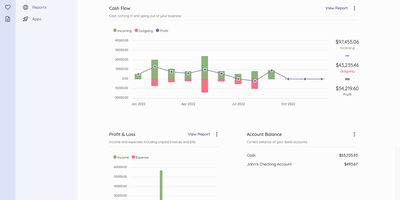
Akaunting is an online accounting software for small businesses and freelancers. The double-entry accounting engine provides a full Chart of Accounts, journal entries, and balance sheet reporting, eliminating the manual errors inherent in single-entry systems. Unlimited invoice creation with customizable templates, automatic payment reminders, and client portal access lets businesses present professional documents and accept payments through PayPal, Stripe, and other gateway integrations. Expense tracking captures operational costs with category-based organization, receipt scanning, and vendor bill management with overdue payment alerts. Bank Feeds auto-syncs transactions from connected bank accounts and matches them against invoices and bills for streamlined reconciliation. The dashboard displays receivables, payables, cash flow summaries, profit and loss charts, expenses by category, and account balances at a glance with configurable date ranges. Quotes and estimates convert directly into invoices upon client approval, while recurring invoices and bills automate periodic billing without manual intervention. The modular architecture built on Laravel with the Akaunting Module package enables an App Store where developers publish extensions for payroll, inventory, projects, and CRM functionality. Multi-company support manages separate books from a single installation with per-company user roles. Running on a dedicated VPS on RepoCloud with guaranteed CPU, RAM, and SSD, full root SSH access, and a browser serial console. BSL licensed.
Flatnotes
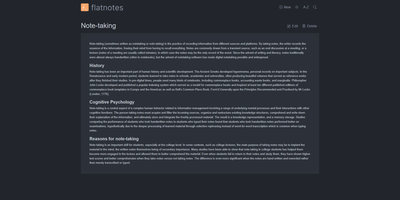
A web interface for a folder of Markdown files - Flatnotes is exactly that, and the discipline of that design is why people love it. Every note is a plain .md file in a single flat directory: no database, no proprietary format, no hierarchy to maintain, no export step if you ever leave. Edit notes in the browser or open the same files in VS Code or Obsidian, sync them with Syncthing or rsync while the app is running - the Whoosh-powered search index synchronizes incrementally, so external edits just show up. The interface is a clean Vue.js app with both WYSIWYG and raw Markdown editing modes (TOAST UI Editor), instant full-text search behind the "/" shortcut with partial-match support, wikilinks for cross-note references, and automatic tag extraction from #hashtags in note bodies. Light and dark themes and a mobile-responsive layout make it pleasant everywhere. Authentication is flexible for a personal tool: none, read-only, username/password, or TOTP two-factor. A documented REST API covers create/read/update/delete for automation. The operational story is the quiet selling point - the only state is the notes folder and a rebuildable index, so backup is copying a directory. For a personal notepad that respects your data, Flatnotes nails minimal.
Gotify
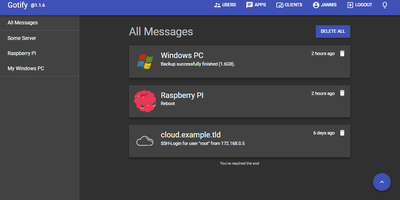
Real-time alerts from your own infrastructure to your phone, with no Firebase, Pushover, or third-party push service in the path: Gotify is a simple, self-hosted notification server written in Go. The model is deliberately minimal: senders push messages with a single HTTP POST to the REST API, receivers subscribe over a WebSocket stream, and a clean React web UI manages the pieces. Senders are namespaced as "applications," each with its own token, so your backup script, Uptime Kuma, CI pipeline, and cron jobs each get an identity, an icon, and independently revocable credentials - centralized alerting from many services with per-source management. Messages carry a title, body, and priority level that maps to notification importance on the client. The official Android app (on both F-Droid and Google Play, notable for working entirely without Google Play Services) shows push notifications for new messages; the web UI itself supports Web Push in the browser; and gotify/cli pushes messages from shell scripts with one command. A server-side plugin system adds custom behavior, and the whole thing runs as a single small binary with SQLite by default - near-zero resource footprint. Because dozens of tools (and Apprise) speak Gotify natively, it slots in as the notification hub for an entire homelab or ops stack.
Healthchecks
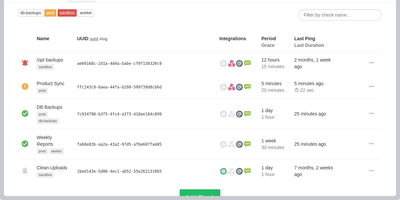
With 10,100+ GitHub stars and 75 releases over a decade of continuous development, Healthchecks is the open-source cron job monitoring service that catches failures your other monitoring tools miss — the jobs that silently stop running, the backups that never completed, the nightly reports that disappeared without error. The dead man's switch architecture requires zero agent installation: your cron jobs, scripts, and services ping a unique URL via HTTP request or email, and Healthchecks alerts you only when a ping does not arrive within the configured Period and Grace Time window. Each check supports cron expression scheduling, optional start, success, and failure signals for measuring execution time, and HTTP body keyword filtering for intelligent alert routing. Twenty-five notification integrations cover every channel teams actually use: Slack, Discord, Microsoft Teams, PagerDuty, Opsgenie, Splunk On-Call, Telegram, Signal, WhatsApp, SMS, email, webhooks, GitHub Issues, Pushover, ntfy, Gotify, Matrix, Mattermost, Zulip, Pushbullet, PagerTree, Spike.sh, and Trello. The web dashboard provides a visual grid showing real-time status with color-coded badges and per-check integration toggles. Monthly, weekly, and daily email reports summarize uptime trends with checks sorted by downtime duration. Team management supports projects with member roles and read-only access. Prometheus metrics expose check health and grace state for Grafana dashboards. WebAuthn and TOTP two-factor authentication secure accounts. Deploy via Docker images available for amd64, arm/v7, and arm64 architectures. Running on a dedicated VPS on RepoCloud with guaranteed CPU, RAM, and SSD, full root SSH access, and a browser serial console. BSD 3-Clause licensed.
Livebook
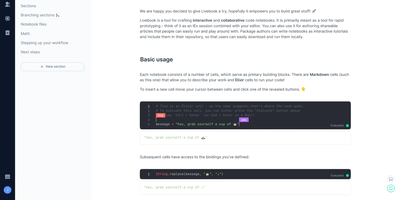
Livebook is an interactive notebook for Elixir where you write code alongside rich Markdown prose, execute it cell by cell with reactive dependency tracking, and deploy finished notebooks as standalone web applications with a single click. Nearly 6,000 GitHub stars reflect the Elixir core team's investment in a platform where code cells run on demand alongside Mermaid diagrams and KaTeX mathematical formulas. The Kino visualization library renders Vega-Lite charts, interactive data tables with sorting and pagination, Leaflet maps, and Mermaid diagrams directly within notebook output cells, while custom Kino components enable building interactive controls with sliders, text inputs, and buttons that feed values back into running code. Smart cells abstract high-level tasks into configurable UI widgets: query PostgreSQL, MySQL, SQLite, and BigQuery databases, train machine learning models with Axon, plot charts, and build map visualizations without writing boilerplate code. Real-time collaboration lets multiple users edit the same notebook simultaneously with cursor presence indicators and synchronized cell evaluation. Notebooks are stored as .livemd files, a Markdown-compatible format that renders cleanly on GitHub and integrates with standard version control workflows. Custom runtimes connect Livebook to existing Elixir applications for live introspection and documentation of running systems. The Docker image at ghcr.io/livebook-dev/livebook exposes ports 8080 and 8081 with password or token authentication. Running on a dedicated VPS on RepoCloud with guaranteed CPU, RAM, and SSD, full root SSH access, and a browser serial console. Apache 2.0 licensed.

LubeLogger
Vehicle maintenance records shouldn't live in a homemade spreadsheet and a shoebox of receipts - LubeLogger exists because of exactly that. It's a self-hosted .NET web application (from Hargata Softworks) that gives every vehicle in your garage a complete digital history: service, repair, and upgrade records categorized and searchable, with invoices and receipts attached as documents; fuel fill-ups that compute economy in MPG, UK MPG, L/100KM, or KM/L without spreadsheet tedium; taxes, odometer logs, inspections, equipment, and supplies inventory for tracking the parts and fluids on your shelf. The reminder system is what saves engines: recurring reminders trigger by date, odometer reading, or whichever comes first - exactly how real service intervals work - so oil changes and timing belts stop relying on memory. A dashboard summarizes expenses by year, month, and category, a planner tracks to-dos by type, priority, and progress, and professional vehicle reports print a full history - genuinely useful when selling a car. Collaboration is built in: invite household members as collaborators on shared vehicles, with single sign-on support. Custom fields adapt records to your needs, CSV import/export moves data freely, an API enables automation, and the mobile-tested UI installs as a PWA on iOS and Android. MIT-licensed.
Multica
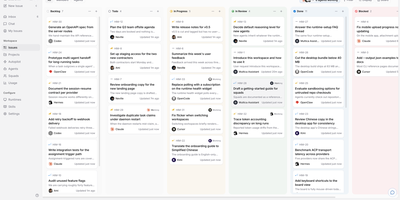
Reaching 45,000 GitHub stars within seven months of launch, Multica is the fastest-growing open-source platform for managing AI coding agents as first-class teammates — assign an issue to Claude Code, Codex, Cursor, Copilot, Kimi, or any of 21 supported agent CLIs and it picks up the work, comments progress in real time via WebSocket, raises blockers, and hands the result back for human review before anything merges. The Go backend (Chi router, sqlc-generated type-safe queries, gorilla/websocket) connects to PostgreSQL 17 with pgvector for semantic search across workspace history, while the Next.js 16 App Router frontend delivers workspace dashboards showing per-agent token spend, execution time, daily cost charts, and runtime status across unlimited connected machines. Agent Skills provide reusable methods, reference material, and supporting files that compound across runs — a persistent knowledge layer that makes each subsequent task faster and more accurate. Squads let a leader agent select the right specialist for subtasks, creating multi-agent workflows without manual orchestration. Review gates ensure no AI-generated code ships to main without explicit human approval. Self-host via Docker Compose or Kubernetes with full Git integration across GitHub, GitLab, Gitea, and Forgejo including self-hosted instances. The CLI and REST API make every surface scriptable, and Autopilot automations trigger agent runs from events. Running on a dedicated VPS on RepoCloud with guaranteed CPU, RAM, and SSD, full root SSH access, and a browser serial console. Apache 2.0 licensed with additional conditions.
Google Maps Scraper
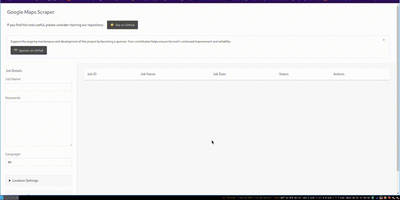
The leading open-source tool for extracting business leads from Google Maps at production scale. The Go-based engine processes approximately 120 places per minute with optimized concurrency, extracting 33+ data points per listing including business name, address, phone number, website URL, rating, review count, latitude and longitude, opening hours, price level, and optionally crawling business websites for email addresses. Three interfaces serve different workflows: the CLI accepts query files for cron jobs and CI/CD pipelines with output to CSV, JSON, PostgreSQL, S3, or LeadsDB; the Web UI provides a browser-based dashboard with real-time job monitoring, a map view of scraped places, and interactive query submission; and the REST API at /api/v1 enables programmatic integration with full Swagger documentation at /api/docs. Built-in proxy rotation supports SOCKS5, HTTP, and HTTPS with authentication for large-scale runs, while the architecture scales from a laptop to Kubernetes clusters with queue-based worker distribution. The SaaS edition adds multi-user access with API key management, admin UI with 2FA, job queue orchestration, and one-command cloud deployment via an interactive wizard. An AI Agent Skill enables coding agents to run scrapes programmatically. Deploy via Docker or build from source requiring Go 1.26.5+. Running on a dedicated VPS on RepoCloud with guaranteed CPU, RAM, and SSD, full root SSH access, and a browser serial console. MIT licensed.
Tymeslot
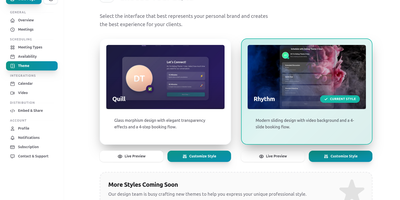
Built on Elixir's fault-tolerant OTP runtime, Tymeslot delivers the complete scheduling toolkit that Calendly charges for and Cal.com relicensed away from open source in 2026. Share one booking link and let clients pick available slots — your calendar stays synchronized and double-bookings disappear automatically through real-time availability checking against Google Calendar, Microsoft Outlook, and any CalDAV server including Nextcloud. Meeting types support configurable durations, buffer times, and availability windows that clients can book without email back-and-forth. Phoenix LiveView powers the real-time UI with WebSocket connections that update instantly as bookings arrive, without client-side JavaScript framework overhead. The platform attaches Zoom video rooms to confirmed bookings through your own Marketplace app credentials, sends confirmation and reminder emails via SMTP, Postmark, SendGrid, Mailgun, or AhaSend, and supports custom booking page themes with embed options for integration into existing websites. Circuit breakers, connection pooling, and graceful degradation maintain availability during provider outages. Authentication supports local accounts, GitHub OAuth, and reCAPTCHA protection on public booking forms. Self-hosting deploys as a single container with PostgreSQL embedded — no separate database container required. Two named volumes persist uploads and database state, while the same image powers the managed cloud at tymeslot.app so self-hosted users get identical features without a crippled community edition. Deploy via Docker, Cloudron with automatic updates, or Railway from a community template. Running on a dedicated VPS on RepoCloud with guaranteed CPU, RAM, and SSD, full root SSH access, and a browser serial console. AGPL-3.0 licensed.
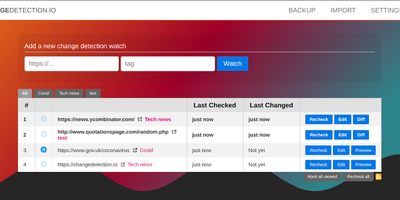
Change Detection
Price drops, restocks, job postings, government announcements, competitor edits - changedetection.io watches web pages and alerts you the moment anything changes, down to PDF text and checksums. Point it at a URL, set a check interval, and precise filters decide what counts as a change: a Visual Selector targets page elements by pointing and clicking, CSS selectors and XPath narrow scope, trigger-text and ignore-text rules (with regex support) cut noise, and JSONPath or jq handles API responses. A dedicated re-stock and price detection mode extracts product metadata and fires on thresholds - alert only when the price drops below your target or the percentage change exceeds a limit. JavaScript-heavy sites render through a real Chrome browser via Playwright, with the ability to execute JS steps first (log in, click, scroll) before extracting text. Notifications reach 85+ services through Apprise - Discord, Slack, Telegram, email, webhooks - optionally with a screenshot of the changed page, and AI-powered summaries (any OpenAI-compatible endpoint, including local Ollama) describe what changed. Per-watch proxies, custom headers, and POST/GET control cover hostile targets. Apache-2.0 licensed with local file-based storage: the URLs you monitor and why stay entirely your business.