Securo
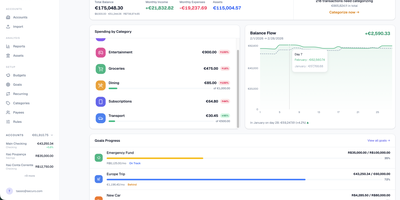
Securo is a privacy-first personal finance platform that keeps all your financial data in your own PostgreSQL instance while connecting to 2,500+ banks across three continents for automated transaction sync. The FastAPI backend with React/TypeScript frontend deploys via Docker Compose on ports 3000 and 8000, with Redis-backed Celery workers handling background synchronization. Bank connections span approximately 2,500 European PSD2 institutions through Enable Banking across 29 countries, US and international banks via SimpleFIN's open protocol, and Brazilian banks through Pluggy, all refreshing automatically every four hours. Multi-account management tracks checking, savings, credit cards, and investments with running balances. The auto-categorization rules engine applies pattern-matching across merchants and amounts. Goal tracking monitors savings targets with progress visualization, asset management handles stocks and custom instruments with configurable valuation growth rules, and reports generate Net Worth and Income vs Expenses charts with category sparklines. Optional AI Agents provide LLM chat with tool-use over your financial data through MCP, supporting OpenAI, Anthropic, Ollama, and compatible providers with per-agent RAG knowledge bases accessible via a global command palette. Multi-user support includes OIDC login, passkey authentication, TOTP two-factor, privacy mode, and multi-currency FX conversion via Open Exchange Rates. 1,500+ stars since March 2026. Running on a dedicated VPS on RepoCloud with guaranteed CPU, RAM, and SSD, full root SSH access, and a browser serial console. AGPL-3.0 licensed.

Maybe Finance
Roughly $1M of development work, open-sourced: Maybe Finance began as a $249/year commercial personal finance product before the company released it all. It aggregates bank accounts, credit cards, loans, investments, crypto, and real estate into a single net worth dashboard with historical trend charts - replacing the spreadsheet that usually glues a whole portfolio together. Transactions are categorized and tagged with rules, with merchant tracking and search across imported or synced activity; budgets track spending by category against plan; and the investment view follows holdings, cost basis, and returns across brokerage accounts. Multi-currency support converts accounts held in different currencies into a single reporting currency, bank synchronization works through Plaid where supported, and manual CSV import covers any institution. An optional AI assistant answers questions grounded in your own financial data. Because the app was built as a paid product with professional design before being open-sourced, its interface quality exceeds most community finance tools - and self-hosting means your balances and transactions are not monetized by a free app or gated behind an annual subscription. The stack is Ruby on Rails with Hotwire on PostgreSQL, licensed AGPL-3.0 and deployed via Docker. The original repository is archived; development continues in the community fork Sure, compatible with the same self-hosted setup.
NextChat
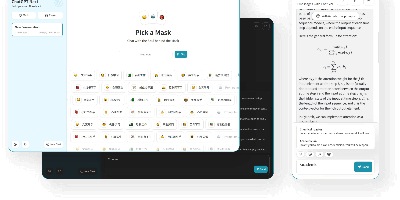
Thirteen-plus LLM providers, one unified client: NextChat (formerly ChatGPT-Next-Web) is an open-source AI chat interface built on Next.js that spans OpenAI GPT-4, Anthropic Claude, Google Gemini, DeepSeek, Groq, Azure endpoints, and self-hosted backends like Ollama, LocalAI, and RWKV-Runner. Its defining trait is minimalism - the first screen loads in about 100 KB, the desktop client is roughly 5 MB, and there is no database or user system to operate; chat history lives locally in the browser with optional WebDAV or UpStash Redis sync. The Mask system saves reusable prompt-template personas you can share and debug, long conversations auto-compress to fit context windows, and Markdown rendering covers LaTeX, Mermaid diagrams, and code highlighting with streaming responses. Plugins add web search and calculators, MCP support enables external tool calling, and Artifacts previews generated content in a separate pane. Ships as a web app, Docker image, and Tauri desktop builds for Windows, macOS, and Linux, translated into 20+ languages. MIT-licensed.
Nango
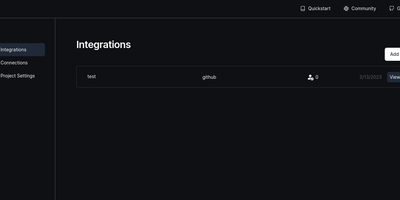
The integrations your SaaS product offers its own users - that is what Nango, an open-source product-integrations platform, exists to build. It solves the repetitive infrastructure work behind every third-party API connection: OAuth flows, API key handling, token refresh, encrypted credential storage, rate-limit backoff, retries, and multi-tenant connection management. It ships pre-built auth configurations for 800+ APIs. Your users connect their accounts through an embeddable, white-label Connect UI, and your backend then reads or writes data through Nango's proxy, SDKs, or REST API without ever touching raw credentials. Integration logic is written as TypeScript functions covering actions, scheduled data syncs, and webhook processing - all running on one runtime with retries, checkpointing, and per-connection logs built in. Syncs pull records incrementally on a schedule, one-way or two-way, which suits RAG pipelines, search indexing, and keeping local copies of external data current. Selected actions can also be exposed as tool schemas or through a built-in MCP server, so AI agents operate on user-connected accounts without ever handling provider credentials. Auth support spans OAuth 2.0, OAuth 1.0a, API keys, basic auth, and JWT, and observability - logs, metrics, failure detection, and a reconnect flow for expired credentials - is scoped per customer connection for easier support debugging. Works with any backend language. Self-hosting on RepoCloud keeps all customer credentials and synced data on infrastructure you control, which matters for data residency and compliance requirements.
Apache Airflow
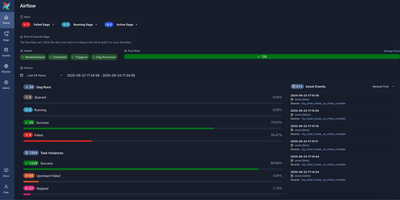
With over 46,000 GitHub stars and one of the largest communities in data engineering, Apache Airflow is the workflow orchestration platform that lets teams define, schedule, and monitor complex data pipelines as Python code through directed acyclic graphs. Airflow 3.x introduced a modernized architecture with a task execution API, the Language Task SDK for writing task implementations in Java and Go alongside Python, asset-based partitioning with FanOutMapper and FixedKeyMapper for data-driven scheduling, a first-class state store for tasks and assets, pluggable retry policies, and a redesigned React-based web UI built on FastAPI. The provider ecosystem ships 80+ packages covering AWS, Google Cloud, Azure, Snowflake, Databricks, Apache Spark, Apache Kafka, PostgreSQL, MySQL, MongoDB, Slack, HTTP, SSH, Docker, Kubernetes, and dozens more, enabling a single deployment to orchestrate jobs across multi-cloud and on-premises infrastructure. The scheduler supports cron expressions, timetable plugins, data-aware scheduling triggered by asset events, and dynamic task generation through Python loops and conditionals. Built-in operators include BashOperator, PythonOperator, DockerOperator, KubernetesPodOperator, and sensor operators that poll external systems. The web UI provides DAG visualization with Gantt charts, grid views, and graph views, task instance logs, SLA monitoring, connection and variable management, and role-based access control. Deployment options include standalone mode, Docker Compose with CeleryExecutor or KubernetesExecutor, Helm charts for Kubernetes, and managed cloud services. Running on a dedicated VPS on RepoCloud with guaranteed CPU, RAM, and SSD, full root SSH access, and a browser serial console. Apache License 2.0 licensed.
CubeSandbox
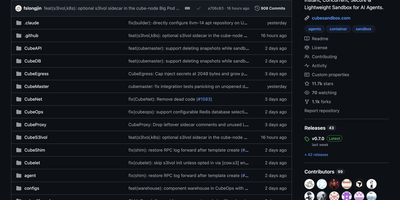
CubeSandbox gives every AI agent its own hardware-isolated MicroVM with a dedicated Linux kernel — not a shared-kernel container but a true KVM virtual machine — booting in under 60ms with less than 5MB of memory overhead per instance, enabling thousands of concurrent sandboxes on a single server via kernel sharing and Copy-on-Write memory. The Rust-built CubeProxy exposes an E2B SDK-compatible REST API on Axum, so existing E2B Cloud applications switch by changing one environment variable with zero client code changes. CubeMaster orchestrates cluster-level scheduling in Go while Cubelet manages node-local sandbox lifecycles including create, run, pause, resume, snapshot, and destroy operations. CubeVS, the eBPF-powered network layer, enforces per-sandbox isolation with LPM trie-based egress policies entirely in kernel space — no userspace context switches — while CubeEgress provides an L7 security proxy with per-domain, per-path, and per-method allowlists plus automatic credential injection that keeps secrets invisible to sandbox code. Hundred-millisecond-granularity snapshots enable checkpoint, rollback, and parallel fork from any saved state. The volume framework supports E2B-compatible pluggable storage with independent lifecycle and cross-sandbox sharing. Production deployment uses Terraform on Tencent Cloud or Helm charts on Kubernetes, K3s, or TKE, with full ARM64 support alongside x86_64 and AutoPause/AutoResume for cost optimization. Running on a dedicated VPS on RepoCloud with guaranteed CPU, RAM, and SSD, full root SSH access, and a browser serial console. Apache 2.0 licensed.
Memos
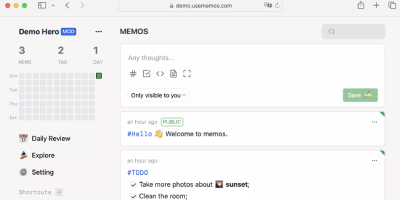
Open the page, write a Markdown note, move on - Memos is a lightweight, self-hosted service built for quick capture. Instead of folders, notebooks, and titles, it presents a timeline: open the page, write a Markdown note, and move on. Notes support headings, code blocks with syntax highlighting, task lists, tables, and file attachments, with tags auto-extracted from #hashtags in the text. Each memo carries a visibility level, private, protected (logged-in users), or public, so one instance works as a personal log, a small team wiki, or a lightweight microblog. The backend is a single Go binary with a React frontend, around 50 MB of memory at runtime and a ~20 MB Docker image, so it fits comfortably on the smallest instance size with near-zero maintenance. SQLite is the default store, with MySQL and PostgreSQL supported for multi-user deployments needing more concurrency, and full REST and gRPC APIs - Connect RPC for browsers, gRPC-Gateway for external tools - make capture scriptable from CLIs, bots, and automation platforms. Fast full-text search spans all memos, pinned notes keep references handy, and a masonry view suits visual browsing. MIT-licensed with zero telemetry; content is stored as plain Markdown in a database you control, so notes remain readable, exportable, and free of proprietary formats.
Grist
With over 11,200 GitHub stars and adoption by France's sovereign digital workspace LaSuite serving 20,000+ government users, Grist is the relational spreadsheet that ends the false choice between fragile Excel files and expensive custom database development — storing all data in portable SQLite files while providing true relational structure where VLOOKUPs become actual linked records that update instantly across entire documents. Python-powered formulas replace complex Excel syntax with clear, readable logic using the full Python standard library, while familiar Excel functions remain available for users who prefer them. Granular access rules control permissions at row, column, table, and cell levels — not just entire sheets — enabling multi-department documents where each team sees only their authorized data. The flexible layout system combines spreadsheets, card views, charts, calendars, and custom widgets on configurable dashboard pages that transform raw data into operational interfaces. Real-time collaboration lets multiple users edit simultaneously with automatic snapshot history capturing every change for full audit trails and point-in-time recovery. AI formula assistance connects to OpenAI, Llama, or any OpenAI-compatible endpoint via OpenRouter to generate formulas from natural language descriptions. The REST API and webhooks enable integration with n8n, Zapier, and custom automation, while incremental imports keep external data sources synchronized. Deployable via Docker with OIDC, SAML, and SCIM authentication support. Running on a dedicated VPS on RepoCloud with guaranteed CPU, RAM, and SSD, full root SSH access, and a browser serial console. Apache 2.0 licensed.
Skyvern
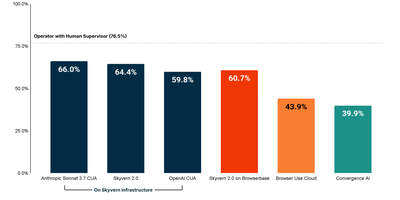
Scoring 64.4 on the WebBench benchmark — state-of-the-art among browser automation platforms — Skyvern replaces brittle XPath-based scripts with Vision LLM reasoning that adapts when websites change their layouts. The platform extends Playwright with AI-powered page methods including page.act(), page.extract(), and page.validate() that accept natural language prompts while still supporting traditional CSS selectors as fallback. The drag-and-drop Workflow Studio offers 17+ block types including navigation, extraction, login, loops, conditionals, code blocks, file download, and file upload — enabling non-technical users to build complex multi-step automations without writing code. Self-hosted deployments support bring-your-own-LLM with OpenAI, Anthropic, Gemini, and Ollama, while the multi-engine architecture allows swapping between Skyvern 2.0, OpenAI CUA, Anthropic CUA, or UI-TARS per task with a single parameter. Built-in infrastructure handles persistent browser sessions preserving cookies and localStorage across runs, automatic CAPTCHA solving for reCAPTCHA and hCaptcha, anti-bot bypass for Cloudflare and DataDome, residential proxy rotation across 20+ countries, and a credential vault integrating with Bitwarden and 1Password for secure 2FA management. Real-time session livestreaming via WebRTC enables visual debugging, while step-by-step action logs with screenshots and full LLM diagnostic traces provide production observability. The MCP server integration exposes Skyvern as a tool for Claude, Cursor, Windsurf, and any MCP-compatible AI agent. Connect to 6,000+ apps through Zapier, Make.com, or self-hosted N8N workflows. Deploy via Docker Compose or pip install with a two-command setup. Running on a dedicated VPS on RepoCloud with guaranteed CPU, RAM, and SSD, full root SSH access, and a browser serial console. AGPL-3.0 licensed.
AMUX
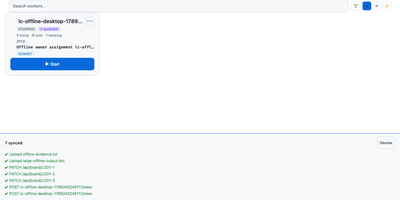
To coordinate swarms of autonomous coding agents across complex software projects, AMUX provides a concurrency-safe kanban workspace with real-time thought stream inspection and live steering controls. Engineers assign development tasks through an interactive board where autonomous worker processes claim cards using compare-and-swap mutexes to eliminate race conditions between parallel sessions. Operators monitor active reasoning streams, inspect streaming terminal outputs, and inject guidance commands mid-turn without interrupting background execution. A cryptographic origin router relays messages between agents, enabling workers to delegate sub-tasks, request automated peer code reviews, and share environment state safely. Built-in schedulers trigger recurring automated maintenance routines, dependency updates, and bug triage sweeps on cron-like timers or autonomous loop cadences. Teams can switch language models dynamically on active sessions to tackle complex architecture challenges with high-capability reasoning engines while conserving resources on routine tasks. An integrated self-healing supervisor watches over agent runtimes, automatically compacting context windows, restarting crashed terminal sessions, and resuming pending instructions seamlessly. Running on a dedicated VPS on RepoCloud with guaranteed CPU, RAM, and SSD, full root SSH access, and a browser serial console. MIT licensed.
BentoPDF
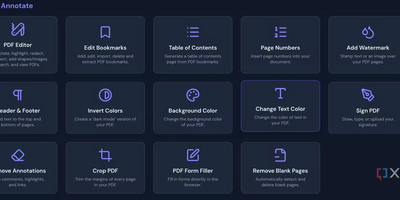
Merge, split, compress, convert, edit, annotate, redact, OCR, and sign PDFs - BentoPDF packs over 130 tools into a privacy-first toolkit that runs entirely in the browser through WebAssembly. Files are never uploaded - processing happens in browser memory on the user's machine and disappears when the tab closes, which makes the tool GDPR-clean by architecture and safe for financial, legal, and internal documents. The engine combines WASM builds of PyMuPDF, Ghostscript, and CoherentPDF; Tesseract handles OCR with searchable text-layer output; Office conversions cover Word, Excel, and PowerPoint; and digital signatures use X.509 certificates (PFX/PEM) with the private key staying on the client. Because there is no server-side processing, deployment is a static-file exercise: a single Docker container, or any static host. A dedicated self-hosted build strips the marketing pages while keeping every tool, and air-gapped deployments are first-class - an automated script bundles the WASM modules, OCR language data, and fonts for fully offline networks. No accounts, no limits, no watermarks; TypeScript and Vite under the hood.
SpiderFoot
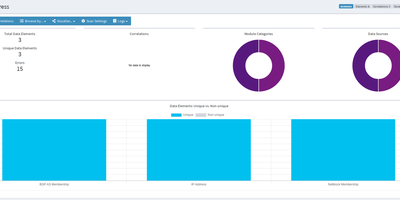
SpiderFoot is an open-source OSINT automation platform, replacing hours of manual reconnaissance with automated intelligence gathering across more than 200 data collection modules. The platform accepts ten distinct target types including IP addresses, domains, hostnames, network subnets, ASNs, email addresses, phone numbers, usernames, person names, and Bitcoin addresses, then feeds them through a publisher-subscriber event bus where each module's findings trigger downstream analysis automatically. SpiderFoot queries Shodan, VirusTotal, HaveIBeenPwned, AlienVault OTX, Censys, crt.sh, WHOIS databases, social media platforms, breach databases, and dozens more sources, with most modules requiring no API keys and many offering free tiers for those that do. The YAML-configurable correlation engine applies 37 pre-defined rules to identify relationships between discovered data points, flagging patterns like shared infrastructure, credential exposure, and domain reputation anomalies. Results export in CSV, JSON, and GEXF graph formats for integration with external analysis tools. TOR integration enables dark web searching, and SpiderFoot can invoke external tools including DNSTwist, Whatweb, Nmap, and CMSeeK for deeper technical assessment. The embedded web server delivers an intuitive dashboard for scan management, data visualization, and result exploration alongside a full command-line interface for scripted automation. Running on a dedicated VPS on RepoCloud with guaranteed CPU, RAM, and SSD, full root SSH access, and a browser serial console. MIT licensed.

Opengeni
Enterprises requiring production-grade governance for long-running autonomous AI operations can rely on OpenGeni, a self-hosted orchestration platform with human-in-the-loop approvals, Connected Machine execution, and comprehensive audit replays. Operators can configure durable multi-turn workflows that execute continuously toward specified goals without premature termination, automatically pausing when human verification, structured multiple-choice decisions, or critical credential approvals are required. Teams can assign execution workloads across ephemeral cloud sandboxes or route them straight to enrolled Connected Machines to run commands directly against local code repositories without exposing inbound network ports. The integrated web console lets developers inspect live Server-Sent Event activity streams, replay complete turn histories from audit logs, inspect generated artifacts, and cancel or steer in-flight agent tasks on demand. Platform administrators can enforce fine-grained access policies through GitHub App repository bindings, broker temporary role-scoped secrets, and maintain a shared organizational knowledge base where agents propose findings for human review before vector indexing. Running on a dedicated VPS on RepoCloud with guaranteed CPU, RAM, and SSD, full root SSH access, and a browser serial console. Apache-2.0 licensed.
MeterSphere
MeterSphere is the open-source continuous testing platform that brings test management, API testing, and AI-powered automation into a single self-hosted environment. The Spring Boot Java backend handles test execution with the JMeter engine while the Vue.js frontend delivers a responsive interface for managing test cases, plans, defects, and reports across projects. The built-in AI assistant leverages large language models to auto-generate functional test cases and API interface definitions, reducing manual test creation effort. Test management covers the complete lifecycle from writing and reviewing cases in list or mind-map views, through test plan creation with single plans and plan groups, to defect tracking with customizable templates and workflow rules. API testing combines Postman-like ease of use with JMeter-level flexibility, supporting interface debugging with server-side and local execution, API definition with visual request and response editors, interface mocking with configurable headers and body parameters, scenario automation with visual orchestration, and detailed test reports with automatic generation. The system-organization-project hierarchy supports up to 30 users in the community edition with role-based access control, file management, and configurable notification channels. MySQL stores application data, Kafka handles message queuing, MinIO provides S3-compatible object storage, and Redis manages caching. The plugin marketplace extends testing capabilities and enables DevOps pipeline integration. On RepoCloud, deploy MeterSphere on a dedicated VPS with Docker, root SSH access, and complete control over your testing infrastructure, all under the GPLv3 license.
ArchiveBox
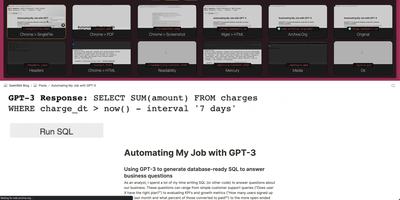
Backed by 27,700+ GitHub stars and actively developed with the v0.9.x architectural overhaul introducing an event-driven plugin ecosystem, ArchiveBox delivers the open-source self-hosted web archiving platform that preserves websites, bookmarks, social posts, media, source code, and research material in durable formats before link rot, platform shutdowns, and censorship erase them permanently. Feed it URLs one at a time or schedule automated imports from browser history, RSS feeds, Pocket, Pinboard, Instapaper, Wallabag, Shaarli, JSON, CSV, HTML bookmark exports, and browser extension captures. Each snapshot stores redundant copies as original HTML, rendered single-file HTML via SingleFile, full-page PDF, screenshot PNG, WARC archive, article text via Readability, favicons, HTTP headers, media files via yt-dlp, git repository clones, and structured metadata in SQLite. The Docker Compose deployment bundles Chrome, wget, curl, yt-dlp, SingleFile, and Readability parsers with automatic dependency management and isolation. Interact through the self-hosted web UI with search, tagging, and admin controls, the comprehensive CLI for batch operations, the REST API for programmatic access, or the Python API for custom integrations. The new abx-plugins system enables community extractors with per-plugin configuration, while the append-only-log architecture provides resumable crawls and audit trails. S3, B2, and Google Cloud storage backends sync archives to remote storage via rclone. Running on a dedicated VPS on RepoCloud with guaranteed CPU, RAM, and SSD, full root SSH access, and a browser serial console. MIT licensed.
GLPI
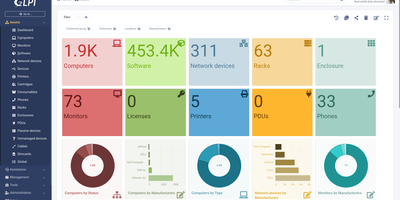
GLPI combines helpdesk ticketing, hardware inventory, license compliance, CMDB, and project management in a single PHP application with over 6,200 GitHub stars and 500,000+ Docker pulls, offering a unified ITSM platform that replaces ServiceNow, Freshservice, and ManageEngine without per-agent pricing. The ITIL-aligned service desk handles incidents, problems, changes, and service requests with configurable SLA management, approval workflows, satisfaction surveys, and business rules that automate ticket routing, escalation, and categorization. Native dynamic inventory through the GLPI Agent discovers Windows, Linux, and macOS endpoints with deep hardware profiling, while network discovery scans switches, printers, and infrastructure devices automatically. Software and license management tracks per-user and per-core license allocations with compliance reporting, expiration alerts, and financial cost tracking across the asset lifecycle from purchase through depreciation to disposal. Data center infrastructure management provides rack visualization with U-level positioning, PDU tracking, and connection mapping. The integrated forms editor builds custom request portals for end-users, while the self-service portal lets users submit tickets, browse the service catalog, and reserve assets. Webhooks trigger external HTTP calls on events, and the High-Level REST API v2 exposes every resource for automation. A plugin marketplace offers 90+ extensions for monitoring integration, advanced reporting, and authentication. Deploy via Docker with the glpi/glpi image alongside MySQL. Running on a dedicated VPS on RepoCloud with guaranteed CPU, RAM, and SSD, full root SSH access, and a browser serial console. GPLv3 licensed.
Arkon
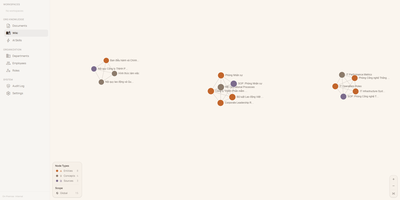
With 1,200+ GitHub stars since its April 2026 launch, Arkon provides an enterprise-grade knowledge management layer that turns scattered organizational documentation into AI-accessible structured context. The platform runs as a centralized MCP server, compiling your SOPs, policies, technical docs, and institutional knowledge into a versioned wiki with draft-approval workflows, then serving that wiki to Claude Desktop, Claude.ai, Cursor, and any MCP-compatible client through a single permission-scoped endpoint. OAuth 2.1 with PKCE authentication eliminates manual token management — employees authenticate through a browser login while the system discovers endpoints automatically via RFC 8414. The RBAC v2 system supports custom roles with granular permissions, department-scoped AI Skills, workspace isolation, and comprehensive audit logging so every query and access event is traceable. RAG retrieval powered by pgvector embeddings enables AI clients to search across all organizational documents with source attribution, while the AI Skills system lets teams define reusable instruction sets scoped to specific departments or roles. The architecture runs seven Docker containers coordinated by Compose: PostgreSQL with pgvector for embeddings and metadata, Redis for caching, MinIO for document storage, a FastAPI backend, two ARQ async workers for embedding generation and document processing, and a Next.js frontend portal accessible on port 3119. API keys are encrypted at rest with Fernet, and no telemetry leaves the deployment. Running on a dedicated VPS on RepoCloud with guaranteed CPU, RAM, and SSD, full root SSH access, and a browser serial console. PolyForm Internal Use licensed.
Checkmate
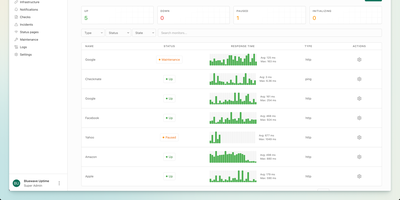
With 10,400 GitHub stars, 153 contributors, and no per-monitor pricing to worry about, Checkmate delivers comprehensive infrastructure monitoring from a single self-hosted dashboard — tracking uptime, page speed, server hardware, Docker containers, and even game servers without sending a byte of telemetry off your network. Ten monitor types cover HTTP, ping, TCP, gRPC, WebSocket, DNS, SSL certificate expiry, Docker container health, Lighthouse page speed with Core Web Vitals tracking, and game server status for over 100 server types including Minecraft and CS2. The Globalping integration enables geo-distributed monitoring from six continents, running ping and HTTP checks from Africa, Asia, Europe, North America, South America, and Oceania with results plotted on an interactive map. The optional Capture agent written in Go collects CPU, RAM, disk usage, temperature, and network metrics from any Linux, Windows, Mac, or Raspberry Pi host. Public status pages ship with four built-in themes and custom branding support, showing per-service uptime bars and incident history on a single shareable URL. Alert notifications reach teams through email, Discord, Slack, PagerDuty, Microsoft Teams, Telegram, Matrix, ntfy, Twilio SMS, and webhooks. Deploy via a single Docker Compose file requiring roughly 1 GB RAM — up and running in under five minutes on any Docker host. Running on a dedicated VPS on RepoCloud with guaranteed CPU, RAM, and SSD, full root SSH access, and a browser serial console. AGPLv3 licensed.