Gitea
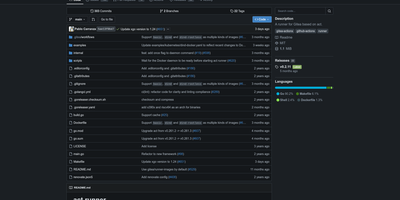
With over 57,000 GitHub stars and deployment across thousands of organizations worldwide, Gitea is the most popular self-hosted Git service, delivering a complete software development platform in a single Go binary that runs on as little as 512MB of RAM. The platform provides full repository management with pull requests featuring inline code review, branch protection rules, merge strategies including squash, rebase, and merge commit, and automated status checks through Gitea Actions. The built-in CI/CD system uses the same YAML workflow syntax as GitHub Actions and can directly reuse over 20,000 existing Actions plugins, allowing teams to migrate from GitHub with minimal pipeline rewrites using the open-source act_runner executor. The integrated package registry supports over 20 formats including npm, PyPI, Maven, NuGet, Cargo, Helm, Composer, Conda, RubyGems, Pub, and an OCI-compatible Container registry for Docker images with no additional configuration required. Project management features include issue tracking with labels, milestones, dependencies, and time tracking, alongside kanban project boards for visual workflow management. Gitea supports LFS for large file storage, built-in wiki pages per repository, webhook integrations with Slack, Discord, Telegram, Microsoft Teams, and custom HTTP endpoints, and OAuth2 authentication with LDAP, SAML, and PAM backend support. Repository mirroring enables bidirectional synchronization with GitHub, GitLab, and Bitbucket, while the comprehensive REST and GraphQL APIs power external integrations and the official tea CLI tool. Running on a dedicated VPS on RepoCloud with guaranteed CPU, RAM, and SSD, full root SSH access, and a browser serial console. MIT licensed.
Swetrix
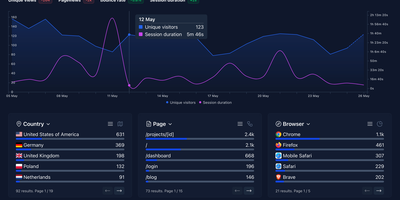
Traffic analytics, real-user performance monitoring, and client-side error tracking - normally three tools - in one cookieless, privacy-first dashboard: Swetrix. The Community Edition ships the same core engine as the cloud product - a NestJS API with ClickHouse for high-volume event storage, MySQL for relational data, and Redis for caching, fronted by a React dashboard and a ~5 KB tracking script with official packages for 20+ frameworks including Next.js, WordPress, and Shopify. Traffic analytics cover pageviews, referrers, UTM campaigns, geolocation, sessions with page flows, funnels, and custom events - all anonymized server-side with no cookies, no cross-device tracking, and no consent banner required for GDPR compliance. Performance monitoring records real-user metrics per pageview: TTFB, DNS and TLS timing, and render times, so regressions surface in the same place as traffic. Error tracking captures unhandled JavaScript exceptions automatically with formatted stack traces, filename/line metadata, affected browsers and pages, first/last-seen timestamps, and a resolve workflow - replacing a separate error monitoring subscription for many teams. Alerts fire to email, Slack, Telegram, Discord, or webhooks on traffic spikes, new errors, and custom events. If Plausible covers your traffic questions but you also want to know why the site broke, Swetrix answers both.
Tailscale
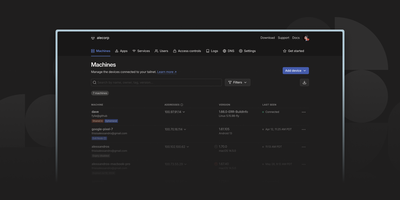
With over 34,000 GitHub stars and backing from a well-funded engineering team, Tailscale has fundamentally simplified how developers and system administrators think about secure networking. The client daemon establishes WireGuard tunnels directly between devices using sophisticated NAT traversal techniques, achieving direct peer-to-peer connections in the vast majority of network configurations without requiring port forwarding, firewall rules, or VPN concentrators. When direct connections prove impossible due to restrictive network environments, DERP relay servers provide encrypted fallback paths. MagicDNS assigns human-readable hostnames to every device on the network, eliminating the need to remember IP addresses across a tailnet. Subnet routing allows nodes to advertise access to entire local networks, enabling remote access to office resources, home labs, or cloud VPCs through a single gateway node. Exit node functionality routes all internet traffic through a designated device for privacy protection or geographic flexibility. Access control lists define granular policies for which devices and users can communicate with which services, enforced cryptographically at the network layer. The authentication layer integrates with identity providers including Google, Microsoft, GitHub, Apple, and OIDC-compliant systems for single sign-on access. Taildrop enables direct encrypted file transfers between devices without cloud intermediaries. The tailscale CLI provides complete network management from the terminal including status monitoring, route advertisement, and node configuration. Running Tailscale on a dedicated VPS on RepoCloud with guaranteed CPU, RAM, and SSD, full root SSH access, and a browser serial console provides a permanent, always-on node in your mesh network. BSD-3-Clause licensed with an active open-source community.
Backstage
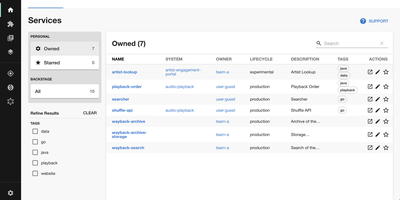
Adopted by over 3,400 companies and backed by 34,000 GitHub stars, Backstage is the open-source developer portal framework created by Spotify and now hosted by the Cloud Native Computing Foundation. The centralized Software Catalog registers every service, library, data pipeline, website, and ML model in your organization using YAML metadata files stored alongside code in GitHub, GitHub Enterprise, or GitLab, tracking ownership, lifecycle status, and dependency relationships across your entire ecosystem. Software Templates provide self-service infrastructure provisioning where developers fill out a form and Backstage automatically scaffolds new repositories, CI/CD pipelines, and cloud resources following your organization's standardized best practices. TechDocs renders Markdown documentation directly alongside the services it describes using a docs-like-code approach powered by MkDocs, with the TechDocs Addon Framework for extending the reading experience. The Search Platform indexes content across the catalog, TechDocs, Confluence, and Stack Overflow through configurable search backends. Kubernetes monitoring built specifically for service owners rather than cluster admins displays pod health, logs, and deployment status across any cloud provider or managed Kubernetes service. The plugin ecosystem includes over 230 open-source integrations covering CI/CD systems like GitHub Actions and GitLab Pipelines, monitoring platforms like Datadog and Grafana, cloud providers including AWS and Azure, plus specialized plugins for security scanning, cost management, API documentation, PagerDuty incident management, and Lighthouse website auditing. Running on a dedicated VPS on RepoCloud with guaranteed CPU, RAM, and SSD, full root SSH access, and a browser serial console. Apache-2.0 licensed.
ZenNotes
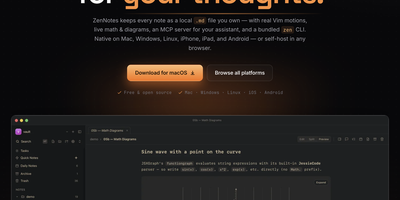
With over 2,200 GitHub stars and a philosophy that your notes should be files you own rather than rows in a database, ZenNotes is the keyboard-first Markdown editor that runs as a self-hosted web app backed by a Go server accessible from any browser on your network. Every note is a plain .md file in a vault directory you mount, with zero proprietary lock-in. Modal editing with real Vim motions, leader-key flows, and a command palette keeps your hands on the keyboard through edit, split, and preview modes. The rendering engine handles KaTeX math, Mermaid diagrams, TikZ graphics, and JSXGraph plots directly from Markdown syntax alongside wiki links and callout blocks. A first-party MCP server ships in the box with one-click integration for Claude Desktop and Cursor, letting AI assistants read and write the same Markdown files on disk without sync layers or duplicate copies. The bundled zen CLI provides note creation, search, tagging, task toggling, and piped capture with JSON output for shell scripting. Board views render plain CSV files as Kanban columns. Daily notes, quick capture, archive, and trash round out the vault workflow. The Go backend serves the browser frontend on port 7878 with token-based authentication, configurable browse roots, TLS proxy support, and file permission hardening at 0600/0700 defaults. Deploy via the multi-arch Docker image for linux/amd64 and linux/arm64. Running on a dedicated VPS on RepoCloud with guaranteed CPU, RAM, and SSD, full root SSH access, and a browser serial console. MIT licensed.
Yaade
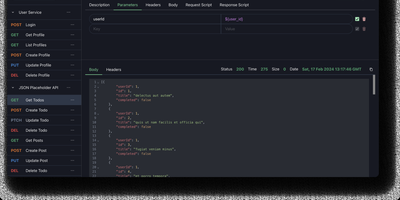
Yet Another API Development Environment delivers a self-hosted alternative to Postman designed from the ground up for teams that need secure, collaborative API development without sending sensitive credentials through third-party cloud services. The multi-user system manages team members with role-based permissions and supports external authentication through OAuth2 and OIDC providers, while all data persists in an H2 file-based database that survives container and server restarts. REST and WebSocket request testing includes environment variable substitution, request chaining, and Markdown documentation for each endpoint. The JavaScript scripting engine runs request and response scripts for automated testing and data extraction, with cron job scheduling and API-triggered execution for continuous integration workflows. Collections import directly from OpenAPI specifications and Postman exports, while outbound export generates request code in multiple languages and frameworks. The browser extension proxy for Chrome and Firefox routes requests through the user's browser to bypass CORS restrictions when testing localhost and internal APIs, with an alternative server-side proxy for headless environments. Single-file data import and export simplifies backup and migration between instances. The React and Vite frontend ships with dark mode enabled by default. Running on a dedicated VPS on RepoCloud with guaranteed CPU, RAM, and SSD, full root SSH access, and a browser serial console. MIT licensed.
ILLA Builder
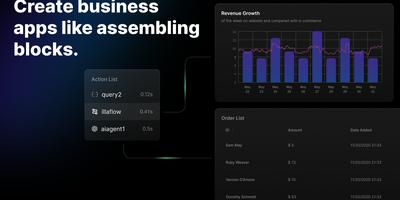
ILLA Builder turns internal tool development from weeks of custom frontend work into hours of drag-and-drop assembly, combining a visual canvas of 60+ UI components with direct connections to over 20 data sources. The TypeScript frontend, powered by ILLA Design, offers data grids backed by MUI X Data Grid Premium, charts, forms, rich-text editors, PDF viewers, QR code scanners, calendar widgets, map embeds, and video players. Each component supports Handlebars-style expression bindings that reference query results, widget state, or global variables, while the reactive execution tree resolves dependencies in topological order and re-evaluates downstream properties whenever upstream values change. Data connectors provide GUI-driven access to PostgreSQL, MySQL, MongoDB, MSSQL, Supabase, Redis, Firebase, CouchDB, Airtable, Google Sheets, Stripe, AWS S3, Hugging Face models, and REST or GraphQL endpoints without writing connector code. Real-time collaboration through WebSocket lets multiple developers edit the same application simultaneously with live cursor tracking and synchronized Redux state. ILLA Flow adds workflow automation triggered by schedules or webhooks, chaining actions across data sources. The Go backend handles application state, resources, and attribute-based access control using PostgreSQL for persistence, Redis for caching, MinIO for file storage, and Envoy for API ingress. Deploys as a single Docker container on port 2022 or scales horizontally on Kubernetes. Running on a dedicated VPS on RepoCloud with guaranteed CPU, RAM, and SSD, full root SSH access, and a browser serial console. Apache 2.0 licensed.
Flexprice
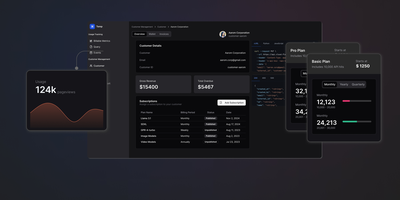
Flexprice is a developer-first billing platform built specifically for AI-native and SaaS companies that need usage-based, credit-based, and hybrid pricing models without building custom billing infrastructure. The metering engine ingests millions of usage events in real time through HTTP APIs or SDK calls, supporting sum, count, unique count, latest value, and multiplier aggregation strategies across custom event schemas like API calls, token counts, compute minutes, and GPU time. Credit management handles prepaid wallets with promotional grants, rollover caps, auto top-ups, and priority-based credit application during invoice generation. The pricing engine supports per-unit, tiered, volume, package, and flat-rate models with per-customer overrides, committed minimums, and enterprise contract terms. Feature entitlements enforce boolean toggles, metered usage limits, and configuration values per plan, enabling applications to gate functionality through simple API checks. Automated invoicing calculates charges from real-time usage data with proration for mid-cycle upgrades and downgrades, generating detailed line items linked to tracked consumption. The architecture separates event ingestion through Kafka from billing computation via Temporal workflow orchestration, allowing each layer to scale independently with ClickHouse handling high-performance usage aggregation. Stripe Connect integration processes payments and manages customer payment methods. Running on a dedicated VPS on RepoCloud with guaranteed CPU, RAM, and SSD, full root SSH access, and a browser serial console. AGPLv3 licensed.
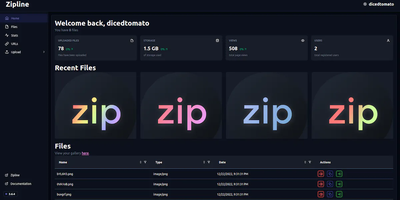
Zipline
ShareX and file uploads, next generation: Zipline is a Node.js/React/PostgreSQL server that turns screenshot sharing and file hosting into something you run yourself instead of renting from Imgur or a paid image host. The core workflow is built around ShareX: generate an .sxcu config from your account settings, import it, and every screenshot or clipboard capture uploads to your domain with a short link copied automatically. Uploads accept any file type, organized with folders and tags, with token-protected uploading, optional password protection, view-limited auto-deletion, image compression, metadata stripping, automatic video thumbnails, and chunked/partial uploads for large files. File URLs come in configurable formats - UUIDs, dates, random alphanumerics, original names, even zero-width spaces. A built-in URL shortener adds vanity slugs, passwords, view caps, and custom domains. Discord embeds are first-class: customize OG metadata titles, descriptions, and colors so links unfurl exactly how you want, and fire fully customizable Discord or HTTP webhooks on each upload. Authentication is serious: OAuth2 (Discord, GitHub, Google, OIDC), TOTP two-factor, and passkeys, with invite-based registration and per-user quotas for shared instances. Storage targets local disk or any S3-compatible backend, a full REST API automates everything, and custom themes plus a PWA round out the experience.
Dify
Dify turns the notoriously complex process of building production-grade AI applications into a visual drag-and-drop experience that teams can actually ship and maintain. With over 87,000 GitHub stars and backing from prominent investors, the platform has become the go-to open-source LLMOps solution for organizations that refuse to be locked into proprietary AI stacks. The visual workflow canvas lets developers wire together LLM calls, conditional logic, iteration loops, tool invocations, and human-in-the-loop checkpoints without writing boilerplate integration code. Its RAG pipeline engine handles the full document lifecycle from ingestion of PDFs, Word documents, and HTML through configurable chunking strategies, embedding with models from OpenAI or open-source alternatives, vector storage in Weaviate, Qdrant, Pinecone, or pgvector, and hybrid semantic-plus-keyword retrieval with citation tracking. Dify integrates with hundreds of model providers including OpenAI GPT-4o, Anthropic Claude, Google Gemini, Mistral, Llama, and any OpenAI-compatible endpoint like Ollama for fully local inference. The agent framework supports both ReAct and function-calling strategies with 50-plus built-in tools spanning Google Search, DALL-E, Stable Diffusion, WolframAlpha, and custom API definitions. Published apps can be deployed as hosted web interfaces, embedded chat widgets, REST API endpoints, or MCP-compatible tools. Enterprise features include role-based access control, SSO integration, and audit logging. A built-in marketplace enables teams to share and reuse model providers, tools, and workflow templates across projects. Running on a dedicated VPS on RepoCloud with guaranteed CPU, RAM, and SSD, full root SSH access, and a browser serial console. Apache 2.0 licensed with an open-source community edition.
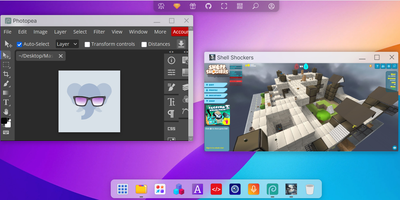
Puter
Puter delivers a complete cloud operating system that runs entirely in the browser — turning any device with internet access into a full-featured personal computer with desktop environment, file management, application hosting, and developer platform. The familiar desktop interface presents windows, taskbar, right-click menus, drag-and-drop, and multi-window management indistinguishable from native operating systems. The hierarchical filesystem supports file creation, uploads, sharing, permissions, and trash recovery with storage backends ranging from local SQLite for self-hosting to S3 and DynamoDB for production scale. Built-in AI integration provides access to GPT-4, Claude, and other models directly from the desktop for text generation, code assistance, and image creation. The developer platform offers a JavaScript SDK, REST APIs, cloud storage, key-value database, and serverless workers for building and hosting web applications without managing infrastructure. Sandboxed applications run in iframes with IPC communication and permission-based access to filesystem, AI, and system services. The app store enables publishing, discovering, and monetizing applications built on the Puter platform. Website hosting publishes static sites with custom domains directly from the file manager. Multi-user support provides individual accounts with authentication, resource isolation, and sharing capabilities. Deploy via Docker with a single command, Docker Compose for production, or npm for development — the one-line install script handles everything automatically on Linux, macOS, and Windows. Running on a dedicated VPS on RepoCloud with guaranteed CPU, RAM, and SSD, full root SSH access, and a browser serial console. AGPL-3.0 licensed.
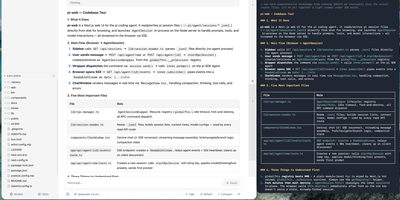
Pi Web
Pi Web is a browser interface for the Pi coding agent ecosystem, providing a visual workspace that reads the same local configuration and session files as the CLI. The session workspace groups conversations by project with running state indicators, context usage percentages, cost tracking, and compaction details, while two branching modes let users create independent session files from earlier messages or fork branches within existing sessions to explore alternative coding directions. Real-time streaming via Server-Sent Events delivers agent responses with structured Markdown rendering, thinking steps, tool call visualization, and image drag-and-drop input. The project file explorer browses working directories with syntax-highlighted source preview, Git diff inspection, and rendering for Markdown, images, audio, PDFs, and DOCX files with automatic refresh. Git worktree support switches checkouts from the sidebar while keeping sessions from the same repository grouped together. The Models panel manages provider authentication via OAuth and API keys, model selection, model smoke tests, and models.json configuration shared bidirectionally with the CLI agent. The Skills panel lists, searches, installs, and toggles agent skills without terminal access. The interface ships with English and Simplified Chinese translations, light and dark themes, a chat minimap, keyboard shortcuts, and completion sounds. Basic Auth protects remote access when binding to non-loopback addresses. Running on a dedicated VPS on RepoCloud with guaranteed CPU, RAM, and SSD, full root SSH access, and a browser serial console. MIT licensed.
Maxun
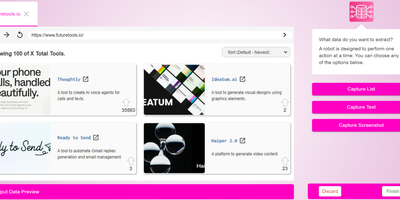
With over 16,800 GitHub stars and growing rapidly, Maxun has become the go-to open-source platform for teams who need structured web data without writing scrapers. The TypeScript-based platform provides a no-code visual recorder that captures point-and-click interactions in real-time browser sync, automatically generating reusable extraction robots that handle pagination, infinite scrolling, and dynamic content. LLM-powered extraction accepts natural language prompts like "Extract 10 companies from the Y Combinator website" without requiring a URL — Maxun identifies the source and performs the extraction autonomously. The platform handles authentication-protected pages, adapts automatically to website layout changes through self-healing selectors, and exports directly to Google Sheets, Airtable, or any destination via webhooks. Robots run on configurable schedules with cron-based timing, turning any website into a perpetually fresh RESTful API endpoint. The crawl engine discovers and processes linked pages across entire domains with configurable depth and URL filtering, while the search capability runs automated queries across multiple engines. Official Node.js and Python SDKs provide programmatic control over robot creation, execution, and data retrieval, with MCP integration enabling direct connection to AI tools like Claude. The n8n community node enables workflow automation without custom code. Running on a dedicated VPS on RepoCloud with guaranteed CPU, RAM, and SSD, full root SSH access, and a browser serial console. AGPLv3 licensed.
Directus
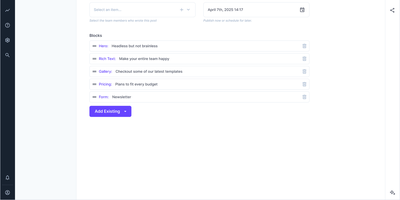
With 37,000 GitHub stars and over 45 million downloads powering 500,000+ deployed projects, Directus is the most widely adopted open-source backend platform that connects to your existing SQL database without requiring schema migrations or data duplication. Point it at PostgreSQL, MySQL, MariaDB, MS SQL, SQLite, OracleDB, or CockroachDB and it instantly generates production-ready REST and GraphQL APIs complete with filtering, sorting, pagination, field selection, and relational queries — all derived from your actual schema with zero configuration. The visual Studio provides a full no-code management interface where non-technical teammates create content, manage assets, build dashboards, and configure access policies without engineering involvement. Field-level granular permissions govern every API request and Studio action through composable policies applied to roles, users, and AI agents identically. A built-in AI Assistant writes copy, translates content across languages, creates records, and routes items for review directly within the Studio interface. The native Model Context Protocol server connects Claude Desktop, Cursor, ChatGPT, or any MCP-compatible tool to your live data governed by the same access policies. Real-time WebSocket subscriptions push collection changes instantly for collaborative editing and live dashboards. Extensibility covers custom endpoints, hooks, interfaces, displays, layouts, modules, and operations. Deploy via Docker with environment-variable configuration or use Directus Cloud for managed hosting. Running on a dedicated VPS on RepoCloud with guaranteed CPU, RAM, and SSD, full root SSH access, and a browser serial console. BSL-1.1 licensed with free self-hosting.
Browser Use WebUI
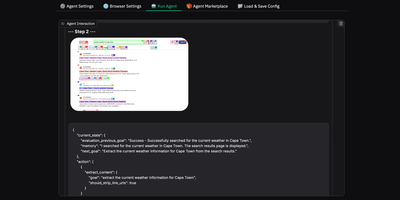
Browser Use Web UI lets you describe a web task in plain English and watch as an AI agent autonomously navigates pages, clicks buttons, fills forms, and extracts information without writing any automation code. Backed by over 16,000 GitHub stars, the Gradio-based interface supports 14+ LLM providers through a unified abstraction layer: OpenAI GPT, Anthropic Claude, Google Gemini, Azure OpenAI, DeepSeek, and local Ollama models are all configurable via dropdown menus without touching code or environment files. The BrowserUseAgent handles interactive single-task automation with step-by-step LLM decision-making and vision-based page understanding, while the DeepResearchAgent orchestrates multi-step research workflows using Langgraph state machines that spawn parallel browser instances with asyncio concurrency control. Custom browser support connects your existing Chrome profile to preserve logins, cookies, and sessions across agent runs, eliminating re-authentication overhead. Persistent browser sessions maintain complete interaction history between tasks for debugging and demonstration. The Docker deployment bundles Chrome, Playwright, and a VNC server in a single container, exposing the Gradio interface on port 7788 and a noVNC viewer on port 6080 for real-time observation of agent behavior. MCP integration via MultiServerMCPClient enables external tool access. Screen recording captures agent workflows as video for review and documentation. Running on a dedicated VPS on RepoCloud with guaranteed CPU, RAM, and SSD, full root SSH access, and a browser serial console. MIT licensed.
Hoppscotch
Backed by nearly 80,000 GitHub stars and recognized as one of the most popular developer tools in the open-source ecosystem, Hoppscotch delivers a complete API development platform that runs instantly in any browser with zero installation. The platform supports six protocols out of the box including REST with full HTTP method coverage, GraphQL with schema introspection and multi-column documentation, WebSocket for full-duplex communication, Socket.IO, MQTT for IoT messaging, and Server-Sent Events for real-time streaming. Request collections organize your API calls into logical groups with support for sub-folders, environment variables with scope inheritance, pre-request scripts and post-request test scripts written in JavaScript, and automatic code snippet generation in over twenty languages and frameworks. Teams can collaborate in real-time with shared workspaces, role-based access controls, and cloud synchronization across devices. Migration from Postman, Insomnia, or OpenAPI specifications happens with a single click import. The self-hosted edition deploys via Docker Compose with PostgreSQL for data persistence, supporting SSO authentication through SAML and OAuth providers, SMTP configuration with OAuth2, and admin dashboard for user management. The platform also ships as a native desktop application for macOS, Windows, and Linux with offline support, plus a CLI tool for running collections in CI/CD pipelines. A built-in proxy mode bypasses CORS restrictions during development, and an interceptor enables request debugging and response modification. Running on a dedicated VPS on RepoCloud with guaranteed CPU, RAM, and SSD, full root SSH access, and a browser serial console. MIT licensed.
Tolgee
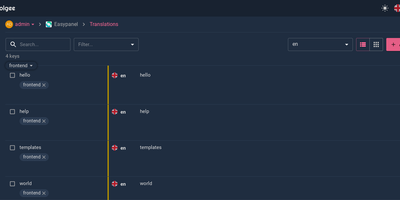
Hold Alt/Option, click any string in your running app, and edit the translation in place: Tolgee is an open-source localization platform built the way developers wish translation worked - changes save straight to the platform with no hunting through JSON or PO files. In-context editing works even in production via the Tolgee Tools browser extension, which injects credentials without touching source code, so a client or colleague with zero coding skills can translate the product inside the product. The SDKs (React, Angular, Vue, Svelte, plus iOS and Android) extract context from each UI element and capture one-click screenshots, giving both human translators and machines the surrounding meaning that raw string files lose. Autonomous translation uses that context: new keys are instantly filled from translation memory or machine translation (DeepL, Google Translate, AWS Translate), with optional human review afterward - shipping no longer waits on a translation agency. A CLI handles import/export, a REST API covers automation, a Figma plugin bridges design, and an MCP server lets AI coding assistants search keys, create translations, and trigger machine translation without leaving the editor. Self-hosting this Crowdin/Phrase/Lokalise alternative keeps every string, screenshot, and API key on your infrastructure.
Screego
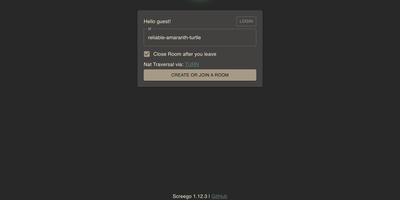
With over 10,000 GitHub stars and a reputation forged in the frustration of laggy corporate screen sharing, Screego delivers what Microsoft Teams and Zoom screen share consistently fail to provide: instant, high-resolution screen streaming that lets remote colleagues actually read your code. Built on WebRTC peer-to-peer connections, Screego transmits screen data directly between browsers without routing through centralized servers, achieving sub-second latency and native-resolution quality that makes pair programming and code reviews genuinely productive. The server component, written in Go with a TypeScript frontend, deploys as a single binary or Docker container with minimal configuration — set your external URL, generate a secret key, and you're live. An integrated TURN server handles NAT traversal automatically, eliminating the need for separate STUN/TURN infrastructure, with configurable UDP port ranges and support for external TURN servers when scaling beyond a single instance. Authentication supports three modes — requiring login for all actions, only for TURN connections, or none — with user management via simple credential files. Rooms are created instantly and support multiple simultaneous viewers, with system and tab audio sharing available for demonstrations that need sound. The architecture supports reverse proxy deployment behind Nginx, Caddy, or Apache with automatic TLS termination, and recent releases added riscv64 architecture support alongside existing amd64 and arm64 builds. Running on a dedicated VPS on RepoCloud with guaranteed CPU, RAM, and SSD, full root SSH access, and a browser serial console. GPL-3.0 licensed.