Subtitle Translator
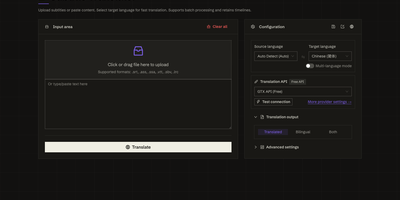
A whole season of subtitles can be translated in a single drop, with every timecode left exactly where it was. Subtitle Translator strips cue numbers and timing out of each file, sends only the dialogue to the translation engine, and puts everything back afterward, so a model never gets the chance to scramble a timeline. Pick any of 120+ target languages, or turn on multi-language mode to export several at once. Engines range from DeepL, Google, and Azure to dozens of LLM providers, gateways, and any OpenAI-compatible endpoint, including a local Ollama or LM Studio model. Context-aware mode feeds surrounding lines to the model for steadier dialogue and consistent character voices, and a glossary keeps names and product terms fixed across episodes. Bilingual output stacks original and translation in one file, either as plain SRT or as ASS with separate styles for each line. SRT, VTT, ASS, and LRC convert between each other during translation. Translated lines are cached, so a rate-limit pause or a closed tab only costs the missing lines. A text extractor strips timing for summaries and scripts. The interface itself is available in 18 languages, and companion tools handle Markdown, JSON locale files, and plain text. A back catalog of course videos or fan-subbed episodes becomes a weekend job instead of a month-long slog. Running on a dedicated VPS on RepoCloud with guaranteed CPU, RAM, and SSD, full root SSH access, and a browser serial console. MIT licensed.
Nao
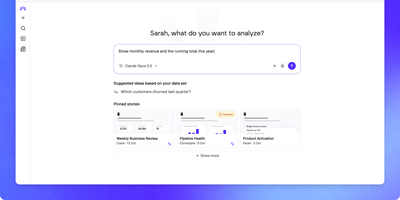
Your analysts write the context once, and everyone else just asks questions: nao turns your warehouse into an analytics agent that answers in plain English, showing the SQL and source files behind every answer. The data team builds the context layer by syncing warehouse schemas, dbt projects, documentation, and business rules into files the agent reads, then tests key questions offline against expected SQL before any change ships. Colleagues ask from the web chat, Slack, Teams, or any MCP client, and turn good answers into live dashboards, data apps, and slide stories they share with their team. Every conversation can be replayed, and when an answer earns a downvote, context recommendations turn the mistake into a fix that arrives as a pull request. You bring your own model key from any provider, sign people in with Google, GitHub, or GitLab, and keep warehouse permissions intact as queries run. Dashboards from Metabase or Tableau migrate over instead of starting blank. Running on a dedicated VPS on RepoCloud with guaranteed CPU, RAM, and SSD, full root SSH access, and a browser serial console. Apache-2.0 licensed.
OpenNotebookLM
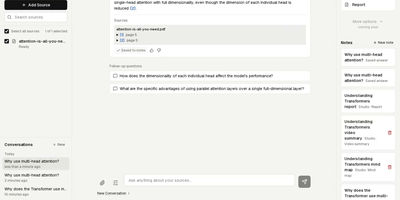
OpenNotebookLM is a self-hosted research workspace that reads your sources with you, answering questions only from the material you gave it and showing the passage behind every claim. Import papers, spreadsheets, recordings, web pages, PDF links, YouTube videos or playlists, Markdown folders, Obsidian vaults, and Git repositories, then select which sources the chat may use as evidence. Stream answers with follow-up questions, hover any numbered citation to inspect the supporting passage and page, and let the app flag citations that look unsupported before you trust them. The Studio turns the same sources into cited reports in briefing, study guide, FAQ, or timeline formats, expandable mind maps you can pan and question, two-host audio overviews in deep dive, brief, critique, or debate styles, narrated slides exportable to PowerPoint, and tables whose cells carry their own citations. Generate flashcards and timed quizzes from what you read, mark cards for review, and resume saved progress later. Save cited answers and Studio outputs as notes, convert notes back into searchable sources, and export almost anything: conversations, projects, mind maps as SVG, flashcards as Anki text, audio as MP3. Share projects with viewer or editor roles, keep conversations private per person, and bring Claude, OpenAI, any OpenAI-compatible provider, or a local Ollama model, with extraction, OCR, Whisper transcription, and Kokoro audio synthesis running on your own server. Running on a dedicated VPS on RepoCloud with guaranteed CPU, RAM, and SSD, full root SSH access, and a browser serial console. MIT licensed.
Memory OS
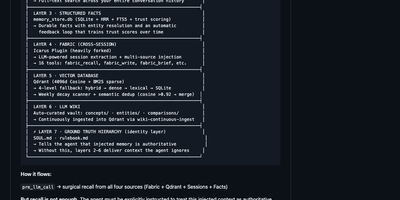
Memory OS gives Hermes Agent a permanent memory, so a new session opens with your projects, decisions, and working style already in context instead of introductions. Seven layers divide the job: workspace files carry your standing instructions into every turn, and a full-text index makes every past conversation searchable in place. Durable facts about your stack, your projects, and your patterns live in a structured store that resolves entities and scores how much each fact can be trusted, promoting what proves itself and demoting what does not. Cross-session recall pulls relevant moments from older threads, while a vector store with hybrid dense and keyword search finds the right memory even when the wording has changed. A self-curating wiki turns raw material into concept, entity, and comparison pages that are re-ingested automatically, and a Ground Truth hierarchy tells the agent to treat injected memories as authoritative instead of re-checking them. Scheduled jobs keep the system honest: hourly ingestion, weekly curation and decay scans, dead-letter reporting, and health heartbeats. It all runs beside the agent on your own machine with whichever provider you already use, from OpenRouter and Anthropic to a local Ollama. Running on a dedicated VPS on RepoCloud with guaranteed CPU, RAM, and SSD, full root SSH access, and a browser serial console. MIT licensed.
ZeroClaw
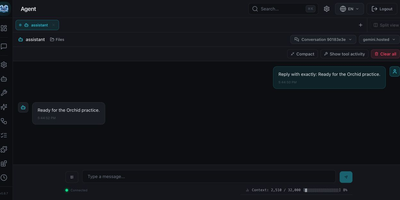
ZeroClaw puts one personal AI agent on every messaging app you already use, answering from your own server with your own model keys. A single instance binds Discord, Telegram, Matrix, Slack, WhatsApp, Signal, email, and webhooks at once, so you can start a conversation on your phone and finish it at your desk without losing context. You choose the brain behind it: Anthropic, OpenAI, a local Ollama model, or any OpenAI-compatible endpoint, with fallback chains that keep the agent answering when one provider has a bad day. The agent acts through tools that run shell commands, drive a browser, call HTTP APIs, and talk to custom MCP servers you plug in. A web dashboard gives you chat, a memory browser, a configuration editor, cron job management, and a tool inspector from any browser. Long-term memory lives in SQLite on your disk with embedding-based recall, so past conversations stay searchable and private. Supervised autonomy is the default posture: medium-risk actions pause for your approval, high-risk actions are blocked outright, and operating system sandboxes plus cryptographic receipts keep every tool call bounded and auditable. Event-driven standard operating procedures react to MQTT messages, webhooks, schedules, and hardware events, and named agents let different personalities guard different channels. Registered as a system service, it stays online around the clock. Running on a dedicated VPS on RepoCloud with guaranteed CPU, RAM, and SSD, full root SSH access, and a browser serial console. MIT or Apache-2.0 licensed.
ChatDev
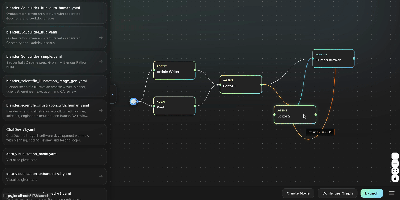
Built around a drag-and-configure canvas of nodes and edges, ChatDev runs teams of AI agents as workflows you can watch, steer, and reuse. Nodes get a role, a model, and a system prompt from a plain form, and edges decide who speaks next. Agent nodes call OpenAI, Gemini, or any OpenAI-compatible endpoint. Human nodes pause the run and wait for your notes or attached files. Edges can branch on keywords or custom functions, extract values with regex, and loop through review-and-revise cycles guarded by loop counters and timers. Map and Tree edges fan one message out to parallel instances, and Tree mode reduces the results into a single answer. Agents can use simple, file, blackboard, or Mem0 memory, reflection thinking, built-in file, Python environment, and deep research tools, Agent Skills, and MCP servers over HTTP or stdio. Dozens of bundled workflows cover software teams, game development, data visualization, and deep research. The Launch page shows each node with a pixel-art avatar, a chat view, file uploads, and downloadable logs and artifacts. A Laboratory page runs one workflow over every row of a CSV or Excel file in parallel and tracks the success rate. The Python SDK runs YAML workflows from scripts. An illustrated tutorial and an English or Chinese interface get a first workflow running in minutes. Running on a dedicated VPS on RepoCloud with guaranteed CPU, RAM, and SSD, full root SSH access, and a browser serial console. Apache-2.0 licensed.
repowise
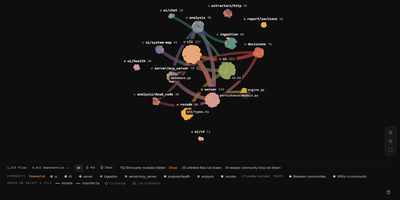
Instead of another round of grepping, a coding agent or developer asks repowise once and gets an answer drawn from a pre-built index of the repository's code, history, tests, and decisions. Indexing needs no API key: the call graph across 29 languages, git co-change and ownership, health scores, and dead code reports all come with zero model calls. A web dashboard opens onto Overview, Docs, Architecture, Knowledge Graph, Code Health, Refactoring, Commits, Decisions, and Usage pages, and a chat view returns cited answers with charts. Ten task-shaped MCP tools let Claude Code, Codex, Cursor, and other hosts ask for callers, risk, tests, owners, and reasons in a single request. Change risk scores any commit or branch against the repository's own history, and impacted-tests lists the tests a diff exercises. Every file earns a 1 to 10 health score from 53 detectors, with refactoring plans such as Extract Method and Break Cycle. Decisions mined from ADRs, comments, and commits stay linked to the code they govern, doc drift flags pages that describe code that no longer exists, and workspaces follow API contracts across repositories. Generated CLAUDE.md and AGENTS.md files keep agents informed, and distill trims noisy test and install output. Running on a dedicated VPS on RepoCloud with guaranteed CPU, RAM, and SSD, full root SSH access, and a browser serial console. AGPL-3.0 licensed.
Agent Swarm
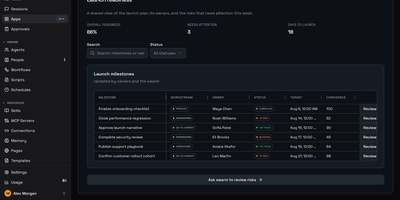
Agent Swarm gives a company one lead AI agent and a crew of coding workers that take requests from Slack, GitHub, Linear, or email and hand back pull requests while people only approve. The lead reads each request, plans it, and delegates to workers that run Claude Code, Codex, pi, opencode, Cursor, or Amp in isolated containers with a full development environment. Every agent keeps a persistent identity, and what one learns goes into shared memory with hybrid keyword and vector search, so the next task starts with context. Schedules run recurring jobs on cron or interval timers, and a DAG workflow engine adds triggers, conditions, per-step retries, and approval nodes that pause until someone answers in the dashboard or in Slack. The dashboard lists tasks, sessions, approvals, agents, people, workflows, scripts, skills, MCP servers, memory, and per-user usage costs. Its Apps feature builds versioned, role-restricted pages such as an incident board or a launch tracker, each with history and rollback. A configuration page tunes steering, memory, and integrations without editing environment files, and official templates supply ready-made agents for coding, review, research, QA, and content work. Workers can expose HTTP services, call approved third-party routes, and pay for x402 APIs in USDC. Running on a dedicated VPS on RepoCloud with guaranteed CPU, RAM, and SSD, full root SSH access, and a browser serial console. MIT licensed.
Happier
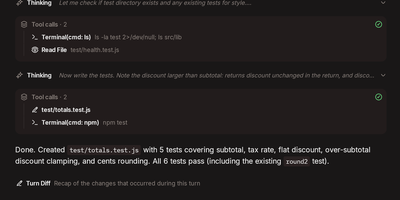
When a dozen coding agents are running at once, Happier puts every session in one list and lifts the ones waiting on you to the top. Sessions that need a decision gather under Needs attention and running ones sit under Working, so nothing stalls unseen. Start Claude Code, Codex, OpenCode, Pi, Cursor, Gemini, Copilot, Qwen, Kimi, Auggie, Kilo, Kiro, or Grok on any computer you have connected, or add a custom ACP backend for another agent CLI. Switch the agent mid-session, let Claude hand a review to Codex as a subagent, and move a live Claude Code or OpenCode session to another machine. Read the tool-call timeline, review the diff, mark exact lines, and send those notes back to the same session or a fresh one. Stage, commit, push, and open pull requests from the Git panel, or give each session its own worktree. Queue messages, steer a running turn, edit files, open a terminal, or dictate to the voice assistant. Pool several accounts so work continues when one hits a usage limit, and watch five-hour and weekly quotas reset. Share a session view-only, with edit rights, or as a public link. Content is end-to-end encrypted by default, and the relay serves the web app, so any browser can reach it. Running on a dedicated VPS on RepoCloud with guaranteed CPU, RAM, and SSD, full root SSH access, and a browser serial console. MIT licensed.
Argus Agentic SOC
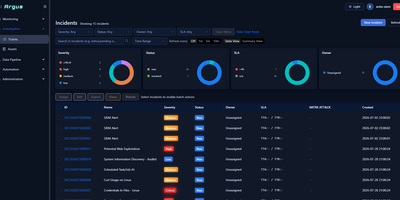
Every incident ticket in Argus, an open-source security operations center, comes with its own AI analyst, ready to explain the alert and suggest what to do next. Scheduled pipeline tasks pull alerts in from Elasticsearch and other sources, and tickets carry severity, owner, and SLA clocks that measure MTTA, MTTI, MTTC, and MTTR with color-coded buckets. Decision buttons walk each case from New through Acknowledged, Triaged, and Contained to Resolved. A War Room gathers analyst notes, system logs, files, pasted images, and extracted indicators. One click on Run AI Assistant returns a plain-language alert explanation, a suggested risk level, finished tasks, and next steps; scoped chat plus @ai and @playbook mentions keep the conversation inside the ticket. Built-in MCP tools look up CMDB assets, find similar past cases, and extract IPs, domains, and hashes, and you can register your own MCP servers and SKILL.md skills with usage monitors. A drag-and-drop workflow editor fires playbooks on new alerts, ticket changes, cron schedules, or webhooks. Detection engineers import Sigma rules from GitHub URLs or files, map fields to Splunk and Elastic ECS names, and review a publish history. Running on a dedicated VPS on RepoCloud with guaranteed CPU, RAM, and SSD, full root SSH access, and a browser serial console. Apache-2.0 licensed.
Marinara Engine
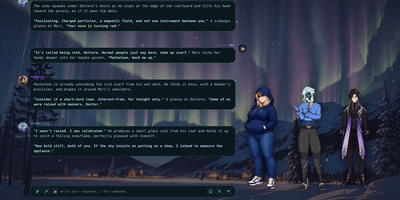
Marinara Engine turns any AI model into a character chat, a roleplay stage, or a tabletop-style game run by an AI Game Master, all in one self-hosted web app. Conversation mode feels like a messenger, with group chats, audio and video calls, selfies, and characters who keep daily schedules and message you first. Roleplay mode adds a stage behind the words: character sprites, scene backgrounds, weather effects, and trackers for time, quests, stats, and mood. Game mode hands the story to a Game Master that runs NPCs, dice and skill checks, classic or tactical battles, maps, and saved sessions on rulesets such as 5e (SRD 5.1). Connect OpenAI, Anthropic, Gemini, OpenRouter, DeepSeek, or any OpenAI-compatible endpoint, run local models through Ollama, LM Studio, or KoboldCpp, or sign in with a Claude, ChatGPT, or Grok plan instead of an API key. Optional agents work beside each chat to check continuity, track the world, draw illustrations, play music, and recall long-term memory, while Professor Mari, the built-in assistant, helps with setup. Lorebooks add world facts when keywords appear, and Peek Prompt shows exactly what the model received. Import characters, chats, and lorebooks from SillyTavern, then export chats as JSONL, Markdown, or styled HTML. Visitors from the network or internet must sign in, with Basic Auth and IP allowlists for extra control. Running on a dedicated VPS on RepoCloud with guaranteed CPU, RAM, and SSD, full root SSH access, and a browser serial console. AGPL-3.0 licensed.
ScribeCrate
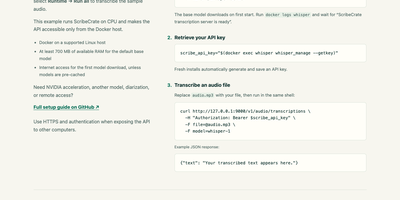
ScribeCrate is a self-hosted speech-to-text API that turns recordings into transcripts, subtitles, and English translations on your own server. It speaks the OpenAI Whisper API fluently: point any compatible client at your server's address, swap in your API key, and uploads come back as text. Ask for plain text, JSON with timestamps, or ready-to-publish SRT and WebVTT subtitle files, and for long recordings the segments can stream back over SSE as they are decoded. Turn on speaker diarization and every segment is labeled with who is speaking, which makes interview and meeting transcripts readable at a glance. Choose the model that fits the job, from tiny for quick drafts to large-v3 for maximum accuracy, and run it on a modest CPU, a Raspberry Pi class ARM board, or an NVIDIA GPU. Almost any recording works: MP3, M4A, WAV, WebM, OGG, and FLAC are all accepted, and with models cached in advance the server keeps transcribing with no internet connection at all. Running on a dedicated VPS on RepoCloud with guaranteed CPU, RAM, and SSD, full root SSH access, and a browser serial console. MIT licensed.
Grasp
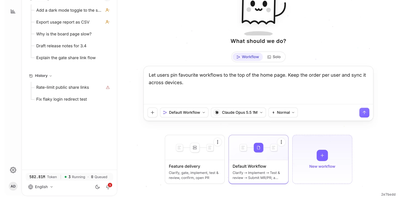
One sentence in, one reviewed pull request out: Grasp sends coding agents through a visual workflow in isolated sandboxes and leaves every approval to people. Describe a task on the home page and run it as a workflow or a Solo session. A clarify agent first asks one question at a time as clickable option cards with a recommended answer, then writes a requirement spec and plan and builds a page mock you can annotate. Workflows are drawn on a visual canvas with six node types, and failure and rollback edges send work back to an earlier step. Eight agent CLIs, including Claude Code, Codex, Cursor, and OpenCode, can run as agent nodes in a Docker, Kubernetes, or E2B sandbox shared by the nodes of a run. Runs pause at human gates in a shared inbox, and a temporary one-time link lets a reviewer without an account approve or reject. Solo sessions give a single agent an IDE, terminal, and browser, and a noVNC panel lets you watch its Chromium and take over with a click. Specs, plans, test results, and HTML previews are kept as versioned artifacts. A token page breaks cost down by workflow, source, and model. Agents push branches and open pull requests or merge requests through gh, glab, or SSH credentials stored per repository. Running on a dedicated VPS on RepoCloud with guaranteed CPU, RAM, and SSD, full root SSH access, and a browser serial console. MIT licensed.
Javis OS
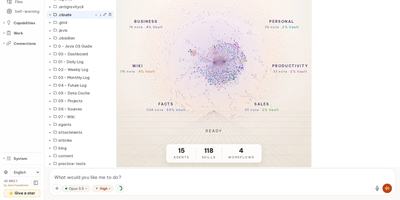
Javis OS turns the AI models you already pay for into a team of coworkers that share one memory, so switching to a better model never means starting over. Fourteen brains plug into the same toolbox, from Claude Code and Codex to OpenRouter, Gemini, Groq, DeepSeek, and local Ollama. Everything they learn lands in a Second Brain, an Obsidian-compatible markdown vault of memories, wiki pages, and sources, drawn as a knowledge graph you can search and edit. After each conversation, self-learning distills new memories, wiki entries, and skills, and every pass is a git commit you can undo in one tap or back up to a private GitHub repository. Hand over a goal in plain words and the Kanban dispatcher writes the spec, picks a worker, runs it in the background, and calls you only on exceptions. Loops and reminders fire on an interval, a clock time, or a cron expression. Coworkers on the Partners page get their own role, model, prompt, and skills, and teams of them chat in one room while a leader hands out work. Chatbots answer customers on WhatsApp, Messenger, Instagram, Telegram, Slack, and Zalo from one shared inbox. An MCP connection store holds several accounts per service under three hard-enforced permission levels. Hands-free voice, cost tracking, TOTP two-factor login, and in-app updates with rollback round it out. Running on a dedicated VPS on RepoCloud with guaranteed CPU, RAM, and SSD, full root SSH access, and a browser serial console. MIT licensed.
Agentic Security
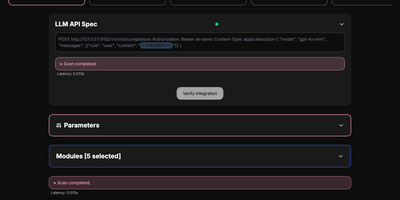
Find out how easily your chatbot can be talked into misbehaving before a stranger on the internet does. Agentic Security points a library of attack prompts at any LLM endpoint you can describe in a few lines of HTTP, then reports which attack families got through. Paste a request template with a marker where the attack goes, press Verify Integration to confirm the endpoint answers, and start the scan. Pick from jailbreak corpora on Hugging Face, obfuscation mutations like Base64, ROT13, mirrored words, and scrambled text, or drop your own CSV of prompts into a folder. Presets cover OpenAI, DeepSeek, Groq, Gemini, Claude, Azure, and custom APIs. Set a token budget, switch on concurrency, and watch a per-module table of failure rates and estimated cost fill in live. Download failed prompts as a CSV, export the full log, or generate a config and run the same scan as a CI gate with failure thresholds. Re-run the same scan after every model or system prompt change to spot regressions early. Running on a dedicated VPS on RepoCloud with guaranteed CPU, RAM, and SSD, full root SSH access, and a browser serial console. Apache-2.0 licensed.
SD.Next
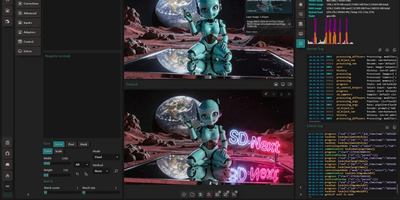
Pick a diffusion model, type a prompt, and SD.Next renders an image or a video clip on hardware you control. It handles text-to-image, image-to-image, text-to-video, and image-to-video, with inpainting, outpainting, a detailer pass, and hires or refine stages for edits. Models come from a reference list that downloads on demand or from your own files, which are detected automatically, and the catalog spans Stable Diffusion, FLUX, Qwen-Image, Wan, and HiDream. LoRA, ControlNet, IP-Adapters, and prompt enhancement steer each result. Kanvas, the built-in editor, offers up to ten stages with painting, a magic wand, text, and masking. Caption and Process tools describe images with vision-language models, interrogate them with CLiP, upscale, remove backgrounds, and turn frame sets into video. A scheduler queues jobs in order, runs them inside an active-hours window, and keeps task history. SDNQ quantization and CPU or GPU offloading fit large models into less memory, and one interface covers NVIDIA CUDA, AMD ROCm, ZLUDA, Intel Arc, OpenVINO, Apple Silicon, or plain CPU. The web UI also offers themes, interface languages, a mobile layout, and a live GPU monitor with server logs. Optional login credentials and TLS certificates protect the web server, and scripts or extensions add more. Running on a dedicated VPS on RepoCloud with guaranteed CPU, RAM, and SSD, full root SSH access, and a browser serial console. Apache-2.0 licensed.
Platypus
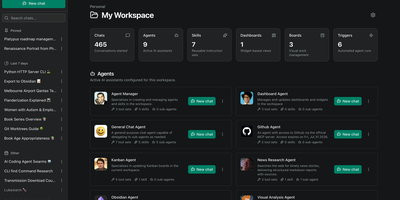
Platypus gives a whole team always-on AI agents that reason, call tools, and keep working on your own servers while everyone is offline. Build an agent once by choosing a provider and model, writing its instructions, and capping its tool-calling loop, then reuse that preset across chats and scheduled runs. Agents load reusable Skills on demand and delegate specialist work to sub-agents that appear to the parent as tools. Connect local and remote data through Model Context Protocol servers, or expose an agent to outside agents and chat platforms through A2A endpoints with a token per client. Triggers run agents on a cron schedule, as one-off jobs, or when workspace events such as a card moving on a board occur, and every run records its result. Kanban boards give agents work they can move and update themselves, while notifications and HMAC-signed webhooks push board and workspace events into your own systems with filtering and retries. Facts and preferences are extracted from conversations in the background and injected into future chats, so returning users are remembered. Sandbox backends give agents shell and filesystem access inside an isolated per-workspace environment instead of the host. Organizations and workspaces keep each team's agents and data separate, and blueprints package shared agents, skills, MCP servers, and providers so a new workspace starts pre-equipped. Running on a dedicated VPS on RepoCloud with guaranteed CPU, RAM, and SSD, full root SSH access, and a browser serial console. MIT licensed.
Chunky
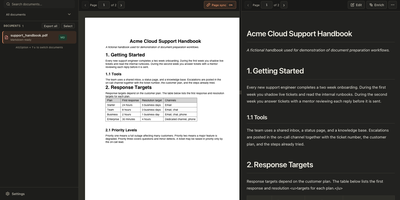
See exactly what your documents look like before a retrieval pipeline swallows them. Chunky puts the original PDF next to the converted Markdown with page-aware scrolling, so broken tables, scrambled columns, and stray artifacts are visible at a glance. Pick a converter, edit the Markdown by hand, then split it into color-coded chunks you can edit, delete, or enrich one at a time. Compare two converters on the same pages in a side-by-side dialog to find which one handles your layouts best. Try token, recursive, sentence, semantic, table, code, and heading-based splitters with adjustable size and overlap, and save the chunk sets that work. Optional model-powered enrichment adds titles, one-sentence context, summaries, keywords, and retrieval questions to each chunk. Process many documents in one batch and export everything as a ZIP. Judge chunk quality by eye, not by guesswork, before any of it reaches an embedding model. Running on a dedicated VPS on RepoCloud with guaranteed CPU, RAM, and SSD, full root SSH access, and a browser serial console. MIT licensed.