Apache CloudStack
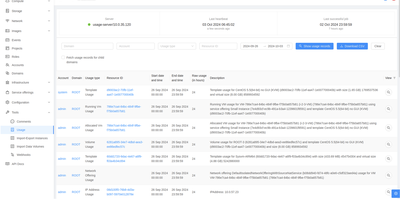
Your racks of hypervisor hosts become one private cloud with Apache CloudStack, the open-source IaaS platform that deploys and manages large networks of virtual machines behind a single web interface and API. One cloud can mix hypervisors side by side, running KVM, XenServer or XCP-ng, and VMware vSphere clusters under the same control plane, each organized into regions, zones, pods, and clusters that mirror your physical datacenters and racks. Administrators provision instances from templates and ISO images, take volume and VM snapshots on schedules, and migrate running instances between hosts in a cluster without downtime. Built-in networking spans isolated and shared networks, VPCs with tiered virtual routers, load balancers with SSL offloading, VPNs, and firewall rules, all exposed both to admins and to end users through separate, customizable interfaces. Multi-tenancy is native: domains, accounts, usage metering, and resource quotas let providers bill departments or customers for what they consume. The 4.22 LTS release strengthens backup and disaster recovery, adds a CSI driver for CloudStack Kubernetes Service, and streamlines VMware-to-KVM migrations for teams consolidating onto open virtualization. Running on a dedicated VPS on RepoCloud with guaranteed CPU, RAM, and SSD, full root SSH access, and a browser serial console. Apache-2.0 licensed.
OpenNebula
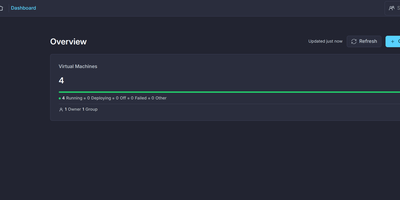
One front-end server can run your entire cloud: OpenNebula orchestrates KVM virtual machines and LXC containers across clusters of hosts, presenting everything through the FireEdge Sunstone web interface and a full API. Operators define VM templates once and instantiate them anywhere, attaching disks and networks, taking snapshots, scheduling actions, and opening remote consoles through Guacamole without leaving the browser. The OneDRS distributed resource scheduler reads historical and real-time metrics to predict demand spikes and migrate workloads before contention bites, with customizable policies and automation levels. GPU passthrough and PCI device hotplugging serve AI and accelerator workloads, while OVA import through the oneswap command ingests virtual machines exported from VMware vCenter for re-virtualization projects. Edge Clusters deploy on demand on premises or at remote providers, extending the same management model to hybrid and distributed sites without a separate stack. The 7.4 Helix release redesigns Sunstone with a slide-in side drawer and richer resource visualizations, and brings OneKS managed Kubernetes plus LVM storage to the Community Edition. Ceph and LVM datastores, incremental backups, cluster-level and generic quotas for resources like vGPUs, and OneFlow service orchestration for multi-VM applications round out daily operations. Running on a dedicated VPS on RepoCloud with guaranteed CPU, RAM, and SSD, full root SSH access, and a browser serial console. Apache-2.0 licensed.
CubeSandbox
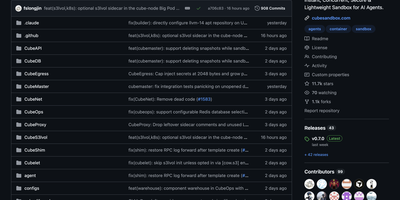
CubeSandbox gives every AI agent its own hardware-isolated MicroVM with a dedicated Linux kernel — not a shared-kernel container but a true KVM virtual machine — booting in under 60ms with less than 5MB of memory overhead per instance, enabling thousands of concurrent sandboxes on a single server via kernel sharing and Copy-on-Write memory. The Rust-built CubeProxy exposes an E2B SDK-compatible REST API on Axum, so existing E2B Cloud applications switch by changing one environment variable with zero client code changes. CubeMaster orchestrates cluster-level scheduling in Go while Cubelet manages node-local sandbox lifecycles including create, run, pause, resume, snapshot, and destroy operations. CubeVS, the eBPF-powered network layer, enforces per-sandbox isolation with LPM trie-based egress policies entirely in kernel space — no userspace context switches — while CubeEgress provides an L7 security proxy with per-domain, per-path, and per-method allowlists plus automatic credential injection that keeps secrets invisible to sandbox code. Hundred-millisecond-granularity snapshots enable checkpoint, rollback, and parallel fork from any saved state. The volume framework supports E2B-compatible pluggable storage with independent lifecycle and cross-sandbox sharing. Production deployment uses Terraform on Tencent Cloud or Helm charts on Kubernetes, K3s, or TKE, with full ARM64 support alongside x86_64 and AutoPause/AutoResume for cost optimization. Running on a dedicated VPS on RepoCloud with guaranteed CPU, RAM, and SSD, full root SSH access, and a browser serial console. Apache 2.0 licensed.

Nanocl
One server, treated properly: Nanocl runs your containers and full virtual machines from a single declarative Statefile, reconciling what is running against what the file says, so a lone host gets cluster discipline without cluster ceremony. Containers group into Cargoes with replica counts, ordered init containers, and health-aware restarts; finite jobs run to completion and stop. When a workload needs a real kernel or a custom disk image, it boots as a QEMU virtual machine beside the containers instead of forcing a second platform. Publishing is built in: the proxy controller terminates TLS and routes HTTP and TCP traffic, and the DNS controller keeps service names resolving while workloads come and go. Secrets for registries, certificates, and environment variables attach where they are used, never inside the file itself. The daily loop is a CLI and an API: list processes, follow logs, exec into a container, watch events, and back up the entire deployment state before you change it. Namespaces keep projects apart on the same host, and Statefile arguments, templates, and sub-states carry one definition from staging to production. Running on a dedicated VPS on RepoCloud with guaranteed CPU, RAM, and SSD, full root SSH access, and a browser serial console. MIT or Apache-2.0 licensed.