OpenBot
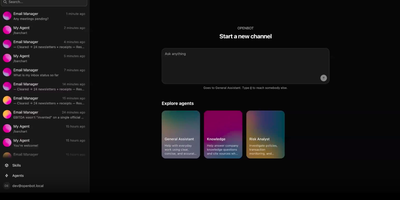
Open source GrokBot, built by the team behind the AG-UI protocol. OpenBot is the open-source enterprise agent platform that gives every AI coworker its own sandboxed computer — a real Chromium browser with its own login sessions, a private filesystem, and only the MCP tools you explicitly grant. The centralized gateway evaluates CEL policy rules against tool name, intent, bot identity, page URL, element attributes, and file paths before any action executes, writing an immutable audit row for every call and outcome. Any agent that speaks AG-UI — LangGraph, Mastra, CrewAI, Pydantic AI, Google ADK, or hand-written endpoints — registers as a Bot and receives its own channel with persistent conversation history. The take-the-wheel system lets humans assume control when an agent encounters login walls or two-factor prompts, recording control transfers as structured audit events. Knowledge documents from Google Drive and OneDrive carry source-based permissions where deny principals always win and ambiguous mappings refuse retrieval entirely. The React and Vite frontend provides live screen viewing of each agent's browser, channel-based chat, admin settings, and component galleries. The Hono API server on port 3001 handles authentication, role-based access, tenant packaging, and credential management backed by PostgreSQL with pgvector. Deploy via Docker Compose with the included supervisor that manages per-bot computer containers. Running on a dedicated VPS on RepoCloud with guaranteed CPU, RAM, and SSD, full root SSH access, and a browser serial console. MIT licensed.
Prime Agent
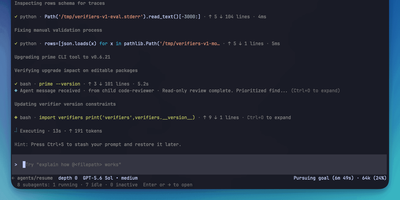
With over 14,000 GitHub stars and 41 releases since its May 2026 launch, Prime Agent delivers a fundamentally different approach to AI coding agents by treating the agent's own operating environment as programmable state that improves through use. The Recursive Language Model architecture provides the model exactly one tool — a persistent IPython kernel — where file operations, shell commands, subagent delegation via rlm() function calls, and context management all happen through code rather than rigid tool-calling schemas. Subagents launch as independent sessions with their own model, kernel, and history, communicating results through agent_message.send() without blocking the parent. The Continual Harness stores supplemental prompts, memories, skill descriptions, and reusable subagent specifications as durable state that the /refine command updates through small, evidence-backed edits with full rollback by ID. Daemon-backed sessions keep running when the terminal disconnects, with automatic context compaction summarizing older messages while preserving recent state. The TUI provides an Agent View for monitoring, switching between, and steering multiple live sessions simultaneously. Autonomous mode operates within configurable turn, token, and time budgets with user-defined quality gates. Persistent goals, heartbeats, and scheduled prompts maintain continuity across terminal sessions. Compatible with Anthropic Claude, OpenAI, Google Gemini, local models via Ollama or vLLM, and Prime Inference endpoints. Install via a single curl command on Linux or macOS. Running on a dedicated VPS on RepoCloud with guaranteed CPU, RAM, and SSD, full root SSH access, and a browser serial console. MIT licensed.
DeepSeek Harness
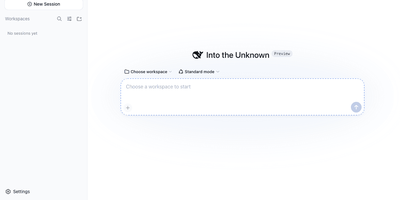
DeepSeek Harness gained over 60,000 GitHub stars within hours of its August 2026 launch, establishing itself as the first fully modular open-source agent runtime where literally every component is a swappable plugin. Built on the Cordis framework—a programming paradigm for spatiotemporal composability—dsh decomposes the entire agent stack into independently replaceable pieces: model adapters for DeepSeek, Anthropic, OpenAI, AWS Bedrock, Azure, and Google Gemini; tool registries covering bash execution, file system operations, web search, subagent delegation, and todo management; plus session stores, sandboxes, approval policies, orchestration loops, and the user interface itself. Four operating modes serve different workflows: Standard provides the full toolset, Code mode uses model-generated code to compose multi-round tool calls, Minimal strips down to a shell and editor for benchmarking, and Creator mode lets developers inspect the running runtime and test Cordis plugins in memory. The kernel handles plugin mounting, unmounting, and dependency resolution while typed events and services coordinate between components. Profiles and bundles allow the same codebase to produce entirely different products—a terminal coding agent, a browser-based workspace, a headless automation service, or an ACP/JSON-RPC endpoint—by swapping YAML configuration layers. Session history is stored as an append-only event stream for full trajectory replay, and project-level hooks on agent lifecycle events enable fine-grained behavioral customization. MCP client integration connects to external tool servers, while Agent Client Protocol enables programmatic orchestration. Running on a dedicated VPS on RepoCloud with guaranteed CPU, RAM, and SSD, full root SSH access, and a browser serial console. MIT licensed.
Hermes Agent
OpenRouter's most-used application by token volume — over 17 trillion tokens processed — Hermes Agent is an open-source autonomous agent built by Nous Research that lives on your server and gets more capable every day. Define a goal in natural language and Hermes plans sub-tasks, executes them through tool integrations, observes results, handles errors, and refines until the job is done or it genuinely needs your input. Persistent memory with full-text search and LLM summarization lets it recall context across sessions, and an agent-created skills system self-improves after complex tasks. A messaging gateway connects Telegram, Discord, Slack, WhatsApp, Signal, and 16 more platforms with cross-channel conversation continuity. A built-in cron scheduler runs daily reports, nightly backups, and weekly audits unattended. Subagent spawning parallelizes workstreams, and six terminal backends — local, Docker, SSH, Singularity, Modal, and Daytona — fit any infrastructure. Works with any LLM provider: Nous Portal, OpenRouter for 400+ models from 70+ providers, OpenAI, Anthropic, or your own endpoint. The API key you supply powers all LLM calls; billing goes through your own account. Running on a dedicated VPS with guaranteed CPU, RAM, and SSD, full root SSH access, and a browser serial console. MIT licensed.
OpenHands
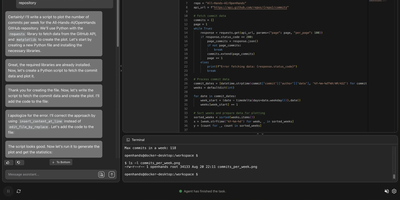
With 83,000+ GitHub stars and $18.8M in Series A funding, OpenHands delivers the leading open-source platform for AI coding agents that scored 68.4% on SWE-bench Verified with Claude Opus 4.6, outperforming Devin 2.0's publicly reported 45.8%. The Agent Canvas web UI organizes work into persistent conversations where agents edit files, run shell commands, browse the web, and execute multi-step development tasks inside isolated Docker sandbox containers. The observe-plan-act loop drives agent behavior: the Python controller manages LLM abstraction via LiteLLM routing to 100+ providers including OpenAI, Anthropic, Google, DeepSeek, Qwen, Llama, and local Ollama models. Built-in skills for code review, Docker management, PRD generation, repo-rules enforcement, release notes, and test running attach to conversations automatically via auto-discovery or trigger-based activation. The Automations system schedules recurring agent tasks with configurable templates for CI workflows, dependency updates, and documentation generation. MCP server integration enables agents to access external tools and data sources. The REST API powers an OpenAI-compatible endpoint for connecting agents to chat UIs, IDEs, and voice platforms. GitHub, GitLab, Slack, and Jira integrations enable pull request reviews, issue resolution, and team notifications. The SDK provides Python and REST APIs for embedding agents in custom tools with local or cloud execution, custom agent behaviors, and Kubernetes deployment. On RepoCloud, deploy OpenHands on a dedicated VPS with Docker socket access, persistent project storage, root SSH access, and complete control over your AI development infrastructure, all under the MIT license.
QM
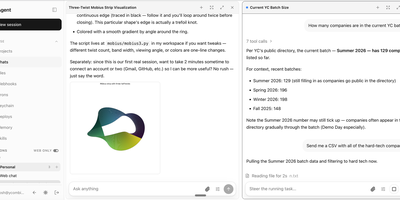
QM is Y Combinator's internal multiplayer agent infrastructure that shifts AI agents from personal assistants to shared company operating layer. The headless TypeScript core runs on Node.js with Fastify handling HTTP, Slack integration via Bolt, and a web UI built with Vite and Lit. PostgreSQL stores sessions, memory, queue state, and audit logs. Every person and every Slack channel gets an isolated sandbox with its own durable file system, installed tools that persist across runs, private memory, keychain view, permissions, and background crons. The harness-agnostic architecture routes agent tasks through Pi, OpenCode, Codex, or Claude Code without vendor lock-in, with production implementations swapping via a single wiring file. Three org-level security postures gate execution: Strict requires human approval for every tool call, Auto applies automated content screening, and Dangerous removes all pauses. Skills are scope-owned and shareable by grant, with admin-gated promotion to the entire organization and skill packs importable from Git repositories. The web apps feature lets agents spin up custom internal applications published to specific users. The qm CLI bootstraps operator-owned deployment directories with digest-pinned release images, infrastructure rendering, secret management, and live verification checks for Docker, Fly.io, or AWS ECS Fargate targets. On RepoCloud, deploy QM on a dedicated VPS with PostgreSQL persistence, Docker socket access, root SSH access, and complete control over your multiplayer agent infrastructure, all under the MIT license.
Letta
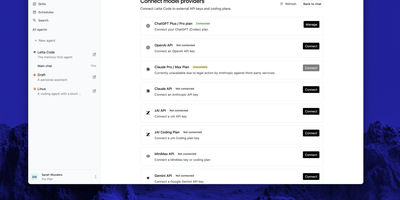
With over 24,000 GitHub stars and origins in the MemGPT research paper on virtual context management, Letta has evolved into the leading open-source platform for building AI agents that maintain persistent memory, identity, and continuity across sessions rather than operating as stateless prompt-response loops. The core architecture uses memory blocks — structured, labeled text chunks that reside permanently in the agent's context window — allowing agents to programmatically rewrite their own memory, learn new skills, and improve through a sleeptime dreaming process that runs reflection and memory organization during idle periods. The self-hosted App Server deploys via Docker and exposes a WebSocket API on port 4500, letting the TypeScript Agent SDK connect from any application using local, remote, or cloud backends. Agents support git-versioned memory through MemFS where every memory change is tracked and auditable, multi-agent communication via subagents, scheduled tasks, and integration with messaging platforms including Slack, Discord, Telegram, WhatsApp, and Signal. The platform is fully model-agnostic, routing to OpenAI, Anthropic, xAI, or self-hosted open-weight models through Ollama depending on cost, performance, and data residency requirements. The Agent File format serializes complete agent state — memory, skills, prompts, and conversation history — into portable snapshots. Desktop applications for macOS, Windows, and Linux provide native interfaces alongside the terminal CLI and web chat at chat.letta.com. Running on a dedicated VPS on RepoCloud with guaranteed CPU, RAM, and SSD, full root SSH access, and a browser serial console. Apache-2.0 licensed.
Vane
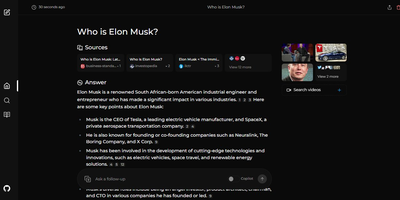
Perplexity's search experience without Perplexity: Vane deploys Perplexica, an open-source AI answer engine built as the self-hosted alternative. Instead of returning a page of links, it reads your question, searches the live web through the SearxNG metasearch engine, and composes a direct answer with cited sources. Retrieval quality comes from embeddings and similarity search: fetched pages are re-ranked against the query so the model answers from the most relevant passages rather than whatever ranked first. Two query modes cover different needs - Normal mode runs a straightforward web search, while Copilot mode generates multiple reformulated queries and actively pulls content from top matches for harder questions. Focus modes specialize retrieval for academic papers, YouTube, Reddit discussions, Wolfram Alpha calculations, or the general web. The answering model is your choice: OpenAI-compatible APIs or fully local LLMs such as Llama 3 and Mixtral through Ollama, which keeps queries entirely on your infrastructure. Because SearxNG pulls live results, answers reflect current information, and no search history is tracked.
ezBookkeeping
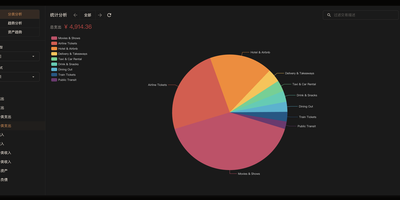
Managing household finances and personal investments becomes completely private with ezBookkeeping, a self-hosted accounting platform that combines multi-currency ledger tracking, automated bank imports, and AI-assisted receipt analysis into a responsive financial dashboard. Users can record daily income, expenses, and asset transfers using hierarchical two-level accounts and customizable tags, attaching photographic receipts and geographic location coordinates to individual entries. The automated data ingestion engine processes bank statements across standardized CSV, OFX, QIF, CAMT, and MT940 files, applying user-defined column mappings and custom conversion scripts to eliminate manual bookkeeping. Financial planners can schedule recurring bills, configure monthly category spending limits, and track asset distribution with interactive charts, trend graphs, and activity heatmaps in the Insight Explorer. Integrated artificial intelligence tools scan uploaded invoice photos to extract line items automatically while a native Model Context Protocol server lets external desktop assistants query balances and audit budgets safely. Security features include time-based two-factor authentication, single sign-on via standard identity providers, and biometric passkey screen locks that secure private monetary ledgers on shared computers. Account owners can export full audit histories to portable spreadsheets, manage multi-currency exchange rate tables, and access clean web interfaces on both desktop monitors and mobile devices. Running on a dedicated VPS on RepoCloud with guaranteed CPU, RAM, and SSD, full root SSH access, and a browser serial console. MIT licensed.
Open Code Review
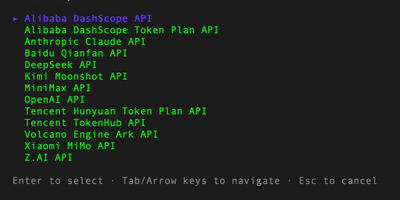
Originated as Alibaba Group's official internal AI code review assistant serving tens of thousands of developers and identifying millions of code defects over two years before open-sourcing in May 2026 — now at 21,000+ GitHub stars — Open Code Review is the production-hardened platform that proves enterprise-grade code review can be fully open-source under Apache 2.0. The hybrid architecture separates deterministic engineering pipelines (file selection, diff parsing, rule matching for NPE, thread-safety, XSS, and SQL injection across 10+ languages) from LLM-powered agent reasoning with tool-use capabilities including FileRead, CodeSearch, and cross-file context inspection, consuming approximately one-ninth the tokens of general-purpose coding agents while delivering line-level precise comments with severity and confidence scoring. The bundled web dashboard (port 4173) provides review management, findings triage, result browsing, and direct GitHub posting without external dependencies, while the session viewer (port 5483) renders full LLM request/response traces for debugging and auditing. Integration spans GitHub Actions, GitLab CI, GitFlic CI, and Gerrit with delegation mode enabling Claude Code, Cursor, and other AI agents to leverage OCR's engineering logic alongside their own LLM reasoning. Supports OpenAI, Anthropic, Google Gemini, DeepSeek via built-in providers plus Ollama and vLLM for air-gapped deployments. Running on a dedicated VPS on RepoCloud with guaranteed CPU, RAM, and SSD, full root SSH access, and a browser serial console. Apache 2.0 licensed.
Securo
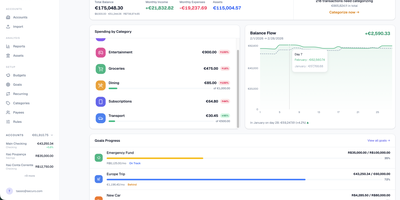
Securo is a privacy-first personal finance platform that keeps all your financial data in your own PostgreSQL instance while connecting to 2,500+ banks across three continents for automated transaction sync. The FastAPI backend with React/TypeScript frontend deploys via Docker Compose on ports 3000 and 8000, with Redis-backed Celery workers handling background synchronization. Bank connections span approximately 2,500 European PSD2 institutions through Enable Banking across 29 countries, US and international banks via SimpleFIN's open protocol, and Brazilian banks through Pluggy, all refreshing automatically every four hours. Multi-account management tracks checking, savings, credit cards, and investments with running balances. The auto-categorization rules engine applies pattern-matching across merchants and amounts. Goal tracking monitors savings targets with progress visualization, asset management handles stocks and custom instruments with configurable valuation growth rules, and reports generate Net Worth and Income vs Expenses charts with category sparklines. Optional AI Agents provide LLM chat with tool-use over your financial data through MCP, supporting OpenAI, Anthropic, Ollama, and compatible providers with per-agent RAG knowledge bases accessible via a global command palette. Multi-user support includes OIDC login, passkey authentication, TOTP two-factor, privacy mode, and multi-currency FX conversion via Open Exchange Rates. 1,500+ stars since March 2026. Running on a dedicated VPS on RepoCloud with guaranteed CPU, RAM, and SSD, full root SSH access, and a browser serial console. AGPL-3.0 licensed.
Maybe Finance
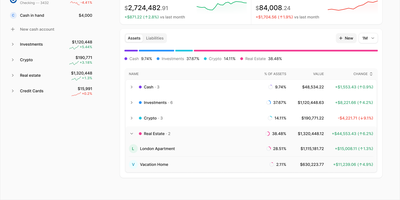
Roughly $1M of development work, open-sourced: Maybe Finance began as a $249/year commercial personal finance product before the company released it all. It aggregates bank accounts, credit cards, loans, investments, crypto, and real estate into a single net worth dashboard with historical trend charts - replacing the spreadsheet that usually glues a whole portfolio together. Transactions are categorized and tagged with rules, with merchant tracking and search across imported or synced activity; budgets track spending by category against plan; and the investment view follows holdings, cost basis, and returns across brokerage accounts. Multi-currency support converts accounts held in different currencies into a single reporting currency, bank synchronization works through Plaid where supported, and manual CSV import covers any institution. An optional AI assistant answers questions grounded in your own financial data. Because the app was built as a paid product with professional design before being open-sourced, its interface quality exceeds most community finance tools - and self-hosting means your balances and transactions are not monetized by a free app or gated behind an annual subscription. The stack is Ruby on Rails with Hotwire on PostgreSQL, licensed AGPL-3.0 and deployed via Docker. The original repository is archived; development continues in the community fork Sure, compatible with the same self-hosted setup.
Tabby
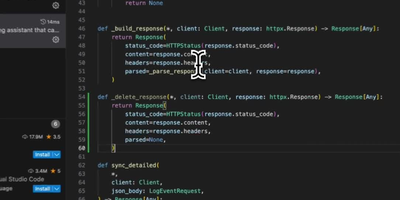
With over 33,000 GitHub stars and a codebase written in 92.9% Rust for maximum performance and memory safety, Tabby is the most widely adopted self-hosted alternative to GitHub Copilot — delivering real-time code completions entirely on your own infrastructure with zero code leaving your network. Deploy a single Docker container on any NVIDIA CUDA, Apple Silicon Metal, AMD ROCm, or CPU-only server and connect VS Code, JetBrains IDEs (IntelliJ, PyCharm, WebStorm, GoLand), Vim, Neovim, and Emacs through native extensions. The completion engine supports a curated registry of models including StarCoder2 (1B to 15B parameters), DeepSeek-Coder, CodeLlama, CodeGemma, Qwen2.5-Coder, and Mistral Code — swappable at runtime through the admin dashboard without redeployment. Repository indexing parses your Git repositories and feeds project-specific types, function signatures, and patterns into completion context via RAG, producing suggestions that understand your codebase rather than generic boilerplate. The Answer Engine provides instant responses to code queries within the IDE, while inline chat enables contextual code editing and explanation without switching windows. The admin dashboard manages per-developer API tokens, usage analytics, and model configuration. Enterprise features include SSO via LDAP, OAuth, and SAML, role-based access control, and audit logging for compliance environments. A single RTX 4090 workstation serves a team of 10-15 developers with sub-500ms completion latency. Running on a dedicated VPS on RepoCloud with guaranteed CPU, RAM, and SSD, full root SSH access, and a browser serial console. Apache 2.0 licensed.
QwenPaw
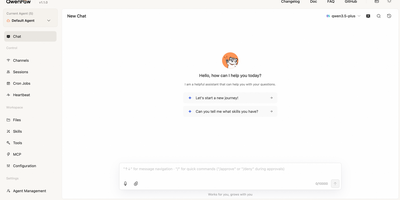
Designed as a unified personal AI workstation, QwenPaw operates as an autonomous digital copilot that coordinates scheduled automations, interactive coding sessions, and multi-channel team communication across everyday messaging apps. Users can dispatch long-running research tasks, process office documents including PDF, Excel, and Word files, and execute browser-based data collection without manual intervention. The built-in web console and terminal interface provide full visibility into agent reasoning, allowing operators to inspect intermediate thinking steps, review proposed file edits, and approve sensitive tool calls. Through direct connectors for Discord, Telegram, DingTalk, Lark, and WeChat, teams can trigger specialized skills or query shared workspaces directly from their existing group channels. A self-evolving personal memory system continuously indexes chat interactions and local resources into editable Markdown files, ensuring knowledge persists across restarts and task delegations. Built-in guardrails including a sandboxed execution runtime, tool access policies, and automated skill scanners protect underlying host files from unauthorized modifications during autonomous scripting runs. Running on a dedicated VPS on RepoCloud with guaranteed CPU, RAM, and SSD, full root SSH access, and a browser serial console. Apache 2.0 licensed.
Multica
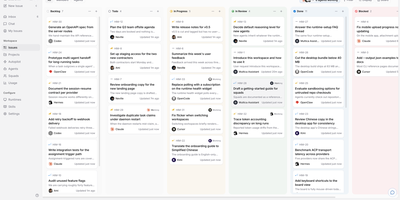
Reaching 45,000 GitHub stars within seven months of launch, Multica is the fastest-growing open-source platform for managing AI coding agents as first-class teammates — assign an issue to Claude Code, Codex, Cursor, Copilot, Kimi, or any of 21 supported agent CLIs and it picks up the work, comments progress in real time via WebSocket, raises blockers, and hands the result back for human review before anything merges. The Go backend (Chi router, sqlc-generated type-safe queries, gorilla/websocket) connects to PostgreSQL 17 with pgvector for semantic search across workspace history, while the Next.js 16 App Router frontend delivers workspace dashboards showing per-agent token spend, execution time, daily cost charts, and runtime status across unlimited connected machines. Agent Skills provide reusable methods, reference material, and supporting files that compound across runs — a persistent knowledge layer that makes each subsequent task faster and more accurate. Squads let a leader agent select the right specialist for subtasks, creating multi-agent workflows without manual orchestration. Review gates ensure no AI-generated code ships to main without explicit human approval. Self-host via Docker Compose or Kubernetes with full Git integration across GitHub, GitLab, Gitea, and Forgejo including self-hosted instances. The CLI and REST API make every surface scriptable, and Autopilot automations trigger agent runs from events. Running on a dedicated VPS on RepoCloud with guaranteed CPU, RAM, and SSD, full root SSH access, and a browser serial console. Apache 2.0 licensed with additional conditions.
Pi Web
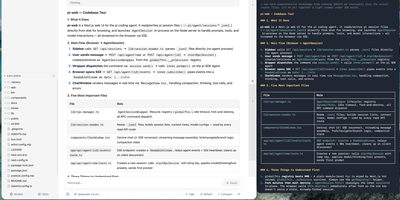
Pi Web is a browser interface for the Pi coding agent ecosystem, providing a visual workspace that reads the same local configuration and session files as the CLI. The session workspace groups conversations by project with running state indicators, context usage percentages, cost tracking, and compaction details, while two branching modes let users create independent session files from earlier messages or fork branches within existing sessions to explore alternative coding directions. Real-time streaming via Server-Sent Events delivers agent responses with structured Markdown rendering, thinking steps, tool call visualization, and image drag-and-drop input. The project file explorer browses working directories with syntax-highlighted source preview, Git diff inspection, and rendering for Markdown, images, audio, PDFs, and DOCX files with automatic refresh. Git worktree support switches checkouts from the sidebar while keeping sessions from the same repository grouped together. The Models panel manages provider authentication via OAuth and API keys, model selection, model smoke tests, and models.json configuration shared bidirectionally with the CLI agent. The Skills panel lists, searches, installs, and toggles agent skills without terminal access. The interface ships with English and Simplified Chinese translations, light and dark themes, a chat minimap, keyboard shortcuts, and completion sounds. Basic Auth protects remote access when binding to non-loopback addresses. Running on a dedicated VPS on RepoCloud with guaranteed CPU, RAM, and SSD, full root SSH access, and a browser serial console. MIT licensed.
MateClaw
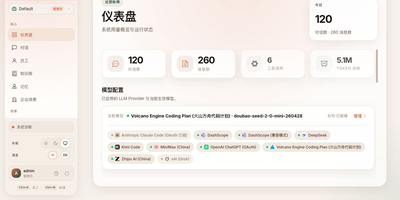
MateClaw delivers a multi-agent AI platform where digital employees run as persistent team members with roles, goals, and accumulated skills rather than stateless chat completions. The Spring Boot backend on Spring AI Alibaba provides ReAct iterative reasoning and Plan-and-Execute decomposition on a StateGraph runtime, with parallel delegation between employees and dynamic context pruning for multi-step tasks. Five career templates ship ready (Product Researcher, Customer Support, Knowledge Curator, Data Analyst, Executive Assistant) while custom employees inherit configurable backstories, pixel-art avatars, and dedicated tool bindings. The MCP integration supports stdio, SSE, and Streamable HTTP transports with per-employee tool isolation preventing capability bleed between agents. ACP bridges bring Claude Code, Codex, and other coding agents in as first-class employees. Workflow orchestration composes multiple employees and system actions into publishable linear DSL processes with seven step modes: sequential, fan_out, collect, conditional, await_approval, dispatch_channel, and write_memory. The trigger system wires cron schedules, webhooks, channel messages, employee lifecycle events, content matches, and workflow completions to automated flows. The Admin Runtime Console provides real-time visibility into running employees with token usage tracking and one-click force-recycle. Spring Boot Actuator monitoring, full audit trail, and per-channel error isolation deliver production-grade reliability. Running on a dedicated VPS on RepoCloud with guaranteed CPU, RAM, and SSD, full root SSH access, and a browser serial console. Apache-2.0 licensed.
MindsHub
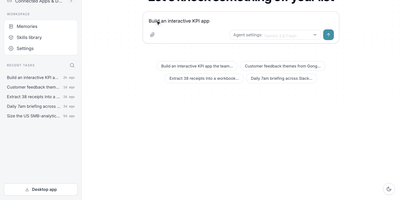
Backed by $50M+ from Benchmark, Y Combinator, and NVIDIA with 800+ contributors and 39,000+ GitHub stars, MindsHub Cowork is the unified AI workspace where open-source models handle entire projects — research, reporting, internal tools, scheduled operations — and return finished, shareable deliverables. The platform runs two interchangeable open-source agent harnesses, Anton and Hermes, swappable from a dropdown without losing context. A built-in Model Router pre-wires 25+ models spanning Anthropic Claude, OpenAI GPT, Google Gemini, DeepSeek, Qwen, Kimi, Grok, and MindsHub Air with automatic failover — no per-provider API keys required. A secure credentials vault connects BigQuery, PostgreSQL, Salesforce, HubSpot, Zendesk, Gong, Gmail, Google Drive, Notion, Linear, Stripe, and Slack, keeping secrets scoped per connection so agents never see raw keys. Agent output becomes publishable artifacts — documents, dashboards, apps, and code — each deployable to a live shareable URL. Cross-session persistent memory, a reusable skill library, and a background scheduler supporting hourly, daily, and weekly cadences enable autonomous recurring workflows. The architecture separates a React/Vite frontend (shipping as both Electron desktop app and web SPA) from a FastAPI backend with a versioned REST API at /api/v1 covering conversations, projects, artifacts, schedules, and connectors. Self-host via Docker Compose with nginx on port 3000 and the API on port 26866, or deploy on-prem, in a VPC, or air-gapped. Running on a dedicated VPS on RepoCloud with guaranteed CPU, RAM, and SSD, full root SSH access, and a browser serial console. MIT licensed.