Maintainerr
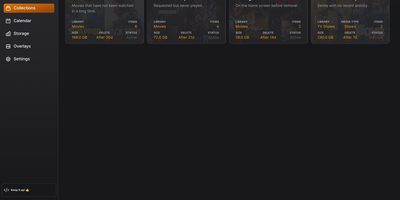
Automating media server storage reclamation, Maintainerr is an open-source library maintenance platform that identifies unwatched, abandoned, or stale movies and shows across Plex, Jellyfin, and Emby and clears them on a schedule. Storage drives fill up rapidly when household members request four-season series or high-bitrate films, watch a single episode, and abandon the rest indefinitely. Instead of forcing administrators to audit disks by hand, the rule engine evaluates metadata from your media server alongside Tautulli watch histories, Seerr and Ombi request records, and Radarr, Sonarr, or Sportarr profiles every eight hours. Matching items enter a staging collection that syncs back to your media server home screen as a Leaving Soon row, complete with dynamic poster overlays displaying the exact removal date so viewers have a grace period to finish watching. Before enabling any destructive workflow, you can run the Test Media inspector against any movie or episode to preview rule evaluations and protect favorites with global or per-collection exclusions. Once the countdown expires, the collection handler deletes or unmonitors files, updates import-list exclusions so automated lists never re-download removed titles, clears orphaned requests in Seerr and Ombi, removes leftover sidecar folders, and dispatches alerts through Discord, Slack, Telegram, Pushover, Gotify, Email, or webhooks. Running on a dedicated VPS on RepoCloud with guaranteed CPU, RAM, and SSD, full root SSH access, and a browser serial console. MIT licensed.
Endurain
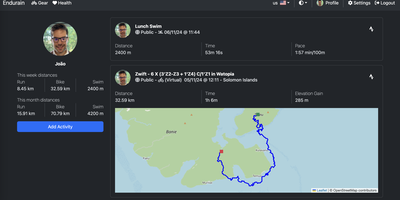
A personal Strava on your own server: Endurain is a self-hosted fitness platform that keeps your complete workout history, GPS routes, and health data out of a vendor's cloud. It ingests the standard device formats (.gpx, .tcx, and preferred .fit with full sensor data) via manual or bulk upload, and syncs directly with Strava and Garmin Connect so migrating years of history is straightforward - Garmin sync covers activities, gear, and body composition. The dashboard shows activity feeds with weekly and monthly statistics, routes on maps, and distance, speed, and training-volume trends over time, with definable goals that update automatically. Gear tracking is notably deep: log wetsuits, bicycles, shoes, racquets, skis, and snowboards, assign default gear per activity type, and track individual components like bike chains against replacement mileage. Multi-user support with admin and user roles, follower features, per-activity privacy settings, and configurable sign-up (email verification, admin approval) make it usable for clubs and coaches as well as individuals. Auth is serious for a fitness app: MFA TOTP, OIDC/SAML SSO, and email-based password resets via Apprise. The stack is Vue.js over a Python FastAPI backend with PostgreSQL, plus weight, steps, and sleep logging, imperial/metric units, multi-language support, and third-party app integration.

Artalk
Artalk embeds a full commenting system into any webpage with three lines of JavaScript, packing multi-site management, social login, spam filtering, and Markdown rendering into a client that weighs roughly 40KB. One server instance manages comments for unlimited websites with complete data isolation between sites, eliminating the need for separate deployments per project. The framework-agnostic Vanilla JS client renders a complete comment interface with Markdown support, LaTeX mathematical formula rendering, image uploads, emoji packs compatible with OwO format, and automatic dark mode detection. An integrated admin dashboard accessible through the comment box provides comment moderation queues, IP banning, comment pinning, page-level statistics, and content management without direct database access. Social login authenticates commenters through GitHub, Google, Twitter, Discord, and additional OAuth providers, while captcha protection spans four backends: image captcha, Cloudflare Turnstile, Google reCAPTCHA, and hCaptcha. Spam filtering layers include Akismet integration, keyword block lists, and cloud moderation services that catch unwanted content before publication. Email notifications support SMTP, Aliyun DM, and Sendmail transports with customizable templates, and multi-channel push notifications extend to Telegram, Bark, and other messaging platforms. The OpenAPI-documented HTTP API enables programmatic comment management. Database flexibility covers SQLite, MySQL, PostgreSQL, and SQL Server. A plugin marketplace offers community extensions for custom behavior. Continuously maintained for over 8 years. Running on a dedicated VPS on RepoCloud with guaranteed CPU, RAM, and SSD, full root SSH access, and a browser serial console. MIT licensed.

HeadlessX
With 2,000 GitHub stars and 10 releases since its September 2025 launch, HeadlessX delivers a self-hosted browser automation platform that replaces Chromium-based scraping with Camoufox — a Firefox fork performing kernel-level fingerprint spoofing to achieve 0% detection across Cloudflare, DataDome, PerimeterX, and other anti-bot systems where Puppeteer and Playwright regularly fail. The web dashboard provides workspace-based job organization with a visual interface for configuring scrape targets, managing browser profiles, monitoring queue status, and viewing extracted results in real time. The protected REST API accepts requests with API key authentication for programmatic access, supporting HTML extraction, screenshot capture, PDF generation, and structured data parsing with configurable stealth parameters. Profile-based scraping maintains persistent browser contexts with cookie jars, localStorage, and fingerprint configurations that survive between requests — reducing cold-start latency from 25 seconds to under 2 seconds on subsequent requests. Queue-backed workflows enable batch processing of URLs with configurable concurrency, retry logic, and webhook notifications on completion. The Google AI Search integration provides AI-assisted web research workflows through dedicated endpoints. Remote MCP support exposes automation capabilities as tool endpoints for AI agent integration. Deploy via the official CLI with `headlessx init` and `headlessx start` commands, scaffolding a Docker Compose stack with Caddy reverse proxy for automatic HTTPS. Running on a dedicated VPS on RepoCloud with guaranteed CPU, RAM, and SSD, full root SSH access, and a browser serial console. MIT licensed.
PanWatch
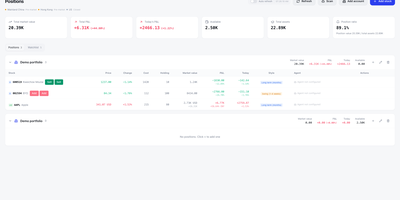
PanWatch's three scheduled AI agents plan the trading day before the bell, watch the session, and review it after the close for your China A-share, Hong Kong, and U.S. holdings. Day one begins with the portfolio: several brokerage accounts, holdings and profit and loss, and search for stocks or listed ETFs by code or name. The pre-market agent folds overnight moves, news, and technical structure into that plan and skips exchange holidays. Through the session, the intraday monitor watches for unusual moves and technical signals. Price alerts combine price, percentage change, turnover, and volume ratio with AND/OR logic, cooldowns, and expiry times. Each rule picks its own channel from Telegram, WeCom, DingTalk, Feishu, Bark, or a webhook. Spot something odd? The brain icon next to a holding starts TradingAgents, where four analyst roles feed a bull and bear debate, a risk review, and a portfolio-manager decision, with the reasoning trail in the app and your notifications. The opportunities screen ranks AI-scored ideas with entry levels and targets, and paper trading simulates signal-based entries and exits and tracks equity and performance. At day's end, the daily report reviews the session and prepares the next trading day's plan. OpenAI-compatible providers or local Ollama models power the analysis, and the PWA installs on a phone in English or Simplified Chinese. Running on a dedicated VPS on RepoCloud with guaranteed CPU, RAM, and SSD, full root SSH access, and a browser serial console. MIT licensed.

Huntly
Capture every article you read, RSS feed you follow, X/Twitter thread you scroll past, and GitHub repository you star into one searchable, AI-enhanced personal knowledge base with Huntly. Auto-save visited web pages through the companion browser extension, extract distraction-free article text using Mozilla Readability and Defuddle, and highlight passages with inline notes that remain anchored in your library. Reconstruct multi-post X/Twitter threads automatically with embedded media preserved intact. Subscribe to RSS and Atom feeds via OPML import, organize subscriptions into custom folders, and triage unread stories alongside your read-it-later queue and hierarchical collections. Synchronize starred GitHub repositories with their README documentation and repository tags so you can filter tools by topic without leaving your dashboard. Run custom AI shortcuts to summarize long-form essays, translate foreign articles, or query your entire archive from external AI coding agents through the built-in MCP server and Agent Skills integration. Execute boolean, phrase, and bilingual fuzzy queries across every saved document or export your entire library to portable Markdown files. Running on a dedicated VPS on RepoCloud with guaranteed CPU, RAM, and SSD, full root SSH access, and a browser serial console. Apache-2.0 licensed.
Talivia
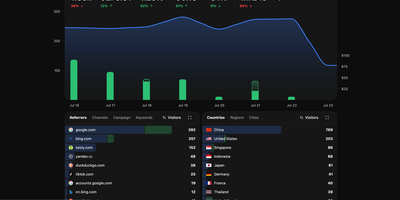
Founders do not need another chart of pageviews; they need to know which visit became money, and Talivia is a self-hosted, revenue-first analytics platform that fuses website traffic with payment data so every metric answers in dollars. Connect Stripe, LemonSqueezy, Polar, Dodo, or Yolfi, and the dashboard pairs visitor counts with revenue, conversion rate, revenue per visitor, refunds, and disputes, so a traffic spike that never buys anything stops masquerading as success. Referrers, campaigns, keywords, and countries are ranked by the money they produce, which reduces budget decisions to one question: which channel brought customers who actually paid? When a page underperforms, session replay shows what visitors actually did there and the moment they gave up, so you debug journeys instead of guessing from aggregates. Events and multi-step funnels trace the path from landing page to checkout, while bot traffic detection stops crawlers from inflating your conversion statistics. The live visitor feed shows who is browsing right now, with country, device, browser, acquisition source, events, and spend for each session as it unfolds. Public links publish any dashboard as a read-only page for investors or clients, and teammates join the workspace with their own accounts when they need to dig deeper. Visitors, replays, and payment records all stay in your own PostgreSQL database, so customer journeys never pass through a third-party analytics cloud. Running on a dedicated VPS on RepoCloud with guaranteed CPU, RAM, and SSD, full root SSH access, and a browser serial console. MIT licensed.
Astuto
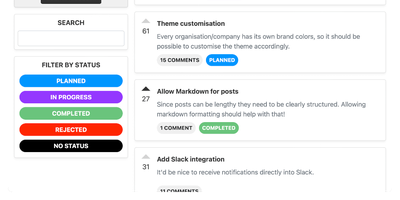
Feature requests, bug reports, upvotes, and a public roadmap: Astuto (Ruby on Rails backend, React frontend) gives users a Canny-style feedback portal so product decisions rest on visible demand rather than the loudest voice in the room. Feedback organizes into as many boards as you want (features, bugs, integrations), each post carrying a custom status you define - "planned," "in progress," "shipped," or whatever matches your process - and those statuses feed a public roadmap view showing users what is actually being worked on. Participation friction is adjustable at both ends: sign-in works with plain email or any OAuth2 provider, anonymous feedback can be enabled for unregistered users, and a moderation queue lets you approve posts before they appear when spam is a concern. Integration hooks are practical rather than sprawling - webhooks fire on events to connect Jira, Trello, or Slack, and a REST API manages the whole feedback space programmatically. Brand customization, an invitation system, private-site settings, and recap emails for administrators complete a deliberately minimal tool: it collects, organizes, and prioritizes feedback well, for free, forever.
Docspell
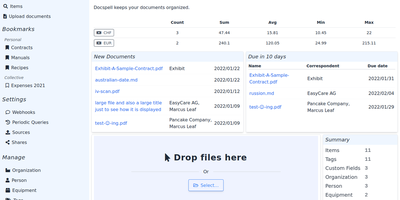
Convert paper archives, email attachments, and PDF records into an organized digital repository with Docspell, an open-source document management system that automates optical character recognition, metadata extraction, and full-text search. Users can ingest receipts and invoices through network scanners, monitored IMAP email mailboxes, mobile uploads, or drag-and-drop browser tools. The background processing pipeline executes optical character recognition via Tesseract, enhances image contrast with unpaper, and extracts text from Word documents and PDFs. Machine learning algorithms analyze document syntax to predict correspondents, suggest relevant organization tags, and identify due dates automatically. Team members can search their entire filing cabinet using complex Boolean queries and full-text indexing powered by Apache Solr or PostgreSQL. Administrators can configure multi-user collectives with isolated permissions, define custom metadata attributes, set up webhooks, and share time-limited document download links. Users can also merge multi-page scans, track processing job queues, and export curated document collections for tax filings or legal audits. Running on a dedicated VPS on RepoCloud with guaranteed CPU, RAM, and SSD, full root SSH access, and a browser serial console. GNU AGPL v3.0 licensed.
Chitchatter
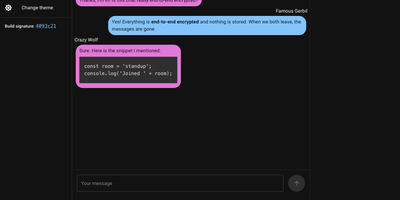
Chitchatter is a browser-based chat room for text, voice, video, screen sharing, and file transfers that exists only while its members are connected and keeps no record of what was said. Every visit starts with a random room name generated on your device, a UUID or a readable passphrase, and you invite people with the link or a QR code. Public rooms admit anyone with the link; private rooms also require a matching password. Messages support Markdown, multiline text, and code blocks, and clicking a name opens a direct conversation. Newcomers to public rooms receive the earlier conversation from peers already there, and typing indicators show who is writing. Start an audio or video call, share your screen to walk a relative through a settings problem, or hand over a file of any size, encrypted before it leaves your browser. Public-key checks verify each peer automatically, with a green lock marking everyone who passes and an icon showing whether the link is direct or relayed. Embed a room in any web page with an iframe or a web component that takes a room name, user name, and color mode. Light and dark themes are built in, and notifications and sounds announce new messages while you work in another tab. Close the tab and the transcript disappears. Running on a dedicated VPS on RepoCloud with guaranteed CPU, RAM, and SSD, full root SSH access, and a browser serial console. GPL-2.0 licensed.
ToolHive
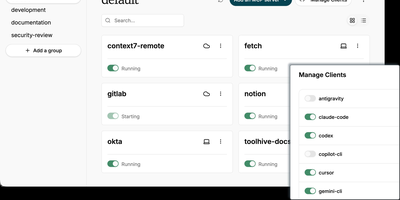
ToolHive is an open-source MCP server management platform that lets you run, secure, and orchestrate Model Context Protocol servers in isolated containers, giving AI agents structured access to tools like GitHub, databases, and cloud services without exposing host credentials or network. Every server launches inside its own sandboxed container with a minimal permission file, network access filtering, and encrypted secrets management, preventing misbehaving connectors from reaching beyond their defined scope. The built-in registry provides a catalog of vetted servers you can install with one command, while custom images and package-manager references let you onboard proprietary connectors without writing Dockerfiles. Platform teams deploy the Kubernetes operator to declare MCP servers as cluster resources using Custom Resource Definitions, with automated lifecycle management and multi-namespace isolation. The Virtual MCP Server gateway aggregates multiple backends behind a single endpoint, centralizing OIDC authentication, tool filtering, and composite cross-server workflows so clients connect once instead of juggling separate URLs. An MCP Optimizer analyzes tool schemas via semantic search and surfaces only relevant tools per request, cutting token consumption by up to 85%. OpenTelemetry traces and Prometheus metrics deliver full visibility into tool execution, latency, and request audit trails across every managed server. Running on a dedicated VPS on RepoCloud with guaranteed CPU, RAM, and SSD, full root SSH access, and a browser serial console. Apache 2.0 licensed.
Revolt
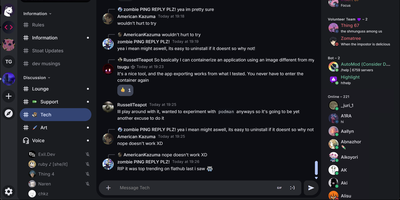
Revolt gives communities the full Discord experience without ads, behavioral tracking, or subscription fees: servers with text and voice channels, direct messages, group conversations, roles, bots, and custom emoji at zero cost per user. The Rust microservices backend splits responsibilities across Delta for REST API and authentication, Bonfire for persistent WebSocket real-time event delivery, Autumn for file upload routing to MinIO S3-compatible object storage, and January for link preview proxy and embed generation. Voice chat operates through LiveKit with WebRTC audio streaming supporting multiple concurrent participants per channel. Server administrators configure hierarchical role-based permissions at the server, channel, and per-role level, controlling who can send messages, manage channels, kick members, and access moderation tools. Text channels support Markdown formatting, custom emoji, file attachments up to 20 MB, GIF search via Tenor integration, and message reactions. The bot API enables automated moderation, entertainment, and custom workflow integration with community-maintained libraries available in JavaScript, Python, and Rust. The TypeScript and Solid.js web frontend provides a responsive interface with theme customization. Docker Compose deployment spins up the complete stack including MongoDB for message and user storage, Redis for caching, and MinIO for attachments, providing complete data sovereignty over all conversations and files. Running on a dedicated VPS on RepoCloud with guaranteed CPU, RAM, and SSD, full root SSH access, and a browser serial console. AGPL-3.0 licensed.

PiGallery2
PiGallery2 turns any mounted folder of images and home videos into a high-speed web gallery without modifying your raw files or forcing migration into a database silo. The server scans directories in read-only mode, keeping folder structures intact while generating responsive previews with hardware-accelerated Sharp processing. Users can inspect detailed camera EXIF metadata, toggle custom full-screen lightboxes with swipe gesture navigation, and stream high-definition MP4 or WebM video clips. Embedded GPS coordinates automatically pin photos onto interactive OpenStreetMap or Mapbox views, allowing travel albums to display alongside synchronized GPX track routes. Powerful boolean search expressions filter across dates, keywords, camera models, and Adobe XMP face regions without requiring expensive background machine learning models. Built-in link sharing creates password-protected access links with custom expiration dates for friends and family. Running on a dedicated VPS on RepoCloud with guaranteed CPU, RAM, and SSD, full root SSH access, and a browser serial console. MIT licensed.

Yuvomi
Replace a dozen household subscriptions with one app that keeps your family's tasks, calendars, meals, budget, and shopping in a single private place you control. Nineteen modules cover the daily rhythms of a household: assign chores with deadlines and priorities, plan the week's dinners and push the ingredients to a shared shopping list in one tap, track income and expenses by category with automatic subscription renewal warnings, and log health activities from vitals to medications. Two-way sync connects to Google Calendar via OAuth, iCloud and Nextcloud via CalDAV, and Outlook via Microsoft Graph, so every family member's phone shows the same schedule without switching apps. CardDAV keeps contacts in sync with external address books. The budget module handles accounts, loans, split expenses, and per-category planning with savings goals and month-over-month comparisons. Documents attach to tasks, receipts link to transactions, and a checked-off grocery item books itself back into the pantry inventory with its quantity. A Kanban board, recurring task schedules, and a rewards ledger that pays out points for completed chores keep kids and adults accountable. Wall mode turns a kitchen tablet into a glanceable family dashboard, and the Immich screensaver shows your own photos when the screen goes idle. API tokens and a built-in MCP endpoint let AI agents and third-party tools interact with every module programmatically. Deploy on a dedicated VPS on RepoCloud with guaranteed CPU, RAM, and SSD, full root SSH access, and a browser serial console. MIT licensed.

Notifuse
Marketing campaigns and transactional mail from one open-source platform: Notifuse is a modern, self-hosted alternative to Mailchimp, Brevo, and Klaviyo without per-email or per-contact pricing. Built with Go and React on PostgreSQL, it separates concerns cleanly: a drag-and-drop visual builder composes responsive templates from MJML components with Liquid variables like {{ contact.first_name }} and per-template version history; campaigns add A/B testing across subject lines, content, and send times; and a REST transactional API serves application-triggered mail. Delivery routes through your choice of provider - Amazon SES, Mailgun, Postmark, SendGrid, SparkPost, Mailjet, or plain SMTP - with multi-provider failover. Contacts carry custom fields and a full activity timeline (messages, profile changes, webhook events), and real-time segmentation builds dynamic rules over properties, activity, and subscriptions. Event-driven automations create behavioral sequences, a notification center gives recipients self-service preference management, and an S3-compatible file manager handles images with CDN delivery. Multi-tenant workspaces with isolated databases and custom domains suit agencies. Open and click tracking report engagement in real time.
Univer Workspace
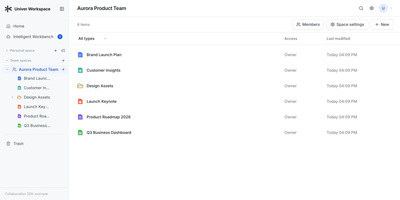
A budget model, the launch document that explains it, and the slides that present it can live side by side in one self-hosted office workspace that people and AI agents edit together. Personal and Team Spaces organize Sheets, Docs, Slides, relational Bases, and Boards, with Recent, Trash, file import, and export views keeping everyday housekeeping close at hand. Sharing follows role and node aware access control, including anonymous viewing, so a single table or document can be opened to a reader without exposing the whole space. Data and references stay connected across artifacts as the workspace changes, which keeps a figure corrected in a sheet consistent with the document that quotes it. The Workspace Agent drafts and revises content in isolated Worktrees, verifies its own changes, and hands the result to a person for review before anything reaches the trunk. Several review rounds can happen while humans keep editing in the Browser, and nothing merges until someone approves it. The Workspace CLI connects existing agents to your deployment, so automation can create content, inspect data, render screenshots and PDFs, and run layout checks before review. Sign-in accepts passwords, GitHub, Discord, or application OAuth, and files move in and out as XLSX, DOCX, PPTX, and CSV without a separate conversion project. Running on a dedicated VPS on RepoCloud with guaranteed CPU, RAM, and SSD, full root SSH access, and a browser serial console. Apache-2.0 licensed.
Forge
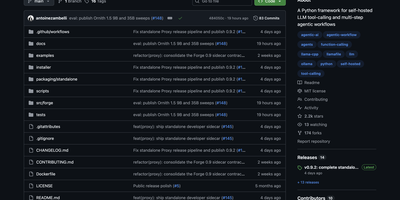
Forge intercepts failing LLM tool calls and fixes them before they derail your agent workflow, applying rescue parsing, retry nudges, response validation, and step enforcement between your AI clients and local model backends. The proxy server mode drops in as a transparent intermediary speaking both the OpenAI chat-completions API and the Anthropic Messages API, so tools like Aider, Claude Code, Continue, and opencode connect through it without configuration changes. Under the hood, the WorkflowRunner provides a complete agentic loop manager with system prompt injection, tool execution, context compaction with configurable thresholds, and VRAM budgeting for consumer GPUs with 12-32 GB. SlotWorker enables priority-queued access to shared inference slots with automatic preemption for multi-agent architectures. The guardrails middleware exposes a two-method check-and-record API that wraps into any existing orchestration loop, providing malformed tool-call rescue parsing, retry nudge generation, required step enforcement, and prerequisite ordering without taking over execution control. Backend adapters support generic OpenAI-compatible endpoints, Ollama, llama-server, Llamafile, vLLM, and Anthropic with automatic model discovery and health checking. Architecture Decision Records document every design choice. Launched February 2026, already at 2,200+ GitHub stars. MIT licensed.
Keila
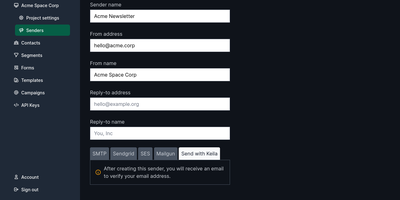
Among open-source Mailchimp alternatives, Keila has the most modern UI - built in Germany on Elixir and Phoenix (the PETAL stack), with GDPR-conscious defaults including an optional no-tracking mode, and 100% open source with no proprietary premium tier. Campaign authoring is flexible three ways: a visual block editor with multi-column layouts, Markdown with or without WYSIWYG for hybrid HTML-plus-plain- text sends, and raw MJML for hand-coded designs. The personalization system is unusually clean - every contact carries custom data as a single JSON object (populated from sign-up form fields or pushed from your CMS/CRM), and Shopify's Liquid template language renders it into fully dynamic emails. Targeting uses a visual segment editor backed by a powerful segment language for complex logic over tags, language preferences, and any custom field. Sign-up forms with custom fields grow your lists; open and click tracking measures campaigns; scheduled sending handles timing. Delivery pipes through your own SMTP or first-class integrations with AWS SES (including automated bounce handling), SendGrid, Mailgun, and Postmark. A full REST API manages contacts, campaigns, and segments, with Erlang/OTP reliability underneath. Comfortable at 100K+ subscribers. AGPL-licensed, EU-hosted project, actively developed.