Carbon ERP
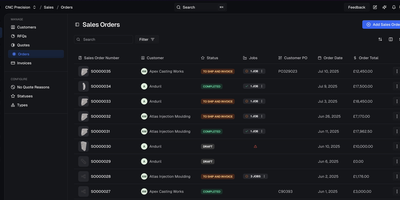
Carbon delivers a unified manufacturing operating system that eliminates the integration tax of running separate ERP, MES, and QMS platforms. The Remix and TypeScript frontend paired with Supabase PostgreSQL backend provides full-stack type safety from database schema to React components, with real-time subscriptions pushing production floor updates to every connected client. The built-in MCP server exposes 1,374 operations across 15 modules through three discovery tools, enabling AI agents to interact with manufacturing data while respecting attribute-based access control. Nested bill of materials with unlimited depth supports complex assemblies, while the MRP engine calculates material requirements across multi-level structures with configurable lead times and safety stock. The configurator handles configure-to-order scenarios with rule-based variant generation. Full lot and serial traceability from receiving through shipping satisfies AS9100, ISO 13485, CFR Part 11, and ITAR compliance requirements. Custom fields extend any entity without schema modification, and the app framework lets integrators build domain-specific modules that plug into the core navigation, permissions, and data layer. Typed API clients for TypeScript, Python, C#, and cURL enable programmatic access to every manufacturing operation. Docker-based local development boots Postgres, Redis, Inngest, and the application stack with a single CLI command. Running on a dedicated VPS on RepoCloud with guaranteed CPU, RAM, and SSD, full root SSH access, and a browser serial console. AGPL-3.0 licensed.
InvoicePlane
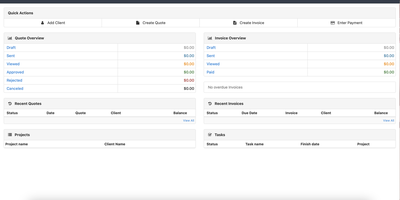
InvoicePlane manages the complete freelance and small-business billing cycle — draft quotes, convert them to invoices, automate recurring charges, collect payments through Stripe and PayPal, and generate EU-compliant eInvoice XML for automated processing by accounting systems. Deployed over 100,000 times across 193 countries, the PHP 8.2+ application on CodeIgniter 3 with MySQL or MariaDB handles everything from first estimate to final receipt. EU-compliant eInvoice generation creates machine-readable XML invoices meeting European Union standards since version 1.6.2. Recurring invoices automate periodic billing with configurable controls that pause generation when previous invoices remain unpaid. Online payment integration lets clients pay directly through Stripe, PayPal with Advanced Credit Cards, and Venmo support. The CRM-like client management module stores contact details, notes, custom fields, and complete transaction history per client. Product and task management modules let you build line-item invoices from reusable product catalogs and project tasks. Customizable PDF templates powered by mPDF support branded invoice layouts with QR codes, while email delivery via PHPMailer handles automated sending with configurable SMTP. A guest portal gives clients read-only access to view and pay their outstanding invoices and quotes. Financial reporting tracks revenue, outstanding balances, and payment history. The multi-language interface supports community translations, and multi-currency handles international invoicing. Deploy via Docker Compose with automatic database migrations. Running on a dedicated VPS on RepoCloud with guaranteed CPU, RAM, and SSD, full root SSH access, and a browser serial console. MIT licensed.
Whiteboard
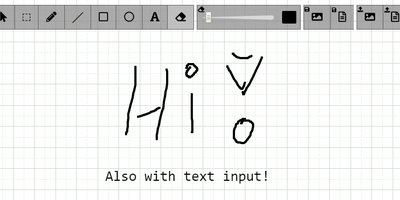
The drawing surface inside WebRTC conference tools like Meetzi and the LAMS online-learning platform is Whiteboard (by cracker0dks) - a lightweight Node.js collaborative sketchboard built to be embedded and customized, which also slots into Nextcloud via the External Sites app. Everyone opening the same whiteboardid URL parameter draws on the same board, with remote user cursors visible live, per-user undo/redo, and an indicator showing the smallest participating screen so nobody draws outside a colleague's view. Content handling goes beyond pen strokes: drag-and-drop or paste images and PDFs from any PC or browser, then resize, rotate, and draw over them on canvas or background; add text and sticky notes; hold Shift for angle-snapped lines and perfect squares. Every function has a keybinding - deliberately friendly to pen displays like Wacom and XP-Pen whose hardware buttons map to shortcuts. Boards save to image or JSON (with reload), export directly to Nextcloud via WebDAV, and persist across restarts with the file-database option. A REST API with bundled interactive docs allows full programmatic control, an optional access token locks down uploads, and YAML configuration tunes behavior and performance. MIT-licensed and reverse-proxy friendly.
LocalAI
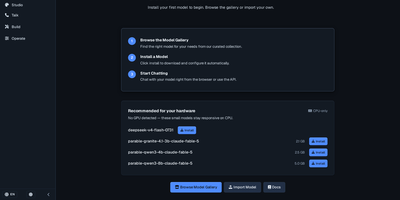
With over 48,000 GitHub stars and monthly releases since March 2023, LocalAI is the self-hosted AI engine that replaces every OpenAI endpoint with a single Docker container running on your own infrastructure — serving chat completions, image generation, text-to-speech, speech-to-text, embeddings, vision, video generation, and function calling through identical API schemas that require zero application code changes. The composable backend architecture isolates each inference engine as a separate gRPC service running in its own OCI container, so llama.cpp, vLLM, SGLang, transformers, whisper.cpp, diffusers, MLX, Stable Diffusion, and Flux install on demand without touching the core, can run on separate machines, and a fault in one never affects others. Hardware acceleration spans NVIDIA CUDA 12 and 13, AMD ROCm, Intel oneAPI/SYCL, Apple Silicon Metal, Vulkan, and NVIDIA Jetson L4T — or runs entirely on CPU without any GPU. Built-in AI agents support autonomous tool use, retrieval-augmented generation, Model Context Protocol integration, and skill-based workflows directly in the web interface. The model gallery provides curated YAML configuration files for hundreds of models that install with a single command, while P2P federated inference distributes model shards across multiple machines for running models larger than any single node's memory. Multi-user API key authentication with quotas and role-based access enables team deployments. Running on a dedicated VPS on RepoCloud with guaranteed CPU, RAM, and SSD, full root SSH access, and a browser serial console. MIT licensed.
Nanobot
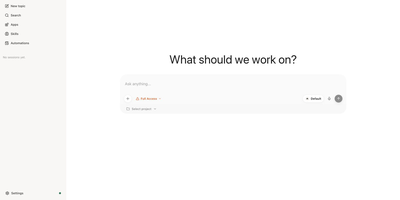
With over 46,000 GitHub stars, nanobot is the ultra-lightweight personal AI agent framework that delivers full agentic capabilities — tools, persistent memory, multi-agent workflows, scheduled automation, and 10+ chat channel integrations — in approximately 4,000 lines of readable Python core code. The agent loop receives messages from any connected channel, builds context from session history and long-term memory files, calls the configured LLM provider, executes requested tools, and publishes replies back to the originating channel. Supported LLM providers include OpenAI, Anthropic, Google Gemini, DeepSeek, Qwen via DashScope, Moonshot/Kimi, Ollama, vLLM for local models, and any OpenAI-compatible API through OpenRouter or LiteLLM. Chat channels connect the agent to Telegram, Discord, Slack, WhatsApp, Feishu/Lark, DingTalk, Email via IMAP/SMTP, QQ, Matrix with end-to-end encryption, Mattermost, and the built-in browser WebUI served from the published Python wheel with no separate frontend build. Built-in tools include filesystem read/write/edit, shell execution with configurable sandboxing via bubblewrap, web search and fetch with SSRF protection, MCP server integration, cron scheduling, image generation, and subagent spawning for parallel task delegation. The Dream memory system consolidates session history into persistent markdown files for long-term context retention across conversations. Deployment runs as a CLI agent, a persistent gateway server, a Docker container with Docker Compose, or an OpenAI-compatible API server. Running on a dedicated VPS on RepoCloud with guaranteed CPU, RAM, and SSD, full root SSH access, and a browser serial console. MIT licensed.
Usermemos
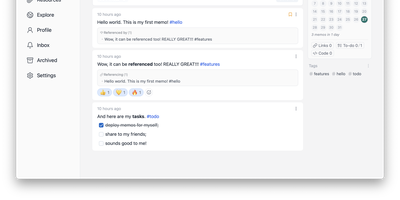
Memos, the lightweight open-source note service from the usememos project, packaged as a containerized deployment for multi-architecture Docker hosts (x86-64 and arm64): that is Usermemos. The model is frictionless capture: no folders or titles, just a chronological stream of Markdown notes with code blocks, task lists, tables, and file attachments, organized by #hashtags pulled automatically from the text. Per-memo visibility - private, protected for logged-in users, or public - lets a single instance serve as a personal journal, a shared team log, or a public microblog simultaneously. Multi-user support with authentication makes it workable for small teams, and full REST and gRPC APIs open capture and retrieval to CLIs, bots, and automation tools. The runtime is a single Go binary with a React frontend that idles around 50 MB of memory and stores content as plain Markdown in SQLite by default, with MySQL and PostgreSQL available for heavier deployments. Configuration happens through environment variables, access works over HTTP or HTTPS behind a reverse proxy, and there is no telemetry - notes stay on your server in a portable format.
Seatsurfing
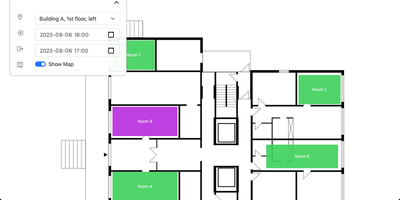
Seatsurfing brings desk booking, room reservations, and parking management to interactive floor plans across multiple office locations, solving the coordination headache of hybrid work. The Go backend serves two React/TypeScript frontends through a single Docker container on port 8080: a Booking UI built as an installable Progressive Web App for mobile and desktop reservations, and an Admin UI for floor plan configuration, capacity enforcement, and analytics. Interactive floor plans accept uploaded office layouts where administrators visually place bookable spaces with per-space metadata and availability rules. Multi-location support handles organizations with distributed offices across multiple buildings and cities. The buddy system displays which colleagues have bookings on a given day, enabling team coordination without manual communication. Capacity management enforces occupancy limits per area with automatic denial when thresholds are reached. SSO integration supports OIDC and OAuth2 providers including Microsoft Azure AD, Keycloak, and Authentik for enterprise identity federation. Microsoft Teams and Confluence integrations embed booking directly into collaboration tools employees already use daily. The REST API enables automation and custom integrations, while the analytics dashboard tracks utilization rates, peak hours, and booking patterns. Docker Compose deployment requires only a PostgreSQL database with multi-architecture images supporting amd64 and arm64. Running on a dedicated VPS on RepoCloud with guaranteed CPU, RAM, and SSD, full root SSH access, and a browser serial console. GPL-3.0 licensed.
Radarr
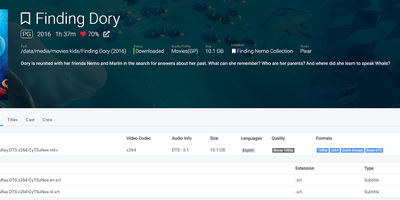
The movie half of the *arr stack: Radarr is a .NET collection manager that automates acquiring films for Usenet and BitTorrent users the way Sonarr does for TV. Add a movie once and Radarr handles the rest: it monitors indexers and RSS feeds, grabs a matching release the moment one appears, sends it to SABnzbd, NZBGet, qBittorrent, Deluge, Transmission, rTorrent, or another connected download client, then imports, sorts, and renames the file into your library structure. Quality profiles are the control surface - define allowed resolutions and a cutoff, and Radarr keeps upgrading files automatically, replacing a DVD rip when a Blu-ray release lands. Custom formats go further, scoring releases by codec, HDR metadata, release group, streaming source, or arbitrary regex so the copy you want always wins the pick. Failed downloads retry with another release automatically; a manual search shows every candidate and explains why one was skipped. Release parsing recognizes director's cuts, special editions, AKA titles, and hardcoded subs. Plex and Kodi integration handles notifications, library refreshes, and metadata like posters, trailers, and subtitles, and a calendar view tracks upcoming releases. It pairs naturally with Jellyseerr for request management and shares its API conventions with the whole *arr ecosystem.
xyOps
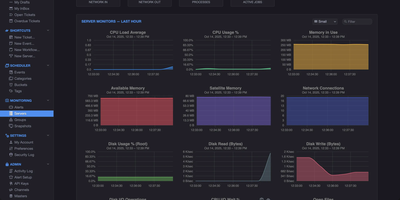
With 4,500+ GitHub stars and version 1.0.92 released August 2026, xyOps delivers a complete operations platform that unifies workflow automation, job scheduling, server monitoring, alerting, and incident response in one self-hosted system. The platform uses a distributed architecture where a central conductor coordinates lightweight xySat satellite agents running on Linux, macOS, or Windows worker nodes via persistent WebSocket connections. The visual workflow builder lets you chain events, triggers, actions, and monitors into multi-step pipelines with conditional logic, fan-out/fan-in parallelism, multiplex controllers for fleet-wide execution, and configurable resource limits. QuickMon provides per-second CPU, memory, disk, and network visibility streamed live to the web UI, while user-defined monitor plugins sample metrics every minute with time-series storage at hourly, daily, monthly, and yearly resolutions. Alert triggers evaluate expressions against live data and fire notifications via email, webhook, or custom actions, with full server snapshots attached showing every running process, network connection, and resource utilization at the moment of detection. Failed jobs and alerts automatically create tickets with linked logs, metrics history, and context for end-to-end incident tracking. The plugin marketplace supports extensions written in any language, and the Docker plugin enables container-based job execution. Deploy via Docker with persistent volumes on port 5522 for the web UI and 5523 for API access, running on a dedicated VPS on RepoCloud with guaranteed CPU, RAM, and SSD, full root SSH access, and a browser serial console. BSD-3-Clause licensed.
Elasticsearch
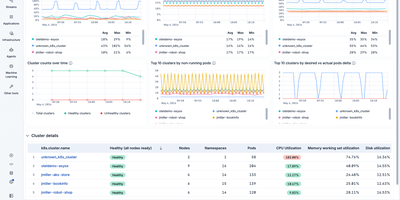
With over 70,000 GitHub stars and billions of documents indexed across enterprises like Uber, Netflix, and Wikipedia, Elasticsearch is the world's most deployed search engine, powering everything from application search to security analytics and AI-driven retrieval. Built on Apache Lucene, its inverted index architecture delivers sub-second full-text search across terabytes of data with BM25 relevance scoring, configurable analyzers for 30+ languages, and fuzzy matching for typo tolerance. The kNN vector search API uses the HNSW algorithm for approximate nearest neighbor queries on dense and sparse embeddings up to 4,096 dimensions, while reciprocal rank fusion enables hybrid search that combines lexical and semantic signals in a single query. Elasticsearch's aggregation framework supports metric, bucket, and pipeline aggregations for real-time analytics directly on indexed data without separate OLAP infrastructure. The cluster distributes data across shards with automatic rebalancing, replica allocation, and cross-cluster search for multi-datacenter deployments. Kibana provides the visualization layer with dashboards, Lens visual editor, Canvas for pixel-perfect reports, and Discover for ad-hoc log exploration. Ingest pipelines with processors like grok, dissect, GeoIP enrichment, and inference handle data transformation at index time, and ES|QL brings pipe-based query syntax with joins and columnar processing. Running on a dedicated VPS on RepoCloud with guaranteed CPU, RAM, and SSD, full root SSH access, and a browser serial console. AGPL v3 licensed.
Hyperswitch
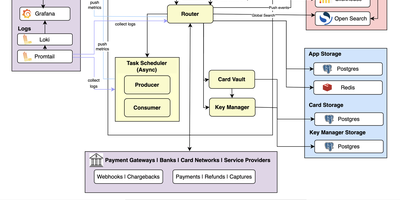
Hyperswitch from Juspay delivers the most comprehensive open-source payment orchestration stack available — a Rust-built platform that connects to Stripe, Adyen, Braintree, Worldpay, Checkout.com, Cybersource, and 120+ payment processors through a single API integration. Intelligent routing drives each transaction to the processor with the highest predicted authorization rate using rule-based, volume-based, and machine learning algorithms, while seamless failover and automatic retries recover revenue from declined transactions using 30+ parameters including decline codes, card BIN, transaction size, and region. The PCI-compliant card vault stores payment methods securely in a dedicated service separate from the main application server, and the reconciliation engine automates 2-way and 3-way matching with backdated support, staggered scheduling, and customizable audit-ready outputs. The Control Center dashboard provides visual workflow builders for routing rules, payment analytics, and operations management. Cost observability tools drill into scheme, interchange, and acquirer fees to detect anomalies and optimize processing costs. The modular architecture allows deploying individual components — routing, retries, vaulting, observability, or the full suite — without vendor lock-in. The web client SDK collects payment information with prebuilt UI components and supports WooCommerce integration. Deploy via Docker Compose with the app server, control center, card vault, and PostgreSQL. Running on a dedicated VPS on RepoCloud with guaranteed CPU, RAM, and SSD, full root SSH access, and a browser serial console. Apache-2.0 licensed.
OpenStatus
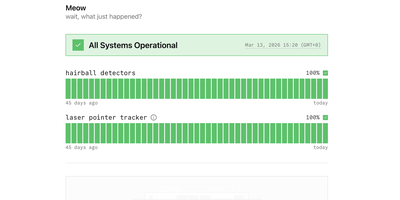
Trusted by Cal.com, WhiteBIT, and Documenso and backed by 8,800+ GitHub stars, OpenStatus delivers the open-source status page and uptime monitoring platform that replaces Atlassian Statuspage, Better Stack, and Instatus with a single self-hosted deployment. The monitoring engine runs Go-based probes across 28 global regions on three cloud providers checking HTTP, TCP, and DNS endpoints in parallel with configurable intervals and multi-region consensus to eliminate false-positive alerts. Status pages ship with custom domain support, password and email-domain access controls, maintenance windows, grouped monitor components, and subscriber notifications via email and RSS. Incident management provides structured status reports with investigating, identified, monitoring, and resolved timeline phases that publish automatically to affected status pages. The monitoring-as-code workflow supports YAML configuration synced through the CLI, a GitHub Actions integration for CI/CD pipelines, and a Terraform provider for infrastructure-as-code deployments. The typed ConnectRPC JSON-over-HTTP API exposes a published OpenAPI specification with a Node SDK for programmatic access, while an MCP server connects AI assistants like Claude, ChatGPT, and Cursor directly to workspace data. The tech stack combines Next.js with shadcn/ui for the dashboard, Hono for the API server, Drizzle ORM over Turso for application data, and Tinybird for analytics. Private monitoring locations deploy as a single 8.5MB Docker image behind firewalls to check internal services. Running on a dedicated VPS on RepoCloud with guaranteed CPU, RAM, and SSD, full root SSH access, and a browser serial console. AGPL-3.0 licensed.
CyberChef
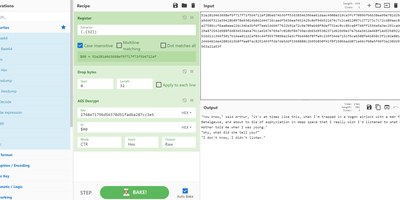
GCHQ open-sourced its "Cyber Swiss Army Knife", and CyberChef became the web app security analysts, incident responders, and CTF players reach for when data needs decoding, decrypting, or dissecting. Its interface is four panes: paste or drag input (files up to 2GB), search a categorized library of hundreds of operations, drag them into a recipe with arguments, and read the output. Operations span Base64, hex, and XOR encoding; AES, DES, and Blowfish encryption; classical ciphers from Caesar to Railfence; hashes and checksums; compression; regex and string extraction of IPs, domains, and URLs; timestamp conversion; and parsers for IPv6, X.509 certificates, and more. Recipes chain arbitrarily - convert from a hexdump then decompress, decrypt AES pulling the IV from the cipher stream, or let the Magic operation auto-detect several layers of nested encoding. Auto Bake re-runs the recipe live as input or arguments change, Step executes one operation at a time for debugging, and flow control (forks, subsections, registers) applies different operations to different parts of the data. Recipes save to files or share as URLs encoding the full pipeline. Crucially, CyberChef is entirely client-side JavaScript - nothing uploads anywhere - and self-hosting guarantees an unmodified copy inside your own network, where malware artifacts belong.
Automatisch
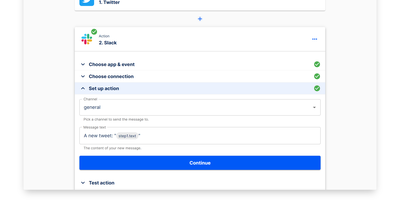
Automatisch runs your Zapier workflows on your own hardware - an open-source, self-hosted automation platform built as a direct alternative. Flows are chains of steps: one trigger (a polling or webhook event such as a new GitHub issue, a Stripe payment, or a form submission) followed by action steps that pass data downstream (post to Slack, append a Google Sheets row, update Notion). The visual builder deliberately mirrors Zapier's trigger-action model, so migrating existing Zaps requires no retraining and no programming knowledge. Roughly 60 integrations cover common business services - Slack, GitHub, Google Sheets, Notion, Stripe, Discord - and connections store credentials per service, with multiple accounts per app supported. Every execution runs on your own server: execution history, logs, and payload data never touch a third-party processor, which matters for GDPR, healthcare, and finance workloads. Error handling with retry logic, a REST API for programmatic flow management, and Docker Compose deployment round out the platform. The AGPL-3.0 Community Edition has no feature limits or per-task billing; an Enterprise Edition adds SSO, roles, and audit logs.
Documenso
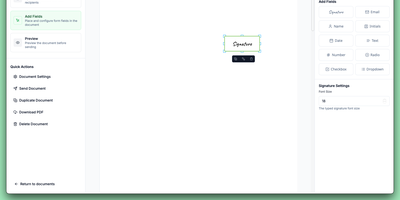
With over 14,000 GitHub stars and a mission to become the world's most trusted document-signing tool, Documenso delivers a beautifully designed electronic signature platform that organizations can self-host for complete data sovereignty. The signing workflow handles everything from simple one-party signatures to complex multi-recipient documents with configurable roles including signers, approvers, viewers, and CC recipients, each with distinct permissions and notification flows. Document templates enable reusable signing packages with pre-configured fields and recipient patterns, eliminating repetitive setup for contracts, NDAs, and onboarding documents that teams process regularly. The PAdES-standard implementation ensures digital signatures are legally compliant and cryptographically verifiable, with complete audit trails documenting every action from document creation through final signature. Direct link signing allows recipients to access documents without email, enabling embedded signing experiences within existing applications and websites. The REST API provides programmatic document creation, recipient management, and webhook notifications for integrating signature workflows into CRM systems, HR platforms, and custom business applications. Team management features organize users into groups with role-based permissions, custom branding per team, and centralized billing for organizations with multiple signing workflows. SSO integration supports standard authentication providers for enterprise identity management. The TypeScript codebase built on Next.js and Prisma with PostgreSQL makes customization and contribution accessible to modern web developers. Zapier integration connects Documenso to thousands of third-party applications for automated document routing. Deploy on a dedicated VPS on RepoCloud with guaranteed CPU, RAM, and SSD, full root SSH access, and a browser serial console. AGPL-3.0 licensed.
It Tools
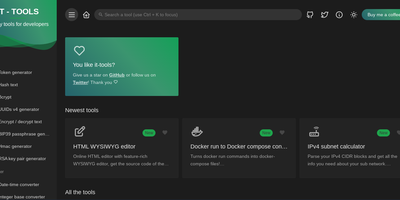
The utilities engineers otherwise scatter across a dozen ad-laden websites - 80+ of them - live together in IT-Tools, one fast, polished web app. Crypto covers JWT decoding, MD5 through SHA-512 hashing, HMAC and bcrypt generation, RSA key pairs, and password strength analysis. Converters handle JSON to CSV, YAML, and TOML, Base64 files, URL encoding, HTML entities, color formats, and Docker run commands to Compose files. Generators produce UUIDv4, ULID, BIP39 mnemonics, QR codes (including Wi-Fi QR), and tokens; text tools include a regex tester, diff viewer, slug and case converters; web utilities parse URLs and user agents, look up HTTP status codes and MIME types, and inspect Open Graph metadata; plus a cron parser, chmod calculator, and more. The privacy argument is the point: JWTs contain user IDs, hashes derive from passwords, JSON dumps hold PII - exactly the inputs you least want a third-party utility site to log. IT-Tools is a frontend-only static bundle (Vue/TypeScript, GPL-3.0, 39k+ GitHub stars) served by Nginx in one container, so everything runs client-side on your infrastructure with nothing transmitted anywhere. New tools ship roughly monthly, and a scaffolding script makes adding custom ones straightforward.
Milvus
With over 45,000 GitHub stars and 100 million Docker pulls, Milvus is the most widely adopted open-source vector database, powering production AI systems at NVIDIA, Salesforce, eBay, Airbnb, and DoorDash. The distributed architecture separates compute and storage with stateless microservices on Kubernetes, horizontally scaling query nodes for read-heavy workloads and data nodes for write-heavy ingestion independently. Milvus 3.0 introduces lake-native retrieval that builds and serves indexes directly over vector data in object storage and open formats including Parquet, Lance, Iceberg, and Vortex without maintaining separate copies. Native hybrid search unifies lexical BM25 full-text retrieval and semantic vector search in a single engine with metadata filtering, eliminating the need for separate search infrastructure. Hardware-accelerated ANN indexing supports IVF, HNSW, DiskANN, and GPU-based indexes with BitQ 1-bit quantization cutting memory usage by 72 percent. SDKs for Python, Go, Node.js, and Java provide programmatic access, while Milvus Lite offers lightweight embedding for local development via pip install. Server-side aggregation, sorting, faceted search, StructArray for nested document structures, and ColBERT multi-vector scoring move ranking and result processing into the engine. The Path Index enables 100x faster JSON filtering with support for 100,000+ collections per cluster for multi-tenant deployments. Self-hosting deploys via Docker Standalone or Kubernetes with Helm charts using S3-compatible, GCS, or Azure Blob storage backends. Running on a dedicated VPS on RepoCloud with guaranteed CPU, RAM, and SSD, full root SSH access, and a browser serial console. Apache 2.0 licensed.
Stalwart Mail
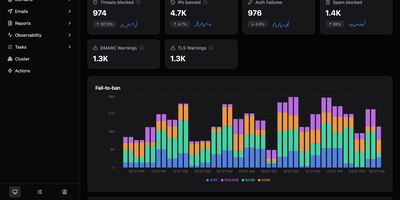
Stalwart replaces the traditional Postfix + Dovecot + SpamAssassin + calendar-server stack with one Rust binary that speaks every standard mail and collaboration protocol natively. JMAP, IMAP4rev2, POP3, SMTP, CalDAV, CardDAV, and WebDAV all run inside the same process — no glue scripts, no sidecar daemons, no version conflicts between components. The pluggable storage architecture lets operators choose RocksDB for single-node deployments, FoundationDB for distributed clusters, PostgreSQL, MySQL/MariaDB, or SQLite for the data store, S3/MinIO/Azure Blob for message blobs, and Elasticsearch or Meilisearch for full-text search, with Redis or the internal engine backing rate limiters and session state. Security features include S/MIME and OpenPGP encryption at rest, automated DKIM key generation with DNS publication, DANE and MTA-STS transport security, automatic ACME TLS provisioning, granular ACLs, rate limiting, and IP banning. The browser-based admin console manages accounts, domains, groups, mailing lists, SMTP queues, DMARC/TLS-RPT/ARF reports, and every configuration object without touching a config file, while the self-service portal at /account gives end users password reset and encryption key management. Multi-tenant support with per-tenant quotas enables hosting-platform deployments, and coordinator-less clustering via Zenoh or NATS scales horizontally by adding nodes. Deploy via Docker or the standalone binary. Running on a dedicated VPS on RepoCloud with guaranteed CPU, RAM, and SSD, full root SSH access, and a browser serial console. AGPL v3 licensed.